By the MusicTech News Desk
Executive Overview
In an aggressive move to capture a wider audience of modern producers, sound designers, and electronic music creators, French music technology powerhouse Arturia has announced the launch of Pigments Play. Derived directly from its critically acclaimed, flagship flagship software synthesizer, Pigments Play delivers a condensed yet remarkably capable iteration of the parent software—completely free of charge.
Designed to bridge the gap between complex sound design workflows and immediate, out-of-the-box musical inspiration, Pigments Play retains much of the sonic DNA that made the original Pigments a powerhouse in contemporary production studios. Featuring a curated factory library of over 100 professionally crafted presets, intuitive macro controls, and access to a diverse array of Arturia’s lauded synthesis engines—including virtual analog, wavetable, granular, harmonic, modal, and sample playback—the software redefines expectations for entry-level music creation tools.
Crucially, Pigments Play is engineered to lower the barrier to entry for aspiring producers. Operating seamlessly either as a standalone application or as a plugin within any major Digital Audio Workstation (DAW), it allows users to jump straight into creative production without requiring an immediate, capital-intensive investment. Furthermore, its tightly integrated ecosystem compatibility with Arturia’s hardware controller lineup—such as the MiniLab, KeyLab, and KeyStep series—positions Pigments Play as both an educational stepping stone and a practical, tactile composition tool for mobile and studio setups alike.
Detailed Chronology: The Evolution of Pigments and the Genesis of ‘Play’
To understand the strategic significance of Pigments Play, one must examine the trajectory of Arturia’s software division over the past decade.
The Rise of a Flagship Synth
When Arturia originally introduced Pigments, the company was primarily known for its meticulous software emulations of legendary vintage hardware instruments (such as the Minimoog, Prophet-5, and CS-80). Pigments marked a radical departure: a forward-thinking, original software instrument that combined multiple synthesis types into a single, highly visual user interface.
Over successive major updates—culminating in recent iterations—Pigments evolved into a powerhouse used by top-tier film composers, chart-topping electronic music producers, and sound designers. However, with immense power comes inherent complexity. The depth of the modulation matrix, dual-engine architecture, and advanced routing options, while celebrated by professionals, occasionally presented a steep learning curve for absolute beginners.
Identifying the Market Gap
Market research within the music software sector consistently highlights a specific consumer bottleneck: the intimidation factor of flagship soft synths. Many prospective producers find themselves overwhelmed by hundreds of deeply nested parameters, ultimately retreating to stock presets or simpler ROMplers.
Arturia’s product development teams identified the need for a streamlined entry point—a "gateway drug" to high-end synthesis that maintains professional sound quality without the cognitive overload. Conceptualized as a standalone experience, Pigments Play was developed to strip away the overwhelming under-the-hood routing matrices while preserving the pristine audio engines and iconic visual feedback that define the Pigments user experience.

The Launch and Immediate Availability
Released globally via Arturia’s digital distribution channels, Pigments Play instantly enters a competitive landscape populated by freemium software instruments and lite versions. By offering a fully functional, high-fidelity instrument without trial limitations or disruptive watermarks, Arturia has signaled a shift toward inclusive, community-driven ecosystem expansion, targeting the next generation of bedroom producers and beatmakers just ahead of the seasonal holiday shopping window.
Supporting Context & Metrics: Under the Hood of Pigments Play
Despite its "lite" classification and zero-dollar price tag, Pigments Play is far more than a simple preset player. It packs a surprising amount of architectural depth under a familiar, streamlined user interface.
Preset Architecture and Sound Design Horizons
At launch, Pigments Play comes pre-loaded with a diverse library of over 100 professionally engineered presets. These sounds are meticulously categorized to serve an expansive spectrum of modern musical genres, including:
- Modern Pop & R&B: Pristine keys, lush pads, and cutting-edge leads designed for commercial radio and streaming dominance.
- Electronic & Dance Music: Punchy basses and evolving textures tailored for House, Garage, and Drum & Bass productions.
- Hip-Hop & Trap: Hard-hitting sub-basses, moody plucks, and atmospheric elements fitting for modern beatmaking.
- Ambient & Cinematic: Expansive, generative soundscapes suitable for media scoring and meditative listening.
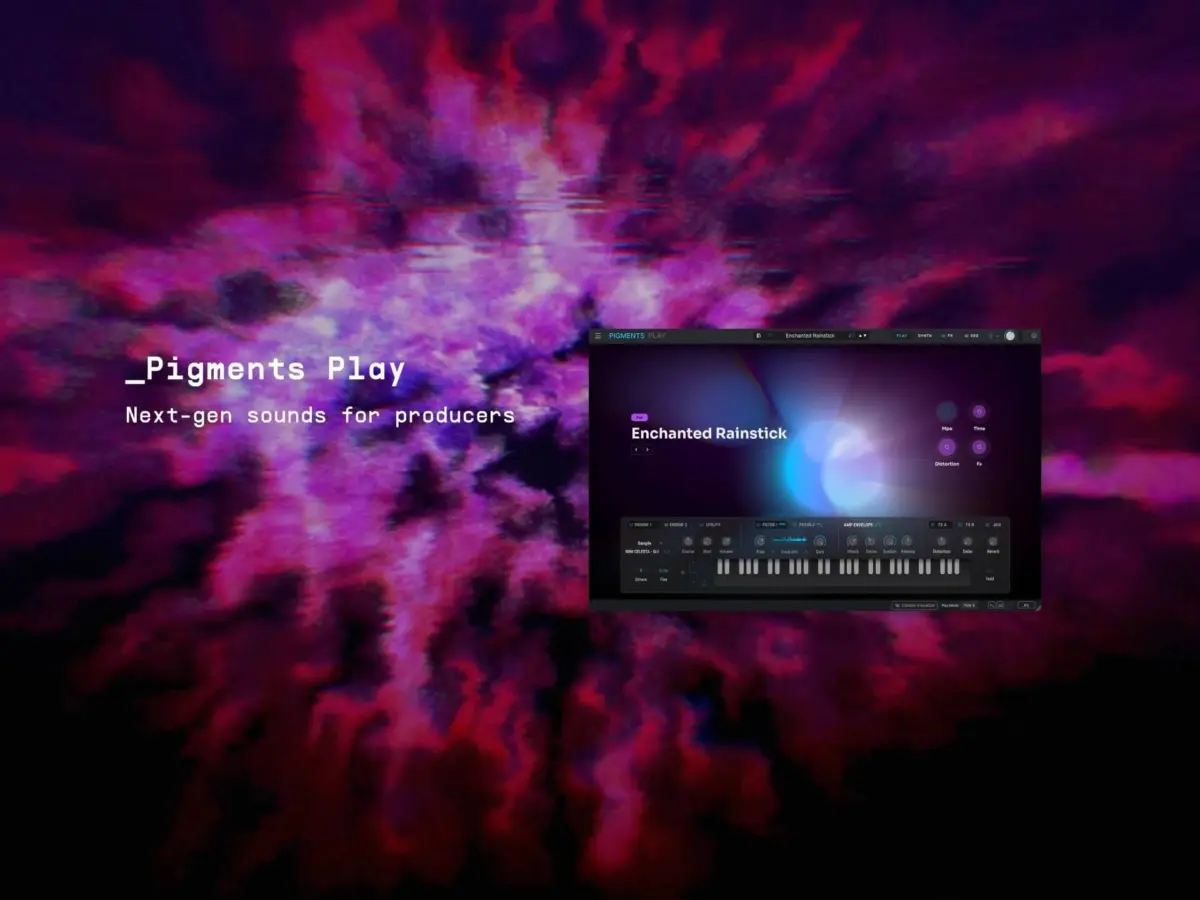
To ensure these sounds can be rapidly adapted to individual tracks, every preset features four dedicated macro parameters. These macros are mapped to the most musically expressive traits of the patch—such as filter cutoff, wavetable position, or effect intensity—allowing users to radically transform presets in real-time. Crucially, Arturia has retained the signature visualizer from the flagship Pigments, providing real-time graphic feedback that demonstrates precisely how parameter changes alter the sound output.
For users looking to expand beyond the factory library, Pigments Play features an integrated Sound Store directly within its UI. This marketplace offers access to over 200 additional sound expansion packs available for purchase, with fresh collections added regularly to keep production workflows inspired.
Synthesis Engines and Effects Processing
Once users move past the preset exploration phase, Pigments Play unlocks deep sonic sculpting capabilities by granting access to several of Arturia’s core synthesis engine typologies:
- Virtual Analog: Emulating the warmth, saturation, and rich harmonic behavior of classic analog circuits.
- Wavetable: Offering morphing digital timbres for contemporary electronic music styles.
- Granular: Perfect for slicing, stretching, and texturing audio samples into ethereal soundscapes.
- Sample Playback: Allowing the integration of custom acoustic and electronic audio sources.
- Harmonic: Facilitating additive synthesis techniques for bright, bell-like, and metallic tones.
- Modal: Providing physically modeled resonance and acoustic simulation.
To further color and shape these signals, Pigments Play includes a robust processing suite boasting over 50 distinct filter modes (spanning classic ladder filters, state-variable models, and modern nonlinear topologies) alongside 20 studio-grade effects units. From pristine digital delays and lush algorithmic reverbs to heavy distortion and compression algorithms, the software ensures that patches can be taken from raw generation to a mix-ready state entirely within the plugin.
Workflow Integration and Hardware Synergy
Designed for ultimate flexibility, Pigments Play functions seamlessly both as a standalone application—allowing users to open the synth and start playing without booting up a heavy DAW—and as a standard VST, AU, or AAX plugin inside environments like Ableton Live, Logic Pro, FL Studio, and Pro Tools.
Furthermore, Arturia has optimized Pigments Play to interface effortlessly with its hardware ecosystem. Musicians utilizing Arturia’s hardware controllers—such as the compact MiniLab series, the flagship KeyLab MIDI keyboard range, or the step-sequencing power of the KeyStep—will find automatic mapping and deep tactile integration, turning software parameters into physical, hands-on knobs and faders.

Official Statements and Industry Perspective
While Arturia has positioned Pigments Play primarily as a creative utility and accessible gateway, industry analysts view the release as a masterclass in software ecosystem marketing.
Industry commentators note that by lowering the barrier to entry, manufacturers can cultivate brand loyalty early in a producer’s career. As emerging artists outgrow the limitations of a free, condensed instrument, they are statistically far more likely to upgrade to the full, paid version of Pigments or invest in Arturia’s comprehensive V Collection of vintage instruments.
In promotional documentation accompanying the release, Arturia emphasized its ongoing commitment to democratizing music production:
"Get started producing with a familiar UI and an impressively wide range of functions… Pigments Play has numerous creative functions that can keep newer (or more experienced) artists busy for a long time."
The company’s focus on tactile integration also underscores a broader industry push toward hybrid workflows. As mobile producers increasingly demand setups that bridge software flexibility with hardware control, tools like Pigments Play serve as reliable software anchors for portable studio rigs.
Future Outlook: The Trend Toward Freemium Software Synthesis
The release of Pigments Play highlights a significant maturation in the business models of virtual instrument developers. Historically, the audio software industry relied heavily on traditional demo limitations (such as timed trials or intermittent white noise bursts) to entice buyers. However, the modern market—saturated with high-quality freeware, open-source plugins, and subscription models—demands a more engaging strategy.
What Lies Ahead for Pigments
By offering a fully functional, high-value derivative of a flagship synth for free, Arturia is setting a new standard for software engagement. Observers speculate on several developments for the platform moving forward:
- Ecosystem Expansion: Regular updates to the Sound Store, potentially introducing artist-signature preset packs tailored specifically for Pigments Play users.
- Educational Integration: Potential adoption of Pigments Play within academic institutions and music technology schools as a standardized tool for teaching synthesis fundamentals.
- Pathways to Upgrade: Streamlined in-app upgrade paths that allow users to transition from Pigments Play to the full Pigments instrument with a single click, retaining their saved user presets and project files.
Conclusion
Pigments Play arrives not merely as a marketing exercise, but as a genuinely robust, highly creative instrument in its own right. By combining world-class synthesis engines, an intuitive and visually engaging interface, and zero financial barrier to entry, Arturia has crafted an essential download for both novices taking their first steps into electronic music production and seasoned professionals looking for a lightweight, inspiring sketching tool.
Pigments Play is available now as a free download. For further technical specifications, system requirements, and installation guides, producers can visit the official Arturia website.