The 2026 Salzburg Festival will long be remembered for staging one of the most polarizing operatic juxtaposition experiments of the decade. On August 7, 2026, at the prestigious Haus für Mozart, audiences gathered for the second performance of Richard Strauss and Hugo von Hofmannsthal’s multi-layered masterpiece, Ariadne auf Naxos. Directed and designed by the multi-disciplinary visual artist Ersan Mondtag, with the world-renowned Vienna Philharmonic Orchestra under the masterful baton of conductor Manfred Honeck, the production promised a bold, contemporary reimagining of a foundational 20th-century work.
Yet, what unfolded on stage was a stark paradox. Musically, the performance was a transcendent triumph, showcasing world-class vocal artistry and orchestral brilliance that captured every nuance of Strauss’s intricate score. Dramatically and visually, however, Mondtag’s over-elaborate, confusing futuristic concept—transporting the action to an isolated human enclave on Mars—strayed so far from the opera’s thematic core that it actively warred with the music.
While the production succeeded in generating intense theatrical conversation, it ultimately served as a cautionary tale of high-concept directorial overreach. By burying moments of stillness and emotional intimacy under an avalanche of chaotic choreography, heavy-handed video projections, and distracting stage business, the staging obscured the delicate meta-theatrical satire that makes Ariadne auf Naxos endure. For the discerning opera-goer, the evening was rescued entirely by the ears, leaving critics to ponder whether a brilliant musical performance can truly redeem a fundamentally misjudged stage vision.

Detailed Chronology: The Salzburg Performance Unfolds
The Prologue: Backstage Chaos in a Retro-Futuristic Colony
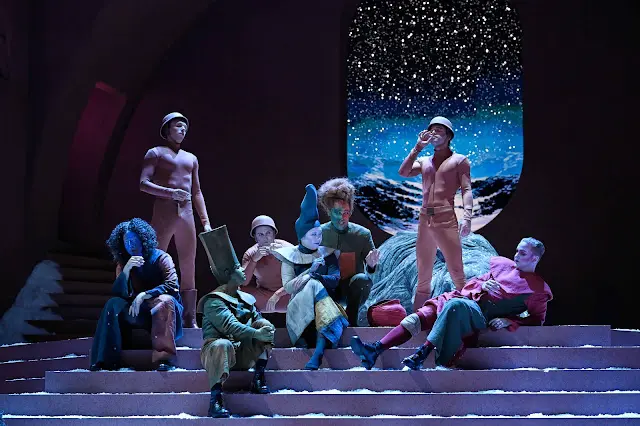
The evening began with a vivid, pulsing account of the overture. As Manfred Honeck drove the Vienna Philharmonic forward, a video projection zoomed into a Martian colony. The aesthetic carried a distinctly retro-futuristic, pulp-fiction vibe—reminiscent of mid-20th-century space exploration serials—that immediately established the production’s eccentric parameters.
The physical set, utilized across both the prologue and the main opera, featured a striking, multi-level 1930s-inspired architectural framework. A central rear portal continuously displayed the desolate Martian surface alongside bizarre, over-imagined spacecraft. While the set design offered intriguing spatial dynamics, it immediately began to compete for the audience’s attention during the crucial backstage setup of the prologue.
Navigating the narrative proved difficult due to the lack of traditional visual signifiers. Christoph Pohl delivered an impressively grounded performance as the Music Master, dressed sombrely in black like a priest. Blaz Stajnko appeared as the wigmaker, sporting a massive, white-hairpiece reminiscent of Game of Thrones. Jonas Hacker injected sparkling energy into the role of the Dancing Master, though he was lumbered with a wildly impractical, bright-orange brush wig. Meanwhile, Johannes Silberschneider brought a sharp, crisp elan to the Spoken role of the Majordomo.

At the emotional center of the prologue was Kate Lindsey, reprising her celebrated interpretation of the Composer (previously seen at Glyndebourne in 2013). Lindsey’s portrayal was a masterclass in nervous, unbridled intensity. Possessing a soprano-like brightness rather than a traditionally rich mezzo warmth, she attacked the role with ferocious passion, physically inserting herself into the backstage chaos.
Ziyi Dai’s Zerbinetta began the evening with a degree of reticence, blending into her commedia dell’arte troupe, but quickly bloomed into a character of genuine pathos, particularly during her remarkably tender exchanges with Lindsey’s Composer. Despite the strong character work, the stage remained aggressively busy, featuring four dancers and five skin-tight-clad guards whose presence hinted at the Vienna patron’s eccentric tastes, but added little to Hofmannsthal’s structural satire.
The Opera Proper: Choreographic Clutter and Sonic Splendor
As the production transitioned into the opera proper on Naxos, the Martian landscape remained, now populated by grotesque representations of dead animals. The trio of nymphs—Anja Mittermüller (Dryad), Jasmin Delfs (Naiad), and Marlene Metzger (Echo)—sang with exquisite, polished blend. However, staging choices undermined their musical impact: Metzger’s Echo was clad like a woolly Smurf and awkwardly suspended from the flies, while choreographer Ashley Alexandra Wright’s angular, contorted dances continually pulled focus away from the vocalists.

Christina Nilsson stepped into the title role of Ariadne with dignified poise. Her voice possessed a calm, focused intensity that anchored the production’s emotional core. During her aria, "Es gibt ein Reich," Nilsson achieved a rare stillness, pulling the audience’s attention entirely inward. A poignant directorial touch featured a dancer physically embodying Theseus to mirror her memories, but such moments of clarity were rare.
As the opera progressed toward its climax, the staging devolved into a sensory overload. When Ziyi Dai launched into "Großmächtige Prinzessin," she directed her performance not at Ariadne, but at Kate Lindsey’s lingering Composer, successfully blurring the lines between art and life. However, this thematic blending was violently derailed by an accompanying orgy: members of Zerbinetta’s troupe and the ensemble dancers engaged in frantic stage sex, accompanied by a relentless cloud of cigarette smoke that hung heavily over the auditorium.
Leon Kosavic delivered a vocally robust Harlekin, but the commedia dell’arte troupe was denied any genuine space to function as a cohesive song-and-dance unit, swallowed up instead by the swirling chaos. Similarly, during the ravishing trio heralding the arrival of Bacchus, the three vocalists were completely upstaged by a swarm of active household staff crossing the stage.

When Eric Cutler finally entered as Bacchus, his dramatic entrance was severely hindered by a poorly fitted, ungainly space suit complete with winged helmet. Cutler sang with heroic, ringing energy, creating an interesting contrast with Nilsson’s introspective restraint. Yet, the final moments of the opera offered little visual relief. As the video projections attempted to conjure genuine cosmic magic, the physical stairs proved hazardous for sopranos in elaborate gowns, culminating in the surreal sight of Nilsson’s Ariadne donning Bacchus’s ludicrous helmet for a final, almost comical space-suited video sequence. Only Ziyi Dai’s wry, knowing delivery as Zerbinetta salvaged a semblance of tonal balance at the final curtain.
Supporting Context & Metrics: Production Overview
To fully understand the scale and ambition of this Salzburg Festival mounting, it is vital to examine the creative personnel, institutional backing, and logistical parameters involved in bringing the production to life.
| Production Parameter | Details |
|---|---|
| Opera Title | Ariadne auf Naxos (Op. 60) |
| Composers / Librettist | Richard Strauss / Hugo von Hofmannsthal |
| Festival & Venue | Salzburg Festival, Haus für Mozart |
| Performance Reviewed | August 7, 2026 (Second Performance) |
| Director & Designer | Ersan Mondtag |
| Conductor / Orchestra | Manfred Honeck, Vienna Philharmonic Orchestra |
| Choreography & Video | Ashley Alexandra Wright (Choreography), Alexander Pannier (Video) |
| Dramaturg | Till Briegleb |
| Key Cast Members | Kate Lindsey (Composer), Christina Nilsson (Ariadne), Eric Cutler (Bacchus), Ziyi Dai (Zerbinetta), Christoph Pohl (Music Master), Johannes Silberschneider (Majordomo) |
Official Statements & Artistic Vision
The artistic rationale behind the production was anchored in Ersan Mondtag’s multidisciplinary background. Known for his radical spatial designs—including representing the German pavilion at the Venice Biennale and helming major operatic productions across Berlin, Rome, Lyon, and Vienna—Mondtag sought to literalize the concept of artistic isolation and alienation.

In pre-festival statements released by the Salzburg Festival press office, the production team argued that placing Ariadne auf Naxos in a futuristic Martian colony was a logical extension of the opera’s central dilemma: the clash between high art (serious opera seria) and low art (popular entertainment), set against the backdrop of a patron’s whims. The creative rationale posited that a sterile, futuristic colony would heighten the desperation of artists forced to perform under duress.
However, critics and audience members noted a profound disconnect between this theoretical framework and the realities of Strauss’s score. The music demands an intimacy of scale and a delicate irony that is easily crushed by heavy-handed science-fiction tropes. While conductor Manfred Honeck and the Vienna Philharmonic leaned into the rich, transparent textures of the reduced chamber orchestra, providing a masterclass in stylistic phrasing, the staging consistently fought against the music’s inherent architecture.
Future Outlook: The Legacy of High-Concept Directing in Salzburg
The polarized reception of Mondtag’s Ariadne auf Naxos feeds into a broader, ongoing debate within the international opera community regarding the limits of Regietheater (director-led theater). As festivals like Salzburg strive to maintain cultural relevance through provocative, visually striking productions, the tension between directorial ego and musical fidelity continues to intensify.

Looking ahead to the remainder of the 2026 festival season and beyond, this production will likely be studied as a textbook example of a bifurcated operatic experience. The vocal triumphs of Kate Lindsey, Christina Nilsson, and Ziyi Dai, combined with the immaculate playing of the Vienna Philharmonic under Honeck, ensure that the musical memory of the evening will outlive its controversial staging.
For future revival houses or upcoming directorial teams tackling Strauss’s slippery masterpiece, the lesson from Salzburg is clear: Ariadne auf Naxos is an intricate Swiss watch of an opera. While it invites reinvention, it cannot withstand being forcibly shoved into a narrative framework that actively silences its quieter, most profound truths. Trusting the music remains, as it has always been, the ultimate prerequisite for theatrical success.