Executive Overview
For the first time in over thirty years, the United Kingdom is hosting a major retrospective dedicated to the uncompromising vision of American artist Robert Ryman. Titled Robert Ryman: The Real Thing and hosted within the stark, brutalist halls of London’s Barbican Centre, the exhibition brings together 68 seminal works spanning from the mid-1950s to the early 2010s. This comprehensive survey is not merely a display of objects; it is an immersive, sensory experiment that challenges contemporary modes of viewing art in an era dominated by screens, digital reproductions, and the hyper-accelerated attention economy.
Arranged entirely on a thematic basis, the exhibition deliberately breaks with traditional museum conventions. Visitors will find no explanatory wall texts, no biographical timelines, and no descriptive labels identifying the individual paintings. This curatorial silence honors Ryman’s lifelong philosophical conviction that painting cannot be fully grasped through intellectualization or textual exegesis. As Ryman himself famously noted, "You cannot understand a painting by explaining something. You can only understand painting by experience."
In an age where visual culture is consumed in a flash through social media feeds, Ryman’s work acts as a formidable counter-current. His paintings are physical, shifting objects that refuse to translate into digital photographs or static reproductions. By stripping away explanatory crutches and meticulously engineering the gallery’s atmospheric lighting, the Barbican has created a temple of slow looking—an environment where viewers are forced to confront the material reality of art, the passage of time, and the subtle interplay between surface, light, and space.
Detailed Chronology: From Jazz Saxophone to Radical Minimalism
To understand Ryman’s revolutionary approach to painting, one must trace an unconventional trajectory that began far outside the traditional academic art world. Born in Nashville, Tennessee, Ryman initially harbored deep aspirations of becoming a professional musician. Following a two-year stint playing the tenor saxophone in the US Army Reserve Corps, he relocated to New York City in 1952 with a singular ambition: to forge a career as a jazz saxophonist.
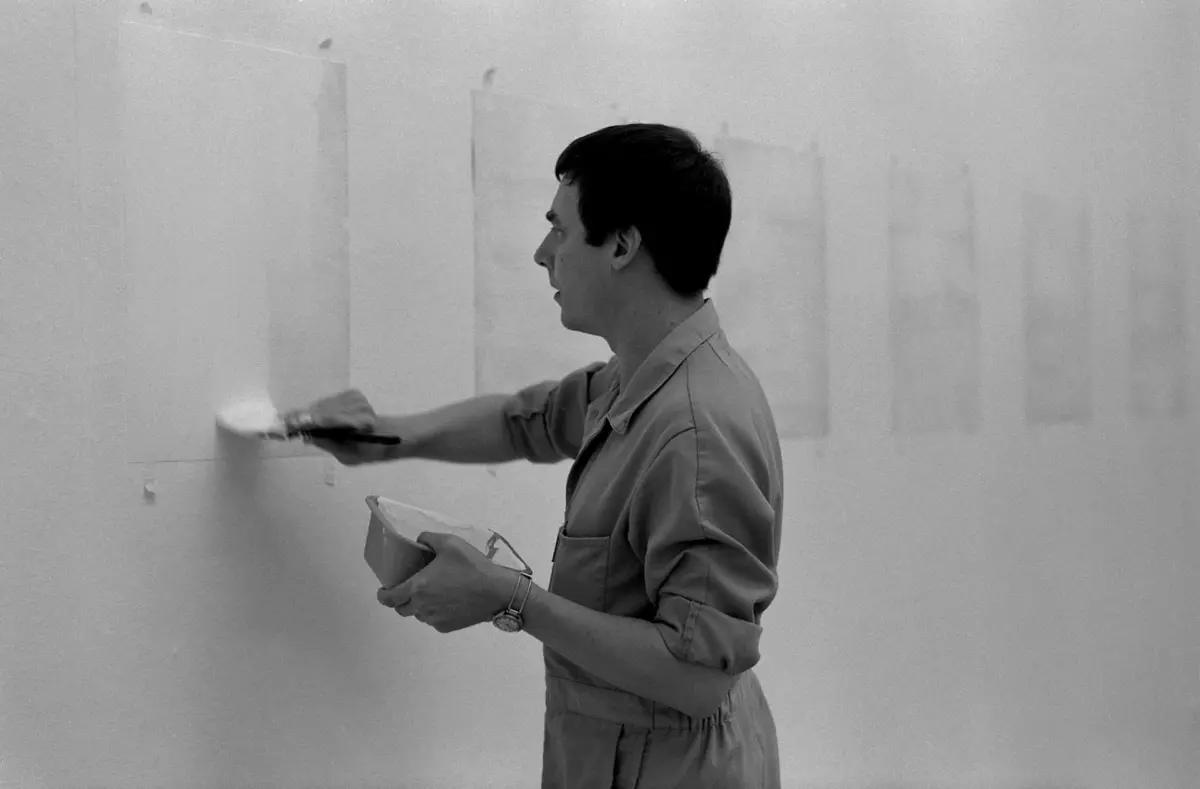
Ryman’s entry into the visual arts was remarkably accidental. Having famously claimed that he "never saw a painting until I came to New York," he took a job as a museum guard at the Museum of Modern Art (MoMA) simply to make ends meet. Stationed in the galleries day after day, he found himself increasingly mesmerized by the physical construction of the artworks around him. To demystify the medium and understand through direct, tactile experience how paintings were actually built, Ryman began making his own works.
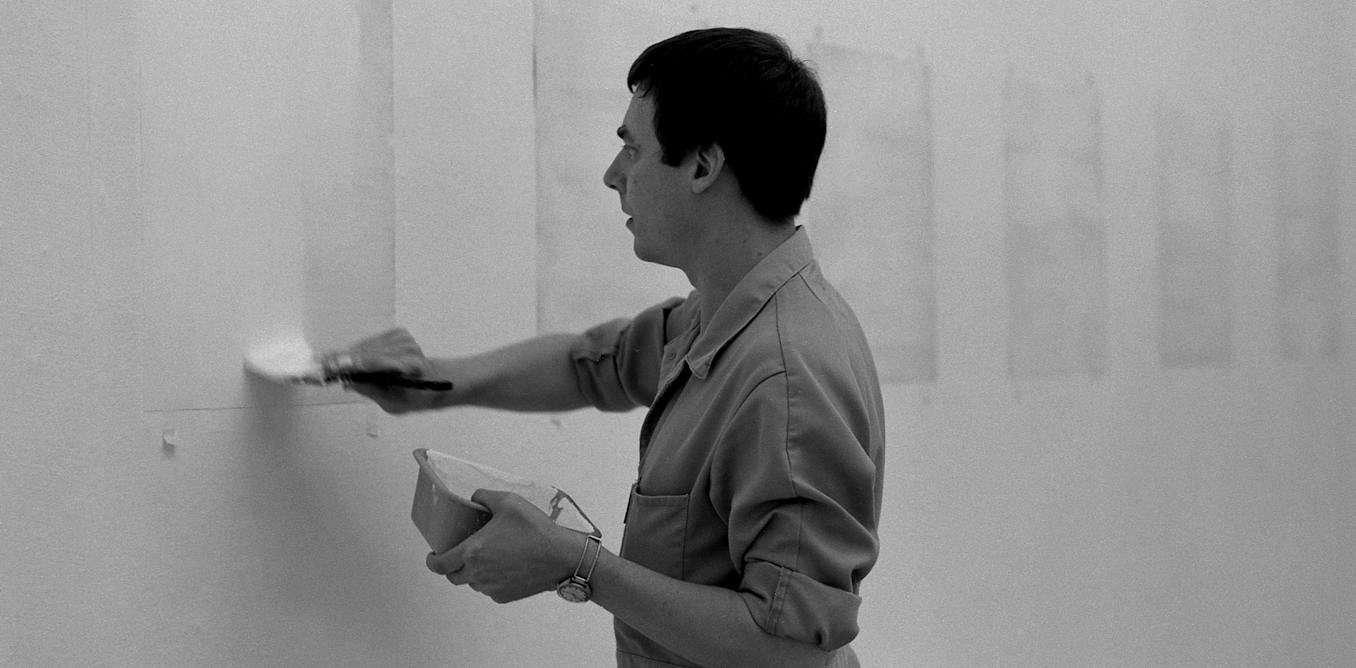
The Real Thing meticulously charts this decades-long investigation, tracking Ryman’s progression from his first "professional" painting executed in 1955 up until the year of his passing in 2019. Throughout his career, Ryman treated the canvas not as an illusionistic window into a fictional world, but as an object in its own right. His material vocabulary expanded wildly over the decades, moving far beyond traditional oil and linen to incorporate aluminium, waxed paper, rolled steel, fiberglass, and even vinyl.
The exhibition highlights how Ryman’s works frequently border on architectural or industrial interventions. Many pieces are actively remade during each new installation, establishing a dialogue between the artist’s historical intent and the contemporary space. For instance, works such as Versions VI (1991) feature structural elements that are stapled directly into the gallery walls. This unorthodox method created unique challenges for the Barbican curatorial team, requiring them to test the gallery’s walls for "tenderness"—the structural pliability needed to accept an ordinary staple—and occasionally replacing standard drywall panels with softer alternatives to accommodate the artist’s precise specifications.
Supporting Context & Metrics: The Architecture of Light and Perception
One of the most striking triumphs of the Barbican exhibition is its radical rethinking of gallery illumination. Rather than relying on traditional spotlights pointed directly at the surfaces of the works—which would flatten Ryman’s delicate brushwork—the curators and exhibition designers have engineered an intricate choreography of light.
In many instances, spotlights are directed at the gallery floor, bouncing indirect illumination upward onto the paintings. In the main exhibition hall, massive ceiling-mounted light boxes have been installed to create a soft, enveloping glow. Meanwhile, in the side rooms, the Barbican’s expansive windowed walls have been cleverly adapted to harness natural daylight.
This shifting, atmospheric illumination is essential to experiencing Ryman’s art. Because many of his works explore the micro-variations of white pigment against diverse substrates, changing natural light sources cause the paintings to dynamically transform throughout the day. Subtle flashes of color break along the edges of the canvases, and delicate brushstrokes seem to pulse and shimmer as the viewer moves through the room.
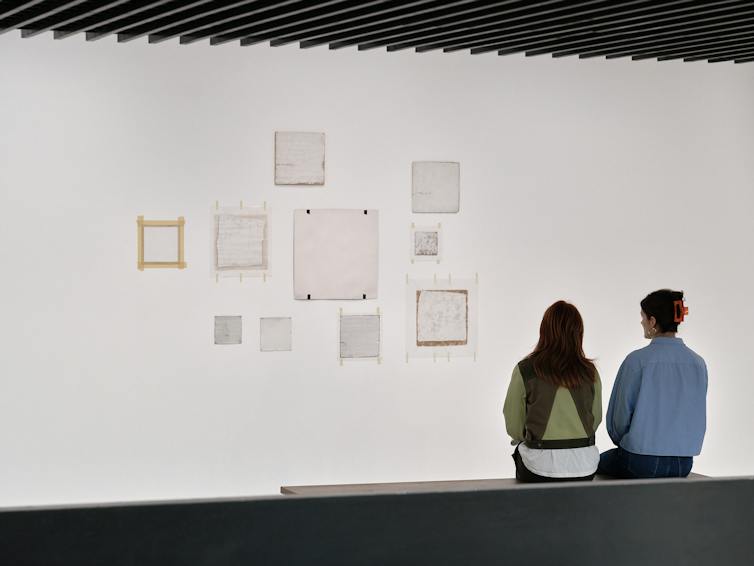
This fugitive quality underscores Ryman’s assertion that visual art is fundamentally temporal, operating much like music. Just as a musical score cannot be reduced to a single frozen chord, a Ryman painting cannot be captured in a photographic reproduction. The flat, unchanging nature of digital documentation utterly collapses the dimensional reality of his work, stripping away the patient observation required to see a white surface come alive with hidden undertones of green, ochre, or rust.
Consider Best or Worst (1996–1997), a masterwork hung slightly above eye level in the main hall. Composed on a matte white ground, its surface is heavily worked with rhythmic, horizontal, creamy-white brushstrokes. The resulting texture is a luminous, near-perfect white that carries the ghostly memory of green beneath its glossy top layer. As the viewer walks past, these microscopic ridges catch and reflect the light in a joyous motion reminiscent of shoaling fish. Subtly integrated textual elements—such as a matte, pale grey "96" in the center and a smaller "7" in the top right—serve as quiet self-reflections on the painting’s exact date of creation, grounding the ethereal visual experience in the concrete facts of its making.
Official Statements and Curatorial Insights
The deliberate absence of wall texts at the Barbican has sparked profound discussions among critics, curators, and visitors alike. By refusing to spoon-feed historical narratives or stylistic classifications, the exhibition forces the audience back onto their own perceptual resources.
Curator Wells Fray-Smith, speaking on the logistical and philosophical hurdles of mounting the show, emphasized the intimate physical relationship between Ryman’s objects and the exhibition architecture. The necessity of testing gallery walls for "tenderness" to support stapled canvas panels illustrates a broader curatorial ethos: Ryman’s works are not precious, untouchable relics, but active, robust participants in physical space.
As Ryman himself once demonstrated by taping a discarded Coca-Cola can to the wall adjacent to one of his paintings simply to retain a sense of scale for a photograph, his art insists on occupying the real, unvarnished world. His creations are not paintings of scenes; they are simply paintings—self-contained objects that report the straightforward facts of their construction while paradoxically soaring far beyond those mechanical facts within the viewer’s consciousness.
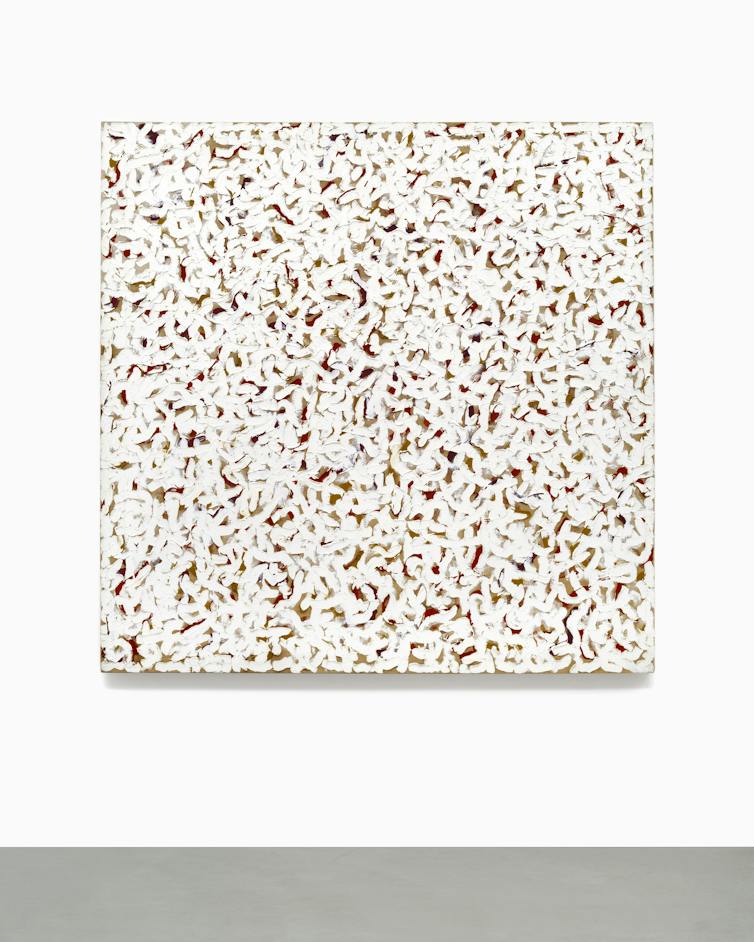
The exhibition also carefully contextualizes Ryman’s legacy alongside his legendary contemporaries. While his artistic vocabulary is undeniably singular, the retrospective traces intellectual and aesthetic dialogues with Minimalist pioneers such as Sol LeWitt and Frank Stella, as well as his foundational inspiration, Mark Rothko. Furthermore, surprising visual echoes emerge across the galleries: the monumental centerpiece Surface Veil II (c. 1970) evokes the shimmering, fugitive light found in the late works of Pierre Bonnard, while Untitled (Background Music) (c. 1962)—with its energetic cluster of glyphic, textured marks on raw canvas—bears a striking structural and psychological kinship to the cryptic ink drawings of poet Henri Michaux.
Future Outlook: Art in the Age of Distraction
Robert Ryman: The Real Thing arrives at a critical cultural juncture. As global institutions increasingly pander to the demands of the attention economy—incorporating interactive digital screens, Instagram-friendly optical illusions, and rapid-fire audio guides—the Barbican has charted a remarkably courageous, counter-cultural path.
Ryman’s work stands as a defiant bulwark against the relentless current of digital information. It explicitly resists being photographed, tokenized for social media, or neatly summarized by algorithmic recommendations. It demands something far scarcer and more valuable in the twenty-first century: unfragmented human attention, prolonged silence, and the willingness to stand still and truly look.
By stripping away the scaffolding of art-historical interpretation, this landmark UK retrospective gives audiences a rare opportunity to encounter art on its own terms. It reminds us that the aesthetic encounter is a deeply physical, relational event that happens exclusively in real time and real space. For those willing to surrender their devices, quiet their digital impulses, and submit to the subtle dance of light and surface, Robert Ryman: The Real Thing offers a transformative reminder of what art can achieve when it stops trying to explain itself and simply exists.