Executive Overview
In the meticulous ecosystem of British jazz preservation, the not-for-profit label Jazz In Britain occupies a singularly vital role. While commercial labels often chase high-gloss, contemporary releases or rely on well-worn, heavily commercialized master tapes, Jazz In Britain operates more like an acoustic forensic unit. Most of the label’s catalog arrives via off-air radio broadcasts or delicate reels salvaged directly from musicians’ personal collections. Every release functions almost like a formal chain of custody: meticulously documenting who taped the performance, who performed the digital transfer, and who granted legal consent.
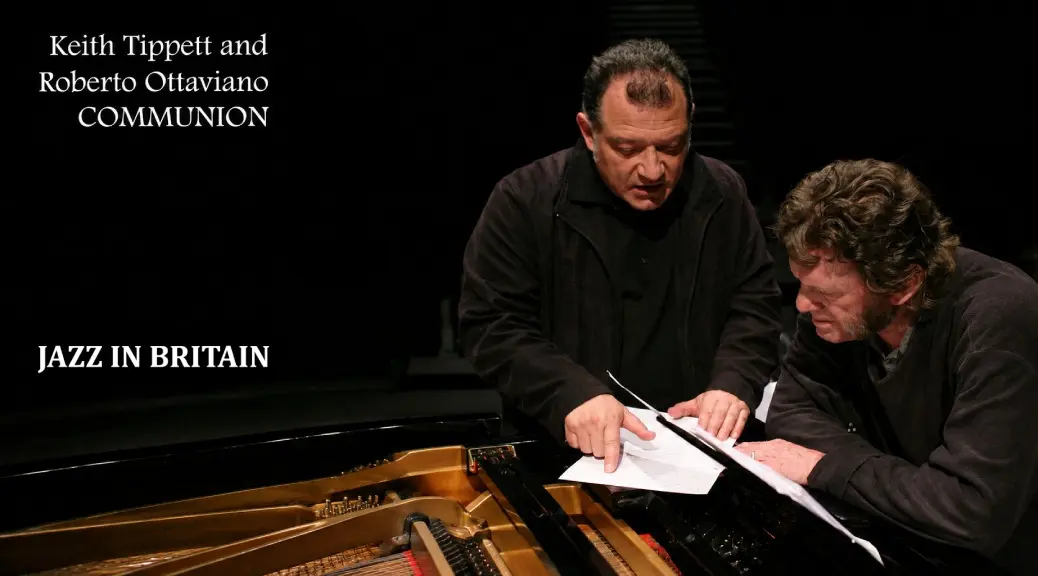
Yet, every so often, a release materializes down a completely different road. Such is the case with Communion, a stunning archival double-CD capturing an extraordinary February 1991 convergence between legendary British pianist Keith Tippett and Italian soprano saxophonist Roberto Ottaviano at Geneva’s famed Sud des Alpes club.
Unlike the label’s typical domestic finds, Communion arrived via Ottaviano himself. The Italian virtuoso brought the master recordings to the label while collaborating with author Martin Phillips on Keith Tippett: Mujician, the authorized biography published by Jazz In Britain. Research for one definitive historical project organically birthed the source material for the next—a brilliant illustration of the label’s interconnected methodology.
The production credits honor this cross-continental provenance: Ottaviano serves as producer; Tommy Cavalieri recovered and meticulously mastered the concert tapes at Sorriso Studio in Bari; and Riccardo Bergerone, the original 1991 tour organizer, is appropriately recognized by name. Intriguingly, Communion stretches the label’s traditional remit: a Geneva venue, an Italian co-leader, an Italian mastering room, and European administrative roots. Keith Tippett stands as the sole British element. But for contemporary listeners and historians alike, the late, great pianist is reason enough.
Detailed Chronology: Keith Tippett and Roberto Ottaviano in 1991
The Geneva Encounters at Sud des Alpes
The setting for these historic performances was the Sud des Alpes, a legendary Geneva venue that has served as the home of the AMR (Association pour l’Encouragement de la Musique Improvisée) since 1981. Founded in 1973 by local Geneva musicians determined to carve out a sustainable ecosystem for improvised music, the AMR remains proudly run by a committee drawn largely from its active players.
It was within this hallowed, artist-centric space that Tippett and Ottaviano locked horns and hearts on February 5 and 6, 1991. The resulting physical release is structured with elegant simplicity: each disc houses one monolithic, unedited performance piece, allowing listeners to track the uninterrupted psychological and acoustic trajectories of these two improvisational titans.
Tippett’s Creative Crosswinds in Early 1991
To fully understand the weight of Communion, one must examine where Keith Tippett’s artistic head was positioned in February 1991. The evidence points to an artist being pulled simultaneously in several brilliant, demanding directions:
- Mujician: The boundary-pushing cooperative quartet featuring Tippett alongside saxophonist Paul Dunmall, bassist Paul Rogers, and percussionist Tony Levin had been firing on all cylinders since 1988. They had recently cut their debut album, The Journey, live at the 1990 Bath Festival.
- Solo and Duo Explorations: In August 1990, Tippett delivered a staggering solo recital in the Great Hall at Dartington—later immortalized as The Dartington Concert. That same year saw the release of 66 Shades of Lipstick, his deeply lyrical duo record with saxophonist Andy Sheppard.
- The Soviet Union Expedition: In the spring of 1991, Tippett took Mujician and vocalist Julie Tippetts deep into the Soviet Union, touching down in Tbilisi for a fortnight of intensive teaching and rehearsing with local Georgian musicians. Gala concerts there directly paved the way for a return to the 1991 Bath International Music Festival and a celebrated, BBC-recorded concert at St George’s, Bristol, on June 1.
Within a roughly twelve-month span, Tippett was operating at every conceivable scale: intimate solo recitals, intricate duos, ferocious cooperative quartets, and sprawling, cross-cultural ensembles.
The Evolution of Tippett’s Expanded Piano Technique
The small percussion instruments and various foreign objects credited in the liner notes of Communion are not mere gimmicks; they carry deep roots extending back through the leaner economic landscape of the 1980s. When traditional band-leading work became increasingly difficult to sustain, Tippett innovated fiercely. He developed an idiosyncratic solo and chamber recital practice wherein diverse objects—metal bolts, erasers, plastic items, and felt—were placed directly upon the piano strings, fundamentally transforming the instrument’s acoustic voice into an orchestra of micro-tonal textures.
Roberto Ottaviano’s Formative Years
Ten years younger than his British counterpart, Roberto Ottaviano was thirty-three years old at the time of the Geneva recordings. Born in Bari, Italy, his musical trajectory shifted decisively after a chance, life-altering meeting with soprano sax maestro Steve Lacy. He subsequently attended Evan Parker’s legendary masterclasses at the turn of the 1980s, absorbing the rigorous grammar of free improvisation.
By 1989, Ottaviano had secured a post teaching jazz at the conservatory in his home city. His critical stature was rising fast, underscored by the release of his acclaimed Splasc(h) albums, Items from the Old Earth and Above Us, both dropping the year prior to the Geneva dates.
Supporting Context & Metrics: The Road to Communion
The Trans-European Itinerary
In his deeply evocative sleeve notes penned in August 2026, Roberto Ottaviano fills in the invaluable human details behind the music. The Geneva dates were merely a single stop on a grueling, ten-day duo tour spanning Italy, Switzerland, and Germany. The two musicians traversed the continent entirely in Ottaviano’s car.
Remarkably, Ottaviano recalls how little the pair actually discussed musical theory or repertoire on the long drives. Instead, the hours were consumed by ordinary, grounding topics: family, romantic life, local traditions, and Ottaviano’s colorful tales of his mandatory military service in the Italian Navy.

Philosophical Convergences
Beneath the mundane road-trip chatter lay a profound aesthetic alignment. Ottaviano highlights two foundational tenets that defined Tippett’s musical worldview:
- The Eradication of Boundaries: Tippett maintained that no genuine divide existed between composition and improvisation. To improvise, in Tippett’s eyes, was to take radical, unmitigated responsibility for shaping sound in the living, breathing present moment.
- Temporal Transcendence: Tippett frequently articulated his explicit wish to physically carry listeners completely out of chronological time, leaving them bathed in an emotional and acoustic afterglow long after the final resonance had faded.
Ottaviano’s phrasing in the liner notes is chosen with exquisite care, noting that while much of the music was "completely improvised," it was built upon a lifetime of internalizing language, leaving ample room for prepared materials and mutual intuition.
Acoustic Quality and Archival Recovery
For vintage archive hunters, degraded audio is an expected hurdle. Many recordings of this era arrive via muffled cassette recorders placed clumsily in the back of a smoky club. Yet, Communion shatters expectations. Despite minor acoustic anomalies noted by some purists, this writer found it to be one of the cleanest, most dynamically rich releases in the entire Jazz In Britain catalog.
The recording appears to patch directly into the mixing desk, capturing a sprawling dynamic range that renders every struck string and piercing soprano note vividly immediate. Credit for this acoustic resurrection belongs to whoever originally captured the 1991 feed, alongside Tommy Cavalieri, whose digital recovery and mastering work at Sorriso Studio in Bari preserves the raw electricity of the night.
Official Statements and Critical Reception
The Repertoire: "Meltem" and "Zephir"
Freely improvised piano music can occasionally alienate casual listeners, and much of Keith Tippett’s sprawling catalog has historically eluded mainstream ears. Communion, however, occupies an entirely different echelon.
Structured around two massive, unyielding improvisational monoliths, the music grips the listener instantly. The shorter pieces of standard jazz albums give way here to structural journeys.
- "Meltem" (taking its name from the strong, dry northerly wind that sweeps the Aegean Sea during summer) is a masterclass in building and releasing tension.
- "Zephir" invokes the classical name for the gentle, mild west wind, unfurling with an organic grace that rivals any structured composition.
Ottaviano’s soprano saxophone acts as a brilliant narrative foil, anchoring the frenetic harmonic explosions of Tippett’s extended piano techniques. Where previous duo efforts like 66 Shades of Lipstick occasionally felt clinical to certain listeners, Communion strikes a rare, pulsing nerve of emotional urgency.
Beyond the Tour: A Lasting Alliance
The creative partnership forged in that car and on that Geneva stage did not dissipate with the tour’s end. Ottaviano continued to collaborate with Tippett across various orchestral and small-group configurations. These included memorable cross-cultural meetings alongside Julie Tippetts, notably at the prestigious Sant’Anna Arresi festival in Sardinia.
Furthermore, Ottaviano’s immersion in the British jazz diaspora bore long-term fruit. He subsequently formed an enduring, critically lauded duo with British pianist Alexander Hawkins. Hawkins’ own musical lineage traced back through his work with legendary South African percussionist Louis Moholo-Moholo—who was, of course, Tippett’s long-standing musical compatriot, and a drummer with whom Ottaviano had also extensively performed and recorded.
Future Outlook: Cementing the Tippett Canon
With the addition of Communion, the Jazz In Britain Keith Tippett shelf has grown into a formidable monument of twentieth-century improvised music. The current catalog now encompasses:
- The essential Mujician set, In Concerts.
- Larry Stabbins’ breathtaking duets, And the birds sang….
- Martin Phillips’ authoritative biography, Keith Tippett: Mujician, complete with its two accompanying historical discs covering 1976 and 1984.
- This limited-edition double-CD physical release.
Read alongside Phillips’ literary work, Communion successfully extends the documented sound record of Tippett’s genius straight into the early 1990s, printing its historical provenance proudly on the sleeve.
Roberto Ottaviano closes his liner notes by explicitly tying Jazz In Britain’s tireless archival mission to a core ethical belief that Keith Tippett championed throughout his life: the conviction that music should never be reduced to mere capitalistic enterprise—a sentiment Tippett frequently inscribed on his own original record sleeves.
On a not-for-profit, fiercely independent release like Communion, this uncompromising sentiment sits precisely where it belongs. As labels like Jazz In Britain continue to unearth these lost monuments of European improvised music, the map of modern jazz history is permanently, beautifully redrawn.