Executive Overview
For nearly a decade, the cultural phenomenon known internationally as Call My Agent!—and natively as Dix pour cent (Ten Percent)—has captured the hearts of television audiences worldwide. What began as a passion project for former agent-turned-producer Dominique Besnehard evolved into a critical darling, securing an International Emmy Award, capturing global audiences via Netflix, and spawning international remakes across the United Kingdom, Germany, Italy, and Spain.
Now, the beloved Parisian casting agency ASK is back, but this time, the chaos has made the leap from the small screen to feature-length cinema.
Transitioning a critically acclaimed television series into a feature film is a notoriously perilous Hollywood—and European—tradition. History is littered with ambitious television properties that stumbled upon theatrical translation, from The Avengers (1998) and Miami Vice (2006) to Sex and the City (2008).
The newly minted Call My Agent! The Movie faces this exact hurdle. Reuniting the core ensemble five years after the dissolution of the ASK agency, the film plunges Andrea, Noémie, Mathias, and the rest of the gang back into the cutthroat, ego-driven trenches of French show business. Yet, while the film succeeds in delivering a heavy dose of nostalgia and witty banter, it ultimately stumbles under the weight of its own narrative constraints.
By condensing the sprawling, multi-layered canvas of a television series into a single, feature-length runtime—and anchoring its plot around a singular, faltering guest star—the cinematic adaptation lacks the rich, tapestry-like brilliance that made its episodic predecessor a global masterclass in comedy.
Detailed Chronology: The Journey from Brides-les-Bains to the Big Screen
The Genesis: A Spa Town Premiere (2015)
Long before it became a household name across streaming platforms, the DNA of Call My Agent! was unveiled to a modest audience in 2015. At a small festival nestled in Brides-les-Bains—a picturesque spa town in the French Alps—industry veteran Dominique Besnehard showcased the first two episodes of a project he had spent eight agonizing years trying to bring to fruition.
Drawing heavily from his own real-world experiences at the prestigious Parisian talent agency Artmedia, Besnehard aimed to pull back the curtain on the glamorous, frantic, and often absurd reality of French cinema. The core conceit was disarmingly simple yet brilliantly executed: follow the fictional agents of the ASK agency as they juggle the astronomical egos, chaotic love lives, and career-threatening meltdowns of their high-profile clients. Crucially, the show’s secret weapon was casting real-life A-list celebrities to play exaggerated, self-deprecating versions of themselves.
Building the Pantheon: Resistance and Recognition
Securing those initial celebrity cameos was no easy feat. During the production of the first season, many major French stars were intensely reluctant to participate. Notable figures like Catherine Deneuve and Gérard Depardieu were conspicuously absent—a blessing in disguise regarding the latter, whose public legacy has since complicated his cultural footprint (a reality acknowledged in the new film, where his name is met with chilling, stony silence).
It wasn’t until seasons two and three that the floodgates opened. Soon, the show’s roster read like a who’s who of European cinema: Juliette Binoche, Isabelle Huppert, and Jean Dujardin stepped in to lampoon themselves. By season four, international icons like Sigourney Weaver joined the fray, playing hilariously demanding diva versions of their Hollywood personas.
This meteoric rise in prestige did more than just entertain; it launched the television careers of its primary cast, transforming actors like Camille Cottin (who portrayed the fierce, unapologetic Andréa Martel) and Laure Calamy (the endearing, chaotic assistant-turned-producer Noémie) into global stars.
The Post-ASK Landscape and the Theatrical Leap
Season four culminated in the dramatic dissolution of the ASK agency, shattering the professional ecosystem that fans had grown to love. Five years later, the feature film picks up the pieces of this fractured universe.
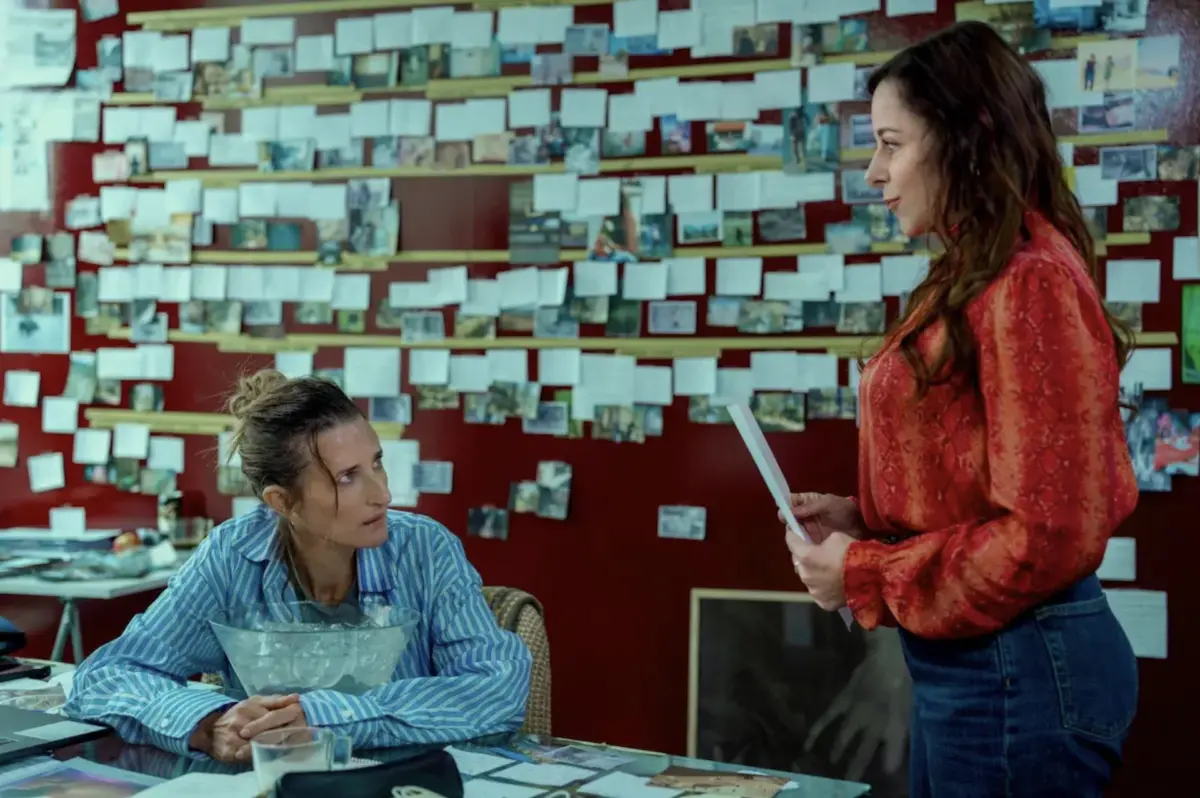
The narrative thrust finds Andréa preparing to direct her very first feature-length film, while Noémie steps into the shoes of a television producer. Both women now operate within the same corporate orbit as their former boss and rival, Mathias (Thibault de Montalembert), who coincidentally happens to be Noémie’s romantic partner.
Predictably, the cinematic peace is short-lived. Andréa’s primary star, Laurent Lafitte, abruptly drops out of the production, forcing her to sack her initial producer. Stepping into the breach, Noémie inadvertently torpedoes an opportunity to cast Hollywood royalty George Clooney by unleashing a string of cringeworthy, tone-deaf remarks that deeply incense the American star.
Desperate for a leading man, the team recruits Vincent Macaigne to play a celebrated yet fragile version of himself. The production then relocates to the sun-drenched, storm-prone landscapes of the south of France, setting the stage for cascading disasters: lead actors resorting to fisticuffs, an unruly wild boar wreaking havoc on set, and a violent tempest that obliterates millions of dollars worth of cinematic equipment.
Supporting Context & Metrics: The Anatomy of a Cultural Phenomenon
To fully understand why Call My Agent! The Movie feels both comfortingly familiar and frustratingly constrained, one must examine the quantitative and qualitative metrics that drove the television series to international acclaim.
| Metric / Dimension | The Original Series (Dix pour cent) | The Cinematic Adaptation |
|---|---|---|
| Format | Episodic (4 Seasons, 24 Episodes) | Feature-Length Film |
| Ensemble Scope | Broad, multi-narrative character arcs | Condensed, single-conflict narrative |
| Celebrity Integration | Dozens of rotating guest stars per season | Concentrated around one primary "star" (Macaigne) |
| Cultural Resonance | Deeply embedded in French cinematic history | Relies heavily on meta-humor and franchise nostalgia |
| Global Reach | Expanded via Netflix and international remakes | Aimed primarily at established franchise loyalists |
The "One-Star" Dilemma
The structural genius of the original television series lay in its kaleidoscopic approach to celebrity culture. Spanning 24 episodes, Call My Agent! was fundamentally sustained by a rich, diverse film culture that celebrated the breadth of French entertainment. The series welcomed internet sensations like Norman Thavaud, international icons like Juliette Binoche, auteur cinema divas like Isabelle Adjani, television staples like Muriel Robin, comedic heavyweights like Frank Dubosc, and figures spanning generations from Guy Marchand to Julien Doré.
Boiling this sprawling, multi-faceted tapestry down to a single star within a single cinematic runtime proved to be an insurmountable challenge. Vincent Macaigne, while a talented actor, is ill-equipped to carry the entire comedic and dramatic weight of the film adaptation. Poned into his trademark depressive, fragile persona, Macaigne is never given adequate room to truly display his craft. In fact, throughout the film’s chaotic second half, he is frequently upstaged by inanimate weather phenomena and an unruly wild boar.
Meanwhile, his co-lead, former model Laetitia Casta, is relegated to a storyline where her primary contribution amounts to physical slapstick—specifically, taking a punch to the nose. The running gag wherein police officers fail to recognize the couple during an arrest feels uncomfortably close to home, blurring the lines between satire and tragic irrelevance.
The Star Power Matrix of French Cinema
To truly achieve major stardom in France, an actor must expertly straddle two rarefied worlds: the intellectual, high-brow sphere of auteur cinema and the accessible, commercially driven landscape of popular genre films.
This ideal duality is perfectly embodied by Laurent Lafitte—an alumnus of the prestigious Comédie Française theatre who effortlessly transitions between complex art-house dramas and blockbuster comedies. Lafitte would have been the optimal choice to anchor the film’s fictional production within the narrative. Because he drops out early in the script, the film loses its anchoring anchor, forcing the narrative to limp forward on the back of Macaigne’s fragile persona.
Despite glamorous cameos by George Clooney and Eva Longoria, these high-end visual treats serve merely as window dressing, insufficient to attract an uninitiated audience or rescue the film from its structural limitations.
Official Statements and Industry Insights
Reflecting on the legacy of the franchise and the challenges of the cinematic transition, creators and critics have offered illuminating perspectives on the nature of adapting television gold for the silver screen.
Dominique Besnehard, speaking on the initial uncertainty surrounding the project’s launch in 2015, noted the anxiety of translating the insider baseball of the talent agency world into mainstream entertainment:
"We spent eight years trying to get this project off the ground, constantly wondering if audiences would accept a comedy that openly mocked the very industry manufacturing their dreams. The success proved that audiences crave authenticity, even when wrapped in satire."
Showrunner Fanny Herrero, whose sharp, perceptive writing defined the voice of the series, has frequently emphasized the delicate balance required to mock celebrity culture while treating the actors with underlying affection. However, transitioning from the episodic breathing room of television scripts to the rigid, two-hour constraints of a feature film required painful compromises.
Industry analysts tracking the international rollout of Call My Agent! The Movie have noted that while built-in fanbases will inevitably purchase tickets out of sheer franchise loyalty, the film struggles to replicate the organic, cascading comedic rhythm that made the television episodes appointment viewing.
Future Outlook: What Lies Ahead for the ASK Universe?
As Call My Agent! The Movie makes its way into theaters and international distribution channels, the future of the franchise remains a subject of intense speculation among industry insiders and passionate fans alike.
Will There Be Another Season?
For dedicated followers of Andréa, Mathias, Noémie, and the rest of the ASK alumni, the cinematic experiment is likely to be viewed as a pleasant, watchable diversion rather than a definitive masterpiece. While the film successfully weaponizes the familiar, razor-sharp banter and toxic chemistry of the former agents—such as Mathias continuing his cad-like antics, Andréa bullying subordinates while waging custody battles with her lesbian ex-partner, and veteran Arlette dropping hints of her improbably eventful past—it leaves viewers longing for the narrative depth of a full television season.
The box office performance and streaming metrics of the film will ultimately dictate whether production houses commission further cinematic outings or seriously consider reviving the television format. However, given the immense logistical challenges of coordinating schedules for a massive ensemble cast and high-profile guest stars, bringing the gang back together for an extended television run remains a monumental undertaking.
The Verdict on Franchising Television
The cinematic adaptation of Call My Agent! serves as a cautionary tale for the modern entertainment landscape. It demonstrates that intellectual property equity and beloved characters are not, in and of themselves, sufficient guarantees of theatrical success. When a property derives its unique flavor from serialized, ensemble-driven chaos and a rotating gallery of cultural touchstones, compressing that universe into a singular narrative arc risks losing the very magic that made it a global sensation in the first place.
Ultimately, fans of Call My Agent! will continue to hold out hope for a formal television revival that can restore the ASK agency to its former glory. Until that day arrives, audiences must content themselves with this amiable yet ultimately disappointing silver-screen postscript—a cinematic snapshot of beloved characters navigating a storm of their own making, both on and off the screen.