In Late Fame, director Kent Jones crafts a poignant, wry, and impeccably observed cinematic eulogy for a vanished bohemia. The film serves as a delicate, multi-layered meditation on F. Scott Fitzgerald’s famous, unsparing dictum: “There are no second acts in American lives.”
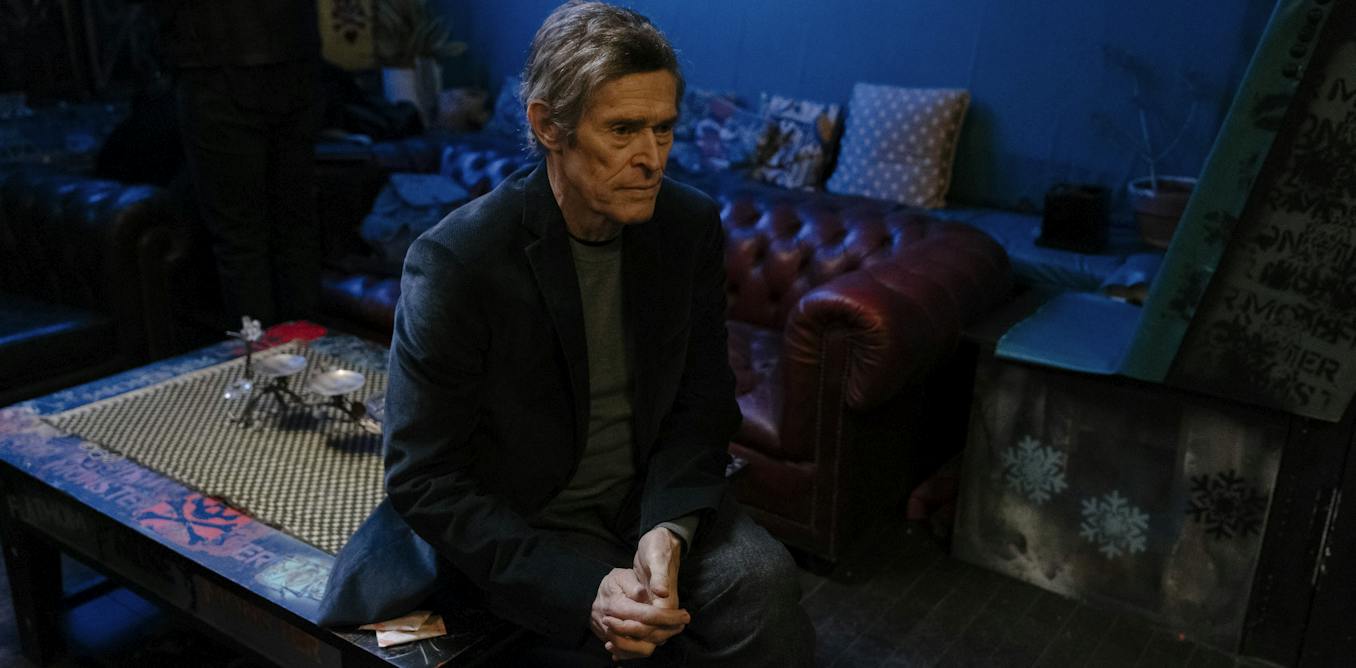
At the emotional center of this atmospheric character study is Ed Saxberger, played with understated brilliance by Willem Dafoe. Almost half a century ago, Saxberger occupied a minor, peripheral space on the fertile New York poetry scene. Today, he is a postal worker navigating the cold concrete of Manhattan, a man whose brief moment in the literary sun has long since faded into the twilight of obscurity.
Yet, cinema has always loved the miraculous, improbable resurrection, and Late Fame investigates what happens when the past comes knocking at the door of a forgotten artist. When a pack of young, nostalgic aesthetes discovers Saxberger’s solitary, long-out-of-print volume of Beat-infused verse, Way Past Go, they seek to pull the aging postal worker back into the limelight.
Jones’s film avoids cheap sentimentality, opting instead for a rich, melancholic exploration of authenticity, artistic vanity, and the profound unknowability of human lives. Supported by an exceptional cast—including Edmund Donovan and Greta Lee—Late Fame establishes itself as a major entry in contemporary American independent cinema, marrying the visual grit of 1970s New York streetscapes with a distinctly modern anxiety regarding digital ephemera and curated identities.
Detailed Chronology: The Resurrection of Ed Saxberger
The Quiet Life of an Unsung Scribe
For decades, Ed Saxberger’s creative life has been confined to the margins. His footprint on the cultural landscape is limited to Way Past Go, a slender collection of poetry published nearly fifty years ago. As Ed himself pragmatically acknowledges with characteristic self-awareness, “I had my moment. It passed.”
His daily routine is a masterclass in blue-collar anonymity. He works in a postal sorting office, eats toasted tuna sandwiches, and unwinds with rounds of pool at a local neighborhood bar alongside a tight-knit coterie of working-class male friends. His home is a book-lined one-bedroom walkup in the Lower East Side—a rare architectural and economic holdover from an era of affordable rents, vastly divorced from the hyper-gentrified landscape of 21st-century SoHo.
Ed is at peace with his obscurity, or so he thinks. His evening companions are not avant-garde firebrands, but the rhythm of his life is steady, predictable, and entirely unbothered by the literary ghosts of his past.
The Incursion of the Neophytes
The equilibrium of Ed’s quiet existence is shattered on a wintry evening when he is ambushed outside his apartment building by Myers (Edmund Donovan), a twentysomething stranger. Myers adopts a vampiric, intensely dramatic posture, hailing Ed as a forgotten literary genius and a living avatar of “Old Downtown” New York.
Myers is the self-appointed leader of a small, self-styled cadre of analogue contrarians. These young aesthetes spend their time openly disparaging the digital influencers huddled over their smartphones at neighboring café tables. Having unearthed Way Past Go, they view Ed’s book as a sacred text. Sceptical yet undoubtedly flattered, Ed allows Myers to coax him into a meeting with his cohort.
This introduction kicks off the film’s light narrative framework. The group relentlessly pressures Ed to compose a brand-new poem—his first in decades—to serve as the star attraction at an absurd, faux-New Wave artistic “happening” they are organizing.
Chasing the Ghost of Inspiration
Spurred by this unexpected adoration, Ed attempts to bridge the vast chasm between his past and present. Surrounded by his personal library of taped literary icons—including audio recordings of T.S. Eliot, Wallace Stevens, and Gary Snyder—Ed doggedly pursues inspiration through the chilly, atmospheric Manhattan streets, brilliantly captured through the lens of cinematographer Wyatt Garfield.
As he walks past the high-end designer boutiques and luxury dining establishments of modern SoHo, Ed looks entirely out of time. He resembles a spiritual cousin to the weary night crawler Willem Dafoe famously played in Paul Schrader’s 1992 drama Light Sleeper.
Yet, the creative spark does not easily relight. While the suggestive phrase “seasons collide” offers a fleeting germ of an idea, his yellow legal pad remains stubbornly blank. The modern world—with its Patti Smith-esque mythology reduced to distant history—refuses to align with his old rhythms.
When the night of the big “happening” finally arrives, Ed has no new masterpiece to unveil. Instead, he reads a 45-year-old poem from Way Past Go. As he astutely points out to a visibly disappointed Myers, to the uninitiated audience in front of him, the words might as well have been written that very morning.
Supporting Context & Metrics: The Anatomy of a Modern Indie Triumph
The Cultural Landscape of Late Fame
To fully appreciate the thematic weight of Late Fame, one must examine the socio-cultural dynamics it critiques. The film draws a sharp, satirical line between the authentic counterculture of the mid-to-late 20th century and the performative nostalgia practiced by contemporary youth subcultures.
The young characters surrounding Myers are quintessential poseurs—wealthy trust-fund kids “slumming” on their parents’ dime. They decorate their lofts with $1,200 first editions of William S. Burroughs’s Naked Lunch while sipping artisanal coffee. As the narrative observes, if these youngsters were genuinely committed to an artistic life, they would be carving out spaces in raw outer-borough neighborhoods like Bushwick or Hoboken rather than rubbing shoulders with hedge-fund managers in SoHo.
Willem Dafoe: Bridging Reality and Fiction
Much of the film’s success rests squarely on the shoulders of Willem Dafoe. Transforming his notoriously edgy, high-voltage screen presence into the humdrum routines of a retired postal worker is a masterstroke of casting against type.
Dafoe brings his own lived history to the project. As a founding member of the legendary avant-garde theater company The Wooster Group, Dafoe is himself an authentic fixture of the real downtown New York art scene. This meta-textual awareness enriches his performance, allowing him to effortlessly balance Ed’s bohemian past, his workaday present, and a latent, unsuspected hunger for validation.
Furthermore, Dafoe’s natural screen intensity prevents Ed from ever appearing pathetic. Even when dealing with callow youths or taking a meeting with a vapid literary agent to discuss a non-existent memoir, Ed retains his dignity. He sees right through the posturing of his new friends, recognizing that his participation in their ersatz coterie is little more than the pleasurable twitch of a phantom limb—a chance to hum a half-forgotten tune from his youth.
Key Character Metrics & Dynamics
| Character | Portrayed By | Archetype / Role | Narrative Function |
|---|---|---|---|
| Ed Saxberger | Willem Dafoe | The Reluctant Relic | Anchors the film’s emotional core; balances blue-collar reality with dormant artistic yearning. |
| Myers | Edmund Donovan | The Aesthete Parasite | Acts as the catalyst for Ed’s re-emergence; channels retro-obsession and cultural voyeurism. |
| Grace | Greta Lee | The Fabricated Muse | Channels classic cinematic icons (Louise Brooks, Marlene Dietrich); seduces Ed toward the precipice of vanity. |
Official Statements & Critical Reception
While Late Fame operates as a quiet character study, its release has generated significant critical commentary regarding its director’s vision and its lead actor’s mastery.
Director Kent Jones, renowned for his insightful film criticism and documentary work (such as Hitchcock/Truffaut), has articulated his fascination with the spaces where everyday life intersects with cultural memory. In promotional materials surrounding the film’s festival run, Jones noted:
"We live in an era obsessed with content, resurrection, and the recycling of aesthetic movements. I wanted to explore what happens when an individual who never sought monumental legacy is suddenly thrust into the machinery of other people’s fantasies. Ed Saxberger isn’t looking to conquer the world; he is simply navigating the quiet architecture of his own survival."
Film critics have been quick to praise the synergy between Jones’s direction and Wyatt Garfield’s cinematography. Reviewers have highlighted how the visual language of the film—contrasting the sterile, high-end commercialism of modern New York with the intimate, shadowed interiors of Ed’s apartment—mirrors the internal conflict of its protagonist.
Industry analysts point out that Late Fame arrives at a unique cultural moment, speaking directly to generational anxiety over digital commodification, authenticity, and the desire to hold onto tangible, analogue history in an increasingly fleeting world.
Future Outlook: Legacy and Cultural Resonance
As Late Fame makes its way through international film festivals and specialized theatrical distributions, its long-term cultural footprint appears assured. The film is already being cited by cinematic scholars as a defining statement on aging within creative industries.
The Universal Question of Identity
Beyond its specific New York milieu, Late Fame resonates deeply because of its refusal to offer neat resolutions. The film’s final movements underline the profound unknowability of people.
- Myers’s true ambitions remain opaque, masking a deep-seated insecurity behind performative intellectualism.
- Grace (Greta Lee), the enigmatic woman in Myers’s circle who channels classic silver-screen sirens like Audrey Hepburn and Louise Brooks, uses her constructed persona to mask a much sadder, more vulnerable reality.
- Even Ed remains an enigma, estranged from his siblings for reasons the audience never discovers, haunted by a lost romance hinted at in his rediscovered poetry.
Conclusion: A Tender Invitation
Ultimately, Kent Jones has fashioned a cinematic work that resists the urge to categorize its subjects neatly. By leaving Ed Saxberger’s ultimate trajectory ambiguous—will he write again? did he succumb to late-in-life vanity, or did he simply indulge in a harmless evening of make-believe?—Late Fame invites audiences into a space of tender contemplation.
In an entertainment landscape dominated by loud franchises and algorithmic predictability, Late Fame stands as a masterclass in subtlety. It proves that stories about quiet lives, missed opportunities, and the haunting, beautiful ghosts of our past can resonate with profound, enduring power.