Executive Overview
History is written by the victors, but for centuries, it was meticulously edited to omit the architects who pulled the strings behind the throne. Nowhere is this historical oversight more pronounced than in the narrative of the 1066 Norman Conquest. Popular culture and centuries of historical tradition have immortalized William the Conqueror as the sole titan of his age, a warlord whose sweeping ambition subdued England and altered the course of European history. Yet, this traditional perspective ignores a fundamental truth: William’s monumental campaign would have likely collapsed into financial ruin and political isolation without his wife, partner, and co-ruler of 30 years, Matilda of Flanders.
While the world-famous Bayeux Tapestry meticulously records the epic clash at Hastings, it notoriously sidelines Matilda. Among the hundreds of figures woven into its 70-metre length, only three women are definitively identified in its main narrative: Edith of Wessex, grieving at the deathbed of her husband Edward the Confessor; the mysterious, enigmatic figure of Ælfgyva; and an unnamed woman fleeing a burning building with her child. Matilda—the financial powerhouse, the royal diplomat who bridged the gap between a controversial bastard duke and the elite Ottonian dynasties of Europe, and the regent who governed Normandy and England—is entirely absent from the embroidery in person.
However, Matilda’s physical absence from the stitches of the Bayeux Tapestry belies her immense, omnipresent impact. Recent historical reassessments, bolstered by groundbreaking works such as Laura Gathagan’s The Queenship of Mathilda of Flanders: Embodying Conquest, reveal that Matilda was not merely a consort, but an indispensable co-architect of the Anglo-Norman realm. From commissioning the Mora—the magnificent flagship that carried William across the English Channel—to securing crucial papal dispensations and wielding judicial power as a royal regent, Matilda’s legacy is a masterclass in medieval statecraft. This investigation explores how Matilda of Flanders engineered the Norman Conquest, weaponized religious patronage, and redefined the boundaries of medieval queenship.
Detailed Chronology
To understand Matilda’s rise to power is to trace a trajectory of high-stakes European geopolitics, calculated matrimonial alliances, and sheer resilience in the face of ecclesiastical resistance.
1030–1050: A Noble Lineage and a Contested Match
Matilda was born around 1030 into the upper echelons of European aristocracy. Her father was Baldwin V, Count of Flanders, a man of immense territorial influence, and her mother was Adela, a royal princess of France. More importantly, Adela was a direct descendant of the Ottonian emperors—a formidable dynasty of Saxon rulers who held sway over the Holy Roman Empire from the 9th century until 1024.
At the time of Matilda’s birth, her family’s wealth, prestige, and bloodlines vastly outstripped those of William, Duke of Normandy. William was the illegitimate son of Robert the Magnificent and a tanner’s daughter, Herleva. As a young duke, William faced relentless internal rebellions, skepticism from his nobility, and severe questions regarding his legitimacy to rule.
Despite the stark disparity in their social standings, William set his sights on Matilda to anchor his political security through an alliance with Flanders and the neighboring French royal court. However, their union immediately triggered a major religious crisis. In 1049, Pope Leo IX strictly forbade their marriage at the Council of Rheims, citing consanguinity (blood relation within prohibited degrees).
Despite the papal ban, the couple defied Rome and married in the early 1050s. The union held firm through political necessity, but the threat of excommunication hung over them for years. It was not until 1059 that a new pontiff, Pope Nicholas II, lifted the ban. The absolution, however, came with a heavy ecclesiastical tax: both William and Matilda were mandated to fund the construction of major monastic institutions as penance for their defiance.
1061–1066: The Prelude to Invasion and the Monastic Pact
Fulfilling the papal mandate became a masterclass in political maneuvering and public relations. As Duchess of Normandy, Matilda leveraged her vast personal wealth to finance the construction of the Abbaye aux Dames (Sainte-Trinité Abbey), a Benedictine nunnery in Caen, which broke ground in 1062. Simultaneously, William began construction on the men’s house, Saint-Étienne.
Matilda drove the construction of Sainte-Trinité with urgent intensity, determined to have the abbey consecrated before William launched his invasion of England in June 1066. To cement her piety and secure divine favor for the impending war, Matilda made the ultimate personal sacrifice: on the very day of the abbey’s dedication, she dedicated her young daughter, Cecilia, as a child oblate to the nunnery, locking her into a lifelong vocation as a nun.
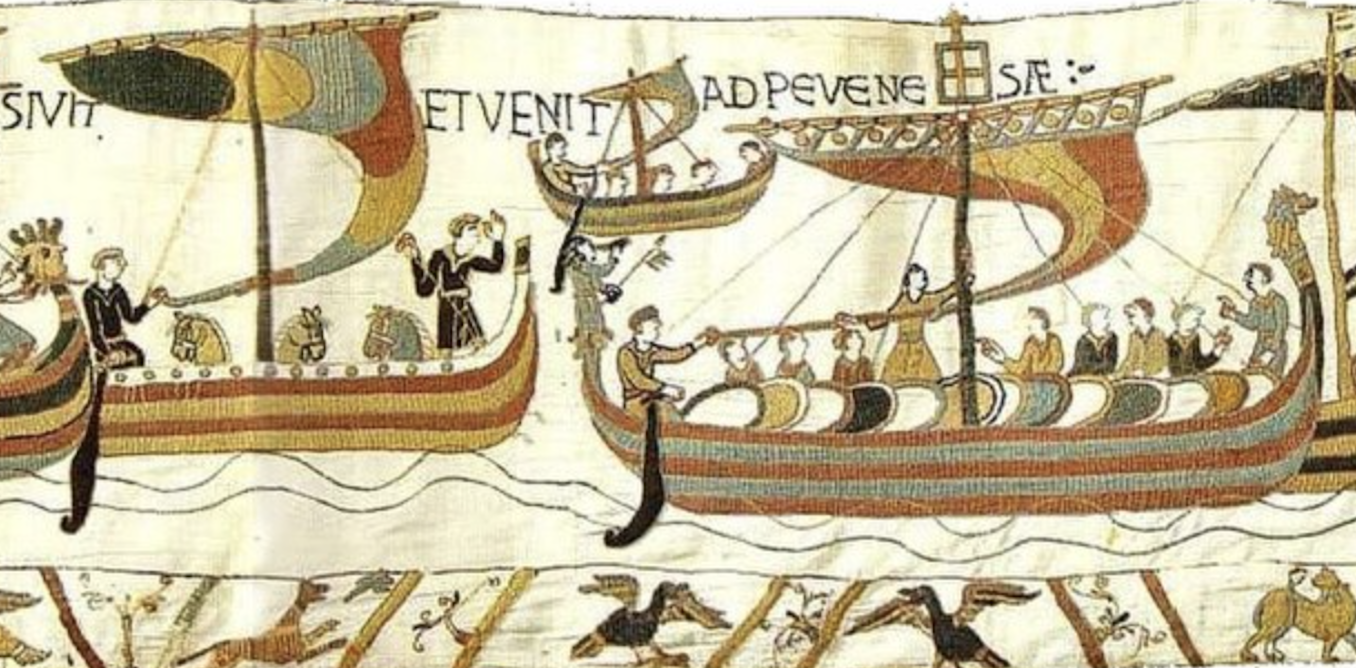
As the invasion fleet assembled at the mouth of the Somme, Matilda’s contributions shifted from spiritual appeasement to hard logistics. She personally commissioned and gifted William the Mora, the largest, fastest, and most heavily decorated ship in the invasion armada. Outfitted with a golden cross, a banner symbolizing divine favor, and a striking gilded figurehead of a child blowing a horn, the Mora served as the vanguard of the Norman fleet.
When William sailed for England in the autumn of 1066, Matilda remained behind in Normandy, pregnant with their daughter Adela of Blois. While her husband fought for a kingdom across the Channel, Matilda governed Normandy as regent, maintaining absolute stability in his absence.
1068–1083: Co-Rulership, Coronation, and Regency
William’s victory at the Battle of Hastings in October 1066 made him King of England, but his crown was insecure. Anglo-Saxon resistance simmered, and the native population viewed the Norman conqueror as a brutal foreign tyrant. Recognizing that sheer military force would not pacify the realm, William summoned Matilda to England.
In 1068, Matilda was crowned Queen of England in a solo coronation ceremony at Westminster Abbey. While William had been rushed to the throne immediately following his military victory, Matilda’s coronation was a carefully choreographed political ritual. Heavily pregnant once again, she brought the unassailable prestige of her Ottonian and French royal bloodlines to the Anglo-Norman court, legitimizing the new regime in the eyes of European monarchs and the domestic populace.
During the turbulent decades that followed, Matilda acted as William’s trusted lieutenant and alter ego. When William was forced to return to the continent to suppress continental rebellions, Matilda stepped in as regent. Between 1081 and 1082, she governed England, actively presiding as a judge in legal disputes—an unprecedented expansion of executive authority for a medieval queen. Across her lifetime, her name was attached to 137 surviving royal charters, underscoring her active participation in governance, land distribution, and patronage.
Supporting Context & Metrics
The scope of Matilda’s influence can be quantified through her landholdings, architectural legacies, and the chroniclers who recorded her era.
- The Mora Legacy: Chroniclers at the monastery of Fécamp noted in the 12th century that the Mora was built specifically by Matilda to honor her husband. Its iconic figurehead—a golden child pointing to England with one hand and holding an ivory horn with the other—was interpreted by modern historians like Elisabeth van Houts as a physical manifestation of the unborn royal dynasty, symbolizing the future of their bloodline crossing into a new empire.
- Domesday Wealth: Following the Conquest, Matilda became one of the wealthiest landowners in England. Records in the Domesday Book confirm extensive holdings gifted to her by William, including the lucrative manors of Hambledon and Little Marlowe in Buckinghamshire.
- Charismatic Governance: Matilda’s signature appears on 137 official charters, placing her at the administrative heart of the Anglo-Norman state. Her judicial role as regent in 1081–82 represents a foundational milestone in the evolution of English constitutional governance, proving that medieval queens could wield the ultimate arbiter’s gavel.
- Architectural Endowments: The Abbaye aux Dames in Caen stands today as an enduring monument to Matilda’s architectural patronage, religious diplomacy, and administrative genius. It remains one of the finest surviving examples of Romanesque architecture in Europe.
Official Statements and Scholarly Insights
Modern historians and medievalists are actively rewriting the narrative of 1066, lifting the veil on how women like Matilda of Flanders shaped the contours of medieval power.
Dr. Laura Gathagan, a leading historian on medieval queenship and author of The Queenship of Mathilda of Flanders: Embodying Conquest, emphasizes that Matilda’s contributions were structural rather than passive:
"Matilda did not merely watch history unfold from a distance; she actively engineered its material and political conditions. Through the commissioning of the Mora, her strategic manipulation of monastic foundations to win papal approval, and her unprecedented judicial acts as regent, Matilda physically embodied the Conquest. Her royal bloodline was the anchor that stabilized William’s precarious throne."
Elisabeth van Houts, a noted scholar of medieval European history, highlights the symbolic weight of Matilda’s gifts to the war effort:
"The inclusion of the golden child on the prow of the Mora was a radical departure from traditional maritime iconography, which favored fierce beasts or mythological monsters. It was a calculated dynastic statement—a visual promise of continuity, legacy, and divine right that sailed at the very front of the invasion fleet."
Orderic Vitalis, the 12th-century chronicler who recorded Matilda’s death in November 1083, detailed the profound grief that crippled William following her passing. According to Vitalis, the king "struggled against constant storms that rose up against him until his death in 1087," underscoring how deeply William relied on Matilda’s political acumen and emotional bedrock. Her magnificent funeral at Sainte-Trinité Abbey—attended by bishops, abbots, monks, and crowds of the destitute whom she had patronized—testified to a legacy that bridged the highest reaches of imperial power with grassroots charity.
Future Outlook: Re-Examining the Hidden Figures of History
The historical reassessment of Matilda of Flanders arrives at a critical juncture for educational institutions and museums across Europe. For generations, historical curricula regarding the Norman Conquest have focused myopically on military tactics, bloodshed, and the political machinations of male barons. However, the growing recognition of material culture—typified by ongoing analyses of the Bayeux Tapestry, the replica at Reading Museum, and newly digitized medieval archives—presents a golden opportunity to reshape how history is taught.
Historians argue that integrating Matilda’s story into the narrative of 1066 does more than correct a biographical oversight; it fundamentally challenges our understanding of how medieval states were run. It forces educators and researchers to look beyond the battlefield and examine the logistics of state-building, the weaponization of religious patronage, and the vital role of female regents in stabilizing war-torn kingdoms.
As digital humanities projects, such as Teaching Medieval Women, continue to unearth documents hidden in plain sight, the shadow cast by William the Conqueror is finally sharing space with the brilliant, formidable light of Matilda of Flanders. The hidden figures of the Norman Conquest are stepping out of the margins of history—proving that while men may have drawn the swords on the battlefield, it was often women like Matilda who forged the empires.