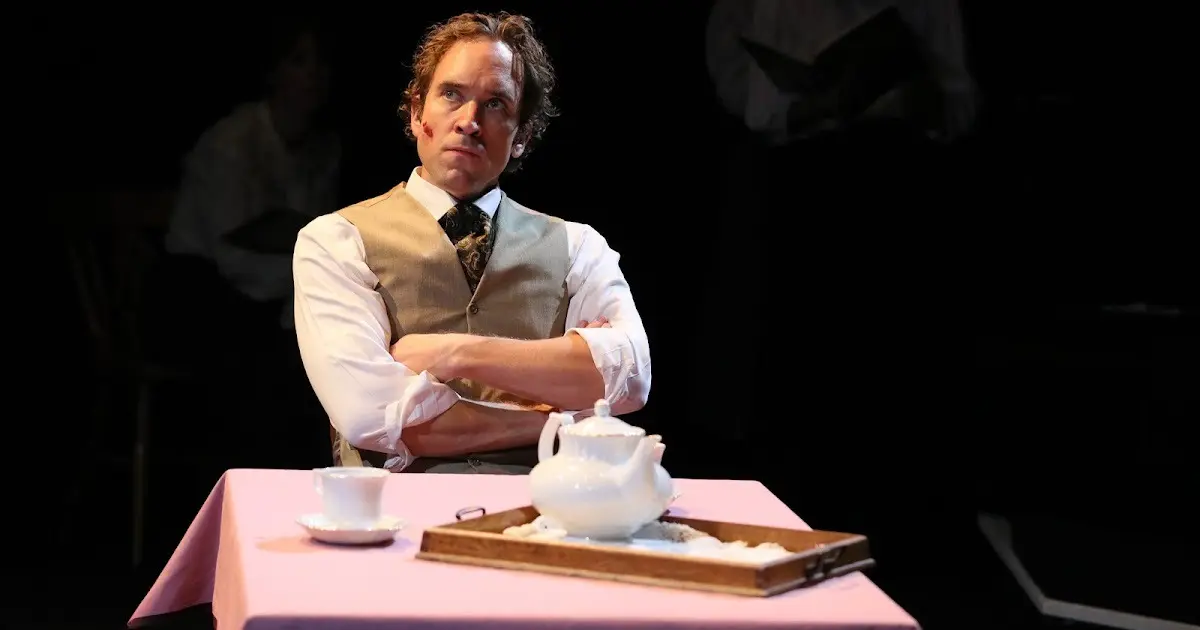
London’s dynamic contemporary opera scene recently played host to an intriguing and ambitious workshop premiere: The History of Mr. Polly: Part One. Staged on September 9, 2026, as part of the esteemed Tête à Tête: The Opera Festival at The Cockpit, this new work by composer and librettist Edward Longstaff tackles a literary giant—H.G. Wells’s 1910 picaresque comic novel. Bringing a bumbling, uneducated Edwardian anti-hero to the operatic stage is no small feat. Yet, aided by tenor Robin Bailey’s disarming charm in the title role, the workshop performance proved to be an inventive, wonderfully engaging exploration of a classic narrative.
Longstaff, a composer who transitioned to full-time writing after a 31-year tenure teaching at the Purcell School, has constructed a work that preserves the intricate, non-linear structure of Wells’s original text. Beginning in media res with a deeply disillusioned Alfred Polly plotting arson and suicide, the narrative loops back to trace the misadventures that led him to that fateful junction. While currently presented as a piano-vocal workshop—ably supported by pianist John Longstaff and directed with theatrical flair by Stuart Barker—The History of Mr. Polly: Part One offers a tantalizing glimpse into a full-scale, orchestrated operatic future. This review provides a comprehensive analysis of the production, examining its narrative framework, musical language, stylistic nuances, and future trajectory within the modern operatic landscape.
Detailed Chronology and Narrative Framework
H.G. Wells’s The History of Mr. Polly is famously rich in plot, overflowing with eccentric characters, class anxieties, and Dickensian social observations. Adapting such a sprawling novel into a condensed theatrical form requires aggressive dramaturgy, a challenge that Longstaff met head-on by penning his own libretto.
From Despair to Accidental Heroics
The opera opens boldly in media res. Alfred Polly is deeply unhappy with his socioeconomic lot, trapped in an uninspired existence, and actively planning to burn down his failing shop to collect insurance and end his misery. This dark opening note quickly pivots, however, as the opera jumps backward in time to chronicle Polly’s formative missteps, his chaotic employment history, and his social entanglements. Part One ultimately culminates at the anticipated fire, where Polly’s botched destructive impulses inadvertently transform him into a local hero.
The Cycle of Social Entanglements
Throughout Part One, Polly drifts through life propelled by inertia rather than ambition. The episodic narrative moves swiftly through several key encounters:

- The Parsons Episode: Polly’s early acquaintance with fellow shop assistant Parsons (energized by Laurie Slavin) serves as an early cautionary tale. Parsons’s ambitious attempts to liven up a drab shop window result in a summary dismissal, illustrating the perils of standing out in rigid Edwardian society.
- The Johnson Family: Sensing that Polly stands to inherit money upon his father’s death, his cousins Mr. Johnson (Jack Holton) and Mrs. Johnson (Maya Kumana) draw him into their social orbit. Holton and Kumana brilliantly navigated the dramatic irony of their characters—contrasting proper, middle-class decorum with predatory financial motives.
- The Larkins Household and Miriam: Introduced to the Larkins family through the Johnsons, Polly finds himself sliding into an almost accidental engagement with Miriam (portrayed with sharp comedic timing by Sophia Jin). The relationship requires zero effort on Polly’s part—a fatal flaw for a man constitutionally unequipped to make decisive life choices.
- The Bicycle Interlude and Christabel: Before his matrimonial doom is sealed, Polly finds brief, transcendent liberation on a bicycle. During a country ride, he meets Christabel (Hailey West), a young woman who momentarily opens his eyes to art, beauty, and authentic emotional connection, only to swiftly disabuse him of his romantic illusions.
- Fifteen Years Later: A flash-forward highlights the grim reality of Polly’s marriage to Miriam. Sophia Jin delivered one of the production’s emotional peaks, singing a blistering aria expressing deep loathing for domestic chores and cooking, venting her frustrations violently upon a lump of bread dough.
Musical Language and Performance Analysis
Edward Longstaff’s compositional style is fundamentally tonal and deeply melodic, characteristics that proved vital in rendering an Edwardian comic novel accessible to an opera audience.
Tonal Palette and Stylistic Shifts
At various points, Longstaff’s score channels the popular parlor and music-hall idioms of circa 1910, effectively anchoring the audience in the period’s cultural zeitgeist. However, the composer avoids pastiche by contrasting these lighthearted moments with darker, more introspective instrumental interludes. These shifts successfully underscore the underlying existential dread that permeates Polly’s internal monologue.
The Choral-Ensemble Dynamic
One of the most striking structural choices in Longstaff’s score is the use of the supporting cast as a flexible, multi-functional ensemble. Comprising seven singers, the ensemble operates as a Greek chorus of sorts. They not only narrate the story and propel the action forward but also directly address the audience, foreshadowing upcoming disasters and openly mocking Polly’s various foibles.
While this choral texture gave the production a unique and highly effective sonic identity, the pacing experienced occasional friction. The solo recitative sections frequently lacked the buoyant, effervescent lightness demanded by light comedy, occasionally causing the dramatic momentum to plod where it ought to dance.
Vocal Highlights and Characterization
The evening’s heavy lifting fell upon tenor Robin Bailey, whose lyrical warmth and innate personal charm made him an irresistible Mr. Polly. Even when Polly behaved foolishly or displayed characteristic cowardice, Bailey’s vocal and physical charisma ensured the audience remained firmly in his corner.

The supporting cast seamlessly shifted between their choral duties and distinct solo characterizations by donning simple outer garments over their neutral Edwardian rehearsal attire:
- Laurie Slavin injected palpable vigor into the ill-fated Parsons.
- Jack Holton and Maya Kumana brought delicious subtext to the grasping, hypocritical Johnsons.
- Elizabeth Lynch commanded the stage as the formidable Ma Larkins, supported by Emily McCarthy and Sophia Jin.
- Hailey West captured the ephemeral, dazzling charm of Christabel during the pivotal bicycle sequence.
Instrumentally, pianist John Longstaff provided heroic support, tackling a dense piano reduction that occasionally tested the physical limits of the keyboard, hinting at the rich textures yet to come once the score receives full orchestral treatment.
Supporting Context and Production Metrics
To understand the scope and significance of The History of Mr. Polly: Part One, it is essential to contextualize the production within the broader ecosystem of contemporary British opera development.
| Production Metric / Detail | Description |
|---|---|
| World Premiere Date | September 9, 2026 |
| Festival Context | Tête à Tête: The Opera Festival |
| Venue | The Cockpit, London |
| Source Material | The History of Mr. Polly by H.G. Wells (Published 1910) |
| Composer / Librettist | Edward Longstaff |
| Director | Stuart Barker |
| Designers | Valassia Barbouti & Maria J. Damia Patino |
| Lighting Designer | Ace McCarron |
| Movement Director | Ruth Howard |
| Music / Accompaniment | John Longstaff (Piano Reduction) |
| Cast Size | 8 Principal Singers (inclusive of Ensemble Chorus) |
The Workshop Aesthetic
Director Stuart Barker embraced the workshop format of the festival. Rather than hiding the mechanics of theatrical creation, the production utilized a visible row of costumes on stage, allowing performers to step into and out of character transparently. The ensemble frequently utilized handheld musical scores during choral narration while executing their solos entirely from memory. This stripped-back aesthetic fostered an intimate, highly collaborative atmosphere that resonated deeply with the capacity audience at The Cockpit.
Official Statements and Artistic Vision
Speaking on the origins of the project, composer Edward Longstaff reflected on the unique challenges of adapting H.G. Wells for the operatic stage. Unlike dramatic tragedies or sweeping romantic epics, Wells’s comic novels rely heavily on internal psychology, verbal idiosyncrasies, and social satire.

"Bringing Alfred Polly to life requires balancing pathos with absurdity," notes production commentary from the festival. "He is a man who achieves redemption entirely by accident, stumbling backward into a life he never had the courage to design for himself."
Critics and attendees alike noted stylistic parallels to Benjamin Britten’s Albert Herring, particularly in the way the central protagonist shares a deprecating, confessional relationship with the audience. However, because economic realities and festival formats restricted this initial presentation to Part One, audiences were temporarily left suspended before Polly’s true journey of self-actualization could unfold.
Future Outlook
As a workshop presentation, The History of Mr. Polly: Part One accomplished its primary mission: it tested structural pacing, showcased vocal dynamics, and engaged a packed house of opera enthusiasts. Yet, several artistic paths forward remain evident for the creative team:
- Full Orchestration: The transition from a piano reduction to a full orchestral score will undoubtedly expand the color palette, allowing the darker instrumental interludes to contrast more sharply with the lighthearted Edwardian pastiche.
- Stylistic Refinement: Polishing the solo recitative sections to inject a greater sense of buoyancy and comedic timing will help mitigate the occasional pacing lags observed during the workshop.
- Developing Part Two: The most pressing next step is the completion and staging of Part Two. While Part One establishes Polly’s entrapment and the disastrous consequences of his domestic life, the second half of Wells’s novel contains his ultimate liberation, escape from domesticity, and finding peace as an innkeeper’s assistant. Seeing Polly "come into his own" will provide the narrative payoff that this first installment so brilliantly sets up.
Ultimately, the immense enthusiasm of the capacity audience at The Cockpit signals a clear appetite for this work. Edward Longstaff has laid a sturdy, highly imaginative foundation. Operatic comedy of this literary caliber is rare, and the artistic community waits with bated breath for the complete transformation of The History of Mr. Polly.