Executive Overview
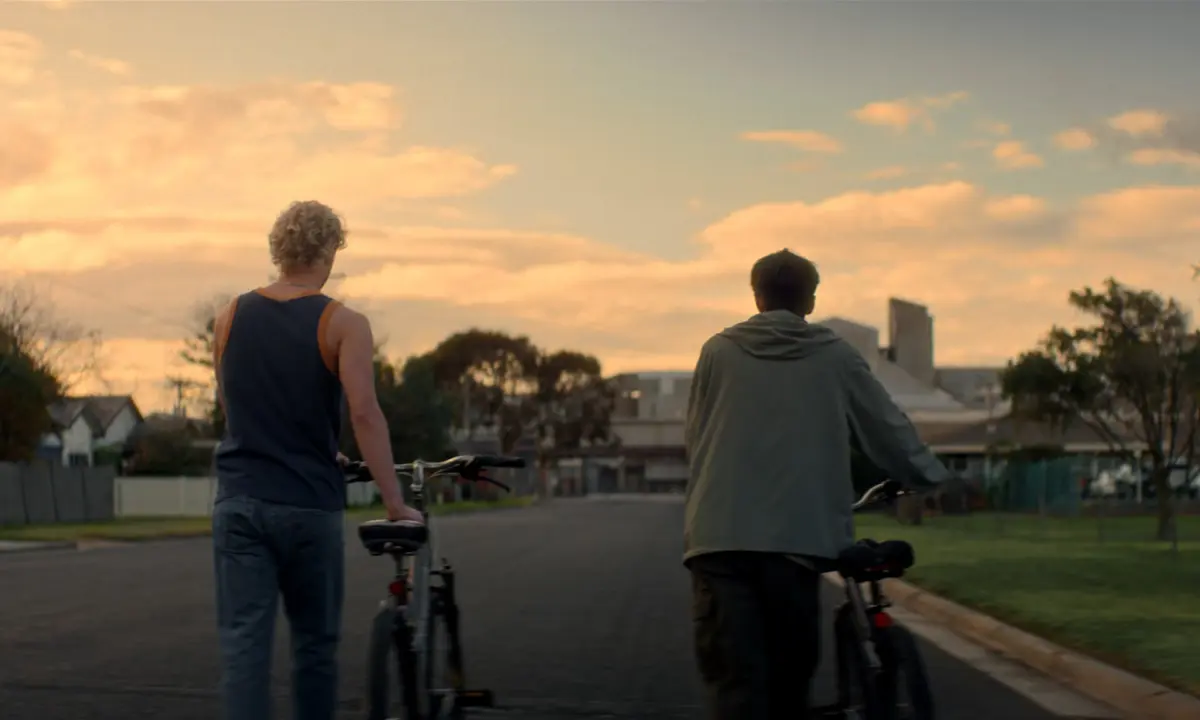
Growing up as a queer teenager within a Christian fundamentalist community in rural Australia presents a profoundly complex social and emotional challenge. In his striking feature-length debut, Leviticus, writer and director Adrian Chiarella amplifies this lived reality by introducing a sinister, supernatural dimension. Set against the bleak, sun-bleached expanse of the Victorian countryside, the film follows 17-year-old Naim (Joe Bird) and his secret romantic partner, Ryan (Stacy Clausen). Caught in the crosshairs of an oppressive religious apparatus, the young men are forced to attend a brutal "conversion therapy" retreat. What begins as psychological and spiritual abuse quickly spirals into a waking nightmare when the participants become hunted by shape-shifting entities that mirror the exact likeness of the people they desire most.
The film serves as a compelling addition to the rich lineage of Australian gothic and horror cinema, trading cheap jump scares for a desolate atmosphere, poignant character dynamics, and an insightful exploration of internalized shame. Bolstered by stellar performances—including a haunting supporting turn from Mia Wasikowska as Naim’s conflicted mother—Leviticus takes the metaphorical subtext of classic genre filmmaking and pushes it directly into the foreground. By literalizing the historic societal trope that transgressive desire equals doom, Chiarella establishes himself as a brilliant new directorial voice, seamlessly blending high-concept indie horror with authentic queer coming-of-age drama.
Detailed Chronology
Genesis and Adaptation: From Sydney to the Outback
The foundational roots of Leviticus stretch back into the personal history of its writer-director. Adrian Chiarella drew heavily upon his own upbringing as a gay man navigating the social geography of Sydney and the broader cultural landscape of Australia. Translating these memories into a cinematic language required a distinct setting—one that mirrored the emotional isolation of the protagonists.
Rather than shooting in an easily accessible urban hub, production moved to the rugged, rural townships situated west of Melbourne. This geographical choice allowed the production design team to utilize liminal spaces: dilapidated agricultural barns, rusted and abandoned farm machinery, and vast, empty horizons that evoke a uniquely Australian brand of southern gothic melancholia.
Narrative Arc and Supernatural Mechanics
The plot accelerates when Naim and Ryan are subjected to an aggressive "fire-and-brimstone" intervention led by a mysterious, self-appointed spiritual healer. Designed to purge the town’s youth of their queer identities, the retreat utilizes extreme psychological breaking points, culminating in intense, Exorcist-style convulsions.
However, the true horror manifests after the sessions conclude. A malevolent supernatural entity begins to stalk the survivors. Taking the physical form of the individual’s truest romantic desire, the monster preys on the vulnerability of the teens. In a merciless twist of the narrative mechanics, if a participant yields to their passion and engages in intimacy with the lookalike, they are brutally torn to shreds mid-encounter. This dynamic forces Naim and Ryan into an agonizing paradox: their love for one another is simultaneously the emotional core of their survival and the very catalyst that could destroy them.
Production and Casting Milestones
Casting proved pivotal to grounding the high-concept premise in believable human stakes. Joe Bird, who previously captured international attention with his standout role in the critically acclaimed Australian horror hit Talk to Me (2022), brings a delicate, nervous energy to the role of Naim. Opposite him, Stacy Clausen delivers an affecting performance as Ryan, anchoring the central romance with genuine vulnerability.
A major coup for the independent production was the securing of Mia Wasikowska for the role of Arlene, Naim’s mother. Wasikowska, whose early career was defined by high-profile studio projects such as Tim Burton’s Alice in Wonderland (2010) and Jane Eyre (2011), deliberately stepped away from the Hollywood machinery to curate an idiosyncratic filmography comprised of independent, challenging features. Her portrayal of Arlene—a mother who turned to fundamentalism following the death of her husband, now torn between maternal instinct and religious dogma—infuses the narrative with profound emotional complexity.
Supporting Context & Metrics
The Cinematic Landscape: The "In-Between" Spaces of Horror
Leviticus arrives at a cultural moment where audiences and creators alike are increasingly fascinated by liminal spaces and localized dread. This trend has been amplified by contemporary works like Backrooms (2026), which capitalizes on the psychological horror inherent in endless, mundane environments.
For decades, Australian cinema has excelled at weaponizing its distinct landscapes to foster dread. From the timeless, eerie mysticism of Peter Weir’s Picnic at Hanging Rock (1975) to the brutal, unforgiving isolation of Greg McLean’s Wolf Creek (2010) and Kevin Lucas’s Killing Ground (2016), the Australian bush functions almost as an active antagonist. Leviticus directly inherits this cinematic tradition, using the starkness of the countryside to mirror the emotional barrenness enforced by religious fundamentalism.
Thematic Lineage: It Follows and the Transgressive Desire Trope
The core concept of Leviticus—where sexual activity marks a character for relentless supernatural pursuit—invites immediate comparison to David Robert Mitchell’s influential indie horror masterwork, It Follows (2014). Chiarella has openly cited the film as a primary inspiration. Both movies utilize a slow-burn pace, rely on downbeat rural or suburban aesthetics, and deploy monsters that function as physical manifestations of the anxieties surrounding youth sexuality.
| Film | Setting | Central Monster / Entity | Primary Thematic Anxiety |
|---|---|---|---|
| It Follows (2014) | Downbeat suburban/rural America | Shape-shifting, unrelenting stalker | General anxieties of youth, consequence, and mortality tied to intimacy |
| Leviticus (2026) | Bleak rural Australian townships | Visage of the beloved | Specifically queer anxieties: internalized shame, longing, and societal rejection |
Academic Perspectives: Queer Theory and Horror Cinema
To fully understand the cultural resonance of Leviticus, one must look to the foundational work of film scholars like Harry Benshoff. In his seminal texts, Benshoff explored the complex relationship between the horror genre and LGBTQ+ audiences. He observed a fascinating paradox: while traditional horror often relied on societal homophobia—casting the "other," the deviant, or the monstrous in coded queer terms—it simultaneously cultivated a massive, devoted following within the queer community.
Monsters throughout horror history, from the dream-stalking Freddy Krueger in A Nightmare on Elm Street (1984) to modern slasher icons like Art the Clown in Terrifier (2016), have frequently been interpreted by critics as physical incarnations of repressed, transgressive sexual urges feared by patriarchal, heteronormative societies. Historically, this subtext remained subtext—hidden between the lines of makeup, monster tropes, and allegorical plot points. Leviticus takes this historical framework and boldly drags it out of the shadows, making the queer subtext the primary, literal text of the film.
Official Statements & Creative Insights
While full promotional press circuits for independent films often prioritize surface-level synopses, statements and interviews from the creative team shed light on the deeper intentions driving Leviticus.
Adrian Chiarella has consistently emphasized that the film’s horrific elements are designed to externalize internal psychological states rather than simply provide cheap thrills. Speaking on the integration of queer identity with genre tropes, the writer-director noted that the transition from a metropolitan upbringing to observing rural insularity exposed him to rigid frameworks of belief that felt, by their very nature, monstrous.
Furthermore, casting choices reflect a deliberate alignment with independent integrity. Mia Wasikowska’s choice to participate underscores a broader industry shift where established talent actively seeks out regional, auteur-driven projects that tackle culturally sensitive material. Though production notes highlight the challenges of shooting in remote, weather-unpredictable Victorian landscapes, the collaborative synergy between the young leads and seasoned veterans like Wasikowska elevated the material beyond standard genre fare.
Future Outlook
Leviticus arrives as a high-water mark for contemporary Australian independent cinema, signaling a maturation of queer horror as a distinct, commercially viable, and artistically rich subgenre. By refusing to rely solely on jump scares, Chiarella demonstrates that the most enduring horror stems from societal pressures, emotional isolation, and the agonizing friction between authentic self-discovery and institutional repression.
Industry Trajectory and Impact
The film’s reception points toward several significant trends for the immediate future:
- The Elevation of Regional Gothic: As international audiences continue to embrace geographically distinct storytelling, Australian filmmakers are poised to export more genre projects that utilize the stark outback not just as a backdrop, but as a psychological pressure cooker.
- Mainstreaming Queer Subtext: Leviticus proves that modern audiences are eager for horror that drops coded metaphors in favor of explicit, front-and-center queer narratives. This is expected to pave the way for more diverse casting and storytelling within studio and indie horror circuits alike.
- Breakout Careers: With powerhouse performances anchoring the production, the industry spotlight will undoubtedly remain fixed on Joe Bird and Stacy Clausen as they transition into larger international projects, while cementing Adrian Chiarella as a visionary writer-director to watch in the coming decade.
Ultimately, Leviticus transcends its monster-movie mechanics to deliver a haunting meditation on love, survival, and the courage required to exist authentically in an uncompromising world. It proves that while the monsters lurking in the shadows of the outback may be terrifying, the real triumph lies in the resilience of those who dare to love despite them.