Executive Overview
At London’s prestigious Lyttelton Theatre, a high-stakes theatrical experiment is rewriting the rules of live performance. Conceived, written, and directed by visionary theatre-maker Benedict Andrews, Electra/Persona is an audacious double bill that welds Sophocles’ ancient Greek tragedy Electra to Ingmar Bergman’s searing 1966 psychological film masterpiece Persona.
Featuring powerhouse performances by two of contemporary dramatic arts’ most formidable talents—Academy Award winner Cate Blanchett and celebrated German stage and screen star Nina Hoss—the production functions as a living laboratory for the deconstruction of identity, the mechanisms of theatrical illusion, and the permeability of the boundary dividing stage and screen.
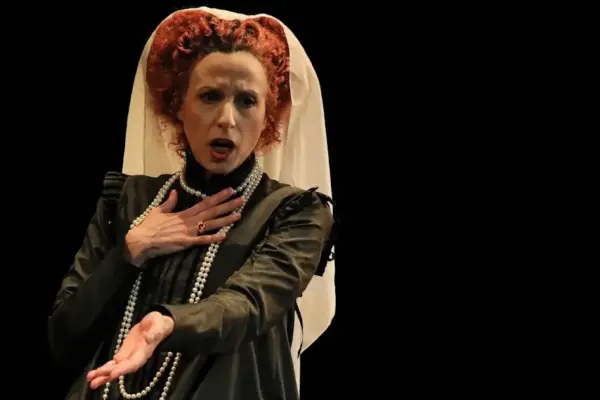
What makes Electra/Persona an unprecedented feat of modern repertory staging is its element of absolute chance. Before a single word of dialogue is uttered, the two leading actresses discover which roles they will play through a live, on-stage coin toss in front of the audience. Alternating between the roles of the vengeance-obsessed Greek princess Electra and the mute, psychologically fractured actress Elisabeth Vogler, alongside the matriarch Clytemnestra and the chatty nurse Alma, Blanchett and Hoss expose the artificiality of performance with every rotation.
Supported by Ella Lily Hyland as Chrysothemis and the doctor, the production is housed within an arresting, liminal set designed by Magda Willi. By merging the ritualistic traditions of ancient Greek amphitheaters with contemporary live-feed cinematic videography—reminiscent of David Lynch’s surrealist touchstones—Electra/Persona invites its audiences to look past the masks we wear and question where the actor ends and the human being begins. Running until October 10, this theatrical tour de force has quickly established itself as a landmark cultural event of the West End season.
Detailed Chronology: Anatomy of a Performance
The journey of Electra/Persona begins long before the curtain rises, blurring the lines of the fourth wall even as the audience settles into their seats. The chronological unfolding of the production reveals a meticulously engineered ritual of transformation.
1. The Threshold and the Toss
The evening begins without the safety of a darkened auditorium or a conventional scene change. Blanchett, Hoss, and supporting actress Ella Lily Hyland make their entrance not from the wings, but directly through the auditorium, mingling with and walking past the applauding audience. On the night of the production under review, Blanchett breaks the ice with a wry, metatheatrical quip: "We haven’t done anything yet."
Following instructions, a member of the audience is called upon to flip a coin. Hoss boldly calls "heads." The coin clatters to the floor: it is tails. With a shrug and a characteristic burst of raw candor, Blanchett announces: "Fuck it, I’ll do Electra."
With the casting for the first half locked in by fate, Hoss and Hyland take their seats in the front row facing the stage. Blanchett moves purposefully toward a communal container of white face paint, smearing it across her hands before vigorously rubbing it onto her face and clothes. The transformation is complete. Electra has arrived, and the tragedy begins.
2. Part One: The Sophoclean Blood-Feud
The first half of the evening plunges the audience into the brutal, cyclical world of Sophocles’ Electra. Written millennia ago, the tragedy tracks the psychological disintegration and obsessive mission of Electra, who lives in a state of suspended animation awaiting the return of her brother, Orestes. Together, they seek bloody vengeance for the assassination of their father, Agamemnon.
Agamemnon had been butchered upon his return from the Trojan War by his wife, Clytemnestra. Clytemnestra, meanwhile, defends her patricidal act as righteous retribution: Agamemnon had sacrificed their first-born daughter, Iphigenia, to appease the gods and secure favorable winds for the Greek fleet.
As the narrative unfolds, Blanchett’s Electra is consumed by grief, rage, and the desperate anticipation of Orestes’ return. Meanwhile, the supporting cast cycles through a kaleidoscopic array of secondary costumes and props, embodying Agamemnon, Orestes, Iphigenia, and even shades of their own contemporary selves. By the climax of the Sophoclean arc, the rapid permutation of costuming and vocal delivery creates an intentional vertigo. The audience is left questioning who, precisely, is exacting vengeance, and whether the violent impulse belongs to the character or the actor trapped within the dramatic framework.
3. The Great Transition: Wiping the Slate Clean
As the production pivots from antiquity to mid-century Scandinavian psychological horror, the actors remain on stage, refusing to break the physical continuity of the theatrical space. In full view of the audience, they remove their chalky white makeup, literally and metaphorically stripping away the classical persona to prepare for the Bergman adaptation.
A massive cinematic screen descends into the dead center of the stage. Blanchett steps into the role of Elisabeth Vogler—the celebrated stage actress who has abruptly ceased speaking entirely after playing Electra—while Hoss assumes the role of Alma, the voluble, well-meaning nurse tasked with nursing Elisabeth back to health in a remote seaside cottage.
4. Part Two: The Bergmanian Mirror
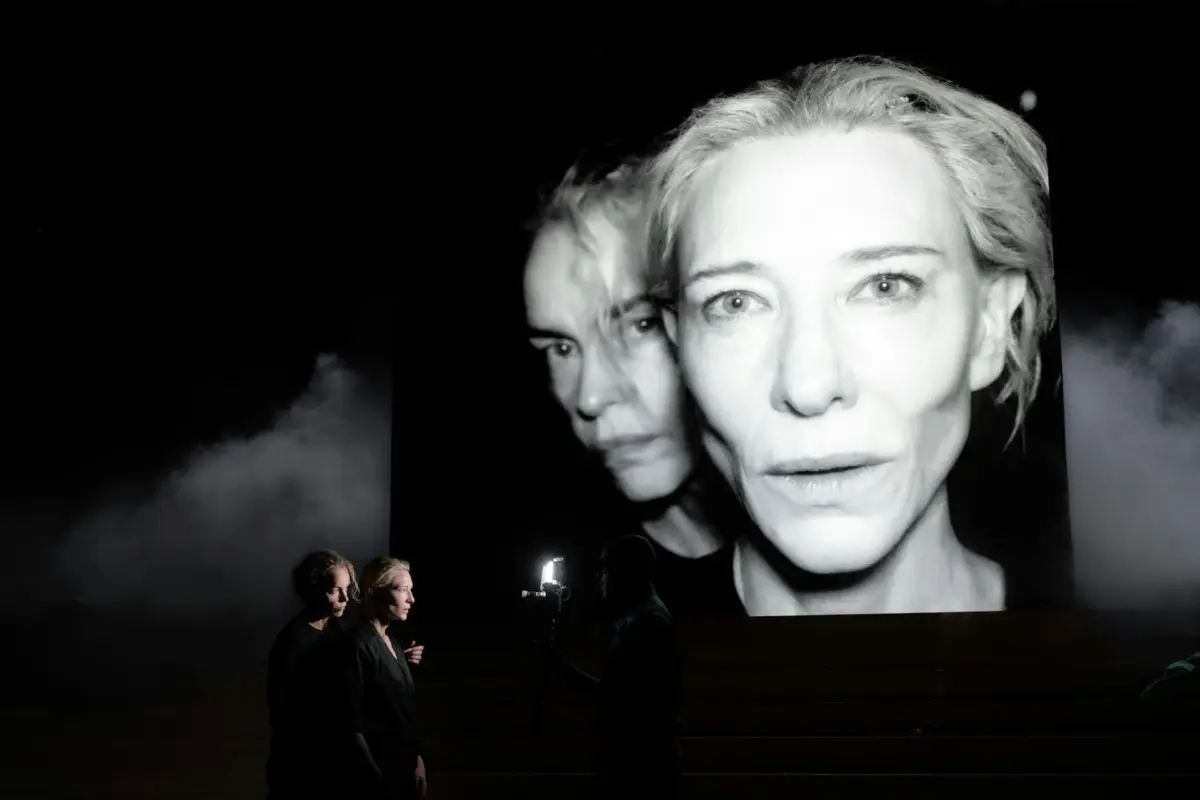
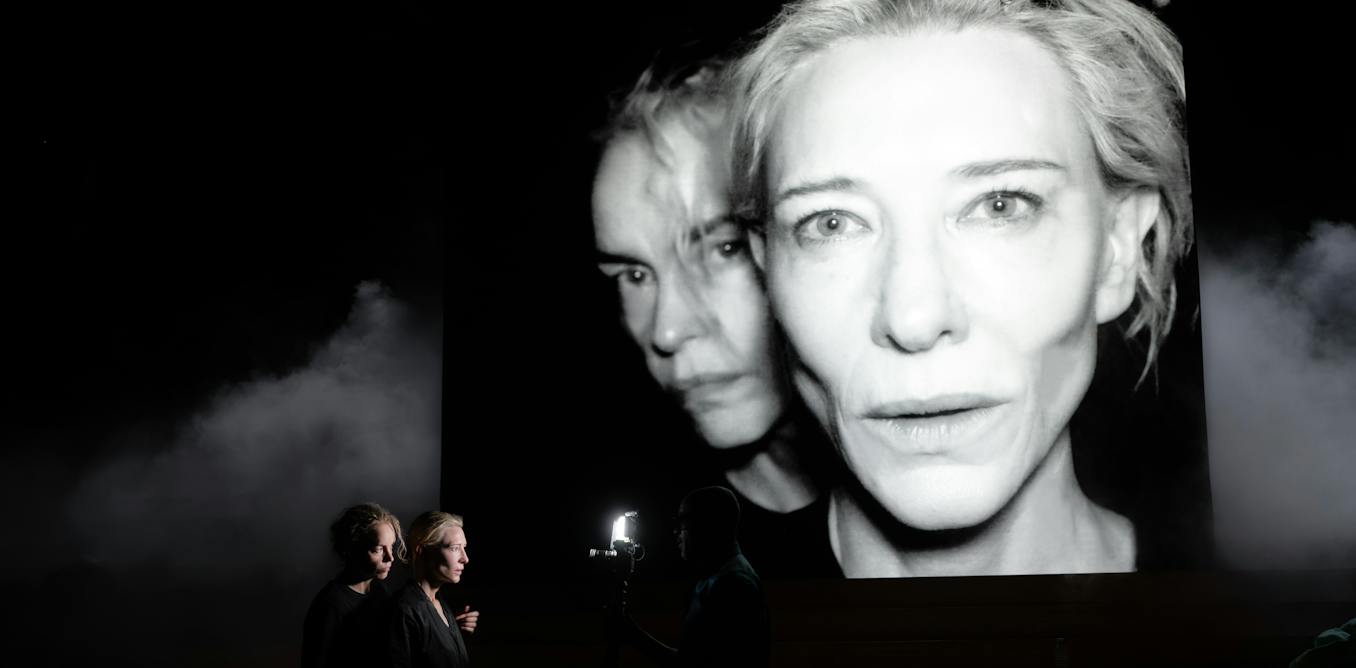
The second half of Electra/Persona leverages a live-feed video system. Throughout the scenes in the country house, Blanchett carries a mobile camera across the stage, broadcasting her own face and Hoss’s expressions in massive, unblinking close-ups onto the descending central screen.
As Alma attempts to fill the oppressive silence of Elisabeth’s muteness by unloading her deepest sexual and emotional secrets, a psychological parasitism takes hold. Alma discovers that Elisabeth has been writing observational letters to their shared doctor, mocking and detailing Alma’s confessions. A devastating confrontation ensues, culminating in a surreal, dreamlike collapse of boundaries. By the final moments of the Bergman arc, the women have psychologically colonized one another, leaving an indelible, permanent blur where their individual identities once stood.
Supporting Context & Metrics: The Mechanics of Persona
To fully appreciate the ambition of Benedict Andrews’ conceptual staging, one must examine the theoretical, historical, and structural mechanics underpinning the production.
The Etymology of the Mask
The title Persona carries a heavy etymological load. In Latin, persona refers explicitly to the theatrical masks worn by actors in Greco-Roman drama—masks equipped with exaggerated mouth openings and painted features designed to project voice and emotion to the furthest tiers of massive open-air amphitheaters.
By initiating the production with the application of white face paint, Andrews directly invokes this classical device. In contemporary mask work, the physical act of donning a mask triggers an embodied transformation, allowing the human actor to cross a threshold into a mythic archetype. In Electra/Persona, this gesture bridges the gap between Sophocles and Bergman. Elisabeth Vogler’s silence in Persona is, fundamentally, the ultimate mask: a refusal to participate in the hypocrisies of language and social performance.
Stage vs. Screen: A Medium-Specific Dialogue
The structural genius of the production lies in its direct interrogation of the dichotomy between theatrical and cinematic acting. Theatre is historically a telling medium, reliant on projection, text, oratory, and the physical sweep of the proscenium stage. Film, conversely, is a showing medium, dominated by the intimacy of the close-up, the editing suite, and the captured inner monologue.
| Medium Characteristic | Theatrical Arc (Electra) | Cinematic Arc (Persona) |
|---|---|---|
| Primary Actor Tool | Full-body physicality, oratory, chalk mask | Micro-expressions, silence, live camera feed |
| Narrative Drive | Externalized vengeance, familial curse | Internalized psychological breakdown, vampirism |
| Spatial Dynamic | Sweeping vertical staircase, open stage | Enclosed cottage, centralized projection screen |
| Performance Metric | Line counts, vocal projection, stage presence | Screen time, reacting shots, silent weight |
By confining Hoss’s vocalizing Alma primarily to the physical stage while casting Blanchett’s mute Elisabeth onto the towering live-video screen, Andrews plays a high-stakes game of aesthetic ping-pong. He asks the viewer to evaluate which medium yields a more authentic truth: the theatrical body shouting into a void, or the cinematic projection of an unblinking, silent face.
Architectural Framing: Magda Willi’s Set Design
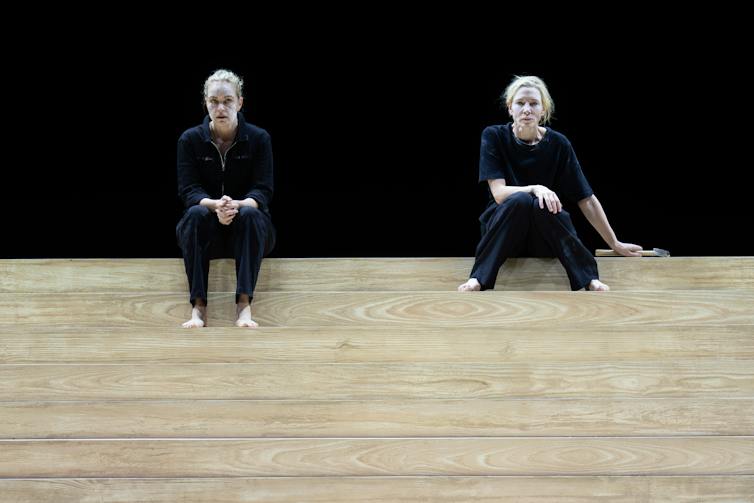
Set designer Magda Willi has constructed an environment that actively participates in the thematic confusion of the evening. Dominating the edge of the stage is an imposing, 23-step staircase made of bleached wood. Stretching from stage left to stage right and climbing almost to the top of the proscenium arch, the staircase visually evokes the stone seating tiers of an ancient Greek amphitheater.
Crucially, because the actors face the audience while utilizing this architecture, the physical arrangement creates an uncanny mirroring effect. The audience looking at the stage is subtly placed in the position of being watched—a sensation amplified during the transition to Persona, when the central screen activates with a live-feed camera aimed directly back at the auditorium. The spectator realizes with a start that the performance is not merely happening to them; they are part of the ecosystem of observation and judgment.
Official Statements & Critical Perspectives
Academic and critical reception of Electra/Persona has highlighted its rare synthesis of intellectual rigor and visceral, star-studded performance power.
In recent scholarship examining multi-cast casting practices, theatre theorists have noted the profound implications of forcing actors to trade monumental roles night after night. In traditional classical repertory, alternating roles is a logistical necessity; in Andrews’ hands, it becomes an ontological statement. As the production demonstrates, when two world-class actors continuously swap the roles of tormentor and victim, mother and daughter, artist and muse, the play suggests that identity itself is a social construct subject to the roll of a die.
National Theatre reviewers and cultural commentators have similarly praised the production for its refusal to spoon-feed conclusions to the audience. Andrews deliberately steps back, trusting the spectator to draw the connective tissue between the ancient house of Atreus and the sterile, sun-drenched isolation of Bergman’s 1960s psychological landscape.
The production’s resonance with David Lynch’s cinematic masterpiece Mulholland Drive (2001)—itself heavily indebted to Bergman’s Persona—underscores a continuous lineage of surrealist art exploring fractured female doubles, identity theft, and the terrifying void behind the Hollywood or theatrical smile.
Future Outlook: The Legacy of a Theatrical Milestone
As Electra/Persona approaches its closing night at the Lyttelton Theatre on October 10, theatre historians and industry professionals are already assessing its long-term impact on contemporary staging practices.
The production serves as a masterclass in how classical texts can be revitalized not through superficial modernization—such as updating costumes or inserting contemporary political buzzwords—but through structural, philosophical juxtaposition. By binding Sophocles to Bergman, Andrews has created a hybrid art form that treats text as raw material for a broader philosophical inquiry into the nature of the persona.
Furthermore, the physical and psychological stamina demanded of Cate Blanchett and Nina Hoss—who must negotiate live video switching, physical mask-work, emotional extremes, and the sheer unpredictability of an opening-night coin toss—sets a new benchmark for virtuosic acting in the 21st century.
Whether Electra/Persona will find a life on international stages or transition to other cultural capitals remains to be seen. However, its brief, electric run in London has already secured its place in the annals of modern theatrical history. It stands as a searing reminder of why we continue to return to the theatre: to watch brilliant artists put on masks, strip them away, and dare us to recognize our own fractured reflections staring back from the dark.