Executive Overview
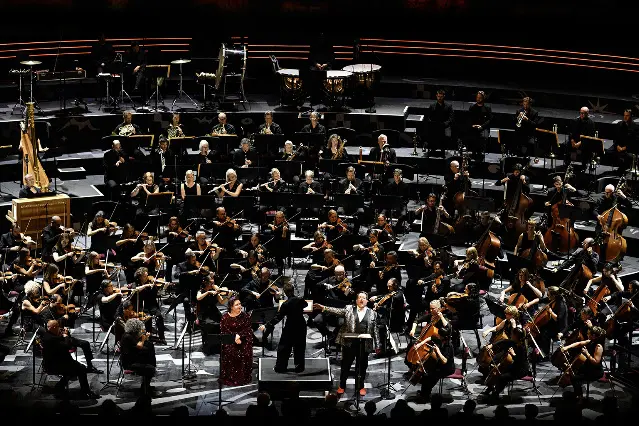
The BBC Proms at the Royal Albert Hall on Friday, August 21, 2026, offered audiences a masterclass in musical programming. At first glance, the concert appeared to be a standard, eclectic festival offering: a diverse trio of works spanning centuries, bridging contemporary classical music, the Classical era, and late-romanticism. Under the baton of principal guest conductor Anja Bihlmaier, the BBC Philharmonic Orchestra delivered a compelling, if occasionally challenging, evening featuring Bushra El-Turk’s Mosaic, Franz Haydn’s Symphony No. 45 in F-sharp minor (‘Farewell’), and Gustav Mahler’s monumental Das Lied von der Erde, performed alongside acclaimed soloists Jamie Barton and Clay Hilley.
Yet, scratching beneath the surface revealed a rich, tightly woven tapestry of connective tissue. The overarching theme of "farewell" bridged Haydn and Mahler in fascinatingly contrasting lights, while Bushra El-Turk’s Mosaic interrogated themes of cultural cross-pollination, rootlessness, and otherness—echoing the exact emotional topography Mahler explored when setting ancient Chinese poetry in Das Lied von der Erde.
While the evening was a triumph of ambitious programming and stylistic exploration, it was not without its acoustic hurdles. The legendary, cavernous acoustics of the Royal Albert Hall posed significant balancing challenges, particularly in matching the raw sonic weight of the BBC Philharmonic against the vocal lines of Barton and Hilley. Nevertheless, Bihlmaier’s disciplined, forward-thinking interpretations provided a riveting evening of live orchestral music that will undoubtedly sound magnificent upon its rebroadcast on BBC Sounds.
.jpg)
Detailed Chronology of the Evening
1. Bushra El-Turk: Mosaic
The concert opened with a rare live airing of Bushra El-Turk’s Mosaic, originally composed for the Manchester Camerata during the 2009/10 season. El-Turk’s work immediately established an atmosphere of fragile tension. It began with a scurrying, hushed shimmer across the string section—rendered so delicately quiet that it was nearly swallowed by the vast expanse of the Royal Albert Hall.
As the piece unfolded, dramatic fragments and jagged motifs emerged from the quietude, creating an anxious, unnerving sonic landscape. Bihlmaier guided the orchestra through a gradual buildup of denser textures, though the motivic fragments intentionally resisted easy resolution. The work concluded in ravishing, breathtaking quiet, with a sudden, romantic, hymn-like figure cutting through the haze. While the complex detailing of El-Turk’s score occasionally strained against the hall’s notoriously unsympathetic acoustics for whisper-quiet dynamics, it served as a striking, contemporary curtain-raiser.
2. Franz Haydn: Symphony No. 45 in F-sharp minor (‘Farewell’)
Haydn’s Farewell Symphony is globally celebrated for its historic, meta-theatrical premiere, where musicians slowly blew out their candles and left the stage one by one. Despite its fame, the work has been a notable absentee from the Proms repertoire, having last been performed at the festival in 1938. Bihlmaier’s decision to program it—and to perform it using a modern, full-bodied symphony orchestra—was an act of bold artistic bravery.
.jpg)
- The First Movement: The strings of the BBC Philharmonic sounded robust, stylish, and thoroughly modern. With such a substantial body of strings deployed, the wind sections occasionally receded into the background, but the movement possessed an undeniable urgency and dynamism, balanced by a tender lyricism in its central episode.
- The Slow Movement: Marked by intimate detail, pointed motifs, and profound harmonic uncertainty, Bihlmaier maintained an intriguing tempo. Though the inclusion of all written repeats stretched the movement’s proportions relative to the surrounding repertoire, it offered performers the necessary temporal breathing room to unpack Haydn’s intricate counterpoint.
- The Menuetto & Finale: The Menuetto brilliantly juxtaposed delicacy against strength, highlighting Haydn’s daring key relationships before evaporating into midair. The finale followed with crisp, urgent momentum. As players progressively extinguished their music stands (metaphorically speaking, as players physically left the stage in traditional fashion), the performance brilliantly mirrored a historical time-lapse, telescoping backward from modern orchestral gigantism down to intimate chamber-scale performance. The ending was as wonderfully weird, mysterious, and historically resonant as the composer intended.
3. Gustav Mahler: Das Lied von der Erde
The second half of the concert shifted scales dramatically. Mahler’s Das Lied von der Erde calls for a massive orchestra featuring quadruple woodwinds, extensive percussion, mandolins, and dual vocal soloists. Bihlmaier adopted a disciplined, almost classical approach to the score, expertly managing the vast palette of tonal and timbral contrasts that define Mahler’s late masterpiece.
- "Das Trinklied vom Jammer der Erde" (The Drinking Song of the Earth’s Sorrow): Tenor Clay Hilley approached the opening movement with a heavy emphasis on dramatic narrative and histrionic intensity. His clear, unforced tone conveyed a surprising, visceral anger by the movement’s close. However, his vocal placement meant his voice was occasionally recessed within Mahler’s thick orchestral textures.
- "Der Einsame im Herbst" (The Lonely One in Autumn): Mezzo-soprano Jamie Barton made her entrance following a breathtaking, gossamer-thin string opening and a sublime oboe solo. Barton prioritized raw emotional truth over superficial vocal beauty. While her interpretation was intensely concentrated, the sheer sonic weight of the orchestra occasionally threatened to eclipse her dynamic range in the hall.
- Middle Movements (‘Der Trunkene im Frühling’, ‘Von der Jugend’, ‘Von der Schönheit’): Hilley brought a sparkling lightness and masterclass in storytelling to "Of Youth," while "Of Beauty" featured a brilliant contrast between the orchestra’s light, dancing rhythms and Barton’s darker, steadier vocal weight. Though some of Barton’s micro-details were lost in the auditorium during faster, more fervent sections, the moments where Bihlmaier reined in the orchestra allowed Barton’s radiant phrasing to soar. Hilley returned for "The Drunkard in Spring," delivering a vividly theatrical performance capped by bravura histrionics.
- "Der Abschied" (The Farewell): The emotional anchor of the evening. Bihlmaier evoked deep aural magic at the outset, drawing out the lower registers of the orchestra alongside the resonant, ghostly groan of the tam-tam. Barton approached the massive final movement with profound dignity, artfulness, and emotional restraint. Carrying the heavy performance history of the piece in this specific hall (alluding to legendary interpretations by Janet Baker and Jessye Norman), Barton maintained a classical discipline. Though the climaxes tested the acoustic boundaries of the hall in a fierce loudness battle with the orchestra, the final fading stanzas—marked by Barton’s internalized, deeply concentrated delivery of the repeated word "Ewig" (Forever) set against a solitary flute—provided a transcendent, haunting conclusion.
Supporting Context & Metrics
- Concert Date: Friday, August 21, 2026.
- Venue: Royal Albert Hall, London (Capacity: approx. 5,200).
- Performing Ensemble: BBC Philharmonic Orchestra.
- Conductor: Anja Bihlmaier (Principal Guest Conductor).
- Featured Soloists: Jamie Barton (Mezzo-Soprano), Clay Hilley (Tenor).
- Repertoire Metrics:
- Bushra El-Turk – Mosaic (Composed 2009/10).
- Franz Haydn – Symphony No. 45 in F-sharp minor, ‘Farewell’ (First Proms performance since 1938; only the fourth time in Proms history).
- Gustav Mahler – Das Lied von der Erde (Completed 1909; scored for massive forces including quadruple woodwinds and mandolins).
Official Statements & Artistic Vision
Reflecting on the overarching architectural design of the evening, classical music critics and festival observers noted the deliberate, thematic scaffolding erected by Anja Bihlmaier and the BBC Proms programming team.
While no official formal press release accompanied the specific performance beyond standard BBC scheduling notes, Bihlmaier’s stylistic choices throughout the evening spoke volumes about her interpretive philosophy. Her dedication to presenting Haydn’s Farewell Symphony with a fully modern, symphonic string body rather than a scaled-down period ensemble signaled a desire to treat the Classical masterwork with the same grand architectural seriousness typically reserved for late-Romantic titans.
.jpg)
Furthermore, pairing Bushra El-Turk’s exploration of cultural diaspora and hybridity (Mosaic) directly alongside Mahler’s assimilation of ancient Chinese texts via Hans Bethge’s Die chinesische Flöte (Das Lied von der Erde) highlighted a sophisticated curatorial effort. The programming actively prompted listeners to consider how composers across centuries grapple with displacement, existential rootlessness, and the inevitable passage of time.
Future Outlook
The August 21st Proms performance stands as a watershed moment for Anja Bihlmaier’s tenure with the BBC Philharmonic, cementing her reputation as a conductor of immense intellectual curiosity and theatrical bravery. Programming a lesser-heard Haydn masterpiece alongside a massive Mahler song cycle and contemporary British-Lebanese composition requires an orchestra of immense versatility and a conductor of unwavering clarity.
For those in attendance, the concert offered unforgettable moments of acoustic and emotional power—even if the Royal Albert Hall’s infamous architectural acoustics occasionally forced listeners to work harder than usual to untangle intricate orchestral balances.
.jpg)
Fortunately, classical music enthusiasts who missed the live broadcast or wish to re-evaluate the performance balance can access the full concert recording via BBC Sounds. As the festival season progresses, Bihlmaier’s bold curation sets a high benchmark for future orchestral programming, proving that the Proms remains an essential laboratory for daring musical juxtapositions.