Executive Overview
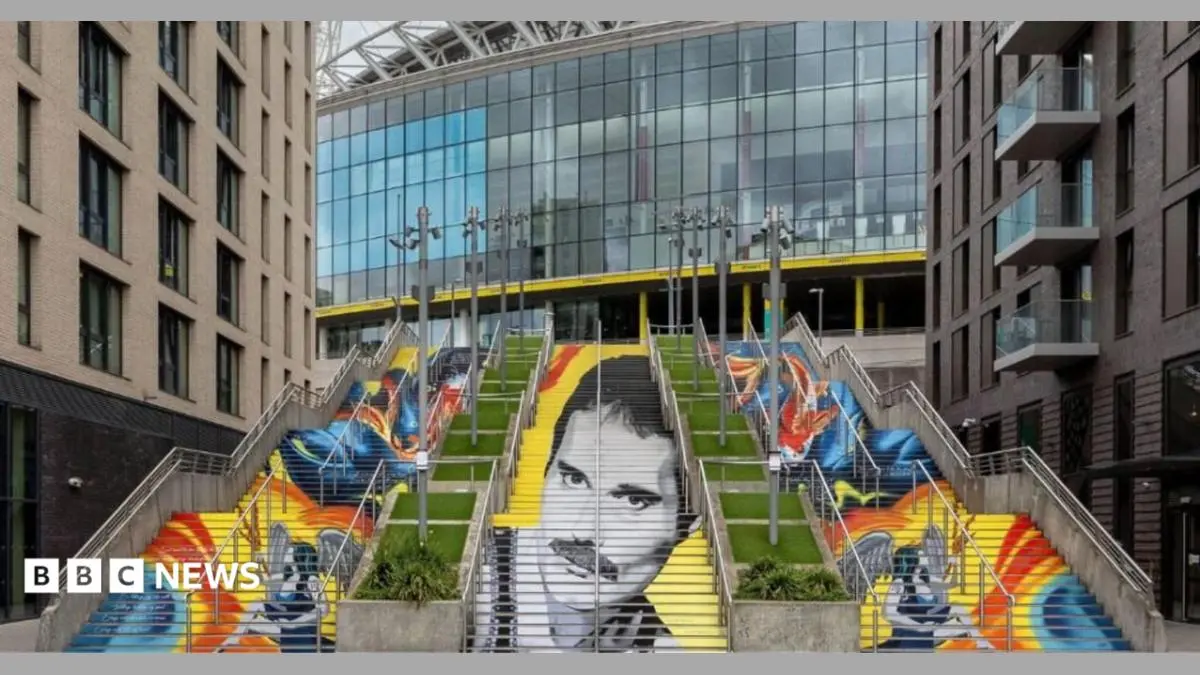
Wembley Park has unveiled a striking new permanent fixture that immortalizes one of rock music’s most defining figures. A sweeping, highly detailed public art installation has been inaugurated on the grand steps connecting the iconic Wembley Stadium to the OVO Arena Wembley (historically known as the Empire Pool). Commissioned to celebrate the profound, historic ties between Queen—fronted by the inimitable Freddie Mercury—and the Wembley district, the mural serves as both a vibrant visual homage and a pilgrimage site for international fans.
Designed by renowned graphic artist and illustrator Dan Styles, the expansive artwork does not merely recount Mercury’s monumental stage presence. Instead, it weaves a deeply personal narrative, bridging the gap between his electrifying public persona and his private passions. From the delicate incorporation of Japanese koi carp reflecting his profound affinity for Japanese culture, to the majestic winged female figures symbolizing his Virgo star sign—a direct nod to the legendary Queen crest he personally designed—every square inch of the installation is steeped in symbolic resonance.
The project was curated and commissioned by Claudio Giambrone for Wembley Park, born out of a desire to provide the global Queen fanbase with a dedicated space for communal reflection and celebration. Freddie Mercury’s legacy in the area transcends a single legendary concert; it is rooted in years of historic performances, cultural milestones, and an enduring artistic ethos. Standing as a free-to-view public monument until December 2026, the mural anchors Wembley as the spiritual home of British rock history, offering locals, tourists, and devout "Queenoids" a fresh vantage point from which to remember a man who redefined modern entertainment.
Detailed Chronology: Queen’s Historic Reign Over Wembley
To fully understand the weight of this new monument, one must examine the deep chronological roots binding Queen to the Wembley precinct. The relationship is a tapestry of sweaty arena shows, stadium-shaking anthems, and cultural watersheds that charted the trajectory of 20th-century rock music.
The Empire Pool Era (1978–1984)
Long before the modern steel arch of the new Wembley Stadium dominated the North London skyline, Queen forged their live reputation in the crucible of the Empire Pool (later rebranded as Wembley Arena). Between 1978 and 1984, the band played a staggering 10 shows at the venue, transforming it into a laboratory for their theatrical ambitions.
During the late 1970s, as disco vied with the emerging punk and new wave movements, Queen doubled down on arena-filling opulence. Their shows at the Empire Pool were masterclasses in pacing, lighting, and audience interaction. It was within these hallowed walls that anthems like "We Will Rock You" and "We Are the Champions" were tested, refined, and cemented into the collective global consciousness. Mercury commanded the room with an unmatched athletic energy, turning cavernous indoor spaces into intimate spaces of mass communion.
The Zenith: Live Aid and the 1986 Magic Tour
If the Empire Pool cemented Queen’s status as arena titans, Wembley Stadium elevated them to the status of immortal legends. The pivotal moment arrived on July 13, 1985, during the global broadcast of Live Aid. Taking the stage in the blistering London afternoon sun, Mercury delivered what is widely considered the greatest 20-minute live performance in the history of rock and roll. With a simple vocal warm-up call-and-response ("Ay-Oh"), he had 72,000 people in the palm of his hand, effortlessly translating the energy of a stadium into a global broadcast reaching billions.
The triumph at Live Aid was not an isolated peak; it was the catalyst for their triumphant return the following summer. In July 1986, during their Magic Tour, Queen played two consecutive, sold-out nights at Wembley Stadium. These concerts—immortalized on film and audio recordings—captured the band at the absolute zenith of their powers. Mercury, clad in his iconic yellow military jacket, strutted across the vast stage with a royal crown and cape, presiding over a sea of adoring humanity. Tragically, these would be among the final live performances of Queen’s original lineup, making the Wembley turf hallowed ground for the faithful.
Supporting Context & Metrics: Unpacking the Artistry of the Mural
The newly unveiled staircase installation is far more than a standard piece of street art; it is a meticulously researched biographical tribute that honors both the public icon and the private man.
Merging Public Iconography with Private Passions
Artist Dan Styles approached the commission with academic precision, deeply informed by Mercury’s own background in the visual arts. Before global stardom beckoned, Farrokh Bulsara (Mercury) studied graphic art and design at Ealing Art College, graduating in 1969 with a diploma in graphic design and art. This foundational training meant that Mercury approached his band’s album covers, stage layouts, and merchandising with a rigorous aesthetic consciousness.
"As a trained graphic designer himself, Freddie was very aware and precise about the visual feel and so I have endeavoured to follow his ethos in the conscious creation of this mural," notes Styles.
This ethos is evident in the layered symbolism embedded within the artwork:
- Japanese Koi Carp: The inclusion of koi fish serves as a direct nod to Mercury’s deep-seated love for Japan—a country that embraced Queen with open arms during their landmark 1975 tour and where Mercury cultivated a lifelong appreciation for Japanese art, antiques, and gardening. The fish visually echo the traditional Japanese pond at his beloved Kensington home, Garden Lodge.
- Winged Female Figures: The majestic figures soaring through the design represent his Virgo star sign. Mercury famously incorporated astrological symbolism into the intricate Queen crest (often referred to as the Queen coat of arms), which features the zodiac signs of all four band members surrounding a stylized phoenix.
- Textual Integration: As visitors ascend or descend the steps linking Wembley Stadium and the OVO Arena, iconic lyrics and personal quotations from Mercury run vertically up the architecture. This transforms a physical transit point into a poetic journey, where fans literally walk alongside the words and thoughts of the artist.
The Architectural Nexus
The physical placement of the mural holds strategic and emotional significance. Situated on the grand public steps that bridge Wembley Stadium and the OVO Arena Wembley, the installation acts as a physical portal connecting two spaces that defined the British live music industry across decades. By positioning the artwork here, developers and curators have transformed a utilitarian thoroughfare into a cultural landmark, ensuring that millions of foot-passengers traversing the Wembley Park regeneration zone encounter the legacy of rock royalty on a daily basis.
Official Statements and Curatorial Vision
The realization of the Wembley Park mural is the result of careful collaboration between urban planners, artists, and cultural custodians dedicated to preserving London’s rich musical heritage.
Claudio Giambrone on Community and Legacy
Claudio Giambrone, who commissioned and curated the work on behalf of Wembley Park, emphasized the broader cultural imperative driving the project. In an official statement, Giambrone remarked:
"Freddie Mercury’s relationship with Wembley goes far beyond a single famous performance. We wanted to create something that gives fans a new place in Wembley where they can come together and remember him."
Giambrone’s vision addresses a long-standing desire among the global Queen community. While Wembley Stadium features plaques and statues paying homage to various sporting and musical icons, there has historically been a distinct spatial void dedicated to the intimate, communal celebration of Mercury’s specific connection to the area. The steps now fulfill that function, serving as an organic gathering space where impromptu tributes, fan meet-ups, and quiet moments of reflection can take place side-by-side with the bustling modern activity of the Wembley Park neighborhood.
Dan Styles on Artistic Integrity
For illustrator Dan Styles, the challenge lay in translating the out-sized, operatic personality of Freddie Mercury into a static, public medium without losing the kinetic energy that defined his life. By focusing on Mercury’s own design sensibilities, Styles bypassed cliché pop-art portraits in favor of an interpretive, narrative-driven visual landscape.
"Freddie understood composition, color theory, and visual impact better than many of his rock contemporaries," Styles explained during the unveiling. "My goal was to channel that exact critical eye into the mural. Every element—from the flow of the koi carp to the placement of the typography along the gradient of the steps—was chosen to honor his meticulous artistic standards."
Future Outlook: Preservation, Accessibility, and Cultural Impact
As urban centers across the globe grapple with how to honor their cultural heritage amidst rapid modernization, the Wembley Park Freddie Mercury installation offers a compelling blueprint for successful public art.
Accessibility and Lifespan
In an era where many cultural experiences are locked behind paywalls, VIP ticketing tiers, or commercial exhibitions, the Wembley Park mural remains entirely democratic. Free to view at any hour of the day or night, it invites spontaneous engagement from casual commuters, local residents, and international music tourists alike.
Organizers have confirmed that the installation will remain in place until December 2026, giving fans from all corners of the globe ample opportunity to visit the site over a multi-year window. This extended residency ensures that the artwork will witness major cultural events, football finals, and blockbuster concert tours, embedding Mercury’s legacy into the evolving modern history of the stadium complex.
The Ongoing Resonance of Queen
Long after the final chords of "God Save the Queen" echoed out over the London turf in 1986, the band’s cultural footprint has only expanded. Bolstered by the critical and commercial success of the 2018 biographical film Bohemian Rhapsody, a new generation of fans has discovered the theatrical genius of Freddie Mercury.
Projects like the Wembley Park mural ensure that this rediscovery is grounded in physical spaces. By anchoring musical history to urban geography, Wembley Park has transformed from a mere venue location into an active monument of rock mythology. As fans walk the steps between the arena and the stadium, they are reminded that while performers may pass, true artistic innovation leaves an indelible, permanent mark upon the world.