Executive Overview
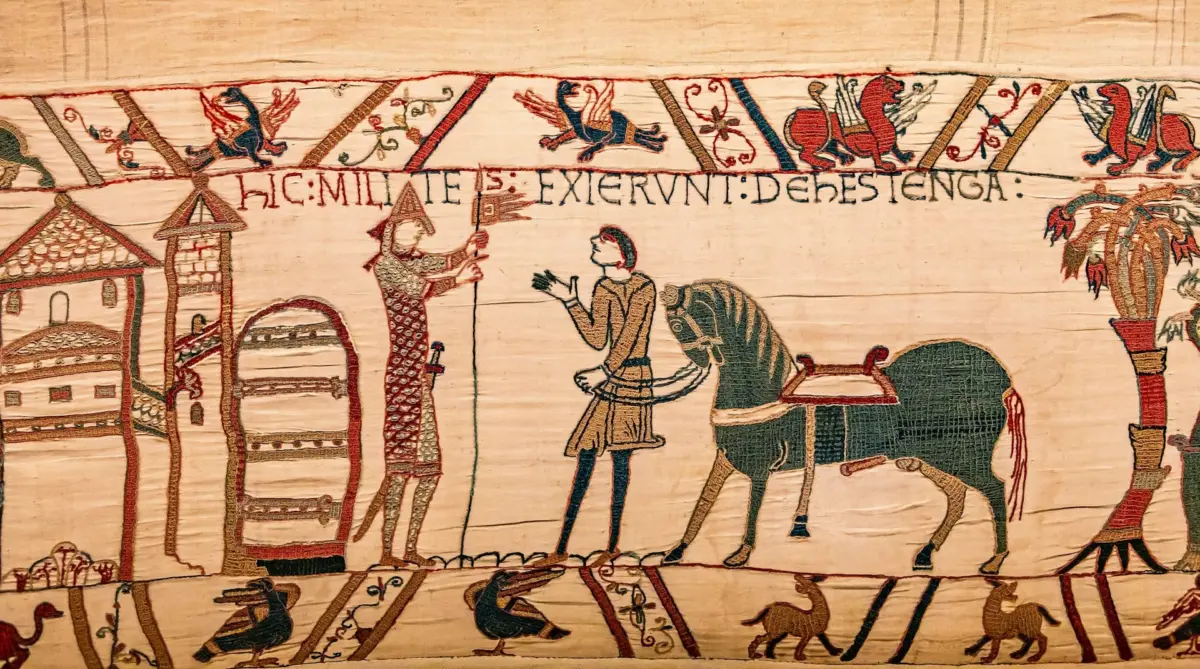
For centuries, the Bayeux Tapestry has occupied a foundational place in the architecture of British and European historical memory. Spanning roughly 70 meters of needle-worked linen, the monumental artifact depicts the sweeping, high-stakes drama of the Norman Conquest, culminating in the fateful Battle of Hastings in 1066 and the dramatic death of King Harold II. Yet, according to contemporary visual culture researchers and historians, the object at the heart of our historical imagination is routinely misnamed, misunderstood, and disconnected from the broader, global lineage of political needlework to which it truly belongs.
First and foremost, the Bayeux Tapestry is not a tapestry at all. It is an embroidery. Rather than having images woven directly into the structural warp and weft of a loom, the creators of the 11th-century masterpiece used worsted wool yarn—historically known as crewel threads, derived from the old Welsh word for wool—stitched painstakingly onto a base of plain linen.
By applying the correct terminology, scholars argue we can properly reposition the artifact within the history of women’s creative labor, political dissent, and visual communication. Far from being a mere domestic pastime or a passive craft of little geopolitical consequence, narrative needlework has repeatedly served as a radical medium for state-sponsored propaganda, community mourning, and subaltern resistance.
Viewed through the lens of modern comic studies, the Bayeux masterpiece emerges as a pioneering example of sequential art. Long before the advent of print journalism or digital media, visual narratives were deployed to shape public opinion, construct national myths, and record the brutal realities of war for largely non-literate populations. By connecting the 11th-century embroiderers of Normandy to modern textile artists in Pinochet-era Chile and war-torn Laos, researchers are uncovering a profound, cross-cultural tradition: the use of the needle and thread as a weapon of memory and a voice for the voiceless.
Detailed Chronology
To understand the weight and cultural trajectory of narrative textiles, it is essential to trace the historical timeline of how humans have utilized visual storytelling across millennia.
- 113 CE: In Rome, Trajan’s Column is completed. Standing 30 meters high and topped with a statue of St. Peter, the monument features a 190-meter spiralling marble frieze detailing the Roman-Dacian Wars. Operating much like a modern stone comic strip, the column communicates military dominance and imperial narrative across linguistic barriers without requiring literacy in Latin.
- Late 11th Century: The Bayeux Tapestry is crafted. Commissioned likely by Odo, Bishop of Bayeux and half-brother of William the Conqueror, the 70-meter embroidery immortalizes the events leading up to the Norman Conquest. Executed primarily by anonymous female laborers, the work blends grand political statecraft with rich, satirical, and occasionally ribald visual commentary hidden within the borders.
- 1959–1975: The Laotian Civil War, often referred to as the "Secret War," ravages Southeast Asia. Amidst immense displacement and violence, the Hmong people begin producing intricate "story cloths." These vibrant embroideries serve as vital historical archives and cultural touchstones for the Hmong diaspora, documenting atrocities and preserving ancestral histories that mainstream channels ignored.
- 1973–1990: Under the brutal military dictatorship of General Augusto Pinochet, Chile suffers widespread political violence and the state-sanctioned phenomenon of forced disappearances. In response, women across the nation utilize scraps of rough burlap and leftover fabric to create arpilleras. These tactile, defiant artworks memorialize the "disappeared" and communicate human rights abuses to the international community.
- Modern Era: Scholars in comics studies, gender studies, and art history begin re-evaluating narrative textiles. By analyzing works like the Bayeux embroidery, Hmong story cloths, and Chilean arpilleras through the methodology of comics reading, academics expand the definition of sequential art beyond spandex-clad superheroes to include centuries of public, political needlework.
Supporting Context & Metrics
The academic re-evaluation of the Bayeux Tapestry hinges on expanding our understanding of how visual literacy operates. Historian George Wingfield Digby famously observed that the Bayeux embroidery was “designed to tell a story to a largely non-literate public; it is like a strip cartoon, racy, emphatic, colourful, with a good deal of blood and thunder and some ribaldry.”
The Metrics of Medieval Storytelling
- 70 Metres: The total length of the Bayeux embroidery, making it one of the longest continuous visual narratives of the medieval world.
- 93 Penises: The startling number of visible phalluses depicted across the length of the cloth, the vast majority of which belong to horses, highlighting the bawdy, subversive humor woven into the margins by the artisans.
- 3 Women: The sparse representation of named or identifiable women depicted within the main narrative body of the entire 70-meter cloth—including the mysterious shrouded figure of Aelfgyva—contrasting sharply with the reality that the physical creators of the masterwork were almost certainly anonymous women.
Sequential Art Across Time and Technology
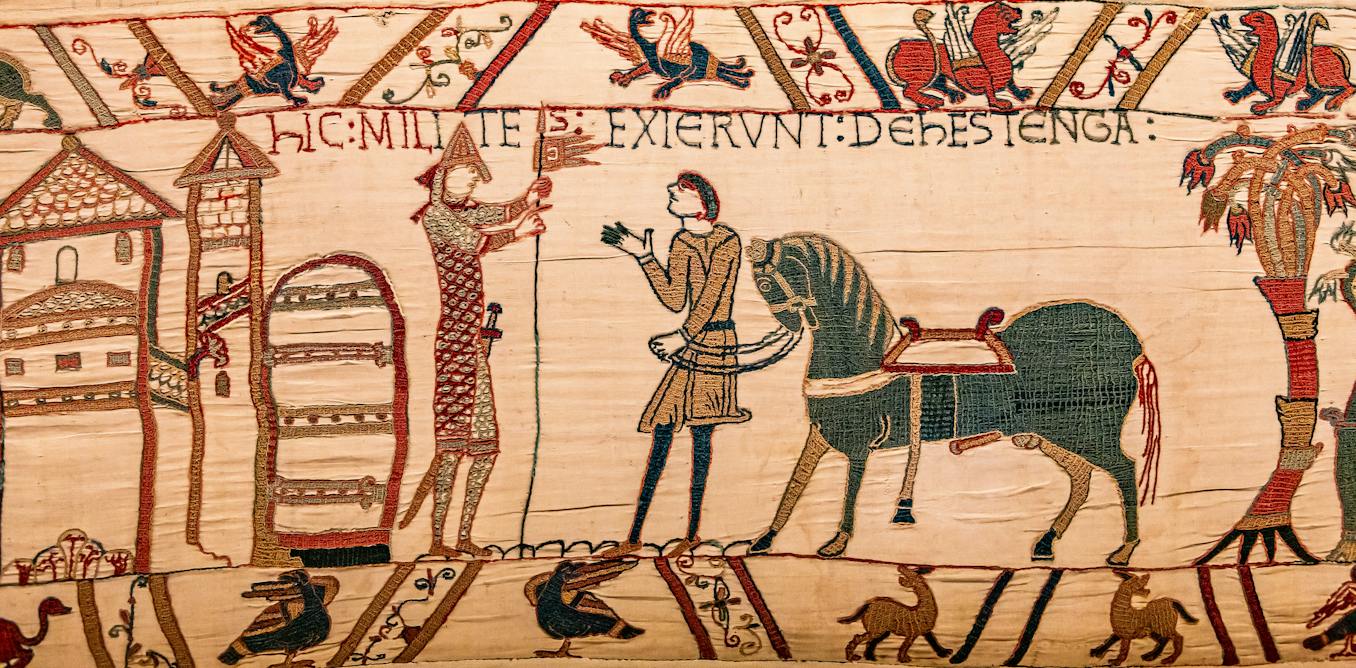
The structural mechanics of the Bayeux embroidery mirror those of modern graphic literature. Sequential art relies on panels, gutters, recurring characters, and visual signifiers of time and motion to guide the viewer’s eye.
[Trajan's Column (113 CE)] ──> [Bayeux Embroidery (11th C.)] ──> [Hmong Story Cloths (1959-75)] ──> [Chilean Arpilleras (1973-90)]
       │                                                                                                     │
       └─────────────────────────► Universal Visual Language / Comics Methodology ◄──────────────────────────┘
This universal visual grammar is not restricted to historical monuments or high art. In the contemporary world, the exact same cognitive processes are utilized in everyday instructional design:
- IKEA Flat-Pack Instructions: Relying entirely on sequential line drawings to guide consumers through assembly without language barriers.
- NHS Medication Guidance: Utilizing step-by-step visual pictograms to explain complex dosages and safety warnings.
- Airline Safety Leaflets: Employing comic-strip logic to instruct passengers on emergency procedures across diverse international demographics.
When applied to the Bayeux Tapestry, this perspective bridges the gap between high-level Norman propaganda and the lived reality of the craftspeople who executed it. While the overarching narrative was dictated by elite patrons to glorify William I, the execution fell to skilled needleworkers who injected individual flair, humor, and subtle subversion into the borders.
Official Statements and Scholarly Perspectives
Recent academic discourse surrounding the Bayeux artifact emphasizes the intersection of gender studies, labor history, and comic theory. Experts stress that the historic dismissal of embroidery as a trivial "domestic hobby" has served to devalue women’s intellectual and political contributions to history.
Dr. Alice Harvey-Linton, a researcher specializing in comics, war, and violence, notes the powerful parallels between medieval European embroidery and modern political textiles from marginalized communities:
"While the Bayeux tapestry was created as a narrative of victory, it was still created by women who would have had very little voice in their own communities and whose labor sits in the background of the work itself. The work of the women who embroidered the greatness of William I could be seen as the creative precursor of that of the women who embroidered their murdered loved ones in Chile and Laos.
The women who stitched the Bayeux tapestry in the late 11th century knew that pictures were a marvelous vehicle for narrative, and this remains true today. Though they did not have creative control over the story, we see the touches of their creativity and humor throughout the piece itself. Centuries later, their crafting sisters in Chile and Laos took up their needles to tell stories that only they could, becoming fully the creators of pictorial memories, making visual the violences that still mark our history."
Furthermore, cultural anthropologists studying Hmong story cloths and Chilean arpilleras emphasize that needlework has frequently functioned as an essential alternative archive when official state histories attempt to erase atrocities. Because textiles are portable, easily hidden, and constructed from readily available domestic materials, they offer a decentralized medium for resistance movements that lack access to printing presses, state broadcasting networks, or official publishing houses.
Future Outlook
As the boundaries of academic disciplines continue to dissolve, the future of historical and visual research points toward a more inclusive definition of what constitutes a "text." The traditional hierarchy that separates high-art monumental painting and sculpture from craft-based textile work is steadily collapsing.
Emerging Areas of Research
- Comics Reading Methods in Narrative Needlework: Scholars are developing new analytical frameworks to "read" textiles using panel-transition theories originally designed for graphic novels and comic books. This allows researchers to decode how stitchers managed pacing, temporal shifts, and emotional resonance across cloth.
- Digital Preservation and Interactive Mapping: Advanced high-resolution digital archiving is allowing researchers to zoom in on individual stitches, wool types, and underlying linen weaves of the Bayeux embroidery, shedding light on the number of individual hands involved in its collaborative creation and identifying distinct stylistic signatures within the stitching.
- Global Tapestries of Resistance: Ongoing documentation of diaspora art, refugee textile projects, and protest craft ensures that modern narrative needlework is preserved alongside medieval monuments. Projects collecting contemporary activist embroideries demonstrate that the impulse to stitch history into fabric remains as vital today as it was in 11th-century Normandy.
Ultimately, expanding our understanding of the Bayeux Tapestry forces a re-examination of popular culture and political history alike. Comics are not merely modern entertainment confined to superheroes in spandex; they are an ancient, universal human technology for public storytelling. By recognizing the intricate, rebellious, and brilliant labor stitched into historical textiles, we open up countless hidden chapters of human history waiting to be discovered across the threads of time.