Executive Overview
For the first time in British exhibition history, the entirety of Katsushika Hokusai’s iconic print series—Thirty-six Views of Mount Fuji—has been brought together under one roof. Hosted at the historic Dulwich Picture Gallery in London, this landmark cultural event features all 36 original landscape prints, alongside the ten additional designs Hokusai appended to the series following its runaway commercial success. Drawn entirely from the prestigious Iuchi Collection, the works offer UK audiences a rare, comprehensive encounter with Edo-period Japan through the eyes of its most celebrated master.
Created when Hokusai was already in his seventies during the early 1830s, these woodblock prints were originally manufactured as inexpensive, mass-produced commodities for the ordinary citizens of Edo (modern-day Tokyo). Yet, centuries later, they stand as monumental achievements in graphic art, composition, and psychological depth.
Beyond the aesthetic triumph of the exhibition, the display offers a profound meditation on human perception, individual bias, and the psychological concept of "mentalising." Viewed through the lens of modern art psychotherapy, Hokusai’s multi-faceted depictions of Japan’s sacred peak challenge viewers to look beyond single, static impressions—exemplified by the ubiquitous cultural footprint of The Great Wave off Kanagawa—and consider how context, environment, and community shape our understanding of the world and one another.
Detailed Chronology: The Genesis and Evolution of a Masterpiece
The Late-Career Renaissance of an Edo Master
The genesis of Thirty-six Views of Mount Fuji dates back to the early 1830s, a period when Katsushika Hokusai was navigating his seventies. In an era when average life expectancies were low, Hokusai’s late-life productivity was nothing short of staggering. Having already established himself as a dominant force in ukiyo-e (pictures of the floating world) printmaking, the artist turned his creative focus entirely toward Japan’s highest and most sacred peak, Mount Fuji.
Originally commissioned and printed as low-cost, commercial souvenirs and decorative items for the working and middle classes of Edo, the series was never intended as an exclusive elite portfolio. Hokusai capitalized on the burgeoning domestic tourism industry, tapping into a widespread cultural obsession with climbing and venerating Mount Fuji. Pilgrims, merchants, and laborers crisscrossed the country, and Hokusai’s prints catered to a populace eager to celebrate their national landscape.
Expanding the Vision: From 36 to 46 Views
The initial conception of the series was strictly limited to 36 distinct vantage points. However, the commercial triumph of the early prints prompted publisher Nishimuraya Yohachi (Eijudō) to expand the project. Hokusai responded by adding ten more designs, bringing the total collection to 46 prints.
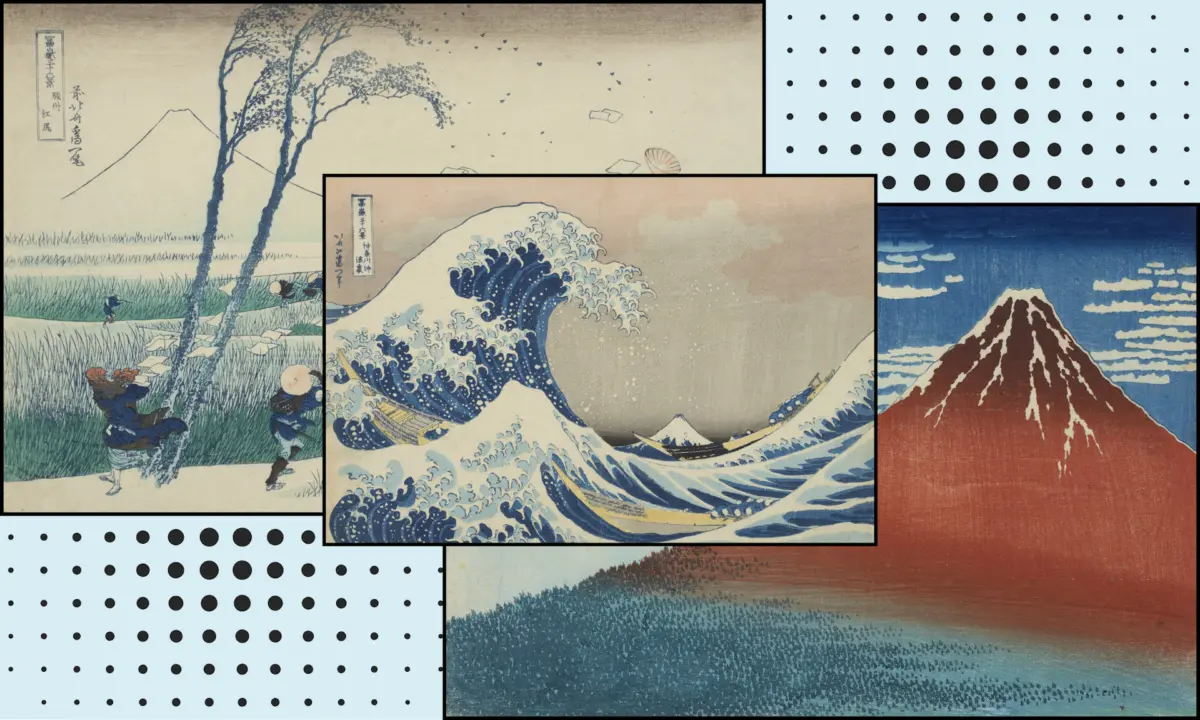
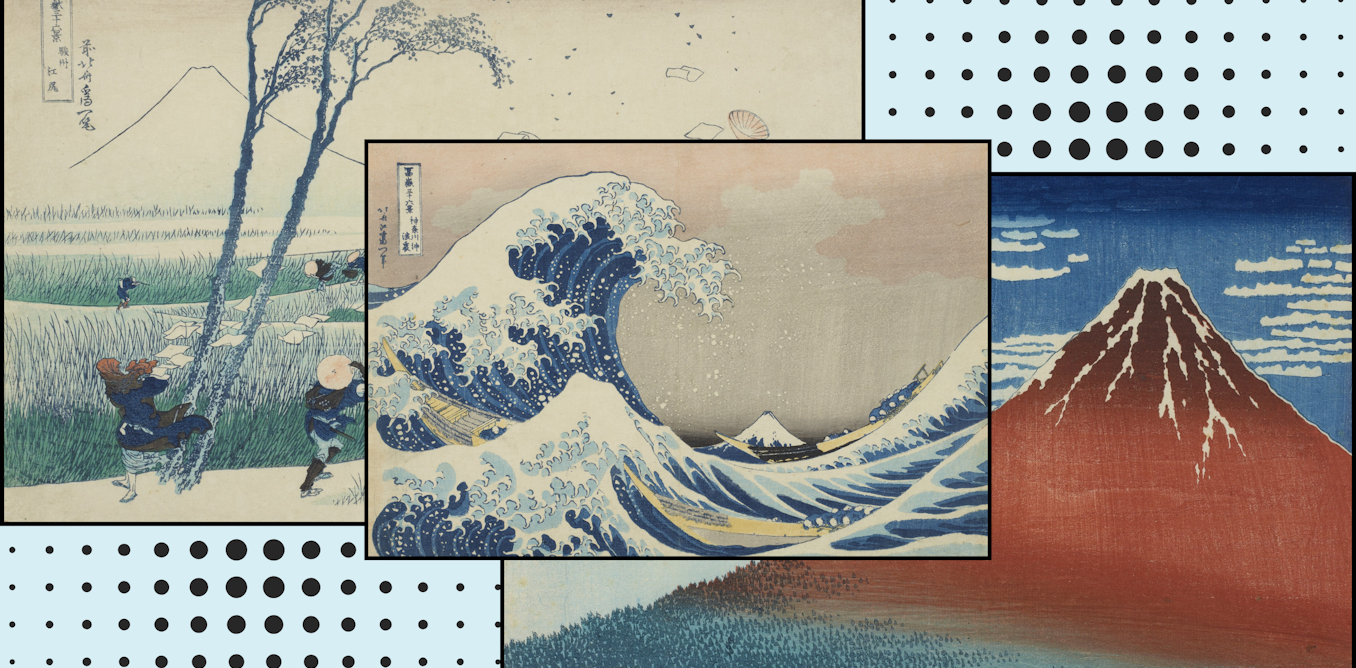
In the first room of the Dulwich Picture Gallery exhibition, this evolution is laid bare through a striking juxtaposition of the mountain’s various iterations. The famous Clear Day with a Southern Breeze (commonly known as Red Fuji) presents the peak as an exercise in almost pure, monolithic form. Its lustrous red body resonates against a receding blue sky, anchored by subtle creases of snow near the summit and a bustling chorus of tiny, easily overlooked trees at its base. The mountain, as Hokusai illustrates, only truly becomes itself in relation to the surrounding ecosystem.
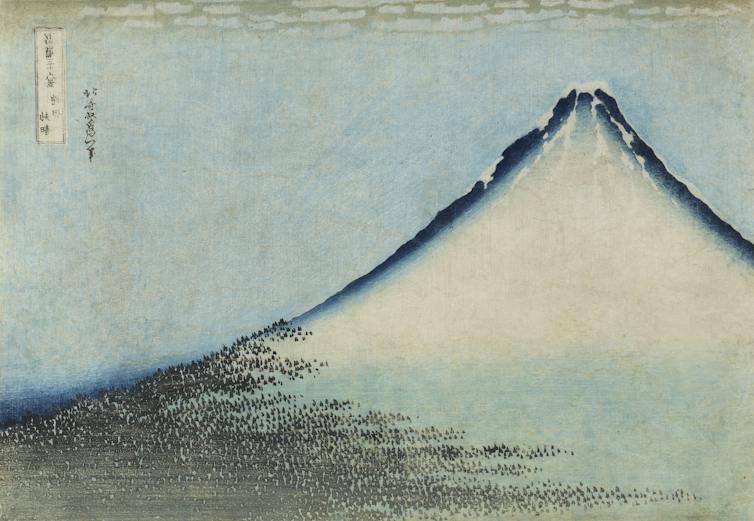
Just adjacent to this fiery depiction hangs a light-blue variant of the same composition, its ridge edged in heavy indigo, inviting the viewer’s eye deep into the geological contours of the land. A third variation features lightning-like cracks reminiscent of a fractured ceramic pot, casting a dark, unsettled mood over the sacred landscape.
Supporting Context & Metrics: The Exhibition and the Iuchi Collection
| Exhibition Detail | Fact / Figure |
|---|---|
| Exhibition Title | Hokusai: Thirty-six Views of Mount Fuji from the Iuchi Collection |
| Venue | Dulwich Picture Gallery, London |
| Closing Date | January 17, 2027 |
| Total Prints Displayed | 46 (36 core views + 10 supplementary designs) |
| Lending Institution | The Iuchi Collection (on deposit at The National Museum of Western Art, Tokyo) |
| Creation Period | c. 1830–1833 |
| Artist’s Age During Creation | In his 70s |
| Target Audience (Historical) | Ordinary citizens and travelers of Edo (Tokyo) |
The Dominance and Misunderstanding of The Great Wave
Globally, Hokusai’s name is inextricably linked to a single, hyper-recognizable image: Under the Wave off Kanagawa, universally known as The Great Wave. Hung prominently on the gallery wall, its foam reaches forward like grasping, knuckled human fingers, while tiny spray flecks scatter across the dark, menacing water like distant stars.
Despite its visceral energy, the print maintains an eerie, suspended stillness. Framed within the dramatic claws of the wave is Mount Fuji once again—rendered here as a tiny, distant triangle, completely dwarfed by the violent power of the ocean.
When viewed in isolation, The Great Wave often dominates public perception of Hokusai’s entire oeuvre. However, surrounded by the remaining 45 prints in the Dulwich gallery, it transforms from an isolated masterpiece into a single perspective among many. Curators and critics alike note that this arrangement serves as an unintentional lesson in human psychology: how rapidly society settles on a singular, reductive view of complex phenomena, whether it is a sprawling artistic series or the inner lives of other people.
Landscapes of Daily Life
Beyond the majestic peaks, Hokusai’s lens frequently sweeps downward to capture the bustling reality of early 19th-century Japanese society. Across the series, ordinary people hurry over arched bridges, toil in agrarian fields, and journey along dusty roads. Hillsides are rendered with geometric patterns resembling patterned bandanas of farmland, while Prussian blue skies fade softly toward the horizon.
Playful visual geometries abound throughout the collection. In one print, three humble haystacks echo the three small peaks of Fuji’s summit, bridging the micro and macro worlds. Hokusai consistently positions the viewer in an intermediate space—looking down upon human industry while looking up toward the heavens, yet never granting an omniscient perspective that reveals the entire picture at once.
Official Statements & Curatorial Perspectives
While the exhibition’s academic and aesthetic value is undisputed, critics and visiting specialists have offered nuanced critiques of its presentation. The Dulwich Picture Gallery has chosen a moody, immersive design, enveloping the galleries in dusky blue walls that mirror Hokusai’s signature Prussian pigments. Soft lighting creates an atmosphere of deep quietness, allowing visitors to contemplate the delicate woodblock lines and subtle color gradations in peace.
However, some art critics and specialized observers have noted limitations in the spatial curation. The arrangement has been described by visiting scholars as somewhat rigid—keeping each print strictly separated within its own visual boundary. For modern viewers eager to trace the flowing, thematic dialogues between individual sheets, this isolation can occasionally feel overly formal, fixing the viewer in place rather than encouraging fluid narrative connections across the gallery space.
Despite these curatorial choices, the emotional resonance of the works remains undiminished. The exhibition successfully guides the visitor on a physical and psychological journey that mirrors the ascent of the mountain itself. As visitors progress toward the final rooms of the gallery, the perspective shifts from distant admiration to intimate participation.
In the concluding phase of the series, Hokusai depicts pilgrims actively climbing into the slopes of Fuji. Rendered with repetitive, rhythmic precision—much like the individual frames of a stop-motion film—these travelers crowd together near the summit to take shelter in a natural rock opening. Here, the vantage point completes its transformation: the audience is no longer looking outward at a distant, unapproachable icon, but is instead drawn inward, shoulder-to-shoulder with ordinary human beings striving toward a common summit.
Future Outlook: Art, Psychology, and the Modern Mind
The Psychological Dimension: Mentalising and Awe
The impact of Hokusai’s work extends far beyond art history, offering fertile ground for psychological exploration. In Mishima Pass in Kai Province—a print housed in the exhibition’s third room—travelers are depicted linking arms around the massive trunk of an ancient tree. At first glance, the gesture reads as an affectionate, communal embrace; upon closer historical inspection, however, it is revealed as an attempt by travelers to measure the tree’s immense girth.
This moment of misinterpretation highlights a core psychological mechanism explored by art psychotherapists: mentalising. Human beings instinctively imagine the thoughts, feelings, and motivations of others, heavily relying on personal projection and internal bias. True mentalising, much like deep art appreciation, requires resisting rapid assumptions and maintaining an attitude of open curiosity. Modern viewers looking back across centuries and oceans at Hokusai’s Japan are inherently separated by an insurmountable cultural gap; yet, the universal language of color, line, and form bridges that distance, evoking genuine emotional resonance.
Furthermore, Hokusai’s towering trees and monumental peaks tie directly into contemporary psychological research on the emotion of awe. Studies conducted on spatial awe—such as experiments where individuals gaze upward at towering eucalyptus trees—demonstrate that experiences of grandeur tend to foster prosocial behavior, generosity, and self-transcendence. While a two-dimensional woodblock print cannot physically replicate standing beneath a giant tree, Hokusai’s composition achieves a similar effect: it decenters the self, reminding the viewer of their place within a vast, interconnected natural world.
Legacy and Cultural Impact
As Hokusai: Thirty-six Views of Mount Fuji from the Iuchi Collection remains on display at the Dulwich Picture Gallery until January 17, 2027, its cultural footprint is set to resonate for years to come. By reuniting this legendary series on British soil for the first time, the exhibition does more than showcase historical printmaking techniques; it challenges contemporary audiences to re-evaluate how they observe the world.
When visitors finally exit the gallery, monuments like The Great Wave are no longer viewed in isolation. Instead, they are contextualized within a richer tapestry of human endeavor, natural beauty, and shared struggle. Hokusai’s sacred mountain, having amassed a profound narrative of journeys across dozens of distinct sheets, ultimately stands as a mirror to the human condition: complex, multifaceted, and forever changing depending on the angle from which we choose to look.