Executive Overview
In the landscape of contemporary theatre, few productions dare to bridge the chasm between classical antiquity and mid-century psychological cinema with the audacity displayed in Electra/Persona. Written and directed by visionary auteur Benedict Andrews, this theatrical tour de force—currently running at London’s Lyttelton Theatre through October 10—conjoins two seemingly disparate masterpieces: Sophocles’ ancient Greek tragedy Electra and Ingmar Bergman’s surreal 1966 cinematic masterwork, Persona.
At its core, the production is anchored by a powerhouse duo: Academy Award-winner Cate Blanchett and celebrated German stage and screen star Nina Hoss. Rather than locking these performers into fixed iterations of grief, vengeance, or silence, Andrews introduces an element of radical theatrical chance. Before each performance, a coin toss determines whether Blanchett or Hoss will embody the wrathful Electra and the mute actress Elisabeth Vogler, or their respective counterweights, Clytemnestra and the talkative nurse Alma.
This high-stakes gamble sets the tone for an experimental investigation into identity, performance, medium-specificity, and the masks we wear. By merging the ritualistic traditions of ancient Greek amphitheaters with the hyper-intimate, subjective gaze of live-feed cinematography, Electra/Persona challenges both the actors and the audience to question where the self ends and the performance begins. This report offers an exhaustive exploration of Andrews’ production, tracing its narrative mechanics, theoretical frameworks, technical innovations, and its profound impact on modern dramatic criticism.
Detailed Chronology: From Mythic Vengeance to Cinematic Silence
Part I: The Coin Toss and the Descent into Myth
The psychological conditioning of Electra/Persona begins before the formal text is spoken. As the house lights settle, Blanchett, Hoss, and Ella Lily Hyland (who portrays Chrysothemis in the first half and the hospital doctor in the second) enter the Lyttelton Theatre directly through the auditorium, mingling with and greeting the audience.
At the performance attended by critics, Blanchett disarms the room with a wry ad-lib: “We haven’t done anything yet.”
An audience member is summoned to execute a public ritual. Under instructions from the stage, a coin is flipped into the air. Nina Hoss calls “heads.” It lands on tails. Blanchett reacts with characteristic grit, muttering, “Fuck it, I’ll do Electra.”
With this casual, high-stakes declaration, the artistic machinery swings into gear. Hoss and Hyland take their seats in the front row, assuming the role of silent spectators, while Blanchett approaches a simple container of white face paint. She scoops the pigment into her hands and smears it aggressively across her face and garments. In an instant, the contemporary Hollywood icon is transmuted into the mythic heroine Electra, and the dramatic engine of Sophocles’ tragedy roars to life.
Part II: The House of Atreus and the Weight of Retribution
Sophocles’ Electra unfolds as a study in generational trauma, righteous indignation, and moral corrosion. In the aftermath of the Trojan War, King Agamemnon returns home only to be brutally murdered by his wife, Clytemnestra, and her lover, Aegisthus. Clytemnestra defends her matricidal act as justified retribution for Agamemnon’s supreme betrayal: the sacrifice of their eldest daughter, Iphigenia, to appease the goddess Artemis and secure favorable winds for the Greek fleet.
Electra, trapped in a household governed by her mother’s tyranny, languishes in grief and insatiable averseness. Accompanied by her more compliant sister, Chrysothemis, Electra spends years waiting, praying, and plotting for the return of her exiled brother, Orestes, whom she trusts will enact the ultimate blood vengeance.
Within Andrews’ staging, the boundaries of this classical narrative rapidly dissolve. As the drama progresses, Blanchett and Hoss—and through them, Hyland—don multiple costumes, slipping fluidly into the roles of Agamemnon, Orestes, Iphigenia, and even reflexive versions of themselves. This rapid cross-casting creates an unstable semiotic field. The audience is forced to ask: Who is the executioner? Who is the victim? When an actor plays both the mother who killed her husband and the daughter seeking vengeance for that father, the moral clarity of myth implodes into a psychological labyrinth.
Part III: The Shift to Bergman’s Persona
Following the bloody resolution of the Sophocles narrative—where it remains pointedly ambiguous precisely which hand exacts the final blow—the production undergoes a radical metamorphosis. The white face paint is wiped away, and the actors prepare for the modern, clinical claustrophobia of Ingmar Bergman’s Persona.
The second narrative introduces Elisabeth Vogler (portrayed here by Blanchett), a celebrated actress who has abruptly fallen into total silence during a stage performance of—fittingly—Electra. Admitted to a psychiatric hospital, Elisabeth is clinically mute, her vital signs stable yet her psyche completely withdrawn from the world. A pragmatic hospital doctor assigns a young, loquacious nurse named Alma (portrayed by Hoss) to aid in Elisabeth’s recovery.
To foster convalescence, Alma accompanies the silent actress to an isolated seaside cottage in the country. Here, the power dynamic shifts dramatically. Alma, desperate to fill the oppressive void of Elisabeth’s silence, begins unspooling her deepest, most vulnerable secrets, confessions, and sexual desires.
The turning point arrives when Alma discovers a letter written by Elisabeth to the doctor, detailing Alma’s confessions with clinical detachment and mocking amusement. A violent psychological confrontation ensues. The lines between nurse and patient, healer and vampire, self and other, begin to blur permanently.
Supporting Context & Metrics: Theoretical Frameworks and Technical Innovations
The Mask of Antiquity and the Birth of Persona
One of the most potent directorial choices in Electra/Persona is the initial application of white face paint. This artistic gesture is far more than a striking visual aesthetic; it serves as a direct bridge to the performance traditions of classical Greek antiquity.
In ancient theatrical festivals, actors wore elaborate masks featuring exaggerated, permanent facial expressions designed to project emotional resonance to thousands of spectators seated in vast stone amphitheaters. In contemporary mask work, the physical act of donning a mask represents an embodied psychological transformation—a literal shedding of the actor’s ego to allow a character to possess the vessel.
Etymologically, the Latin word persona originally referred to the theatrical mask worn by actors to project different roles. By infusing the opening moments of the Sophoclean tragedy with this mask-like application of white pigment, Andrews lays the theoretical foundation for both halves of the evening. The production explores how humans constantly construct, adjust, and hide behind social masks, whether navigating the ancestral curses of Argos or the clinical surveillance of a modern psychiatric ward.
+-----------------------------------------------------------------+
|                       THE DUALITY OF PERSONA                    |
+---------------------------------+-------------------------------+
|       ELECTRA (Antiquity)       |       PERSONA (Modern)        |
+---------------------------------+-------------------------------+
| Medium: Spoken Tragedy / Myth   | Medium: Psychological Cinema  |
| Aesthetic: White Face Paint     | Aesthetic: Live-Feed Screen   |
| Core Conflict: Blood Vengeance  | Core Conflict: Identity Theft |
| Driving Force: Spoken Word      | Driving Force: Silence        |
+---------------------------------+-------------------------------+
Bridging Stage and Screen: Telling vs. Showing
The transition from the Sophoclean tragedy to Bergman’s cinematic psychological thriller allows Andrews to explore a profound ontological question: What is the difference between theatrical and filmic acting?
Theatre is traditionally a telling medium—relying on vocal projection, poetic text, grand architecture, and the physical presence of the body in space. Stage actors frequently gauge the weight and significance of their roles by sheer line count.
Film, conversely, is a showing medium. Screen actors measure their craft in reaction shots, micro-expressions, and screen time, where a silent close-up can articulate a complex internal monologue more effectively than a soliloquy.
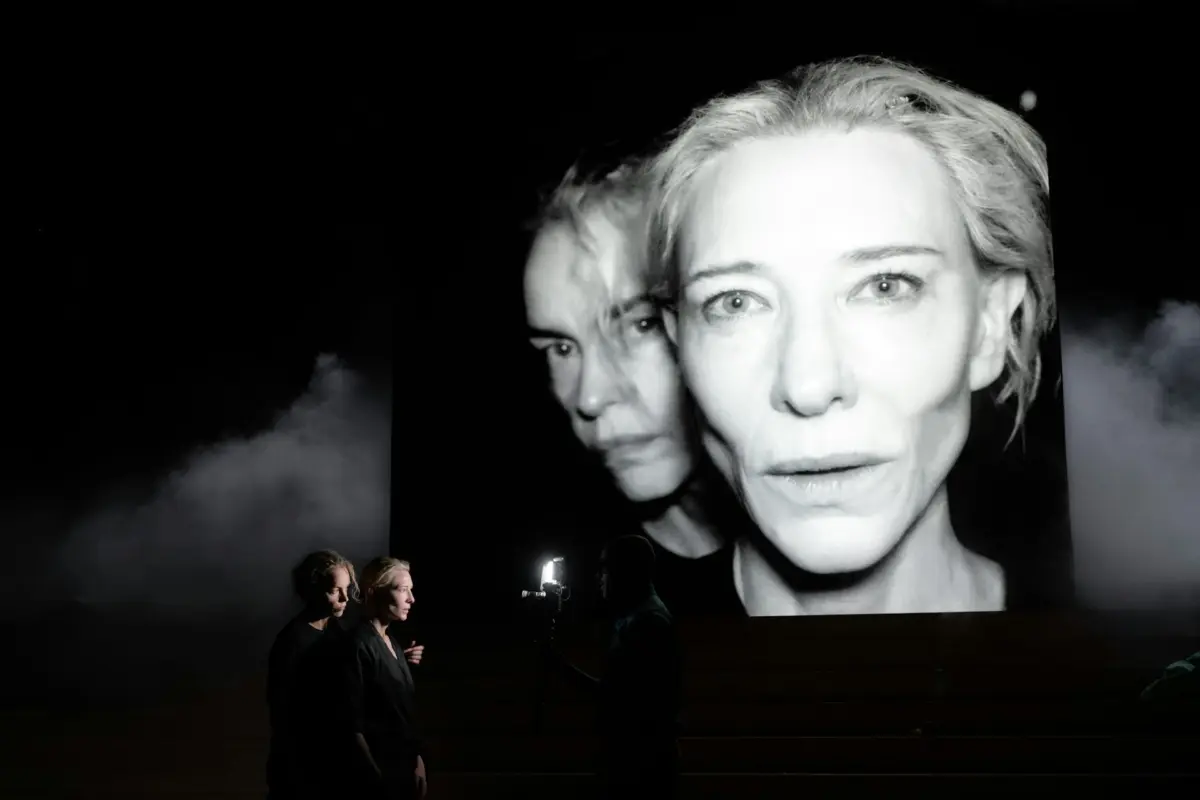
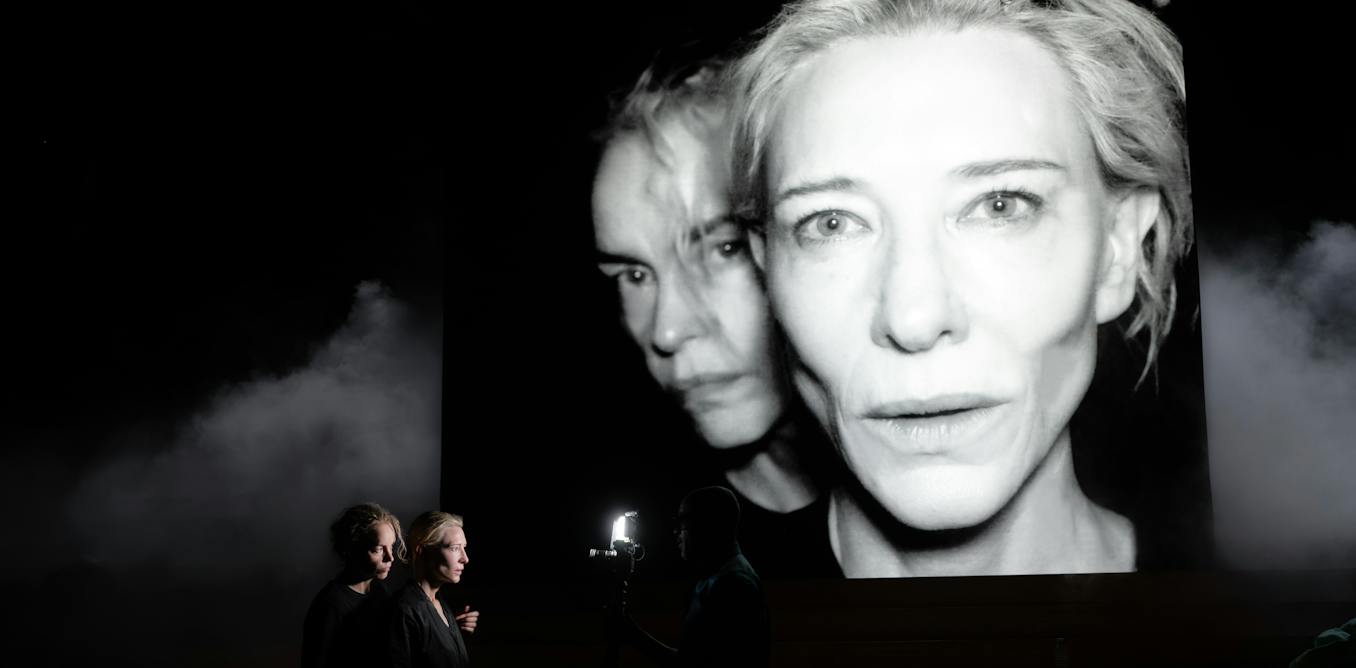
Electra/Persona exploits this dichotomy with breathtaking ingenuity. During the second half, as Blanchett’s Elisabeth remains entirely non-verbal, a massive projection screen descends into the center of the stage. This screen broadcasts a live-feed video generated by a camera that Blanchett carries with her across the set.
Thus, the audience watches Hoss’s Alma on stage, delivering torrents of dialogue with theatrical urgency, while concurrently viewing Blanchett’s silent face magnified to cinematic proportions on the suspended screen. This technical framing asks piercing questions: Who is truly holding the power in this dynamic? Is the live theatrical body or the mediated filmic image more authentic? By fusing these two art forms, Andrews breaks down the proscenium barrier, demonstrating how the camera can capture the claustrophobia of modern alienation just as effectively as classical verse can articulate ancient doom.
Set Architecture as a Mirror of the Audience
Designed by visionary set architect Magda Willi, the physical environment of the Lyttelton Theatre is engineered to implicate the viewer directly in the drama.
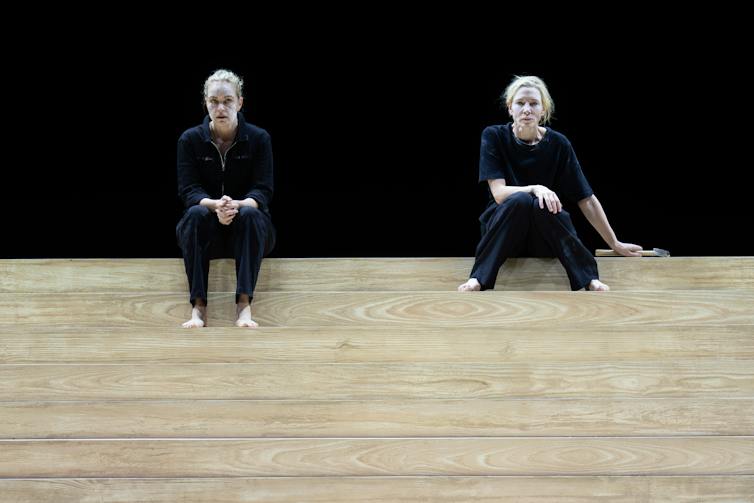
Dominating the edge of the stage is a monolithic, 23-step staircase crafted from bleached wood. Running from stage left to stage right, it climbs almost to the apex of the proscenium arch. This monumental architectural feature deliberately evokes the steep, tiered seating of an ancient Greek amphitheater.
Furthermore, Willi’s design plays on reflections and inversions. When the massive screen descends during the transition to Persona, it initially projects a live-feed video of the audience itself. The spectators seated in the Lyttelton Theatre suddenly find themselves staring not just at the actors, but at a mirror image of their own collective body. In classical Athens, tragedies were rarely performed in isolation; they were part of tetralogies accompanied by satyr plays, designed to provoke communal reflection. Electra/Persona taps into this ancient lineage, turning the theatre into a hall of mirrors where the audience is forced to confront its own voyeuristic impulses.
Official Statements and Critical Reception
The production has garnered widespread critical acclaim from theatrical scholars, drama critics, and audiences alike, positioning it as a landmark event in the National Theatre’s programming calendar.
In academic circles, the production’s structural mechanics have been lauded as a masterclass in adaptation. Dr. Jonathan Vance, a prominent researcher in classical reception theory, noted in a recent journal publication:
"Andrews does not merely adapt texts; he fractures them to expose their underlying mechanics. By forcing Blanchett and Hoss to alternate roles via a public coin toss, the production strips away the comfortable illusion of fixed character identity. It transforms the stage into an arena of radical exposure, where the actor’s vulnerability becomes the primary text."
National Theatre representatives have emphasized the logistical and artistic rigor required to maintain the production’s dual nature. In a statement released ahead of the London premiere, the production team highlighted the unique stamina demanded of its two leading women:
"The interplay between Sophocles and Bergman requires an extraordinary balancing act of performance styles. Cate Blanchett and Nina Hoss are not simply performing roles; they are engaging in a high-wire artistic dialogue across millennia, shifting effortlessly from the heights of mythic poetry to the quiet, devastating silences of modern psychological breakdown."
Critics reviewing the Lyttelton Theatre run have been equally effusive, praising the seamless integration of live cinematography with classical staging. Reviewers have singled out the coin toss as a stroke of theatrical genius that injects a palpable, dangerous energy into the room, ensuring that no two performances are ever identical.
Future Outlook: The Legacy of Electra/Persona
As Electra/Persona heads toward the final weeks of its London run at the Lyttelton Theatre, industry insiders and cultural analysts are already speculating on the production’s future trajectory. Given the immense star power of its leads and the ground-breaking nature of its directorial vision, international transfers to major cultural capitals in New York, Berlin, and Sydney are widely anticipated.
Beyond its commercial prospects, Electra/Persona has established a vital new benchmark for how classical texts can be meaningfully interrogated through modern lenses. By placing Sophocles in direct conversation with Ingmar Bergman—and by utilizing live-feed video not as a cheap technological gimmick, but as an essential philosophical tool—Benedict Andrews has expanded the lexicon of contemporary staging.
The production proves that theatre remains uniquely capable of holding contradictory ideas in suspension. It demonstrates that the ancient Greek obsession with fate, bloodlust, and divine retribution is not so distant from the modern anxiety of psychological fragmentation, surveillance, and identity theft.
For the audiences fortunate enough to witness the coin toss, the white face paint, and the haunting interplay between stage and screen, Electra/Persona is more than a play—it is an unforgettable theatrical ritual that lingers long after the house lights return.
Electra/Persona plays at the Lyttelton Theatre, London, through October 10.