Executive Overview
For decades, the standard entry point into multi-channel mixing has been financially prohibitive for bedroom producers, aspiring club residents, and budget-conscious vinyl enthusiasts alike. Stepping up from a standard two-channel setup to a four-channel configuration typically requires a significant financial investment, often starting north of £600 and quickly climbing past £1,000 for industry-standard mainstays like the Pioneer DJ DJM-750mk2 or Allen & Heath Xone series. This cost barrier has long forced DJs to compromise—either limiting their creative workflow, giving up the ability to permanently hook up external hardware and turntables, or settling for sub-par gear.
Enter German manufacturer Omnitronic, a brand that has steadily built a reputation for delivering accessible, reliable studio and DJ hardware, particularly through its well-received TRM series of rotary and fader mixers. With the release of the Omnitronic PM-404F, the company targets this exact market gap, offering a fully featured, compact four-channel fader mixer for a street price of just £225.
Featuring robust build characteristics, per-channel bipolar filters, comprehensive connectivity—including built-in Bluetooth integration—and a remarkably compact footprint, the PM-404F promises high-end versatility at a fraction of the cost. However, compromises had to be made to hit this aggressive price point. This deep-dive investigative review explores the hardware’s design, input/output capabilities, acoustic performance in both home and club environments, and its ultimate viability in a crowded market landscape featuring seasoned competitors like Behringer and Reloop.
Detailed Chronology & Product Evolution
To understand the positioning of the PM-404F, one must look at Omnitronic’s trajectory within the budget DJ hardware sector. Over the past several years, the German audio brand has carved out a distinct niche by refusing to abandon traditional fader and rotary analogue workflows while major brands pivot heavily toward digital integration, HID controllers, and software-heavy ecosystems.

The Budget Predecessors
- The TRM Series: Omnitronic’s rotary mixers (such as the TRM-202 and TRM-422) captured the attention of audiophiles and underground selectors seeking the warm, isolating sound of classic rotary mixing without paying boutique prices.
- The PM-422P: Omnitronic’s previous-generation four-channel fader mixer, the PM-422P, served a similar demographic. While it featured a more versatile three-band EQ, it notoriously lacked onboard per-channel filters, leaving modern techno and house DJs wanting more dynamic transition tools.
The Development of the PM-404F
Realizing that contemporary DJs demand tactile effects like filters alongside multi-channel mixing capabilities, Omnitronic engineered the PM-404F to bridge this functional gap. By retaining a streamlined chassis size, updating the internal preamps, integrating Bluetooth functionality for modern consumer crossover, and adding individual bipolar filters to all four channels, the brand created a modern hybrid unit. The hardware made its way onto testing benches and into underground club booths—such as South London’s renowned AAJA sound system—to evaluate how a sub-£250 four-channel mixer performs under heavy, professional loads.
Design, Build Quality, and I/O Architecture
Exterior Chassis and Ergonomics
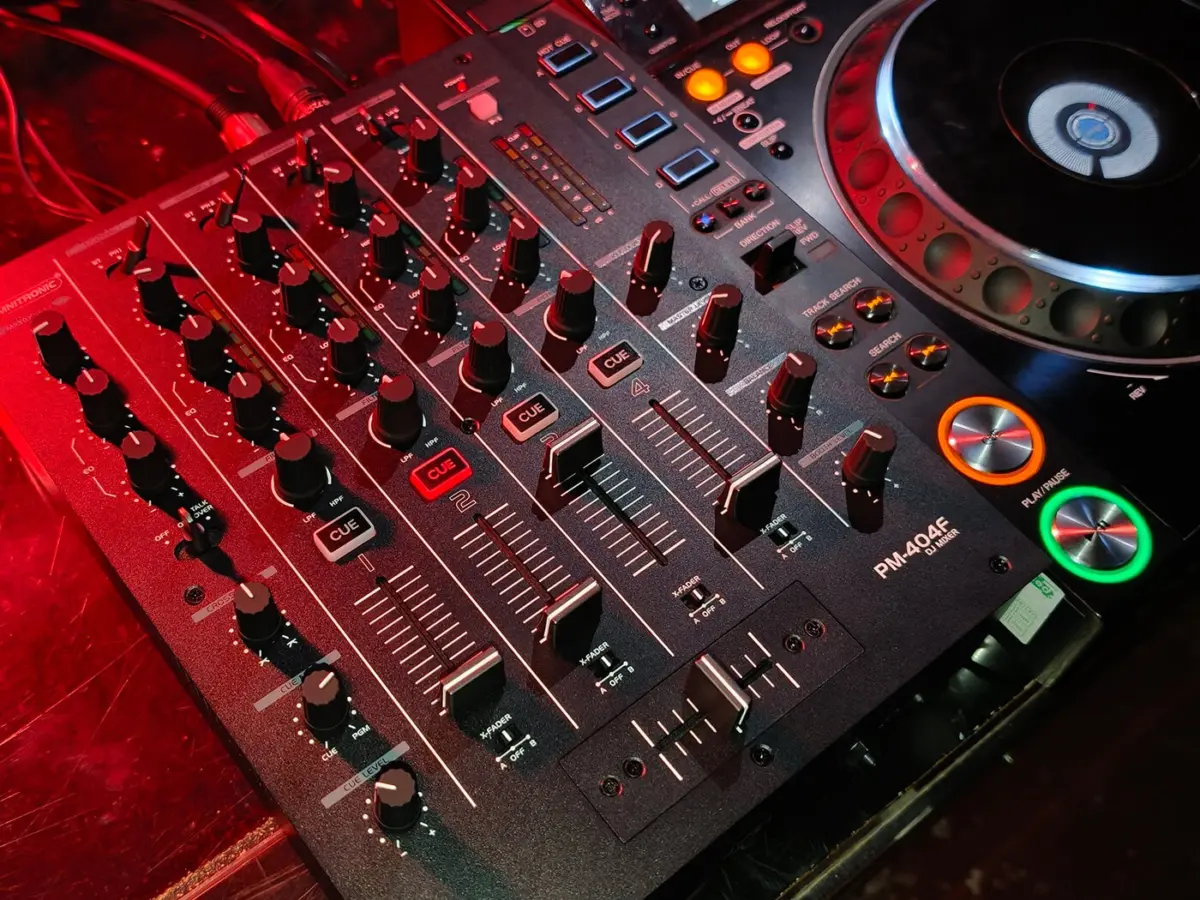
True to its German design heritage, the Omnitronic PM-404F presents a sleek, professional, all-black aesthetic. What immediately strikes any engineer or DJ handling the unit is its remarkably compact footprint. The mixer is only 12 percent larger than the Pioneer DJ DJM-250mk2—a strictly two-channel device. Weighing in at a modest 2.85 kg, the PM-404F feels like a tank thanks to its robust, all-metal chassis, making it an attractive proposition for mobile DJs and promoters needing a reliable backup unit that can easily fit into a backpack.
While the core housing inspires confidence, concessions are naturally visible in the control caps. The fader caps and chic paddle switches are molded from plastic, though the underlying fader stems themselves are constructed from sturdy metal.
Special mention must be given to the removable crossfader. While it may not match the boutique feel of a custom optical Innofader, its inclusion at this price point is a luxury. Featuring an adjustable curve, a reverse switch, and an impressively tight cut-in distance, it handles quick cuts and blends with ease.

However, not all tactile elements hit the mark. The cue buttons, manufactured from a tacky rubber compound, exhibit noticeable wobble around their central points of contact, slightly undermining the otherwise tight tactile feedback of the top panel.
Comprehensive Input and Output Roster
Where the PM-404F truly excels is its extensive I/O layout, ensuring users will rarely find themselves searching for adapter cables, whether setting up a complex home studio or plugging into a club booth.
- Outputs: The unit features both Master and Booth outputs delivered via balanced XLR and RCA connections. (Note: The industry-standard 6.3mm TRS jacks for booth outputs are notably absent, though balanced XLRs more than compensate for clean signal transmission).
- Headphones & Mic: The front panel houses dual headphone outputs (both 6.3mm and 3.5mm jacks) alongside a dedicated XLR dynamic microphone input.
- Main Channels: The channel strip consists of two dedicated line/phono channels and two alternating line/line channels.
- Bluetooth Integration: Setting itself apart from traditional analog competitors, all four channels feature the option to route the built-in Bluetooth receiver as an audio source. This inclusion is a major win for everyday home listening, impromptu requests, and streaming backing tracks on the fly.
Sound Quality, Preamps, and Frequency Sculpting
Headroom and Output Gain
One of the most surprising characteristics discovered during acoustic testing is the sheer output volume of the PM-404F’s line inputs. With the master volume and studio monitors set to a neutral 12 o’clock position, the mixer outputs a hotter signal than virtually any comparable entry-level mixer or digital controller on the market.
Taking the mixer out of the studio and into a real-world stress test on the main sound system at South London’s AAJA nightclub revealed the genuine benefits of this architecture. The high line-level volume and generous headroom pay massive dividends on a properly driven, high-SPL club system. The sound profile leans slightly flat, but tracks sum cleanly together. While the low-end lacks the aggressive sub-bass punch and transient attack found on high-end boutique mixers, the PM-404F punches well above its weight class for smaller venues and mobile setups.

The Phono Preamp Bottleneck
Conversely, vinyl purists will encounter a frustrating limitation: the two phono inputs are significantly quieter than their line counterparts. Compounding this issue, these phono preamps are hardwired exclusively to channels one and two. Consequently, DJs spinning exclusively with two turntables are permanently locked into the leftmost channels, restricting workflow flexibility.
EQ and Bipolar Filters
Frequency management on the PM-404F relies on a two-band EQ configuration—similar to Omnitronic’s TRM-202 rotary mixer, but lacking its cousin’s warm three-band isolators.
- The Low EQ: Uniquely aggressive, the low-frequency pot is one of the greediest found on a modern DJ mixer. Cranking it to full reduction strips away virtually all of the bass and a substantial portion of the lower-mid range.
- The High EQ: Conversely, the high-frequency control performs admirably, imparting a crisp, clean sheen onto vintage percussion and older vinyl pressings.
While a two-band EQ requires an adjustment period for DJs accustomed to surgical three-band frequency chopping, the inclusion of per-channel bipolar filters completely transforms the mixing dynamic. Operating more as an creative effect than a precision sculpting tool, these filters feature a fixed resonance that injects a noticeable boost into the signal. They allow for smooth, dramatic transitions and energetic drops, adding immense creative value to a sub-£250 unit.
Market Positioning and Comparative Analysis
To contextualize the Omnitronic PM-404F within the broader hardware ecosystem, one must analyze its pricing structure against competing manufacturers:

| Manufacturer & Model | Channel Count | Approx. Retail Price (£) | Notable Features / Trade-offs |
|---|---|---|---|
| Omnitronic PM-404F | 4 Channels | £225 | Bluetooth, per-channel filters, XLR outputs, weak phono preamps, 2-band EQ. |
| Behringer DJX900USB | 4 Channels | < £200 | Built-in FX suite, USB audio interface; often criticized for build durability. |
| Reloop RMX44BT | 4 Channels | £270 | 3-band EQ, per-channel filters, Bluetooth connectivity; robust mid-tier build. |
| Allen & Heath Xone:43 | 4 Channels | £590 | Legendary analogue filters, superior 3-band total kill EQ, premium routing. |
| Pioneer DJ DJM-750mk2 | 4 Channels | £1,099 | Industry-standard club mixer, Rekordbox hardware unlock, pro-grade FX. |
When evaluated against its direct peers, the PM-404F occupies an interesting gray area. For users whose primary priority is maximizing channel count for the absolute minimum financial outlay, Omnitronic delivers an unbeatable hardware value proposition. However, for aspiring DJs looking to master club-standard workflows, the absence of a 3-band EQ and the limitations of the phono preamps mean competitors like the Reloop RMX44BT may offer a more complete learning platform for a marginally higher investment.
Future Outlook
The launch of the Omnitronic PM-404F highlights a broader, ongoing shift in the DJ hardware market: manufacturers are relentlessly racing to democratize features once restricted to flagship club installations—such as independent booth outputs, balanced XLR connections, and tactile filters—and pack them into ultra-budget footprints.
As digital streaming and hardware-agnostic mixing continue to dominate bedroom setups, the inclusion of wireless protocols like Bluetooth in traditional analog fader mixers signals a new design philosophy. Audio hardware is increasingly expected to serve dual purposes: functioning as a serious mixing tool for underground selectors late at night, and doubling as a flexible home-audio hub during the day.
While the PM-404F is not without its operational quirks—specifically regarding its phono preamp sensitivity and two-band EQ constraints—it establishes a compelling benchmark for what sub-£250 engineering can achieve. For digital DJs, hardware tinkerers, and hybrid setup architects who need four independent channels without breaking the bank, Omnitronic’s latest offering is a bold, disruptive statement piece that forces major manufacturers to reconsider the true cost of multi-channel mixing.