Executive Overview
Hot on the heels of the feature-rich, ecosystem-expanding 5.0 software update—which gifted producers the highly coveted capability to import bespoke samples and wavetables—Arturia is doubling down on its flagship hybrid synthesizer line. Enter the MiniFreak 49, a larger, performance-optimized evolution of the critically acclaimed 37-key original.
Designed to bridge the gap between compact desktop sound design and expressive, traditional keyboard performance, the MiniFreak 49 upgrades nearly every physical interaction point without sacrificing the delightfully chaotic, cutting-edge sound engine that made its predecessor a modern staple in electronic music studios.
Priced at €799, the MiniFreak 49 expands the physical layout with 49 velocity-sensitive, semi-weighted keys featuring mono aftertouch, an all-new XYZ touch control matrix, expanded panel controls, and a larger, more informative OLED display. Beneath the hood, it retains the powerful six-voice polyphonic, dual-engine architecture, over 30 versatile oscillator modes, and resonant analog filters that define the "Freak" ethos. Whether you are crafting delicate ambient pads, crushing industrial basslines, or sequencing polyrhythmic electronica, this new hardware iteration is engineered to place tactile control at the absolute center of your creative workflow.
Detailed Chronology & Hardware Evolution
To understand the significance of the MiniFreak 49, one must trace the lineage of Arturia’s experimental hardware division. The journey began with the MicroFreak, an unconventional PCB-keyboard synthesizer that proved avant-garde sound design could be democratized for the masses. Its unique blend of digital oscillator algorithms—co-developed with software legends like Mutable Instruments and Noise Engineering—paired with an analog filter captured the imagination of bedroom producers and high-end film composers alike.
When Arturia introduced the original MiniFreak with 37 keys, it addressed calls for polyphony, introducing a six-voice architecture, stereo processing, and a more robust hardware housing. However, many traditional keyboardists and live performers felt restricted by the 37-note keybed, desiring a larger canvas to execute complex chord voicings and dynamic two-handed playing.
The introduction of the Firmware 5.0 update earlier in the cycle proved that the MiniFreak ecosystem was maturing, adding user sample and wavetable import capabilities that transformed the synth from an algorithmic generator into an open-ended sampler hybrid.

Now, with the release of the MiniFreak 49, Arturia has synthesized these software advancements into an enlarged, performance-first hardware chassis. The timeline of the "Freak" series demonstrates a deliberate, listener- and user-responsive evolution:
- Phase 1 (MicroFreak): Introduction of algorithmic synthesis and the capacitive touch keyboard.
- Phase 2 (MiniFreak 37): Scaling up to 6-voice polyphony, stereo operation, and integrated digital effects.
- Phase 3 (Firmware 5.0): Deepening sonic capabilities via user wavetable and sample import mechanics.
- Phase 4 (MiniFreak 49): Perfecting the hardware interface with a 49-note semi-weighted keybed, XYZ touch matrix, and enhanced visual feedback systems.
Supporting Context, Architecture, and Technical Metrics
While the most immediate change is physical, the MiniFreak 49’s technical specifications remain an absolute powerhouse for sound design and live performance.
Sound Engine & Oscillators
At the heart of the MiniFreak 49 is a dual-engine architecture. Each of its six voices can utilize two sound engines simultaneously, which can be processed independently or combined. The synth features over 30 distinct oscillator modes, drawing from Arturia’s proprietary algorithms alongside powerhouse contributions from Mutable Instruments and Noise Engineering.
Users can blend these modes together or feed them directly into a resonant analog filter per voice. Furthermore, the unit features Audio-rate Filter Frequency Modulation, allowing producers to push the analog filters into audio-rate self-oscillation and aggressive, metallic frequency modulation territories. Dedicated Type, Wave, Timbre, and Shape controls, alongside three rapid selection shortcuts per oscillator, ensure that deep timbral shifts are always just a twist away.
Control Surfaces & The XYZ Touch Matrix
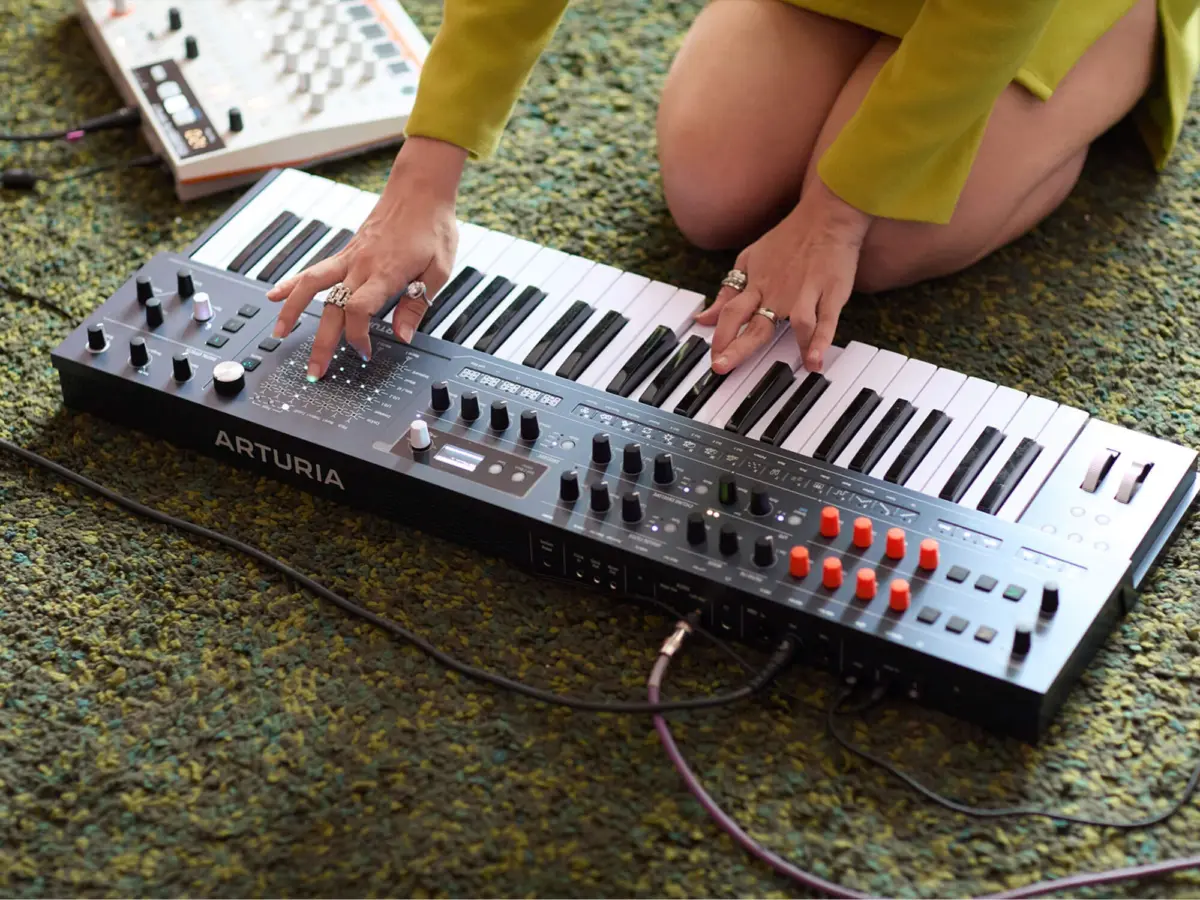
The physical standout of the 49-key variant is the all-new XYZ touch control matrix. Moving beyond standard modulation assignment, this multi-dimensional touch pad can be used for live performance expression, complex modulation routing, and patch navigation. Notably, it doubles as a visualizer interface, displaying reactive graphics that respond dynamically to the user’s playing style in real time.
The keyboard itself has received a major professional upgrade: 49 full-size, velocity-sensitive semi-weighted keys with mono aftertouch. This offers a much more natural resistance and expressive response than the slim keys of the original model. Traditional expression is further rounded out by physical aluminum pitch and modulation wheels positioned thoughtfully on the left flank of the unit. Due to the expanded physical footprint, Arturia has also integrated a larger OLED screen, reducing menu diving and providing clearer visual feedback for parameters, envelopes, and patch names.

Effects, Sequencing, and Preset Management
Sonic sculpting is completed by an onboard effects section featuring three dedicated FX slots, each equipped with its own access button and 13 algorithms. The arsenal covers everything from lush choruses, shymmer reverbs, and analog delays to saturation, distortion, and full vocoder processing.
For composition and live generative sequencing, the MiniFreak 49 features an advanced 64-step sequencer complete with four modulation lanes and a flexible arpeggiator. Out of the box, the unit ships loaded with 350 factory presets, alongside 162 user slots for storing custom sound creations.
As an invaluable bridge between hardware and software production, Arturia bundles a copy of the MiniFreak V software synthesizer with every unit. This allows producers to mirror the exact hardware architecture and patch state directly inside their DAW of choice, ensuring seamless project portability between the studio and the live stage.
Official Statements and Design Philosophy
Arturia’s engineering and product design teams have framed the MiniFreak 49 not merely as an upsizing exercise, but as a holistic refinement of the instrument’s personality.
"MiniFreak 49 puts the familiar and the unruly within reach, from rich polyphonic textures to fractured rhythms and abrasive harmonics," states Arturia in their official launch communications. "Play a chord, reach for a control, press into the matrix. Playing a patch is only the beginning."
This philosophy underscores the brand’s commitment to "happy accidents" in electronic music production. By keeping the interface immediate—avoiding the labyrinthine menu structures common in modern workstations—Arturia ensures that the physical act of playing remains intrinsically linked to sound manipulation. The integration of the XYZ touch matrix and physical aluminum wheels speaks directly to feedback from live performers who demanded an instrument that could breathe and mutate dynamically beneath their fingers.

Future Outlook: The Sonic Landscape Ahead
The release of the MiniFreak 49 at a price point of €799 strategically positions Arturia in a highly competitive bracket previously dominated by workstation heavyweights and mid-tier polysynths. However, by retaining the chaotic, experimental DNA of its boutique digital origins while adopting the professional trappings of a 49-key semi-weighted layout, the MiniFreak 49 carves out a completely unique niche.
Looking forward, the convergence of deep hardware integration (via the MiniFreak V plugin) and expansive firmware support (such as the recent 5.0 wavetable and sample updates) signals a new era for hybrid synthesizers. Consumers are no longer forced to choose between the tactile immediacy of hardware and the recall convenience of software; they can have both, housed inside an instrument that actively encourages sonic exploration.
As electronic music producers continually seek ways to stand out in a saturated sonic landscape, instruments that embrace both pristine fidelity and "abrasive harmonics" will reign supreme. With the MiniFreak 49, Arturia has proven that they understand this balance intimately—delivering a comprehensive, expressive, and wildly inspiring instrument ready to anchor the studios and stages of tomorrow.