Executive Overview
Korg’s fascination with downsized, highly portable audio hardware has been a defining characteristic of modern electronic music production. From the chaotic charm of the Monotron series and the tactile workflow of the Volca lineup to the DIY ethos of the Nu:Tekt range, the Japanese manufacturer has repeatedly proven that sonic inspiration does not require massive studio real estate. With the introduction of the Nu:Tekt NTS-4, Korg has applied this pocket-sized, hands-on philosophy to a utilitarian studio staple that is rarely associated with fun: the audio mixer.
Priced at £199, the NTS-4 immediately invites scrutiny. In an era where basic audio summing can be achieved for a fraction of that cost using budget-tier line mixers, a £199 price tag for a mini-jack-based summing device seems steep. However, the NTS-4 is far more than a simple junction box. Equipped with onboard multi-effects, flexible cue monitoring, and class-compliant USB audio and MIDI integration, it positions itself not merely as a utility tool, but as the potential heart of a minimal, DAWless hardware setup.
This review explores the build process, ergonomic layout, connectivity limits, routing idiosyncrasies, and onboard sound manipulation capabilities of the Korg NTS-4, analyzing whether its creative charm justifies its premium price point.
Detailed Chronology: From Raw Materials to the Live Rig
Phase 1: The DIY Build Experience
True to the Nu:Tekt lineage, the NTS-4 arrives as a flat-packed kit, requiring preliminary assembly by the user. While unboxing a pre-built piece of gear is efficient, there is a distinct psychological shift that occurs when assembling your own studio hardware.
The build process is remarkably straightforward, approachable, and genuinely engaging. Requiring roughly 20 minutes from start to finish, the construction phase relies on clear instructions and well-organized components. Beyond the ease of assembly, the act of putting the unit together fosters a sense of pride and ownership. This is not just a generic piece of gear pulled from a cardboard box; it is your NTS-4 mixer.

Phase 2: Physical Ergonomics and Chassis Design
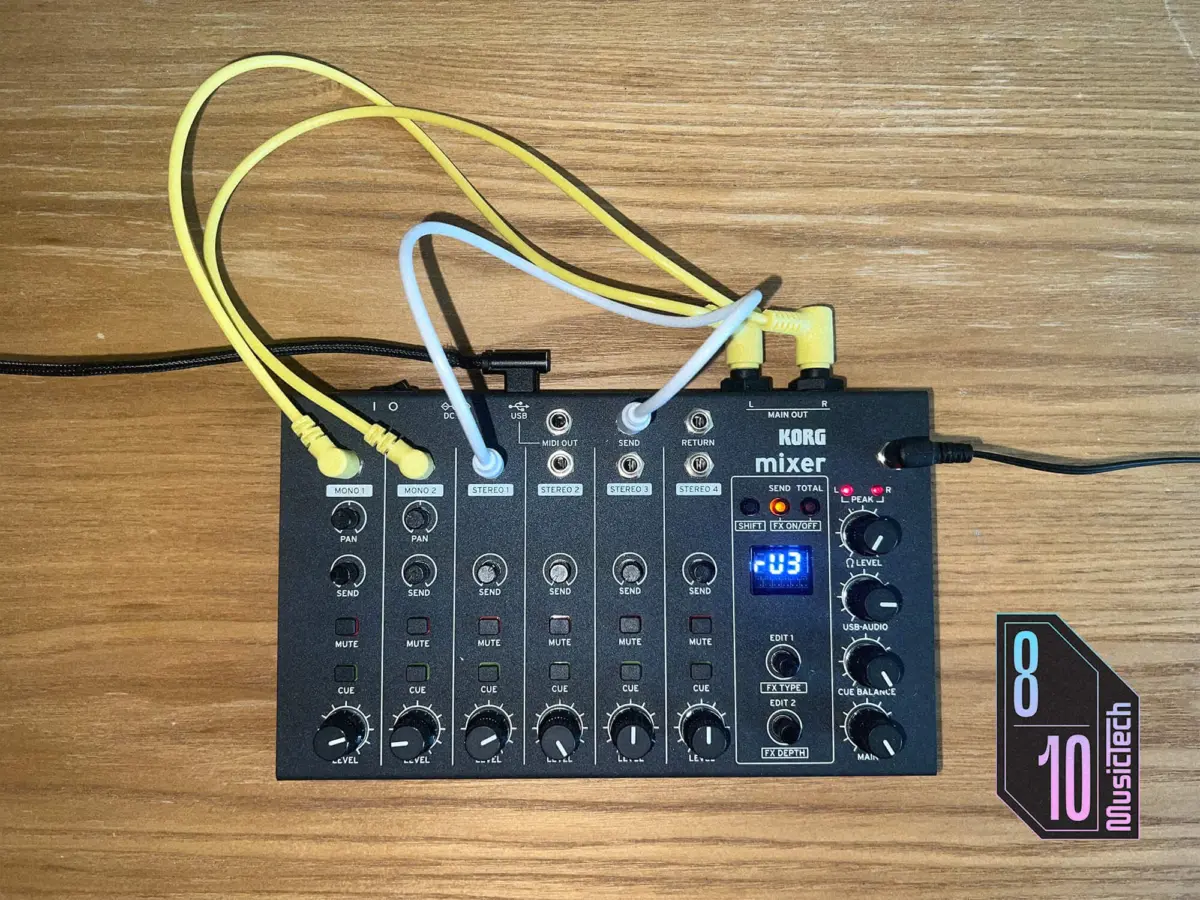
Once assembled, the NTS-4 dispels any lingering perception that Nu:Tekt gear is fragile or toy-like. Weighing in at a sturdy 613 grams and anchored by dependable rubberized feet, the mixer stays firmly planted on the studio desk or live performance table, refusing to slide around when cables are tugged or controls are aggressively adjusted.
The chassis is constructed from a visually striking matte gunmetal grey steel that exudes industrial durability—a significant step up from the more plasticky builds of earlier Nu:Tekt entries.
However, the physical layout presents a few ergonomic compromises. The large level potentiometers offer wonderful resistance, allowing for smooth, deliberate volume sweeps. Unfortunately, their tight physical proximity to one another means that users must exercise precision to avoid accidentally brushing an adjacent channel while performing quick adjustments. One might argue that Korg should have utilized the smaller Pan and Send knob design across the entire faceplate; while equally accurate, their smaller footprints prevent finger-crowding on a densely packed surface. Additionally, the 3.5mm minijack sockets exhibit a slight degree of lateral play, reminding the user of the device’s ultra-compact scale.
Phase 3: Integration into the Minimal Setup
Historically, Korg’s attempts at miniature mixing—such as the four-channel Volca Mix—offered mixed results, often proving too restrictive for anything beyond the most basic multi-instrument rigs. The NTS-4 expands these horizons considerably, featuring two mono channels and four stereo channel strips capable of summing up to 10 distinct audio signals simultaneously.
Because it relies entirely on 3.5mm minijacks, the NTS-4 is clearly tailored for the growing ecosystem of compact hardware: Teenage Engineering Pocket Operators and EP-133 modules, Eurorack modular systems, and Korg’s own Volca and Nu:Tekt instruments. For producers whose workspaces are dominated by gear with headphone outputs, integration is seamless. With the appropriate adapters, even electric guitars and line-level synthesizers can find a home within its architecture.

Supporting Context & Metrics: Inputs, Outputs, and Architecture
To fully understand the value proposition of the Korg NTS-4, it is necessary to examine its structural capabilities, signal flow limitations, and how it measures up against competitors in the broader hardware market.
Connectivity and Routing Specifications
- Channel Configuration: 2 Mono channels, 4 Stereo channels (supporting up to 10 total audio inputs).
- Physical Connections: 3.5mm (1/8-inch) TRS minijacks for inputs, outputs, sends, and returns.
- USB Functionality: Class-compliant USB audio and MIDI interface, enabling direct connection to computers, mobile devices, and standalone samplers (such as the Akai MPC series) without proprietary drivers.
- Power Supply: USB bus-powered or via external mobile power solutions.
The USB Recording Compromise
One of the NTS-4’s strongest selling points is its class-compliant USB audio interface functionality, which makes capturing DAWless jams remarkably straightforward. Performers can stream their entire live mix directly into a laptop, tablet, or portable recorder on the fly.
However, a notable limitation dictates its studio utility: the NTS-4 can only stream or record the fully summed stereo master mix, rather than outputting individual channels as multitrack stems. While this limitation aligns with traditional live mixing workflows, multitrack USB routing would have elevated the NTS-4 into an indispensable hybrid studio hub. As it stands, it functions best as a performance capture tool rather than a tracking front-end.
Market Comparison Matrix
| Feature / Model | Korg Nu:Tekt NTS-4 | Behringer MX400 | Behringer Xenyx 802S |
|---|---|---|---|
| Approximate Price | £199 | £13 | £65 |
| Input Channels | Up to 10 (2 Mono, 4 Stereo) | 4 Mono (Line-level) | 8 Inputs (Stereo/Mono channels) |
| Form Factor | Compact DIY kit, Metal Chassis | Tiny plastic box | Traditional desktop mixer |
| Onboard Effects | 17 multi-effects (Sends & Master) | None | None |
| USB Audio Interface | Yes (Class-compliant stereo) | No | Yes (Multi-channel streaming) |
| Cue / Monitoring | Dedicated Cue per channel | None | Basic monitoring |
As the comparison demonstrates, budget-oriented utility mixers from manufacturers like Behringer offer basic audio summing at a fraction of the cost. Yet, those alternatives are designed exclusively to solve routing problems in an uninspiring manner. The NTS-4, conversely, is explicitly engineered to be played.
Official Insights & Operational Performance
Audio Fidelity and Gain Staging
Operating the NTS-4 reveals a remarkably quiet noise floor. Even when empty channels are cranked to maximum volume, unwanted hiss is kept to an absolute minimum, and engaging the physical Mute or Cue buttons yields zero audible clicks or pops.

However, achieving proper gain staging requires discipline. The NTS-4 completely lacks physical input gain trim pots on its channels; users are provided solely with individual channel output levels and a Master volume control. Furthermore, peak level indicators are reserved exclusively for the Main Output. Consequently, producers must carefully balance levels directly at the source instruments to prevent input clipping, relying on careful monitoring rather than visual metering per channel.
Monitoring and the Cue Workflow
For live performance and studio jamming, the inclusion of dedicated Mute and Cue buttons on every channel is a massive ergonomic win. The Cue function allows operators to route any selected signal directly to the headphone output, auditioning patterns, synth lines, or transitions in isolation before introducing them to the Main Out mix.
The inclusion of stereo send and return sockets opens the door for external effects integration. Interestingly, each channel’s Send control simultaneously feeds the physical send output and the internal DSP effect engine, meaning external and internal sends cannot be independently adjusted.
This routing quirk can lead to creative accidents. For instance, routing a channel through the Cue output into an external guitar pedal and back into a stereo input can inadvertently spark a feedback loop. Rather than a design flaw, this characteristic introduces adventurous sound designers to a classic underground technique: No-Input Mixing Board (NIMB) experimentation. By routing the NTS-4’s Main Output directly back into its own inputs, users can generate chaotic, abrasive, and highly malleable feedback loops that can be sculpted dynamically via panning, leveling, and onboard effects.
The Onboard FX Engine
Korg has packed 17 distinct effects into the NTS-4, designed either to add subtle spatial depth to individual instruments or to radically transform a complete stereo mix.

The effects are divided into two distinct operational groups:
- Send-Fed Effects: Delays, reverbs, and choruses fed by individual channel Send controls. At conservative levels, they impart a clean, polished studio sheen. Pushed to extremes, they introduce atmospheric degradation and space, though caution is required to avoid output clipping.
- Master Stereo Effects: Applied to the final summed mix. Notable inclusions encompass a crunchy Decimator for dirtying up drum busses and responsive resonant filters that offer plenty of bite for dramatic frequency sweeps during DJ-style transitions.
The primary operational hurdle regarding the FX engine lies in its physical interface. Editing parameters requires interacting with tiny, closely spaced buttons. Engaging an effect necessitates holding a "Shift" key combination, a two-finger operation that can prove frustratingly fiddly when attempting rapid adjustments in the heat of a live performance. Furthermore, unlike the NTS-1 and NTS-3—which support custom, user-loaded effects via Korg’s Logue SDK and Librarian software—the NTS-4 does not currently feature user effect expandability, representing a missed opportunity for deep platform longevity.
Future Outlook & Verdict
Who Is the Korg NTS-4 For?
Before investing in any hardware mixer, musicians must confront two fundamental questions: “How many hardware devices do I need to connect today, and is that collection likely to expand tomorrow?”
The Korg NTS-4 provides ample inputs for a tidy, mobile hardware collection, but its fixed minijack infrastructure, lack of multitrack USB recording, and limited master routing mean it will quickly outgrow complex studio environments. At £199, it is undeniably an expensive proposition for basic signal summing.
Final Assessment
The Korg NTS-4 occupies a fascinating, highly specialized niche. Its limitations—specifically the absence of input gain controls, per-channel EQ, and multitrack USB streaming—prevent it from earning an unconditional recommendation as an all-purpose studio console.

Yet, to evaluate the NTS-4 purely on technical specifications is to miss the point entirely. Korg has engineered a utility device that captures the playful spirit of the instruments plugged into it. It transforms the mundane chore of audio mixing into a tactile, exploratory performance art. For minimal hardware jammers, DAWless mobile producers, and sound designers seeking a pocket-sized creative sandbox, the NTS-4 justifies its existence—and redefines what a mini-mixer can be.