Executive Overview
In the rapidly evolving landscape of desktop music production, the intersection of uncompromising analog warmth and high-resolution digital workflow has long been the holy grail for modern creators. Enter the Harrison Audio Flex-10, a formidable 10-in/12-out USB-C audio interface designed to distill the legendary heritage of Harrison’s iconic studio consoles into a sleek, highly portable footprint.
Engineered for minimalist studio setups, on-the-go mobile tracking, and project studios alike, the Flex-10 challenges the notion that mobile interfaces must sacrifice sonic integrity for convenience. Boasting pristine 32-bit/192 kHz conversion, tactile hands-on controls derived directly from the acclaimed Harrison 32Classic desk, and integrated H-DRIVE real transformer saturation, this desktop powerhouse bridges the gap between vintage analog workflow and modern digital flexibility.
Furthermore, Harrison Audio has ensured that the hardware is supported right out of the box by a comprehensive software bundle. Every unit ships with a full license for Harrison Mixbus 12 and the extensive "Creator Pack," featuring virtual instruments, loops, and processing plug-ins from industry heavyweights such as Solid State Logic (SSL), Native Instruments, and IK Multimedia. As the lines between bedroom production and professional tracking continue to blur, the Flex-10 emerges as a defining piece of hardware for producers looking to level up their sonic palette without chaining themselves to a massive control surface.
Detailed Chronology: The Evolution of Harrison Desktop Audio
Tracing the DNA of the 32Classic to the Desktop
To truly understand the significance of the Flex-10, one must look back at the developmental lineage that Harrison Audio has cultivated over decades of console manufacturing. Renowned for outfitting some of the most legendary recording studios in history—facilities that tracked seminal albums by artists ranging from Michael Jackson to ABBA—Harrison has historically been associated with large-format, high-channel-count analog consoles.
The turning point for the brand’s modern era arrived with the release of the 32Classic, a console that re-imagined Harrison’s traditional circuit topologies for contemporary hybrid studios. The 32Classic won critical acclaim for its ability to marry the punch, headroom, and musicality of vintage analog design with modern routing and DAW integration.
However, as the commercial recording industry shifted toward mobile, project-based, and remote workflows, a significant portion of Harrison’s user base found themselves working outside of traditional control rooms. Producers, film scorers, and tracking musicians demanded the signature Harrison sound—characterized by open highs, punchy mid-range, and musical saturation—in a form factor that could fit into a backpack alongside a laptop.
The Conception and Engineering of the Flex-10
Development on the Flex-10 began as an engineering challenge: how to scale down the discrete preamp architecture, filtering systems, and tactile ergonomics of the 32Classic console into a desktop bus-powered (or adapter-powered) interface without compromising audio specs or build quality.
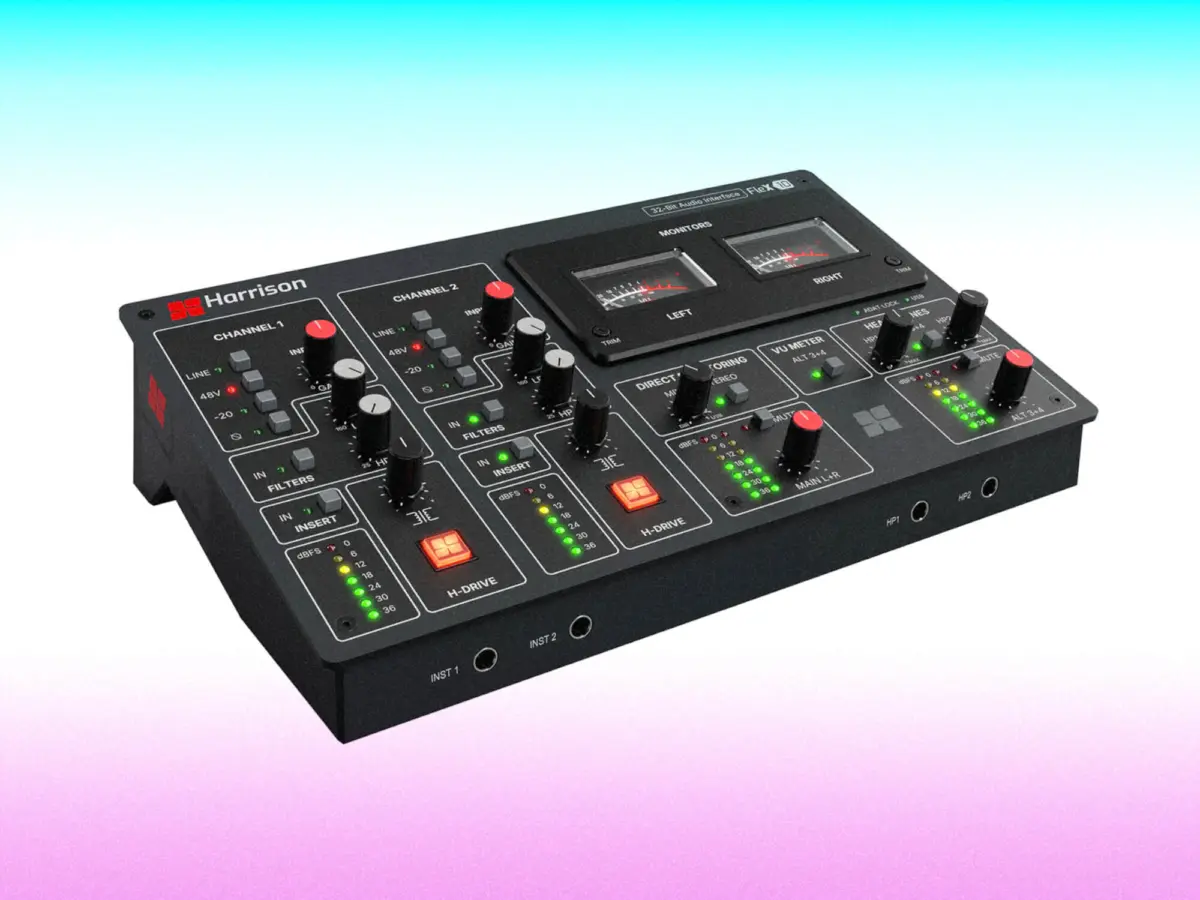
Engineers focused heavily on preserving the tactile user experience. Rather than burying controls inside deep software menus or crowding the front panel with confusing multi-function knobs, the Flex-10 maintains a dedicated, hands-on layout. Every filter engagement, gain staging choice, and monitoring adjustment can be executed via physical controls that feel reassuringly solid.
By integrating high-performance discrete mic preamps equipped with H-DRIVE real transformer saturation, the development team successfully captured the harmonic distortion characteristics that make vintage analog hardware so desirable. The integration of ADAT I/O further future-proofs the unit, allowing producers to scale their input counts as their mobile or home studio rigs expand. The culmination of this R&D cycle resulted in the official launch of the Flex-10, positioning Harrison Audio as a major contender in the high-end desktop audio interface market.
Supporting Context & Metrics: Hardware Architecture and Capabilities
Conversion, Clocks, and Connectivity
At the core of the Harrison Flex-10 lies an advanced digital conversion stage capable of operating at up to 32-bit/192 kHz resolution. This high bit-depth capability provides an expansive dynamic range, effectively eliminating digital clipping floors during intense tracking sessions and offering unmatched transient clarity during mixing and mastering stages.
The hardware operates on a flexible 10-in/12-out architecture, thoughtfully laid out to accommodate a wide variety of studio routing scenarios:

- Analog Inputs: Two high-performance front-facing channels featuring combo XLR/TRS inputs, complete with discrete mic preamps, dedicated line-level switching, 48V phantom power, -20 dB pad, and phase inversion.
- Digital Expansion: Eight channels of ADAT I/O, enabling users to hook up external multi-channel mic preamps (such as Harrison or SSL units) to expand their tracking capabilities for drums and live ensemble setups.
- Monitoring Solutions: Two independent pairs of monitor outputs with individual level controls, alongside dual headphone outputs designed to drive high-impedance professional monitoring cans without distortion or crosstalk.
- MIDI Integration: Dedicated 3.5mm TRS MIDI I/O ports, ensuring seamless integration with hardware synthesizers, drum machines, and external MIDI controllers without requiring bulky breakout hubs.
The Analog Front-End: H-DRIVE and Filtering
What truly sets the Flex-10 apart from standard USB-C audio interfaces in its price and size class is its analog front-end processing. The first two channels are heavily inspired by the channel strip architecture of the Harrison 32Classic console.
- H-DRIVE Transformer Saturation: Producers can push the input stage to introduce real transformer saturation, dialing in everything from subtle warmth and harmonic thickening to aggressive, edgy distortion for guitars, bass, and vocals.
- Variable High-Pass and Low-Pass Filters: Harrison is legendary for its sweeping analog filter designs. The Flex-10 includes onboard filtering capabilities to instantly clean up low-end mud or tame harsh high frequencies right at the source before the signal ever hits your DAW.
Software Ecosystem: The Creator Pack and Mixbus 12
Modern hardware cannot live by specs alone; it requires a robust software ecosystem to unlock its full creative potential. Recognizing this, Harrison Audio has partnered with industry giants to bundle an exceptional software suite with every Flex-10 unit.
Harrison Mixbus 12
Every purchase of the Flex-10 includes a full license for Harrison Mixbus 12, the company’s flagship digital audio workstation. Mixbus is celebrated for bringing a classic analog mixing console workflow directly to the computer screen. Featuring built-in EQ, compression, and bus routing modeled directly on Harrison’s legendary hardware desks, Mixbus 12 allows users to mix "in the box" with the intuitive feel and sonic cohesion of a physical console.
The Harrison Creator Pack
To ensure users can start making music the moment they unbox the interface, Harrison includes the Creator Pack. This curated collection of virtual instruments, loops, samples, and mixing plug-ins draws from the collective catalogs of top-tier audio developers, including:
- Solid State Logic (SSL): Bringing world-class console processing algorithms to your insert chains.
- Native Instruments: Supplying industry-standard virtual instruments and sound libraries to fuel melodic and rhythmic ideas.
- IK Multimedia: Providing versatile effects processors and modeling tools to round out your mixing chain.
This all-in-one approach transforms the Flex-10 from a simple audio converter into a complete, turnkey mobile production studio.
Official Statements and Industry Insights
In promotional materials and technical disclosures surrounding the launch, Harrison Audio representatives have emphasized the philosophy driving the Flex-10’s design.
"We wanted to build something that doesn’t just record audio accurately, but actively participates in the creative process," noted a lead product designer for Harrison Audio. "When producers use a Harrison console, they fall in love with the tactile nature of the EQ, the saturation of the preamps, and the immediate workflow. With the Flex-10, we’ve managed to pack that exact same musical DNA into a portable desktop unit that goes wherever your inspiration takes you."
Industry early-adopters and touring musicians have also weighed in on the unit’s practical applications. Guitarist and clinician Joe Coombs, discussing tone and mobile rigs, highlighted the importance of capturing great sound at the source: "When you’re out on the road or writing in a hotel room, you don’t want to compromise on your tone just because you’re using a mobile rig. Having tactile gain staging, true transformer saturation, and pristine conversion right there on your desktop changes how confidently you can track guitars and synths away from the main studio."
Future Outlook: The Rise of the Hybrid Mobile Studio
As remote collaboration, mobile recording, and hybrid studio setups become the dominant paradigm for modern music creators, the demand for compact, high-performance hardware will only accelerate. The Harrison Audio Flex-10 arrives at the vanguard of this movement.
By refusing to compromise on analog circuit quality while fully embracing high-resolution digital connectivity, Harrison Audio has set a new benchmark for what producers should expect from a desktop production tool. Whether serving as the centerpiece of a minimalist bedroom setup, acting as the primary interface for a mobile laptop rig, or expanding an existing studio via ADAT, the Flex-10 proves that legendary console sound can indeed fit in the palm of your hand.
For producers looking to elevate their tracking fidelity, inject genuine analog warmth into their workflow, and streamline their mobile production capabilities, the Harrison Audio Flex-10 represents a definitive, future-proof investment in their sonic future.