In the high-stakes, pressurized environment of the BBC’s Dragons’ Den, entrepreneurs typically walk away with either a lucrative investment deal or the harsh sting of rejection. However, for 38-year-old Peterborough-based street artist Nathan Murdoch, his appearance on the August 27 episode resulted in a uniquely hybrid outcome—one that redefined his trajectory as both a creative and a business owner.
Stepping into the Den with a striking, hand-painted red dragon and a formal request for £60,000 in exchange for a 10% stake in his enterprise, Street Arts Hire, Murdoch was hoping to secure the capital needed to transition from a solo creator to a structured commercial operation. While the panel of multi-millionaire investors ultimately declined to pump liquid cash into the venture, they were utterly mesmerized by his raw talent.
Rather than a standard rejection, Murdoch walked out of the studio with something potentially more valuable for his long-term growth: invaluable strategic mentorship and an immediate, high-profile commercial commission. Entrepreneur and investor Steven Bartlett was so captivated by Murdoch’s artistic dexterity that he offered him a coveted one-on-one strategy session alongside a lucrative job offer to paint the expansive blank walls of his new London headquarters. For Murdoch, whose portfolio ranges from celebrated local murals to globally shared portraits, the experience proved that while his business model required refinement, his artistic genius was undeniable.
Detailed Chronology: The Journey to the Den
Building a Reputation on the Streets
Long before stepping in front of the television cameras, Nathan Murdoch had firmly established himself as a cornerstone of Peterborough’s vibrant contemporary art scene. Operating under the banner of Street Arts Hire, Murdoch spent over two decades breathing new life into urban landscapes, transforming drab concrete underpasses, decaying walls, and neglected public spaces into vibrant galleries of public art.
His breakthrough to wider public consciousness came in 2019, when he painted a striking, emotive tribute to the late Prodigy frontman Keith Flint. The mural—featuring Flint’s iconic pierced tongue and vibrant aesthetic—went viral, cementing Murdoch’s status as a household name far beyond the borders of Cambridgeshire. Following that success, his portfolio expanded to include high-profile cultural touchstones, such as a widely praised portrait of England footballer Jude Bellingham created during the 2022 FIFA World Cup.
In February, Murdoch further solidified his cultural footprint by hosting Diesel Streets, a major exhibition celebrating more than 20 years of graffiti and street art culture within his home city. Yet, despite his high output and critical acclaim, Murdoch faced a classic entrepreneurial bottleneck: the tension between artistic purity and commercial scalability.
Entering the Lion’s Den
With a desire to scale his operations, hire a full-time project coordinator, and bridge a massive operational deficit—his team was currently forced to turn down roughly 40% of incoming client requests due to bandwidth constraints—Murdoch decided to take a gamble. Adopting the mindset of "What have I got to lose?", he applied to feature on the BBC One entrepreneurial show.
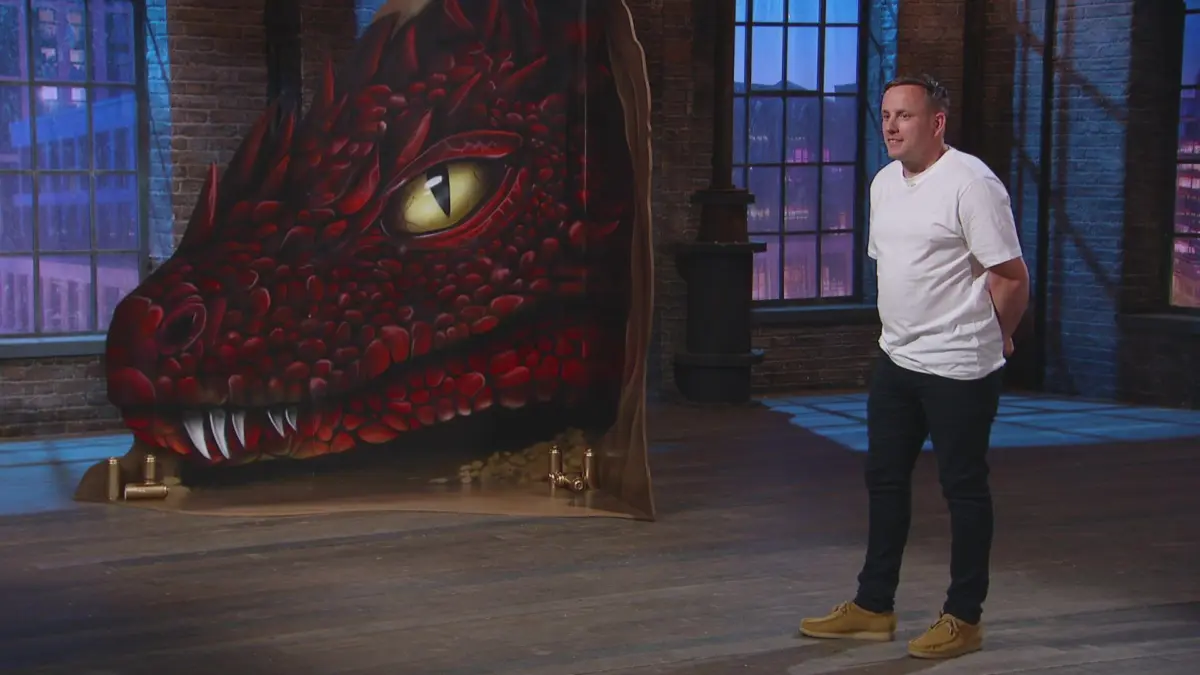
Arriving on set carrying a massive, hyper-detailed painting of a scaly, red-scaled dragon with piercing yellow eyes—a piece he had meticulously crafted specifically for the appearance—Murdoch stood before the five formidable Dragons. He pitched his core proposition: a £60,000 investment for a 10% equity stake in Street Arts Hire.
The reaction from the panel was instantaneous and overwhelmingly positive, though not necessarily in the financial direction Murdoch had anticipated. The Dragons were immediately disarmed by the sheer visual power of the dragon canvas, which Murdoch had completed in a mere four hours.
Steven Bartlett voiced the collective astonishment of the room, remarking:
"You make me feel like a muggle just looking at that, thinking that a human being could do that versus what I can do. It’s incredible."
The Pivot: Advice Over Equity
As the conversation shifted toward the numbers, the financial realities of Murdoch’s business model became apparent. Former footballer and entrepreneur Gary Neville noted the stark contrast between Murdoch’s immense valuation as a creative genius and his modest personal financial return.
"The artwork is absolutely stunning," Neville observed, pointing directly at the four-hour dragon painting. "You’re taking home only £30,000 a year, but you’re a creative, you’re a genius. That’s worth thousands of pounds." Neville even playfully quipped that he would gladly write a check for £5,000 on the spot just to acquire the canvas.
When Bartlett pressed Murdoch on his daily operational rates—learning that the artist charged roughly £600 per day—the collective consensus among the Dragons shifted. They agreed uniformly that Murdoch was dramatically undervaluing his labor and lacked the structural framework required to scale efficiently. Consequently, none of the investors chose to take the equity deal.
However, recognizing his extraordinary talent and untapped market potential, Bartlett stepped in with an alternative package. He promised to dedicate an hour of his personal time to sit down with Murdoch to draft a comprehensive, growth-oriented business plan. Furthermore, Bartlett made an immediate commercial pitch:
"I will pay you five times your day rate to do our new London HQ which has completely blank walls."
Reflecting on the whirlwind experience after leaving the studio, Murdoch maintained a remarkably pragmatic and positive outlook.
"Although I didn’t get the investment today, the advice I got was kind of what I needed to hear and overall it’s been a great experience," he stated.
Supporting Context & Metrics
To fully understand the dynamics of Nathan Murdoch’s pitch on Dragons’ Den, it is essential to examine the underlying economic and operational metrics of the independent street art sector in the United Kingdom.
The Economics of Street Art
Independent muralists and graffiti artists frequently navigate a precarious financial landscape. While monumental public works and corporate commissions can command significant sums, the operational overhead—including specialized safety equipment, scaffolding, premium weather-resistant aerosols and masonry paints, insurance, and travel—often eats deeply into profit margins.
Revenue vs. Valuation: Murdoch’s personal annual earnings of approximately £30,000 stood in stark contrast to the £600 daily rate he charged clients. In the eyes of the Dragons, this mathematical discrepancy signaled a critical failure in time management and pricing strategy. By undercharging for his labor and operating without a dedicated administrative buffer, Murdoch was effectively capping his own earning potential.
The Capacity Trap: Operating primarily as a hands-on creator left Murdoch with zero bandwidth for business development, client acquisition, and administrative logistics. By his own admission, Street Arts Hire was forced to decline 40% of inbound client requests due to a lack of coordination personnel. This uncaptured market demand formed the core justification for his £60,000 funding request, which was earmarked explicitly for hiring a full-time coordinator.
Metric / Financial Indicator
Detail / Value
Requested Investment
£60,000
Equity Offered in Return
10%
Current Personal Annual Earnings
~£30,000
Standard Daily Charge-Out Rate
£600
Unfulfilled Client Demand
~40% of total inquiries
Time Invested in Show’s Dragon Painting
4 hours
Steven Bartlett’s Commission Rate
5x standard day rate (£3,000/day equivalent)
Official Statements and Industry Reactions
The broadcast of the episode on BBC One generated significant digital and local engagement, prompting reflections from both the artist and media observers across Cambridgeshire.
Nathan Murdoch, reflecting on the experience:
"I entered the Den thinking, ‘What have I got to lose?’ Walking away without the cash injection was initially a hurdle, but the feedback from Steven, Gary, and the rest of the panel exposed the blind spots in how I run my business. Hearing industry titans validate my artistic output while diagnosing my operational shortcomings gave me the exact roadmap I needed."
Steven Bartlett, during the evaluation:
"You make me feel like a muggle just looking at that… It’s incredible. We have an upcoming London headquarters with entirely blank walls, and I want you to paint them. I will pay you five times your standard day rate to do the job."
Gary Neville, addressing Murdoch’s financial output:
"The artwork is absolutely stunning. You’re taking home only £30,000 a year, but you’re a creative, you’re a genius. That piece right there is worth thousands of pounds."
Future Outlook
While Nathan Murdoch did not secure the backing of a financial partner on Dragons’ Den, his appearance has fundamentally altered the trajectory of Street Arts Hire.
1. Strategic Restructuring and Pricing
Armed with the direct mentorship of Steven Bartlett—who agreed to spend an hour helping construct a scalable business plan—Murdoch is positioned to overhaul his pricing structures. By transitioning away from archaic day rates and moving toward project-based, value-driven pricing, Street Arts Hire can dramatically increase its annual revenue without requiring an exponential increase in physical labor hours.
2. High-Profile Corporate Exposure
The commission to paint Steven Bartlett’s new London headquarters represents far more than a lucrative paycheck. As Bartlett operates within elite entrepreneurial, tech, and media circles, having a sprawling, bespoke Murdoch mural at the center of his corporate hub serves as a premier living portfolio. This exposure is anticipated to unlock high-tier corporate contracts across the capital, bridging the gap between regional street art and elite corporate interior design.
3. Resolving the Capacity Bottleneck
Although the initial £60,000 capital injection was not secured, the revenue generated from Bartlett’s enhanced commission—paying five times the standard day rate—provides immediate liquidity. This capital can be strategically redeployed to fund administrative support or part-time coordination, allowing Street Arts Hire to capture the 40% of inquiries previously left on the table.
Ultimately, what began as a traditional pitch for investment transformed into a masterclass in business mentorship, proving that for exceptional creative talents, the right advice can often outweigh a bank transfer.