NEW YORK — The 79th session of the United Nations General Assembly became the epicenter of intense political friction and civil disobedience as high-profile Hollywood actors, activists, and prominent public figures were detained by the New York City Police Department (NYPD). The detentions occurred outside the United Nations headquarters in Manhattan amidst a massive, high-stakes demonstration organized by Jewish Voice for Peace (JVP).
The protest coincided with the arrival and controversial address of Israeli Prime Minister Benjamin Netanyahu. Among those handcuffed and led away by law enforcement were Emmy Award-winning Hacks star Hannah Einbinder and Academy Award-winning actress Susan Sarandon. The sweeping police response also ensnared other prominent political and cultural figures, including Sex and the City star Cynthia Nixon, whistleblower Chelsea Manning, and comedian Caleb Heron.
Demonstrators flooded the surrounding streets in an anti-war sit-in, demanding an immediate end to United States military aid to Israel, a permanent ceasefire in Gaza, and the arrest of Prime Minister Netanyahu on allegations of genocide. While the NYPD attempted to clear the thoroughfares to maintain security corridors for visiting heads of state, the resulting mass detentions have reignited fierce national debates over First Amendment protections, police overreach, the boundaries of celebrity activism, and the profound domestic polarization surrounding the ongoing conflict in the Middle East.
Detailed Chronology: From Peaceful Demonstration to Mass Detentions
Morning Mobilization: The Gathering at Dag Hammarskjöld Plaza
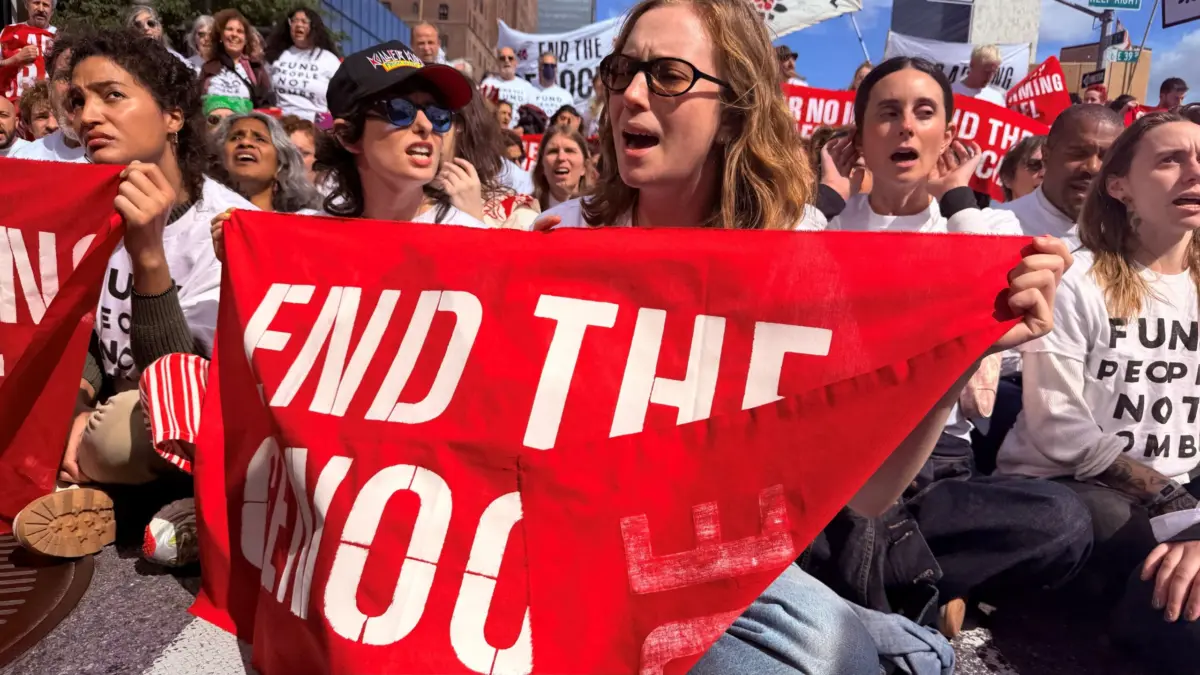
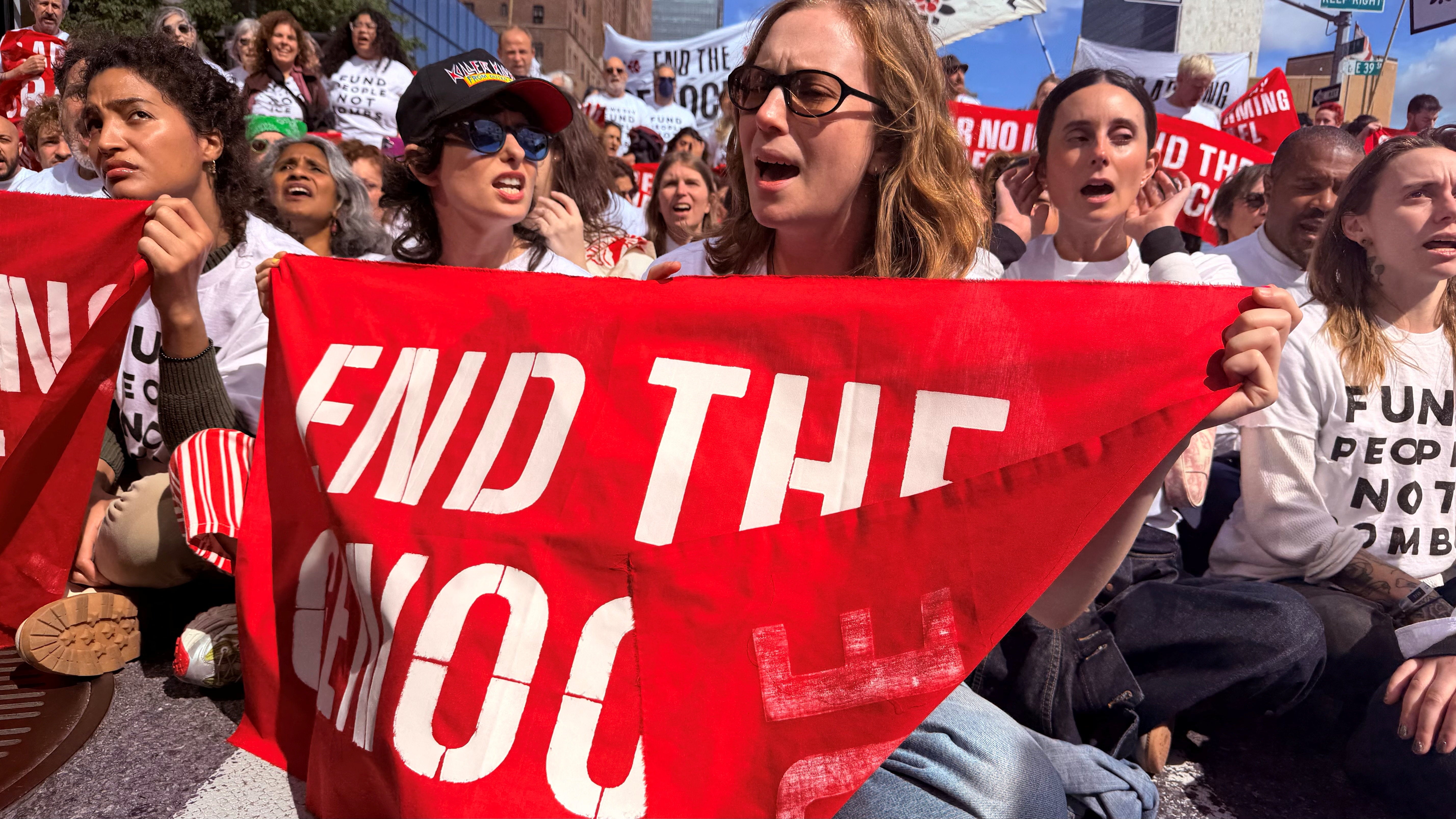
The sequence of events began early Thursday morning as thousands of anti-war protesters, labor organizers, human rights advocates, and progressive coalitions converged near the United Nations headquarters. Organized primarily by Jewish Voice for Peace—a progressive Jewish anti-Zionist advocacy group—the demonstration was planned as a coordinated mass sit-in designed to disrupt normal diplomatic access and register moral outrage against the Netanyahu administration’s military campaigns in Gaza and Lebanon.
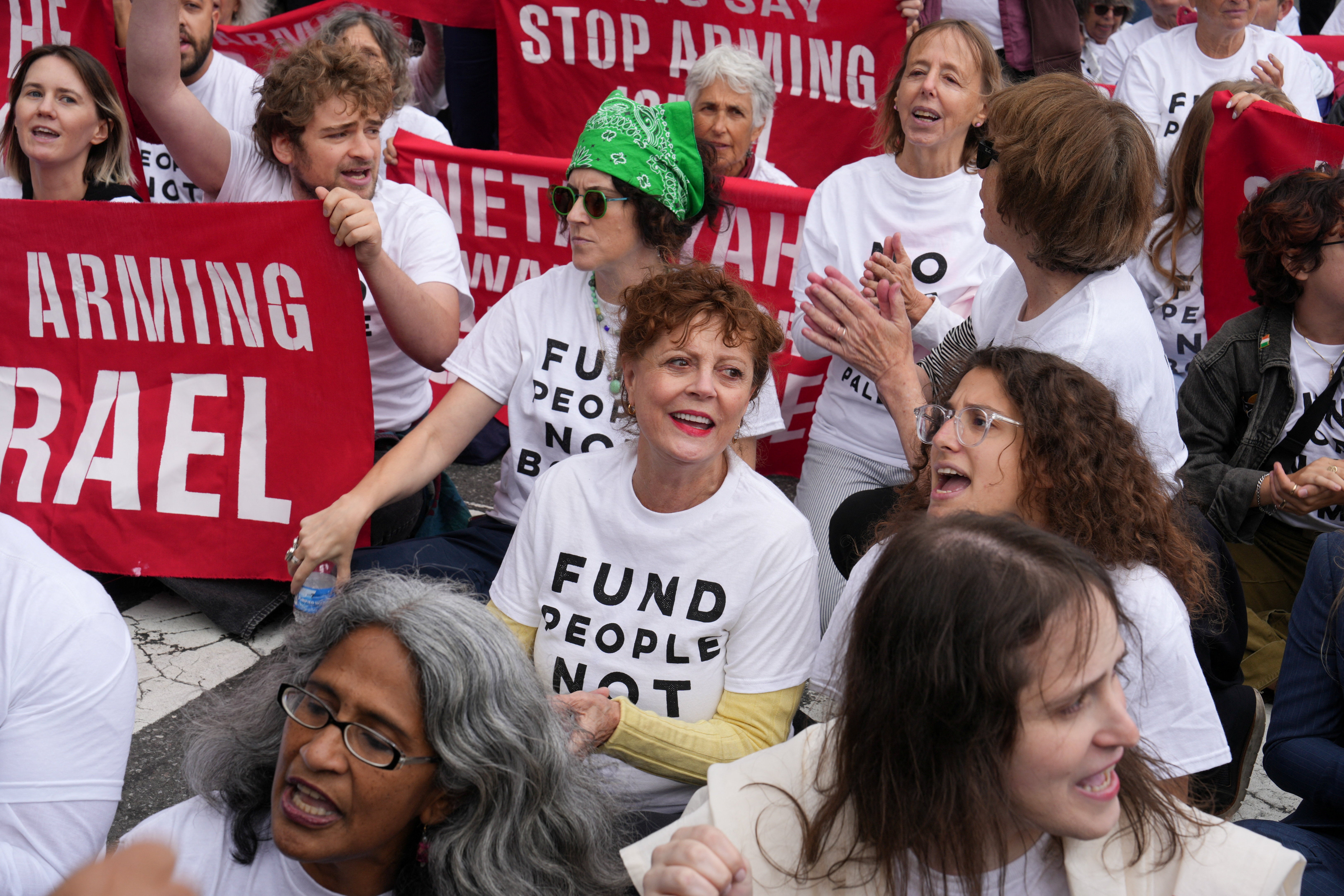
Participants carried massive banners reading "End the Genocide," "Fund People, Not Bombs," and "Arrest War Criminals." Chants of "Netanyahu, you can’t hide, you are wanted for genocide" echoed off the concrete canyons of Midtown Manhattan, drawing international media attention.
Prominent cultural figures integrated themselves directly into the front lines of the blockade. Susan Sarandon, wearing a graphic tee bearing the slogan "Fund People, Not Bombs," sat cross-legged on the asphalt alongside hundreds of fellow activists. Nearby, Hannah Einbinder held a Palestinian flag while leading chants through a megaphone, joined by Cynthia Nixon—who had previously engaged in a high-profile hunger strike advocating for a ceasefire—and whistleblower Chelsea Manning.
The Security Lockdown and NYPD Intervention
As the time approached for Prime Minister Netanyahu to deliver his scheduled address to the UN General Assembly, the security posture shifted dramatically. The NYPD, operating under strict federal and municipal mandates to maintain the security perimeter for international dignitaries, issued multiple dispersal orders via loudspeaker, warning that blocking the roadways violated local ordinances and constituted disorderly conduct.
When the crowd refused to disperse and instead linked arms to maintain the sit-in blockade, tactical units moved in. Officers began physically breaking through the human chains, separating demonstrators, and utilizing zip-ties to detain those who refused to move.
Video footage captured the chaotic moments as officers cleared the streets. Hannah Einbinder was filmed shouting "Free Palestine" and "Get Netanyahu out of New York" as she was escorted away by multiple officers. Susan Sarandon was similarly photographed being lifted from the pavement and led toward an NYPD transport vehicle in handcuffs.
According to law enforcement sources and local media reports, dozens of individuals were taken into custody during the operation. While most were processed for low-level offenses such as disorderly conduct and obstructing vehicular traffic, uncertainty lingered regarding the exact formal charges levied against the high-profile detainees.
Supporting Context & Metrics: Celebrity Activism and the Cost of Dissent
The Price of Advocacy: Hollywood Blacklisting and Career Fallout
The arrests outside the United Nations underscore a broader, increasingly volatile intersection between political expression and the American entertainment industry. For figures like Susan Sarandon and Hannah Einbinder, public advocacy regarding the Israeli-Palestinian conflict has carried tangible personal and professional consequences.
Sarandon, a decades-long veteran of political activism—ranging from anti-war protests during the Iraq War to environmental justice campaigns—has openly discussed the professional repercussions of her outspoken stance on Gaza. Earlier this year, while accepting a career achievement award at Barcelona’s Goya Awards, Sarandon revealed the profound economic and professional isolation she experienced following the escalation of hostilities in late 2023.
"It became impossible for me to even be on television," Sarandon stated at a press conference. She revealed that she was dropped by her long-time representation at United Talent Agency (UTA) in late 2023 as a direct consequence of her participating in pro-Palestinian marches and speaking publicly about the humanitarian crisis in Gaza. "I don’t know lately if it’s changed, but I couldn’t do any major film, anything connected with Hollywood."
Generational Shifts in Jewish Identity and Activism
For Hannah Einbinder, whose ascent in Hollywood has accelerated rapidly following her critical acclaim in HBO’s Hacks, activism is inextricably linked to her identity as a Jewish woman. Her arrest outside the UN is the latest in a series of high-profile political statements.
During her acceptance speech at the 2025 Emmy Awards, Einbinder famously declared, *"F** ICE and free Palestine," utilizing her platform to draw national attention to intersecting human rights abuses. In subsequent interviews, she elaborated on her motivations:
"I feel like it is my obligation as a Jewish person to distinguish Jews from the State of Israel, because our religion and our culture is such an important and long-standing institution that is really separate to this sort of ethno-nationalist state."
Einbinder has frequently noted that her political awakening is informed by personal connections to humanitarian workers on the ground. She has cited close friends working on the frontline as volunteer doctors in northern Gaza, providing medical care to malnourished children, pregnant women, and displaced families trapped in overcrowded refugee camps.
Official Statements and Institutional Responses
Law Enforcement and Municipal Authorities
The New York City Police Department defended its actions by citing the critical need to maintain public safety, traffic flow, and the security of foreign heads of state visiting the United Nations. In an official briefing, NYPD representatives emphasized that law enforcement personnel provided ample warnings and opportunities for protesters to move to designated free-speech zones before initiating arrests.
"While the NYPD strongly protects and upholds the constitutional right to peaceful assembly and free speech, we cannot allow individuals to unlawfully block major thoroughfares, obstruct critical diplomatic infrastructure, or create hazardous conditions during high-security international events," an NYPD spokesperson stated.
Advocacy Groups and Defense Organizations
Jewish Voice for Peace, alongside civil liberties organizations such as the New York Civil Liberties Union (NYCLU), sharply condemned the police response, characterizing the arrests as an infringement on First Amendment rights and a heavy-handed attempt to suppress legitimate anti-war dissent.
"The mass arrests of peaceful protesters, including beloved artists and cultural leaders, expose the extreme lengths to which authorities will go to shield war criminals from accountability," JVP said in a statement released hours after the sweep. "We will not be silenced by police tactics, nor will we stop demanding an immediate arms embargo and an end to the destruction of Gaza."
Future Outlook: The Ripple Effects on Domestic Politics and Culture
The detention of Einbinder, Sarandon, Nixon, and other public figures outside the United Nations serves as a microcosm of the deeper cultural and political fractures defining contemporary American society. As the conflict in the Middle East continues to reverberate through domestic institutions, several key trends are likely to emerge in the wake of this high-profile confrontation:
Heightened Polarization in Entertainment: Major talent agencies, studio executives, and casting directors face mounting pressure from both activist networks and conservative lobbying groups. The willingness of top-tier talent to risk their careers for political convictions suggests that industry blacklisting will not deter a dedicated faction of Hollywood creatives.
Escalation of Direct Action: With diplomatic channels appearing gridlocked and the humanitarian crisis compounding daily, activist coalitions indicate that disruptive, non-violent civil disobedience will remain a primary tactic throughout the upcoming political cycle.
Legal Battles Over Free Speech: Legal defense funds are mobilizing around the detained celebrities and activists. The outcomes of any subsequent court proceedings regarding the legality of the NYPD’s dispersal orders and the nature of the charges could set vital legal precedents for protest rights in New York City.
As the international community grapples with ongoing violence in the Middle East, the intersection of celebrity influence, grassroots civil disobedience, and municipal law enforcement in New York City ensures that the fallout from Thursday’s protest will be felt far beyond the halls of the United Nations.