Opera North has returned to the Leeds Grand Theatre with a provocative, visually uncompromising new production of Pyotr Ilyich Tchaikovsky’s Eugene Onegin. Premiering on October 24, 2026, this co-production with Irish National Opera and Opera Queensland scales down the 19th-century aristocratic Russian milieu of Alexander Pushkin’s verse novel to the turbulent geopolitical pivot points of late-20th-century history. Under the direction of Patrick Nolan and the baton of conductor Garry Walker, the staging deliberately swaps the pastoral elegance and rigid class distinctions of 1820s Russia for the claustrophobic concrete halls, grey utilitarianism, and burgeoning oligarchy of the Soviet Union and post-communist transition between 1980 and 1991.
While Nolan’s high-concept framing frequently undercuts the psychological subtext of the original libretto—stripping away essential dramatic markers such as the iconic jam-making scene and traditional peasant choreography—the production ultimately avoids total misfire due to an extraordinary cast of principals. Anchored by John Brancy in the title role and Verity Wingate as Tatyana, alongside a deeply committed chorus and a luminous orchestral performance from the pit, the evening proves satisfying on a purely musical and vocal level. This review provides a comprehensive look at the production’s structural choices, design aesthetics, vocal triumphs, and dramatic frictions.
Detailed Chronology & Production Design
Act-by-Act Breakdown: Traversing a Decade of Upheaval
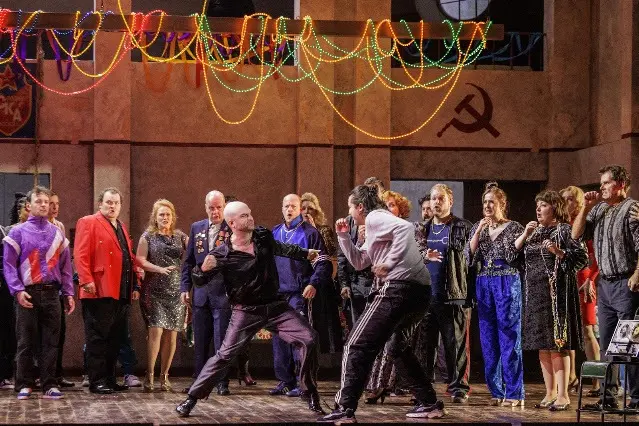
Patrick Nolan’s conceptual reimagining stretches Tchaikovsky’s three acts across a precise eleven-year timeline, utilizing a single, run-down multi-purpose community hall as the permanent set designed by Leslie Travers.
Act One (1980): Set against the grim backdrop of the run-up to the Moscow Olympics, the opening act replaces traditional folk dances with a static, regimented routine involving colored boards manipulated by the chorus. Instead of private domestic spaces on the Larina estate, private scenes—including Tatyana’s intimate letter scene—play out in public view within the same battered hall. Madame Larina and Filipyevna find themselves shorn of their traditional agrarian oversight, engaging in extraneous stage business that bypasses the class distinctions pivotal to the original narrative. The act culminates in an intensely uncomfortable dynamic as a self-satisfied, anti-heroic Onegin plants an uninvited kiss on a bewildered Tatyana.
Act Two (1985): Framed in the immediate wake of Mikhail Gorbachev’s perestroika and glasnost reforms, this act shifts from the stark Soviet grey to unironic, garish 1980s party aesthetics. Choreographer Maxine Braham crafts an unstylish, nostalgic display of period dad-dancing that wins over the audience but undercuts the dark, fatalistic momentum of Madame Larina’s nameday party. The tension builds toward Lensky’s fatal challenge, though the staging omits vital libretto details, such as Onegin employing his own valet as a second, which muddies the historical etiquette of the duel.
Act Three (1991): The final act leaps to the dawn of the oligarchic era, opening with a sophisticated black-and-white color palette for the Polonaise ball. Aristocratic grandeur sits awkwardly within the same shabby, decaying hall, creating a stark visual dissonance. Yet, it is here that the dramatic tension finally clicks into place, as Brancy’s polished, thuggishly corporate Onegin confronts Wingate’s hardened, poised Tatyana amidst the ruins of their shared past.
Musical Execution and Vocal Performances
Despite the hurdles imposed by a directorially disruptive set, the musical execution under Garry Walker’s baton and the stellar work of the principal cast elevate the production into a vocally rewarding experience.
The Principals
John Brancy (Eugene Onegin): Shedding any trace of the Byronic hero, Brancy embodies an abrasive, self-absorbed anti-hero. Shaven-headed and lithe, his Onegin treats those around him with casual cruelty. Vocally, however, Brancy soars well above the drab stage routine. His baritone is rich, focused, and dramatically incisive, bringing a razor-sharp musicality to the role that anchors the opera’s emotional core.
Verity Wingate (Tatyana Larina): Wingate delivers a masterclass in vocal and dramatic transformation, effectively mapping Tatyana’s journey from a distant, bookish adolescent to a commanding, emotionally scarred woman of high society. In the letter scene, her soprano rings out with plangent yet luminous strength. By Act Three, her remarkable poise transforms into a coruscating emotional intensity, forging palpable dramatic sparks with Brancy.
Caspar Singh (Lensky): Singh portrays the poet as an intense, serious figure. While his lyric tenor occasionally felt pressed under the weight of the boisterous Act Two party scene, his performance in the lead-up to the duel was a marvel of controlled, nuanced phrasing. His vocal blending with Brancy in the final moments before the tragic shooting achieved a heartbreaking, moving restraint.
Jingwen Cai (Olga): Cai infuses Olga with bubbly, engaging energy, using her lower vocal register to suggest a young woman itching for excitement beyond the provincial estate, viewing Lensky as merely a temporary waypoint.
Joshua Bloom (Prince Gremin): Cast as a silver-fox oligarch rather than a battle-scarred military veteran, Bloom delivers Gremin’s sole aria with a resonant, commanding bass tone that exudes effortless authority.
Florian Panzieri (Monsieur Triquet): Panzieri injects a dose of eccentric levity as an unusually youthful Triquet, blending vibrant lyricism with smooth, Elvis-esque physical comedy.
Supporting Cast & Orchestral Brilliance
The supporting ensemble—featuring Hannah Mason as Madame Larina, Claire Pascoe as Filipyevna, Paul Gibson as the Captain, Simon Grange as Zaretsky, and Dean Robinson as Guillot—demonstrates Opera North’s exceptional depth, with five solo roles drawn directly from the chorus. Pascoe’s scenes with Wingate in Act One proved particularly memorable.
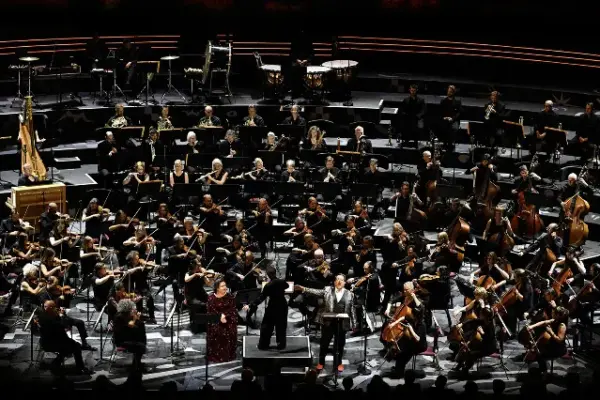
In the pit, Garry Walker drew luminous, impassioned playing from the orchestra. Treating Tchaikovsky’s score not as a grand romantic epic, but as a collection of intimate lyric scenes designed for student forces, Walker matched the acoustic intimacy of the Leeds Grand Theatre, ensuring every nuance of the woodwinds and strings resonated clearly.
John Brancy (Onegin), Verity Wingate (Tatyana), Caspar Singh (Lensky), Jingwen Cai (Olga), Joshua Bloom (Gremin), Florian Panzieri (Triquet)
Co-Production Partners
Opera North, Irish National Opera, Opera Queensland
Temporal Setting
Soviet Russia / Post-Soviet Transition (1980–1991)
Official Statements & Critical Reception
The production has sparked considerable debate among critics and audiences regarding the validity of updating 19th-century classics to 20th-century political flashpoints.
"Directors have a fondness for relocating Eastern European operas into a recent time period covered by Soviet and Communist rule… [Yet] what the production was supposed to tell us about the characters remains unclear. The class element so vital to Pushkin and Tchaikovsky was totally missing from the first two acts."
— Production Review Summary
While directorial concepts that strip away pastoral romanticism to reveal institutional decay are increasingly common in European houses, this staging proved that a conceptual mismatch can be successfully redeemed by stellar vocal artistry. The contrast between Nolan’s heavy-handed socio-political framing and the transcendent musicality of the performers highlighted the resilient power of Tchaikovsky’s score.
Future Outlook
As Opera North’s autumn season continues its run, this staging of Eugene Onegin serves as a fascinating case study in modern opera direction. It demonstrates that while conceptual risks—such as transforming the Larina estate into a decaying Soviet community center and substituting peasant dances with Olympic board formations—can alienate purists, an unyielding commitment to vocal excellence can salvage an otherwise jarring night in the theatre.
Future tour stops and subsequent remounts with international partners Irish National Opera and Opera Queensland will likely test whether audiences abroad embrace the 1980s Soviet aesthetic more warmly than Leeds audiences did. Regardless of how the staging ages, the vocal masterclasses delivered by John Brancy, Verity Wingate, and Caspar Singh have set a high benchmark that will be remembered long after the neon-lit 1980s party lights have faded.