Executive Overview
“If you can listen to Rebel Rebel and not be a tiny bit glad you’re alive, you’ve got an answering-machine for a heart.”
With these words, celebrated Irish writer Joseph O’Connor captured the immutable, life-affirming core of David Bowie’s 1974 rock anthem. Over half a century later, that exact sentiment serves as the heartbeat and title of a groundbreaking theatrical production that has taken European arts festivals by storm. Directed by visionary Belgian theatre maker Ivo van Hove, Rebel Rebel—a bold musical tapestry constructed entirely from the catalog of David Bowie—recently concluded a critically acclaimed, completely sold-out run at Germany’s prestigious Ruhrtriennale Festival in Bochum.
Blending the kinetic energy of rock-and-roll with the stark, chilling aesthetics of modern European avant-garde theatre, Rebel Rebel reimagines Bowie’s discography as a searing narrative of love, totalitarian oppression, and resilience. For two intense hours, audiences are transported into a dystopian future governed by a heartless regime that outlaws human connection. Yet, through roughly 25 meticulously arranged songs spanning Bowie’s illustrious career—from his glittering early-1970s glam era to his haunting Berlin period and later-life works—the production offers a soaring testament to the enduring power of hope.
This article explores the anatomy of van Hove’s latest masterpiece, examining its literary roots in George Orwell’s 1984, its breathtaking musical arrangements led by musical director Henry Hey, and its striking resonance with contemporary global anxieties. As theatergoers across Europe clamor for an international tour, Rebel Rebel proves that Bowie’s music remains an indispensable weapon against despair.
Detailed Chronology: From Bochum to the Stage
The journey of Rebel Rebel to the Ruhrtriennale Festival represents the culmination of years of conceptual development between van Hove and his elite creative collaborators. Known for his unflinching adaptations of classic texts and films—ranging from Arthur Miller’s All My Sons to Hanya Yanagihara’s harrowing novel A Little Life—van Hove turned his sights toward the Starman’s musical legacy.
Setting the Stage in Bochum
The production’s premiere run in Bochum positioned the Ruhr region as a temporary global capital for Bowie aficionados and theater critics alike. The author of this report traveled to Bochum, taking a seat for two consecutive nights to witness the phenomenon firsthand. From the moment the house lights dimmed, the atmosphere crackled with a palpable, electric tension.
The production opens with a staggering sonic and visual punch. The word “Genocide” echoes through the auditorium as the first spoken line of the performance. Looming above the stage is a massive, high-definition video screen designed by Christopher Ash, projecting relentless, haunting imagery of war-torn cityscapes and desolate urban ruins. While the creative team deliberately avoids naming specific contemporary conflicts, the psychological parallel to a world besieged by perpetual war is impossible to ignore.
The Anatomy of the Narrative
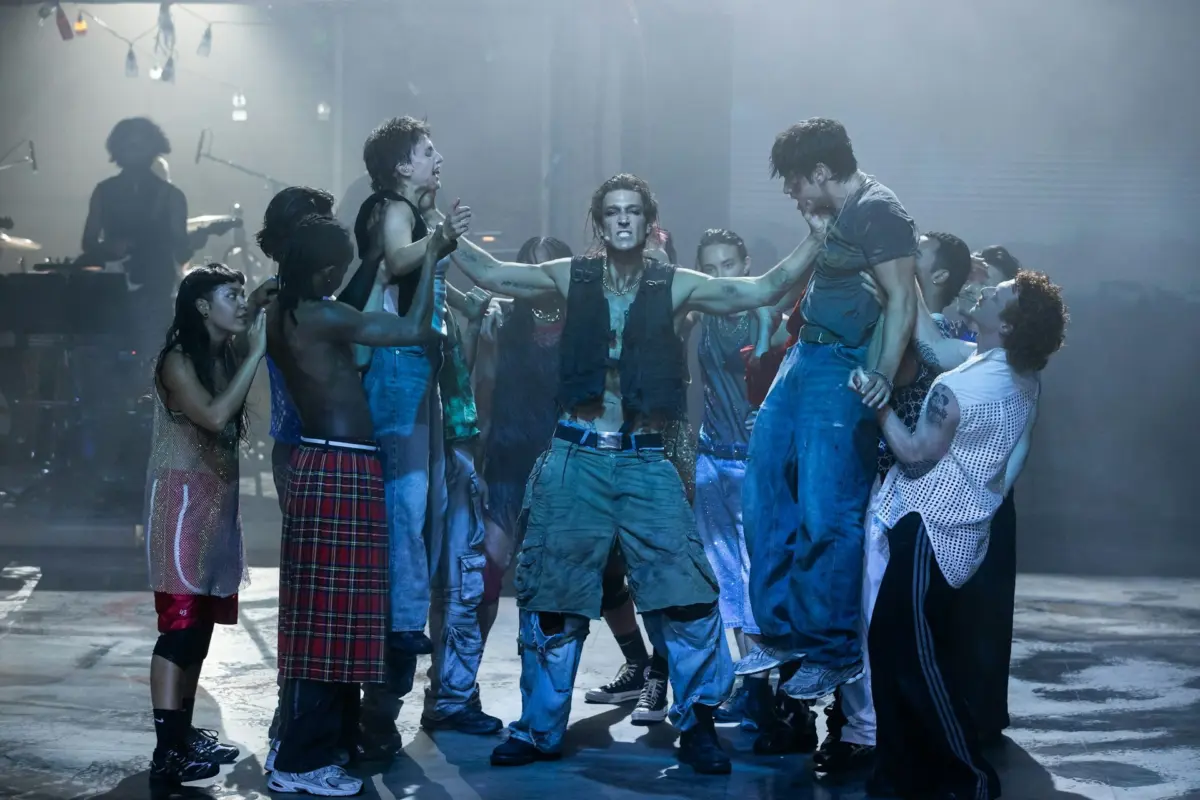
Within this bleak socio-political landscape, van Hove establishes a simple yet devastating premise, detailed in the production’s program notes: a top-down authoritarian government has outlawed interpersonal relationships, rendering genuine human connection impossible. To maintain control, the regime permits violent, roaming gangs to terrorize an already subjugated populace.
The narrative focuses on three central figures who echo timeless archetypes of resistance:
- Girl (Ari Notartomaso): A young woman driven by an innate, unquenchable desire for intimacy and freedom.
- Boy (Diego Rodriguez): Her counterpart, representing tenderness and hope in a landscape designed to foster cruelty. Together, they form a subtle modern parallel to Julia and Winston, the doomed lovers of George Orwell’s 1984.
- Gang Leader (Daniel Donskoy): The brutal manifestation of the state’s apparatus of terror, embodying the forces determined to crush any flicker of individual agency.
Much like Tony and Maria caught in the crossfire of West Side Story—a production van Hove memorably directed in New York in 2020—Girl and Boy embody the universal human urge toward desire, connection, and peace in a world where powerful authorities find division and violence far more expedient.
Supporting Context & Metrics: The Bowie-Orwell Connection
To truly understand the DNA of Rebel Rebel, one must look back to the origins of Bowie’s 1974 studio album, Diamond Dogs. The album, which birthed the title track, was originally conceived by Bowie as a direct theatrical adaptation of George Orwell’s dystopian masterpiece, 1984.
A Denied Collaboration
Bowie’s ambition to bring Orwell’s totalitarian nightmare to the theatrical stage was famously derailed when Sonia Orwell, the author’s widow, flatly refused to grant the musician the rights to the novel. Undeterred, Bowie salvaged portions of his conceptual work, weaving the themes of surveillance, psychological decay, and rebellious youth into the sonic tapestry of Diamond Dogs.
Ivo van Hove’s Rebel Rebel effectively completes the circle that Bowie started over fifty years ago. By casting the narrative within an Orwellian framework of state-mandated isolation, the musical honors the socio-political underpinnings of Bowie’s heaviest artistic statements.
A Masterclass in Collaborative Design
Rebel Rebel is a masterwork of interdisciplinary collaboration. Rather than relying on traditional dialogue, the production communicates almost entirely through song. The musical architecture is built upon roughly 25 tracks, carefully selected from across Bowie’s vast chronologies.
The collaborative weight of the production is reflected in its creative leadership team, whose names share equal billing in the official program:
- Director: Ivo van Hove, providing narrative clarity and emotional structural integrity.
- Choreographer: Sidi Larbi Cherkaoui, whose athletic, visceral movement direction transforms songs into physical battles for survival.
- Musical Director: Henry Hey, leading a powerhouse live band that breathes fresh air into classic arrangements.
- Set and Lighting Designer: Jan Versweyveld, utilizing stark minimalism, industrial lighting rigs, and atmospheric shadows to heighten the psychological claustrophobia.
- Video Designer: Christopher Ash, whose monumental back-stage screen plunges the audience into shifting realms of beauty and devastation.
Official Statements and Artistic Vision
The artistic philosophy driving Rebel Rebel relies heavily on treating lyrics with the reverence typically reserved for classical poetry. Ivo van Hove has frequently pushed back against critics who accuse him of violently dismantling source material.
“People talk about me as if I rip apart texts,” van Hove noted in a past interview. “I don’t do that. I always start with the text.”
This commitment to textual integrity is acutely visible in how the musical handles Bowie’s lyrical paradoxes. For instance, the upbeat, bouncy rhythms of Modern Love (1983) are weaponized when sung by the Gang Leader (Daniel Donskoy). Delivered with a clear-eyed understanding of the song’s misanthropic, shut-in, and anti-romantic undertones, the performance exposes the dark irony hidden beneath a radio-friendly pop exterior.
Reimagining the Canon
Crucially, the performers—Notartomaso, Rodriguez, and Donskoy—refuse to fall into the trap of doing hollow Bowie impersonations. They do not attempt to mimic his distinct vocal cadence. Instead, they invest the material with their own vocal freshness, verbal clarity, and emotional urgency.
This approach aligns with observations made by musician Nick Cave regarding the nature of the true love song. Cave once wrote that a great love song “must resonate with the susurration of sorrow, the tintinnabulation of grief.” Even at its most euphoric, Rebel Rebel satisfies this requirement by acknowledging that joy is all the more precious when forged in the crucible of suffering.
Standout Musical Moments
Two specific numbers during the performance encapsulate the production’s emotional range:
- "Starman" (1972): Beginning as an intimate, tender romantic duet between Girl and Boy, the song gradually swells into a raw, joyous ensemble piece. Backed by the full 12-person dance chorus and Hey’s thunderous live band, the cast belts out the iconic lines: "Let the children lose it, let the children use it." Simultaneously, the massive video screen displays footage of a child running through an open field, clutching a toy plane and willing it into a flight path that can never truly happen. It is a moment of pure, devastating theatrical poetry.
- "Slowburn" (2002): Drawn from Bowie’s critically acclaimed late-career album Heathen, this track becomes a searing meditation on climate catastrophe and societal collapse. Standing before a digital backdrop of roaring fire and intense flames, Diego Rodriguez delivers a bell-clear vocal performance. Combined with the fierce, driving instrumentation of Hey’s band, Slowburn transforms into an anthem of heat, devastation, and the stifling terror familiar to anyone who lived through the scorching heatwaves and environmental crises of recent summers.
Future Outlook: The Road Ahead for Rebel Rebel
As the final curtain fell on the Bochum run, the overwhelming consensus among critics and audiences was clear: confining Rebel Rebel to a single festival run would be a tragic artistic missed opportunity.
The production offers a rare synthesis of high-concept European arthouse theater and universally beloved rock-and-roll catalog performance. By tapping into contemporary anxieties regarding authoritarianism, systemic violence, and the desperate human need for touch and affection, van Hove and his team have created something profoundly relevant to the cultural zeitgeist of the mid-2020s.
Prospects for an International Tour
Industry insiders and theater advocates are already speculating about the inevitable announcement of an international tour. For European audiences—and particularly in the United Kingdom, where David Bowie’s cultural legacy runs deepest into the bedrock of modern British identity—the arrival of Rebel Rebel would be nothing short of a cultural milestone.
If and when van Hove’s production secures venues across London, Paris, Berlin, and beyond, it will undoubtedly offer thousands of theatergoers the chance to experience what Joseph O’Connor described decades ago: the undeniable, pulse-quickening realization that, despite the dystopias we navigate daily, music can still make us more than a tiny bit glad to be alive.