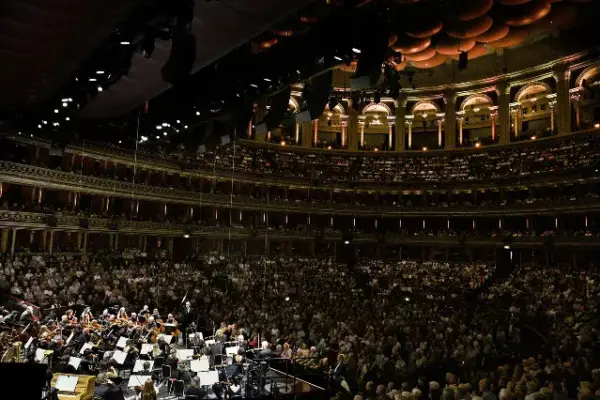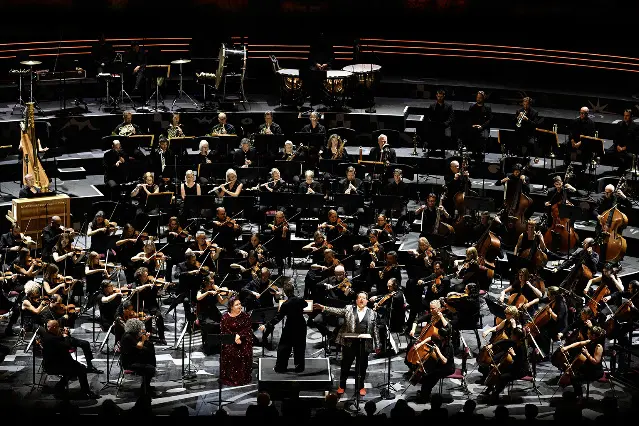
The 2026 BBC Proms season at the historic Royal Albert Hall recently played host to a captivating, thematic masterclass in musical programming. On Friday, August 21, principal guest conductor Anja Bihlmaier led the BBC Philharmonic Orchestra through an ambitious, multi-faceted concert. The evening bridged centuries, styles, and cultures, juxtaposing contemporary British-Lebanese composition with classical-era innovation and late-romantic emotional cataclysm.
At first glance, the programme appeared to be a standard mixed bill: Bushra El-Turk’s vibrant 2009/10 chamber work Mosaic, Joseph Haydn’s revolutionary Symphony No. 45 in F-sharp minor (‘Farewell’), and Gustav Mahler’s monumental symphonic song cycle, Das Lied von der Erde (‘The Song of the Earth’), featuring acclaimed vocal soloists Jamie Barton and Clay Hilley.
Yet, beneath the disparate surface lay a profound conceptual thread. The evening explored the melancholic, universal themes of departure, exile, rootlessness, and cultural "otherness." While Bihlmaier and her forces delivered moments of staggering orchestral beauty and dramatic intensity, the notorious acoustic challenges of the Royal Albert Hall occasionally tested the limits of balance between a massive late-romantic orchestra and its vocal soloists. Nevertheless, it remains a landmark evening in the current Proms calendar—one that rewarded deep listening and will undoubtedly sound revelatory upon its radio broadcast rebalance.
Detailed Chronology: A Night of Departures and Discoveries
Act I: Bushra El-Turk’s Mosaic and the Anxiety of Cultural Cross-Pollination
The evening commenced with Bushra El-Turk’s Mosaic, originally composed for the Manchester Camerata. El-Turk’s musical language—deeply invested in cross-cultural dialogues and the friction between diverse sonic traditions—served as a brilliant modern thematic mirror for the rest of the programme.
The work opened with an almost imperceptible, scurrying shimmer from the strings, swallowed up by the cavernous expanse of the Royal Albert Hall. Out of this near-silence, dramatic fragments and jagged motifs emerged, injecting an anxious, unnerving atmosphere into the auditorium. As the piece progressed, Bihlmaier guided the BBC Philharmonic through a gradual densification of textures. Yet, El-Turk’s fragmented design deliberately resists easy resolution; motifs hovered, collided, and dispersed. It was only in the final bars that the turbulence subsided, yielding to a ravishingly quiet, hymn-like figure. While the acoustic constraints of the venue masked some of El-Turk’s finer micro-tonal textures, the performance established an immediate atmosphere of displacement and longing.
.jpg)
Act II: Haydn’s Farewell Symphony on Modern Instruments
The mood shifted dramatically with Haydn’s Symphony No. 45 in F-sharp minor (‘Farewell’). Despite its legendary status in music history—famously written in 1772 as a subtle, musical hint to Prince Esterházy that the orchestra’s summer residency had outstayed its welcome—the work has suffered from an inexplicable neglect at the Proms, marking only its fourth appearance in the festival’s history and its first since 1938.
Bihlmaier took a courageous artistic gamble by performing this canonical Sturm und Drang masterpiece with a modern-instrument symphony orchestra. In the first movement, the modern string body sounded rich, stylish, and urgent. However, the sheer size of the string contingent occasionally caused the woodwinds to recede in the dynamic balance. The central episode, by contrast, offered a striking, lyrical oasis amid the turbulent key relationships.
The slow movement showcased intimate detail, characterized by pointed motifs and harmonic uncertainties that bely the perceived simplicity of the Classical era. Bihlmaier’s tempo choices proved controversial; while the walking-pace speeds stretched the movement’s proportions given the repeat structures, they granted the musicians the necessary air to unearth hidden harmonic subtleties.
The Menuetto pitted delicate articulation against sheer physical force, setting up the iconic, theatrical finale. Here, the performance functioned as a fascinating historical time-lapse, bridging the 18th-century court theatricality of retreating musicians with modern-day ideals of scaled-down ensemble performance. As players extinguished their music stands and filed off the stage one by one, leaving only a skeletal pair of muted violins to whisper the unresolved final cadence, the hall fell into an eerie, suspended silence.
Act III: Mahler’s Das Lied von der Erde
Following the interval, the stage transformed to house Mahler’s massive orchestral forces for Das Lied von der Erde, complete with quadruple woodwinds, expanded percussion, and mandolins. Bihlmaier adopted a disciplined, almost classical structural approach, ensuring that the sprawling architecture of Mahler’s final symphonic statement remained lucid, even while drinking deeply from the score’s rich well of timbral contrasts.
.jpg)
Tenor Clay Hilley opened the cycle with the Drinklied vom Jammer der Erde (‘Drinking song of the earth’s misery’). Hilley leaned heavily into dramatic, histrionic delivery, projecting a raw, burning anger by the movement’s conclusion. His unforced, focused vocal production prioritized narrative clarity, though the sheer volume of Mahler’s orchestra occasionally pushed his voice into the background of the mix.
Mezzo-soprano Jamie Barton took center stage for Der Einsame im Herbst (‘The lonely one in Autumn’), preceded by a gossamer-light string texture and a sublime, plaintive oboe solo. Barton presented a dignified, deeply internalized reading, eschewing superficial vocal beauty in favor of emotional gravity and textural weight.
Throughout movements like Von der Jugend (‘Of Youth’) and Von der Schönheit (‘Of Beauty’), Hilley and Barton navigated the tricky waters of orchestral volume with varying degrees of success. Hilley brought a sparkling, nimble storytelling touch to Youth, while Barton injected dark, steady resilience into Beauty. Bihlmaier coaxed an infectious, swaying dance rhythm from the BBC Philharmonic, though purists might have yearned for more liberal applications of Mahlerian portamento to warm the clean, modern string lines.
The evening culminated in the monumental Der Abschied (‘The Farewell’). Bihlmaier conjured pure aural magic from the orchestra’s lower registers and the tolling of the tam-tam. Barton assumed the immense mantle of past interpreters—recalling legendary Proms performances by Janet Baker and Jessye Norman—with poise, artfulness, and profound emotional intelligence.
Though the acoustic hurdles of the Royal Albert Hall occasionally forced a contest of volume between singer and ensemble, Barton’s final, lingering repetitions of the word "Ewig" ("Forever") were delivered with a concentrated, inward intensity that left the audience spellbound long before the final acoustic resonance dissolved into the dome.
.jpg)
Supporting Context & Metrics
- Concert Date: Friday, August 21, 2026.
- Venue: Royal Albert Hall, London (Capacity: ~5,272 seats, known for its unique acoustic dome and historic reverberation challenges).
- Performing Forces: BBC Philharmonic Orchestra.
- Conductor: Anja Bihlmaier (Principal Guest Conductor).
- Vocal Soloists: Jamie Barton (Mezzo-Soprano), Clay Hilley (Tenor).
- Repertoire Metrics:
- Bushra El-Turk: Mosaic (Approx. 10–12 minutes; composed 2009/10).
- Joseph Haydn: Symphony No. 45 in F-sharp minor, ‘Farewell’ (First Proms performance since 1938; only the fourth time in Proms history).
- Gustav Mahler: Das Lied von der Erde (Composed 1908–1909; orchestrated for massive late-romantic forces).
Official Statements & Artistic Insights
Reflecting on the programming philosophy of the 2026 season, festival organizers and critics alike pointed to the deliberate narrative arc uniting the evening’s three seemingly disparate works.
"The subject of a farewell linked Haydn and Mahler in a way that was sufficiently contrasting as to be intriguing," noted cultural observers covering the event. Furthermore, the inclusion of Bushra El-Turk’s Mosaic served to ground the evening in contemporary discourse regarding cultural displacement: "Bushra El-Turk’s work addresses issues of cross-pollination between cultures, finding elements of the rootlessness and otherness that Mahler found in the Chinese poetry he set in Das Lied von der Erde."
Conductor Anja Bihlmaier’s willingness to tackle Haydn’s Farewell Symphony with a full modern symphony orchestra was widely praised as a masterstroke of festival programming, breaking long-standing curatorial taboos. As critical reviews highlighted: "It was brave of Bihlmaier to decide to do it with a modern instrument orchestra and all credit to her. We should hear more Haydn like this."
Future Outlook
The success of Anja Bihlmaier’s collaboration with the BBC Philharmonic at the 2026 BBC Proms underscores a vital evolution in classical music programming: the art of thematic juxtaposition. By refusing to treat historical epochs as isolated bubbles, the concert demonstrated how contemporary works like El-Turk’s Mosaic can throw sharp, revealing light onto canonical masterpieces by Haydn and Mahler.
For classical music enthusiasts who missed the live spatial experience—or those frustrated by the acoustic vagaries of the Royal Albert Hall’s upper tiers—the complete performance remains readily accessible via BBC Sounds.
.jpg)
As Bihlmaier continues to build her tenure as Principal Guest Conductor with the BBC Philharmonic, this Proms outing signals a fearless appetite for risk-taking, historical revisionism, and deep emotional storytelling. Audiences can eagerly anticipate future programming that similarly challenges orthodoxies and invites listeners to hear familiar repertoire through radically modern, interconnected lenses.