Executive Overview
The acoustic vastness of the Royal Albert Hall has historically presented a formidable obstacle to operatic staging. Yet, on August 19, 2026, Glyndebourne Opera proved that stripped-back aesthetic discipline can yield profound artistic rewards. Bringing its reimagined production of Richard Strauss’s Ariadne auf Naxos to the BBC Proms, the renowned opera house delivered an evening that defied the venue’s notorious acoustic and spatial limitations.
Under the baton of Robin Ticciati, leading a nimble London Philharmonic Orchestra (LPO), and directed by Paul Higgins—whose work adapted Laurent Pelly’s fresh Glyndebourne staging—the performance substituted massive theatrical sets with acute dramatic focus and peerless musical values.
Anchored by a formidable international cast featuring Rachel Willis-Sørensen, David Butt Philip, Alina Wunderlin, and Samantha Hankey, the production transformed backstage theatrical chaos and mythological gravity into an intensely gripping, human-scale drama. Rather than exposing the emptiness of the Albert Hall stage, the minimalist design threw the spotlight entirely onto the textual nuance, vocal flexibility, and character-driven comedy that define Strauss and librettist Hugo von Hofmannsthal’s operatic masterpiece.
Detailed Chronology & Production Breakdown
The Prologue: Backstage Mayhem and Creative Obsession
The production opened with striking visual economy. Eschewing elaborate scenery, the staging relied solely on a pair of utilitarian doorways during the Prologue, augmented by simple platforms when the opera proper commenced. Contemporary costumes, conceptualized by Laurent Pelly, immediately grounded the madness of backstage theatrical triage in recognizable modernity.
From the outset, the Prologue was dominated by Samantha Hankey’s searing portrayal of the Composer. Sporting a severe, uninspiring suit, intense makeup, and physically contorted body language, Hankey embodied artistic obsession. Whenever the character contemplated the transcendent beauty of music, Hankey’s vocal delivery soared, contrasting sharply with Michael Kraus’s older, stiffer Music Master and William Relton’s wonderfully acerbic, dry-witted Majordomo.
.jpg)
On the opposite side of the artistic spectrum, Ru Charlesworth injected dazzling vitality into the role of the Dancing Master. Combining precise musicality with deft footwork and irrepressible personality, Charlesworth elevated a secondary role into a masterclass of character acting. He was ably supported by Alina Wunderlin’s initial glimpses of Zerbinetta’s charm and devilry, alongside a mischievous commedia dell’arte quartet comprising Mikhail Timoshenko, Caspar Singh, Liam James Karai, and Liam Bonthrone.
Crucially, this pared-back approach preserved Hofmannsthal’s philosophical core: an intimate meditation on the nature of art, creation, and the uneasy truce between high-minded idealism and commercial entertainment.
The Opera Proper: Myth, Mischief, and Vocal Splendor
Transitioning into the opera proper, the staging remained deliberately austere. Rachel Willis-Sørensen’s Ariadne was introduced lying on the floor—a stark, unadorned image that forced the audience to look past visual spectacle and focus entirely on vocal and psychological characterization.
Willis-Sørensen portrayed Ariadne as a sober, deeply serious figure acutely aware of the madcap commedia antics unfolding around her. Her initial interactions established a poignant tension that heightened the anticipation for Bacchus’s arrival. When she launched into “Es gibt ein Reich,” Willis-Sørensen deployed her ample, richly generous voice with mesmerizing control. Navigating the delicate balance between filling the cavernous hall and scaling down to moments of haunting, vulnerable intimacy, she generated immediate, profound audience sympathy.
Complementing her was David Butt Philip as Bacchus. Delivering what stands as one of the finest-sung accounts of the role in recent memory, Butt Philip proved tireless. Clad in an open robe over a tight vest, his physical diaphragm movements were visibly traceable, revealing the staggering breath control and muscular exertion required to make his high tenor soar effortlessly. Together, Willis-Sørensen and Butt Philip treated the first portion of their climactic duet not merely as a soaring romantic culmination, but as a subtle, tragi-comic misunderstanding—infusing the mythological text with psychological realism.
.jpg)
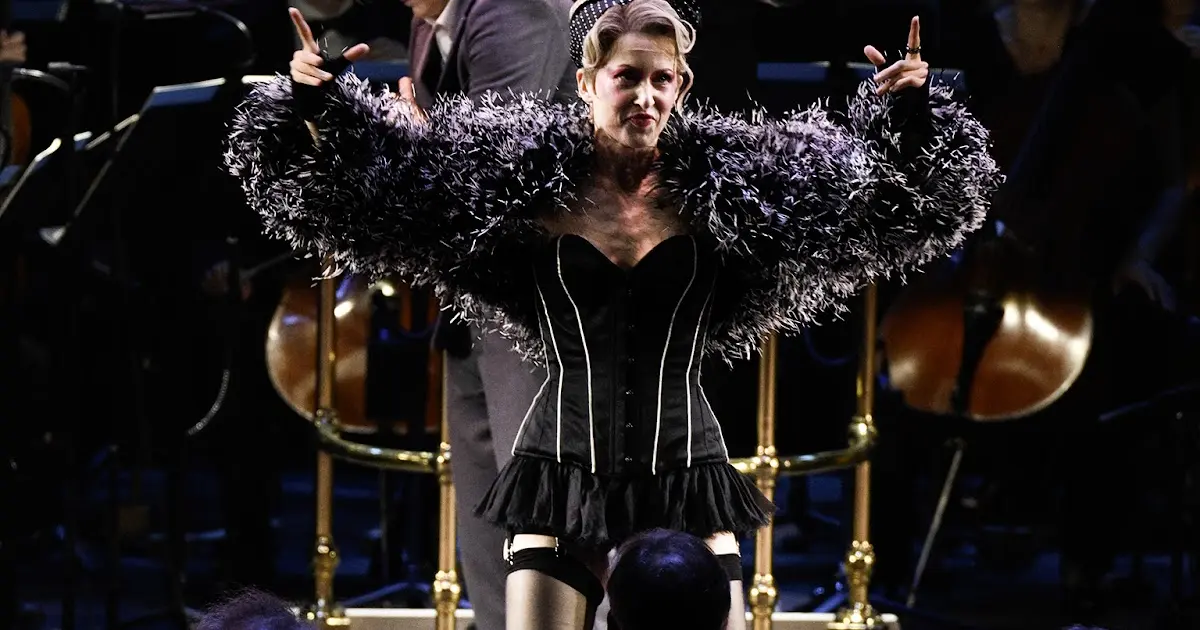
Meanwhile, Alina Wunderlin’s Zerbinetta initially sparked concerns that her lyric coloratura might struggle against the Albert Hall’s vast acoustic expanse. However, during her tour-de-force numbers—notably “Grossmächtige Prinzessin”—Wunderlin demonstrated an exceptional ability to "work the room." Transforming sections of the aria into an audacious, high-stakes cabaret, she combined vocal agility with absolute stage command.
The nymph trio—comprising Anna Denisova (Naiad), Ekaterina Chayka-Rubinstein (Dryad), and Eirin Rognerud (Echo)—delivered fine-grained tone and sophisticated ensemble blending, treated as equals rather than mere vocal background. Similarly, Mikhail Timoshenko’s energetic Harlequin anchored the commedia troupe, whose members actively sang and danced with visceral theatrical effect.
Supporting Context & Metrics
Venue Acoustics and Orchestral Balance
| Production Metric / Parameter | Detail / Observation |
|---|---|
| Venue | Royal Albert Hall, London |
| Event | BBC Proms (August 19, 2026) |
| Performing Company | Glyndebourne Opera |
| Orchestra | London Philharmonic Orchestra (LPO) |
| Conductor | Robin Ticciati |
| Director | Paul Higgins (after Laurent Pelly) |
| Key Soloists | Rachel Willis-Sørensen, David Butt Philip, Alina Wunderlin, Samantha Hankey |
Historically, the Royal Albert Hall’s acoustic profile has swallowed up orchestral detail and forced conductors to over-compensate dynamically. Under Robin Ticciati, however, the London Philharmonic Orchestra performed in a reduced chamber formation. This stylistic choice allowed for rapid dynamic shifts and a kaleidoscope of orchestral colors that mirrored the mercurial mood swings of Strauss’s score.
Rather than competing with the singers, the orchestral texture offered a supportive, transparent cushion. Every woodwind flutter and string sigh resonated clearly, avoiding the balance issues that have previously plagued full-orchestra operatic ventures in the space.
Comparative Artistic Framework
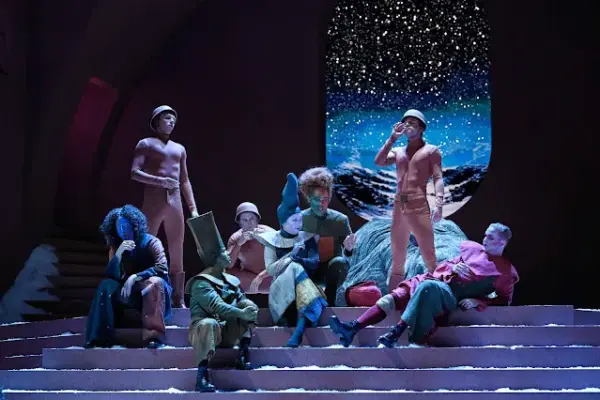
This triumphant Proms outing stood in stark contrast to other recent European treatments of the same score. Critics and audiences alike noted how refreshing it was to encounter a production that respected the dramatic and musical integrity of Strauss and Hofmannsthal, sidestepping the alienating futuristic concepts—such as Ersan Mondtag’s controversial Life on Mars staging in Salzburg earlier that month—in favor of textual fidelity and deep psychological insight.
.jpg)
Official Statements & Artistic Vision
While formal press releases from Glyndebourne emphasized the institutional triumph of exporting festival-standard opera to a mass audience via the BBC Proms, the artistic intent was best captured through the execution of the performers.
Director Paul Higgins, working from Laurent Pelly’s foundational vision, prioritized clarity and emotional truth over extraneous directorial concepts. By stripping away complex set pieces, the creative team forced a renewed concentration on the spoken and sung text.
Conductor Robin Ticciati consistently championed the adaptability of the LPO, noting in pre-festival discussions the necessity of flexibility when migrating productions conceived for the intimate, enclosed auditorium of Glyndebourne to the sprawling arena of South Kensington. The seamless transition underscored a growing institutional mastery of "promenade opera" adaptation—a trend that has seen recent successes, such as 2024’s acclaimed Carmen, cement Glyndebourne’s reputation for inventive spatial pragmatism.
Future Outlook
The success of Glyndebourne’s Ariadne auf Naxos at the 2026 BBC Proms signals a promising trajectory for large-scale opera presentation in non-traditional spaces. By proving that high musical values, rigorous vocal discipline, and intelligent, minimalist staging can conquer the acoustic and spatial challenges of the Royal Albert Hall, the partnership has established a viable blueprint for future festival co-productions.
As opera companies across Europe grapple with escalating production costs and the logistical burdens of touring elaborate physical sets, Glyndebourne’s minimalist methodology offers an economically sustainable and artistically superior alternative. Future Proms seasons will undoubtedly look to this production as a benchmark for how to honor complex masterworks without losing the audience in the expanse of a 5,000-seat auditorium.
.jpg)
For the fortunate thousands in attendance on August 19, 2026, the evening was a potent reminder that when music and drama are executed with this level of uncompromising dedication, no stage is too large, and no venue too unsympathetic.