Executive Overview
The contemporary landscape of global underground music is undergoing a profound structural shift. Driven by hyper-connectivity, cross-continental collaborations, and a collective yearning for authentic regional identities mediated through modern production techniques, the boundaries separating traditional folkways from cutting-edge electronic manipulation continue to dissolve.
Nowhere is this phenomenon more acutely observed and celebrated than in Nightshop, the flagship curation and broadcast series spearheaded by the cultural collective Rebel Up. For its October 2026 edition, the program delivers an uncompromising, multi-layered journey across the international sonic spectrum.
This month’s broadcast transcends simple genre-hopping. It acts as an anthropological and musicological archive in real-time, mapping the circulatory routes of diaspora communities, ancestral rhythms, and avant-garde sound design. From the chill, hypnotic contours of Peruvian chicha-cumbia to the fierce, broken-beat political collages traversing the Middle East and Ireland, the October 2026 session presents a masterclass in global jazz-rock, Anatolian psychedelic trance, Okinawan global dub, and modern club-oriented Maloya.
Designed for both the casual listener and the dedicated ethnomusicological crate-digger, this edition reinforces Rebel Up’s status as a vital curator of transnational counter-narratives. This article provides an exhaustive, analytical breakdown of the October 2026 installment, examining its conceptual underpinnings, the ideological and cultural weight of its featured albums, and the broader geopolitical soundscapes shaping the modern underground.
Detailed Chronology: A Sonic Voyage Through October 2026
The October 2026 Nightshop journey unfolds with a deliberate structural cadence, moving from foundational "Songs of the Day" that ground the listener in distinct regional idioms before expanding into a sprawling ecosystem of feature albums and compilations.
Phase One: The Overture and Songs of the Day
The broadcast commences with an evocative introductory sequence before launching into three disparate geographic anchors.
- Abelardo Carbono & Frente Cumbiero – "Kambamba Liki": This collaboration merges the legendary Colombian guitar stylings of Carbono with Frente Cumbiero’s contemporary, avant-garde tropicalia. The track establishes a dense rhythmic baseline that honors Caribbean and South American coastline traditions while bending them into modern configurations.
- Matthew Herbert – "Pasta (is not a luxury)": Demonstrating the program’s penchant for conceptual, socio-politically charged art-pop, Herbert subverts standard compositional tropes, using acoustic manipulation and conceptual sound-design to critique modern economic precarity through the lens of everyday sustenance.
- Dorival Caymmi – "Canoeiro (Pescaria)": Reaching back into the archival canon of Brazilian MPB and coastal folklore, Caymmi’s timeless vocal and acoustic guitar framework serves as a reminder of the deep ancestral waters from which contemporary tropical music draws its lifeblood.
Phase Two: The Global Album Showcase
Following the introductory overture, Nightshop plunges into its core focus: a meticulously sequenced battery of album showcases and deep-dive compilations.
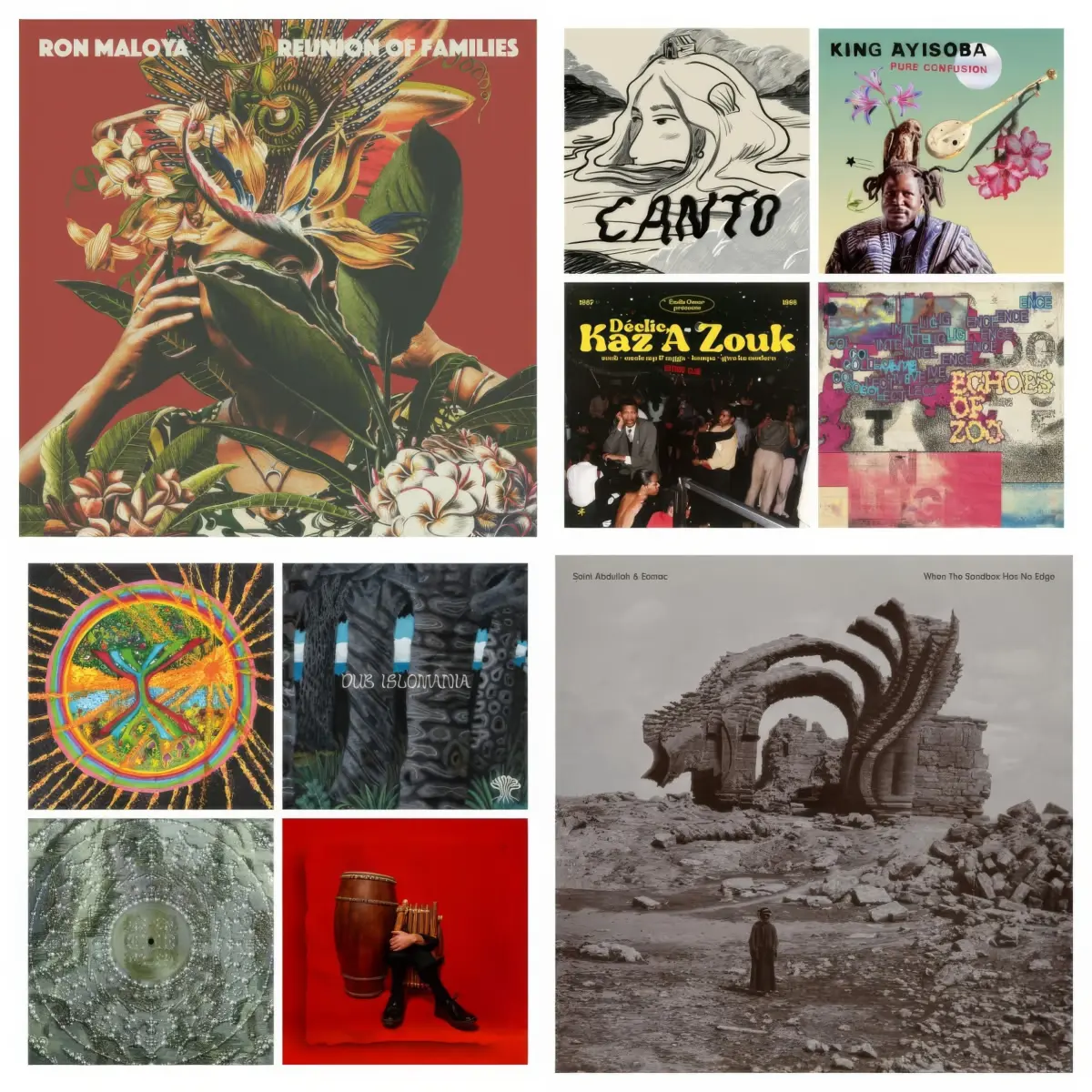
1. Oriente Tio – Canto (Self-Released)
- Featured Tracks: "Ballon," "Cumbia del Desierto," "Cumbión Del Fin"
- Analysis: Hailing from Peru, Oriente Tio anchors the month’s Latin American representation with a masterclass in chill, hypnotic chicha-cumbia. The tracks eschew the frantic energy of contemporary commercial cumbia in favor of spacious, reverb-drenched guitar lines, undulating bass frequencies, and organic percussion that evoke vast Andean plateaus and dry coastal deserts.
2. King Ayisoba – Pure Confusion (Mais Um)
- Featured Tracks: "Property," "Dey Come," "Memsoh"
- Analysis: Ghanaian traditionalist and modern minstrel King Ayisoba brings an uncompromising, ferocious folk-pop energy to the forefront. Utilizing the kologo (a traditional two-stringed lute) alongside raw, driving percussion and his signature guttural vocal delivery, Ayisoba balances ancient Ghanaian storytelling with a punchy, modern urgency.
3. V/A – Ron Maloya: Reunion of Families (JuJu Sounds)
- Featured Tracks: Maëlle Philéas – "Namouniman," Kozman Ti Dalon – "Goïnda ilé," Etinsèl Maloya – "Amize Marmaille"
- Analysis: Curated as an intergenerational family reunion of Réunion Island’s traditional Maloya music, this compilation traces the roots and evolution of a genre born from the descendants of slaves and contract laborers. The tracks highlight call-and-response vocal structures, the resonant beat of the roulé drum, and the rattling metallic sati, celebrating endurance and communal identity.
4. Émile Omar présente – Déclic, Kaz A Zouk: Zouk – Créole Rap & Ragga – Kompa – Gwo Ka Modern (1987 – 1998) (Heavenly Sweetness)
- Featured Tracks: Van Lévé – "Invitation à la Danse," Sylviane Cédia – "La Guyanaise," Zshea – "Rozalie, Rozalie"
- Analysis: A vital archival intervention curated by Émile Omar, this compilation rescues the vibrant, highly danceable Caribbean club sounds of the late 1980s and 1990s. Spanning high-gloss Zouk, early Créole rap, infectious ragga, smooth Kompa, and modernized Gwo Ka, the release maps the cultural exchange networks between the French Antilles, Guyana, and the broader diaspora.
5. Echoes Of Zoo – Collective Intelligence (Zephyrus & Rebel Up)
- Featured Tracks: "Higher Levels," "Wolf Pack Telepathy," "Multicellularity"
- Analysis: Belgian outfit Echoes Of Zoo bridge the gap between jazz improvisation and rock aggression through an ecological lens. Their global jazz-rock compositions mimic the complex communication systems of the natural world, utilizing frenetic saxophone lines, heavy drum grooves, and hypnotic basslines to construct an intense auditory ecosystem.
6. BaBa ZuLa – XXX (Glitterbeat)
- Featured Tracks: "CÃplusrtlak 9," "Kutsal Zeytin HalayÃplus," "Hak Bitmez Güç Bitee"
- Analysis: Veterans of the Istanbul underground, BaBa ZuLa return with XXX, reinforcing their legacy as pioneers of Anatolian psychedelic trance rock. Integrating electric saz, dub-heavy production, traditional belly-dance rhythms, and immersive analog electronics, the band creates a trance-inducing ritualistic soundscape.
7. Harikuyamaku – Dub Islomania (Self-Released)
- Featured Tracks: "Kubagasa Gwaa," "Turubaimun," "Pacific Dub"
- Analysis: Operating out of Okinawa Island, producer Harikuyamaku reinterprets traditional Ryukyuan folk music through the lens of global sound-system culture. The result is a deep, immersive dub record that honors indigenous Japanese scales and percussion while enveloping them in heavy bass, tape echoes, and spacious spatial reverb.
8. Le Motel – Pozo de Agua (Constellation Tatsu)
- Featured Tracks: "Mangrove," "Sundogs," "Cabane"
- Analysis: Brussels-based producer Le Motel offers a contrasting breath of fresh air with Pozo de Agua. Known for his field-recording-heavy, textural electronic productions, this album moves softly between ambient atmospheres, organic micro-rhythms, and delicate melodic motifs, capturing an intimate, meditative sonic geography.
9. Saint Abdullah & Eomac – When The Sandbox Has No Edge (Planet Mu)
- Featured Tracks: "As We Are (ft. Armand Hammer)," "Eyes See What The Camera Cannot Feel," "Willing In The Name Of (ft. Seraphim)"
- Analysis: One of the most politically and sonically confrontational releases of the month, the Iranian-Irish duo Saint Abdullah joins forces with producer Eomac (alongside guest contributions from experimental hip-hop duo Armand Hammer). The album presents a fierce, fragmented broken-beat collage, stitching together Middle Eastern sonic textures, industrial grit, and heavy bassweight to explore themes of displacement, surveillance, and resilience.
10. Roscius & Loya – B‐Sides (Nomadic Recordings)
- Featured Tracks: "Grit (club rework)," "Carnawar (Loya Remix)"
- Analysis: Concluding the primary album journey, French-Réunionese electronic artists Roscius and Loya team up to deliver club-ready mutations of Maloya. By feeding acoustic island instruments and ancestral polyrhythms into modular synthesizers and club-ready drum machines, they bridge the gap between rural heritage and European club culture.
Supporting Context & Metrics: The Anatomy of Rebel Up
To fully comprehend the significance of the October 2026 Nightshop broadcast, one must analyze the infrastructure and cultural momentum driving Rebel Up as an independent media and event production node based in Brussels.
Distribution and Reach
- Accessibility: Rebel Up maintains an open-access philosophy, utilizing digital distribution nodes such as TinyURL endpoints (
https://tinyurl.com/Night142) for direct podcast downloads, alongside dedicated streaming integration via platforms like Rhythm Passport. - Archival Depth: Nightshop is not an isolated broadcast; it forms part of an extensive, multi-year chronological archive that documents the underground global music community, numbering over 140 distinct monthly iterations.
- Geographical Hub: Centered in Brussels—a primary geopolitical and cultural crossroads of the European Union—Rebel Up leverages its physical location to absorb migrant sounds, diasporic communities, and pan-European touring circuits, transforming the Belgian capital into a listening post for the Global South.
Official Statements and Curatorial Philosophy
While independent underground music curation often resists corporate public relations frameworks, the underlying ethos of the Rebel Up collective can be understood through recurring editorial statements and liner notes accompanying the featured releases:
- On the Elimination of Geographic Hierarchies: Curatorial notes across the October 2026 selections emphasize that the program rejects the historical dichotomy between "Western art music" and "World music." By placing Peruvian chicha alongside Irish-Iranian industrial club tracks, the platform asserts that contemporary electronic and folk experimentation are occurring simultaneously across all coordinates of the globe.
- On Archival Preservation via Modern Production: Compilations like Émile Omar’s Déclic, Kaz A Zouk and Ron Maloya reflect a deliberate curatorial mission: "To rescue regional sonic histories from the threat of digital obsolescence by recontextualizing them for modern sound systems and contemporary dancefloors."
- On Political Resistance Through Sound: Speaking on collaborative projects like Saint Abdullah & Eomac’s work with Armand Hammer, underground music critics and the artists themselves frequently frame their sonic collages as acts of sonic counter-surveillance and geopolitical reclamation, using broken beats and fragmented samples to mirror the fractured realities of modern displacement.
Future Outlook: The Trajectory of Global Underground Curation
As the music industry continues to grapple with algorithmic homogenization and the hyper-commercialization of streaming platforms, independent curators like Rebel Up and their monthly Nightshop broadcasts provide an indispensable public service.
Looking forward into late 2026 and beyond, several structural trends can be inferred from this month’s programming:
- The Regional Club Mutation: Traditional folk forms are increasingly shedding their museum-piece status. Artists like Roscius, Loya, and Harikuyamaku demonstrate that ancestral rhythms (whether Maloya or Ryukyuan folk) can be successfully weaponized for contemporary club environments without stripping them of their cultural significance.
- Diasporic Cross-Pollination: Collaborations spanning disparate conflict zones and diaspora hubs—such as the Iranian-Irish alliance of Saint Abdullah & Eomac—signal a rising wave of transnational solidarity through shared studio experimentation.
- The Vitality of Hyper-Local Archives: As demonstrated by the robust reception of 90s Caribbean zouk/kompa rediscoveries, listeners are increasingly hungry for deep-dig archival projects that challenge dominant Western pop histories.
For music fans, researchers, and DJs alike, Rebel Up’s October 2026 Nightshop serves as both an essential listening session and a navigational map for the future of borderless sound. Listeners are encouraged to download episode #142 via the official Rebel Up portals and explore the extensive back-catalogue of previous sonic dispatches.