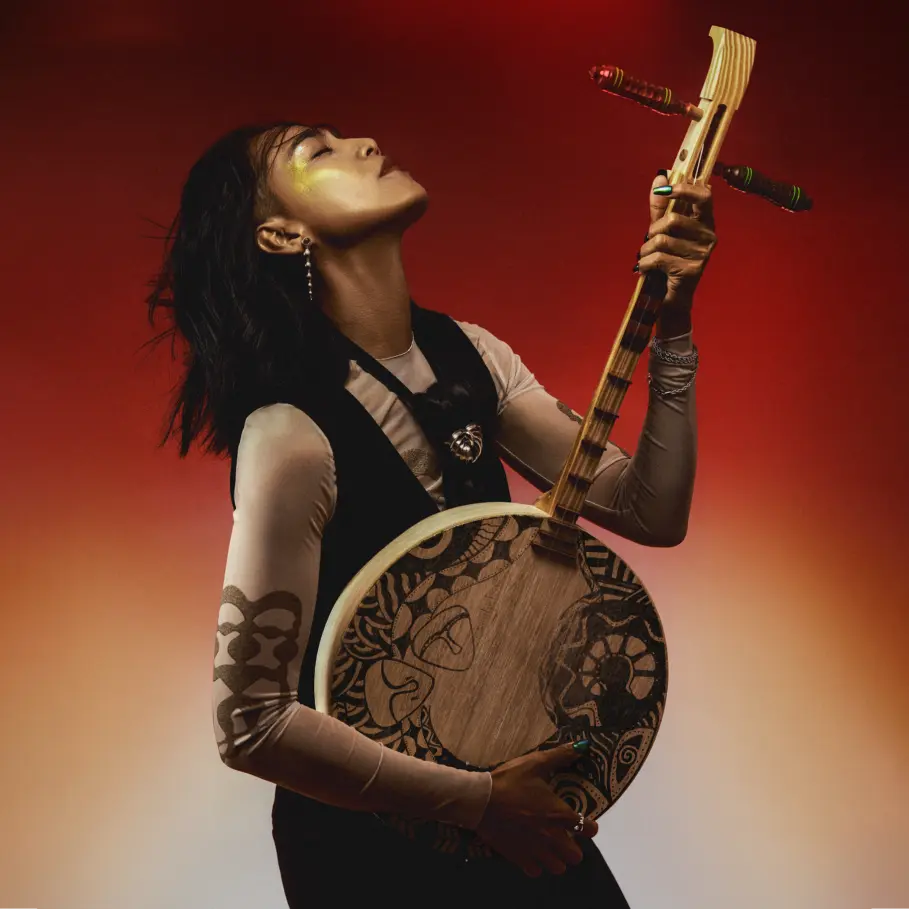
In the rugged southern reaches of Taiwan’s Hengchun Peninsula, where the Pacific Ocean collides with the Taiwan Strait, a quiet sonic revolution has been brewing. It is a movement that bridges the generational divide between ancient Indigenous traditions and the modern global music market. At the vanguard of this cultural resurgence is Sauljaljui, a genre-defying artist whose artistic trajectory has taken her from the frustrated iterations of a university nu-metal band to the grand stages of international world music showcases, most notably WOMEX 2026 in Las Palmas de Gran Canaria.
Sauljaljui’s journey is not merely a tale of personal reinvention; it is a profound testament to the resilience of the Paiwan people—an Indigenous community whose population numbers fewer than 200,000 and whose ancestral language faced systemic suppression under decades of colonial rule. Her self-produced 2025 album, VAIVAIK—a title translating from Paiwan as both "searching" and "embarking"—swept Taiwan’s prestigious Golden Melody Awards, taking home the coveted prize for Best Indigenous Language Album. Furthermore, its opening track, "Dipin Kari Tang," earned the accolade for Best Arrangement.
This deep dive examines Sauljaljui’s artistic evolution: from her accidental stumbling into a village elders’ folk circle to her cross-continental collaborations across the Indo-Pacific, her innovative adaptation of the two-stringed Chinese yueqin, and her upcoming mission to bring the pulsating life force of the Paiwan lands to a global European audience.
Detailed Chronology: From Heavy Metal Rejections to Village Elders
The City and the Dead Ends
Long before she was recognized as a standard-bearer for Austronesian contemporary music, Sauljaljui was just another frustrated youth navigating the underground music scene in Taiwan’s urban centers. Immersed in university life, she served as a heavy metal drummer, channeling teenage angst through double-kick bass pedals and distorted power chords. Like many ambitious underground musicians of her generation, her ultimate aspiration was to secure a slot at Spring Scream, Taiwan’s legendary independent music festival—a cultural milestone considered the Holy Grail for domestic rock bands.
Yet, year after year, her applications were rejected. The heavy metal circuit, for all its countercultural posturing, offered her little creative sanctuary. Burnt out by the relentless grind of urban life and the dead ends of her musical pursuits, Sauljaljui made the pivotal decision to pack up her kit and return home to Kapanan, her ancestral village nestled in the Hengchun peninsula at Taiwan’s southernmost tip.
The Village Room Revelation
Back in her home village, Sauljaljui confessed to an auntie that she still harbored a burning desire to make music. Recognizing the young musician’s restless energy, the auntie pointed her toward a local gathering space—a simple village room where elderly Paiwan community members habitually congregated to preserve and pass down their traditional folk songs.
When Sauljaljui opened the door that afternoon, she was greeted by a scene entirely removed from the high-gain amplifiers of her past. Inside sat a dozen elderly villagers, cradling yueqin—the traditional two-stringed Chinese moon lute—patiently working through ancient Paiwan melodies. Initially, her reaction was dismissive. To her urban-conditioned ears, it sounded like quintessential "old people’s music."
Unsure of how to exit politely, she pulled up a cajón box drum and began keeping time for them. Instantly, the dynamic shifted. Bolstered by a steady percussion anchor, the elders’ vocals locked into a unified, resonant rhythm, gaining newfound stability and syncopation. What began as a polite gesture soon evolved into regular attendance. She played every session, joined them on stage, and was swiftly embraced by the community as one of their own grandchildren.
The Flower on the Cliff
It was during these intimate musical sessions that Sauljaljui experienced a profound cultural awakening. Curious about the narrative weight of the songs she was accompanying, she asked one of the grandmothers to translate the lyrics.
The elder recounted a memory from her childhood: while playing hide-and-seek in the rugged terrain of the Hengchun hills, she had spotted a wild flower blooming high up on a sheer cliff face. Unreachable by hand, the young girl simply stood at a distance, gazing at the blossom until a sudden spring wind carried its delicate fragrance down to where she stood.
For Sauljaljui, the revelation was both humbling and searingly emotional. "At that moment, I felt a little ashamed, but also deeply warmed," she reflected. She realized that traditional folk music was not an archaic relic to be dismissed, but a living, breathing cartography of the land itself—a way of singing the earth into existence. Abandoning her role as a mere rhythm-keeper, she began studying the oral histories, idioms, and linguistic nuances directly from the elders, sitting alongside the village children to relearn the heritage she had long overlooked.
The Irony of the Stage
The culmination of this mentorship arrived through an unexpected full-circle moment. The village elders, who had adopted Sauljaljui into their artistic lineage, were invited to perform at Spring Scream—the very festival that had repeatedly slammed its doors in the face of her former heavy metal bands.
Standing backstage, Sauljaljui fondly remembers attempting to coach one of the grandfathers on how to flash the universal "rocker" hand gesture when stepping into the spotlight. Overcome by the adrenaline of the festival stage, the grandfather fumbled the gesture and instead bellowed out a triumphant, "Local!" into the microphone. The festival crowd erupted into pandemonium, instantly validating the raw, unpolished authenticity of the village troupe over decades of commercial packaging.
Supporting Context & Metrics: Instruments, Language, and Global Reach
Reinventing the Yueqin
Central to Sauljaljui’s signature sonic profile is her unorthodox deployment of the yueqin. Though historically a Chinese two-stringed lute rather than a native Austronesian instrument, the yueqin was adopted by the Hengchun Peninsula’s local folk traditions generations ago. Sauljaljui approached the instrument not with academic reverence, but with the structural curiosity of a drummer.
Recognizing the extreme limitations of an instrument boasting only two strings, she leveraged those constraints to carve out a unique minimalist idiom. Rather than treating the lute as a traditional melodic voice, she deployed it as a core rhythmic engine. By folding in the syncopated Austronesian rhythms she encountered during her travels across the Indo-Pacific, she transformed the folk lute into a bridge connecting disparate island cultures.
The Linguistic Struggle
Sauljaljui sings primarily in Paiwan, an indigenous language spoken by fewer than 200,000 people. Like many Formosan languages, Paiwan suffered systematic suppression during decades of authoritarian colonial rule, which outlawed native tongues in schools and public administration. This linguistic rupture hit close to home; Sauljaljui has openly recounted instances of her father criticizing her Paiwan pronunciation, and the lingering feelings of imposter syndrome that haunted her even after winning her first major accolades.
Yet, rather than viewing this linguistic barrier as a dead end, she uses it as a wellspring of resilience. "It’s okay if the audience doesn’t understand my language," she asserts. "When I stand on stage, I believe they can still feel the conviction and energy that I carry… If there were no language barriers, what would remain is energy."
Transnational Collaborations and VAIVAIK
Sauljaljui’s artistic scope extends far beyond local preservation. Her engagement with Small Island Big Song—an ongoing transnational arts project connecting Indigenous musicians across the Indian and Pacific Oceans—has profoundly shaped her worldview.
This cross-cultural dialogue culminated in her critically acclaimed 2025 self-produced album, VAIVAIK. The album’s creative process involved a transformative month-long residency in Mauritius, where she lived, ate, and jammed alongside local musicians. This immersive exchange birthed the album’s opening track, "Dipin Kari Tang," which subsequently secured the Golden Melody Award for Best Arrangement. Recorded alongside the renowned Taiwu Ballads Troupe back in Taiwan, the track serves as a manifesto for her artistic philosophy: that shared human recognition supersedes bloodlines and borders.
Official Statements & Artist Insights
In exclusive reflections shared ahead of her landmark showcase at WOMEX 2026, Sauljaljui articulated the core philosophy driving her musical mission:
-
On the Transition from Metal to Tradition:
"When I moved back to my hometown from the city to work, I met an auntie… When I opened the door [to the village room], I was surprised to see that everyone inside was elderly. They were playing the yueqin and singing traditional songs. At that time, I was honestly a little confused… But after I joined them, I started playing the cajón… As I spent more time with these elders, they began treating me like their own granddaughter. Being around them also made me softer and more gentle… It was as if I had found myself."
-
On Cultural Innovation:
"My culture has given me confidence. It taught me to truly believe that ‘tradition can be invented.’ When I became brave enough to respond to my culture with my own ideas, rather than simply following what already existed, I finally felt a sense of openness within myself."
-
On Transnational Kinship:
"’Dipin Kari Tang’ wasn’t something I imagined from a distance. It came from a real experience and became part of me. In my culture, recognition and belonging can sometimes be more important than blood relations. If we recognize one another, then we are brothers and sisters."
-
On the Role of the Artist:
"I never imagined that one day I would step outside of myself through my music. For me, I’m really just a messenger, a person who carries and shares the things I believe in. And strangely, that gives me a sense of freedom."
Future Outlook: The Van Tour and the Global Stage
As Sauljaljui prepares to step onto the international showcase stage at WOMEX in Las Palmas de Gran Canaria this October, her trajectory points toward an ambitious expansion of her grassroots educational and musical endeavors.
Far from viewing international festival circuits as an endpoint, she treats global exposure as fuel for community empowerment at home. In September, following the acquisition of a dedicated tour van, Sauljaljui is launching a mobile residency across Indigenous communities throughout Taiwan. Spending approximately a month in each village, she aims to share the insights, courage, and creative methodologies she has gathered on world tours with the next generation of rural youth. Her core message to them remains defiant and uplifting: Culture is not a limitation; it is the ultimate vehicle for engaging with the wider world.
For the audiences gathered in Las Palmas—and for the global music community tuning in—Sauljaljui offers a simple, disarming invitation:
"I’m Sauljaljui. Your long-lost half-sibling from another mother and another father. Come and listen to what I have to say."