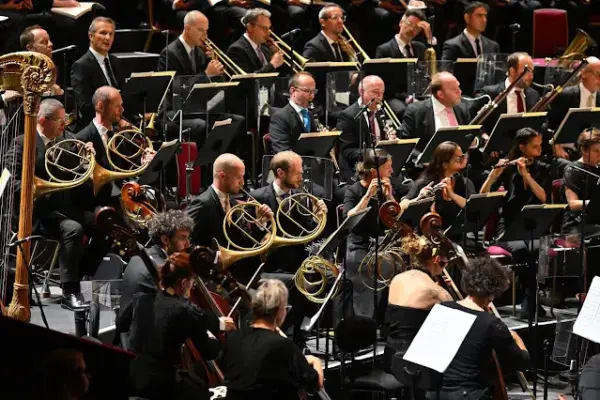
On Saturday, August 15, 2026, the historic Royal Albert Hall played host to one of the most monumental and formidable undertakings in the classical choral-orchestral repertoire: Hector Berlioz’s Grande messe des morts (Requiem), Op. 5. Delivered as a pinnacle event of the prestigious BBC Proms, the performance was spearheaded by Sir Antonio Pappano, who conducted the elite forces of the London Symphony Orchestra (LSO). The magnitude of the staging was further magnified by the titanic union of the London Symphony Chorus, prepared by chorus-master Mariana Rosas, and the BBC Symphony Chorus, under the guidance of chorus-master Neil Ferris. Marking a significant career milestone, French tenor Julien Henric made his highly anticipated Proms debut as the featured soloist in the Sanctus.
Rather than relying entirely on the overwhelming, chaotic noise often associated with Berlioz’s spatial experimentations, Pappano opted for an interpretation characterized by a meticulous marriage of grandeur and razor-sharp clarity. While purists of the composer’s theatrical layout noted the absence of the classic spatial diffusion—traditionally achieved by placing separate brass choirs in the far-flung balconies or cathedral domes—Pappano’s centralization of the forces granted him astonishing control. The result was an artistic paradox: a performance of immense, earth-shattering power that simultaneously laid bare the stark, austere, and deeply intimate chamber-like textures embedded within Berlioz’s monumental score. Culminating in a moment of pure transcendence, the concert reaffirmed the enduring capacity of the Royal Albert Hall to contain and project seismic emotional landscapes, even as critics and connoisseurs debated the nuances of modern-instrument performance practice.
Detailed Chronology: A Journey from Austerity to Transcendence
Opening and the Kyrie: Establishing the Tone
The evening commenced with an immediate subversion of expectations. Berlioz’s Requiem is frequently stereotyped as a work of relentless, bombastic "blood and thunder," but Pappano was quick to correct this misconception from the outset. The opening orchestral chords drifted into the hall with a hushed, restrained intensity that commanded absolute silence from the packed auditorium.
When the massed voices of the London Symphony Chorus and BBC Symphony Chorus made their initial entry, they delivered a breathtaking synthesis of floated tone and sharply pointed accents. Throughout the Requiem aeternam and the subsequent Kyrie, Pappano favored a spare, unvarnished aesthetic. Reviewers noted that terms like "spare" and "austere" dominated their mental margins as the music unfolded with an architectural purity. There was a notable absence of indulgent romanticism; instead, Pappano drew out the striking, minimalist potency of Berlioz’s writing, proving that the composer could achieve maximum psychological weight using just two or three meticulously drawn motifs.
.JPG)
The Dies Irae Sequence: Terror and Control
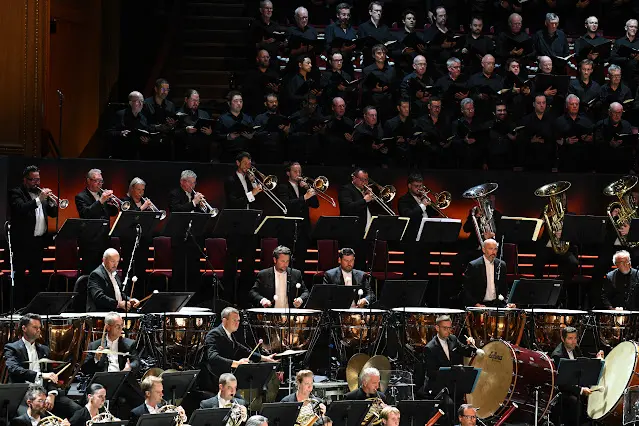
The emotional temperature rose exponentially with the arrival of the Dies Irae. Pappano drove the choral counterpoint forward with palpable urgency, showcasing the phenomenal technical discipline of the combined choruses. Visually and sonically, the performance transformed into high theater during the Tuba mirum. Ten timpanists—wielding no fewer than 19 drums arranged in an imposing arc behind the orchestra—unleashed a cataclysmic rhythmic assault that reverberated through the chests of everyone in the hall.
The integration of the extra brass ensembles, positioned in plain sight behind the percussion and the choir, provided an immediate, visceral thrill. Yet, this was never a descent into chaos. Pappano maintained a tight rein over the dynamic spectrum. In Mors stupebit, a chilling, mysterioso atmosphere blanketed the hall, while Liber scriptus highlighted the profound, hushed beauty of the tenor and bass sections.
As the sequence progressed into Rex Tremendae, the full might of the eight French horns was unleashed to create a grand, imposing edifice, which Pappano instantly juxtaposed with astonishingly intimate choral whispering. The Quaerens me stood out as a particular triumph, executed by the choir with near-total independence from the orchestra in an austere display of contrapuntal mastery. The sequence climaxed in a thoroughly operatic Lacrimosa, where the off-stage brass units joined the fray to weave an intricate, overwhelming sonic tapestry.
The Offertorium, Sanctus, and Agnus Dei
Turning the page to the Offertorium, the interpretive focus shifted squarely to the string section. Pappano coaxed a rich, resonant phrasing from the LSO strings, building a slow-burning architectural arc that held the audience spellbound. In the Hostias, the warm, ethereal tone of the chorus was humorously and brilliantly contrasted by the "Brucknerian" pronouncements of the extra trombones, whose rich, deep timbres added an earthy gravity to the sacred text.
.JPG)
The Sanctus offered a vehicle for tenor Julien Henric, whose Proms debut was marked by fine-grained vocal tone, elegant phrasing, and effortless projection. Henric’s lyrical contributions cut through the hall’s acoustics with refined grace, offering a moment of spiritual luminescence before the vigorous contrapuntal fireworks of the Hosanna. Upon the repeat of the Sanctus, Berlioz’s famous structural demand for eight pairs of cymbals was met with devastating precision, producing that signature, shivering "whoosh" that cuts straight through the listener’s senses.
The Agnus Dei brought the emotional trajectory back down to a low-key, contemplative state. Warm, hushed choral lines mingled once more with the characteristic, low-register brass flourishes. As the orchestra gradually re-entered, Pappano ensured every vocal and instrumental entry was positioned with pinpoint accuracy.
Resolution: Te Decet Hymnus
The evening drew to a close with the final movement, beginning with Te decet hymnus. Moving at a measured, deliberate pace, the music balanced moments of intense dramatic gravity with profound inwardness. Rather than concluding with mere acoustic volume, Pappano guided his forces toward a state of genuine, transcendent peace, leaving the audience suspended in the afterglow of a meticulously curated sonic journey.
Supporting Context & Metrics
The Venue and Spatial Dilemma
Staging Berlioz’s Requiem is inherently a logistical and acoustical puzzle. Written in 1937 to honor the victims of the July Revolution, the work calls for forces that far exceed standard orchestral writing. Historically, composer-conductors and modern interpreters have grappled with how to spatialize the four extra brass bands.
.JPG)
In a notable 2012 performance at St. Paul’s Cathedral, Sir Colin Davis placed the brass bands high up in the basilica’s dome, exploiting the cavernous, multi-second reverberation of the cathedral to create a disorienting, immersive spatial effect. At the Royal Albert Hall, Sir Antonio Pappano chose a different path. By clustering the massed timpani in an arc behind the orchestra and positioning the brass units directly behind the performers, Pappano sacrificed the radical spatial antiphony intended by Berlioz. In exchange, however, he gained absolute rhythmic and dynamic control. This decision favored structural clarity and transparency over cathedral-sized acoustic wash, though purists debated whether the loss of spatial bloom detracted from Berlioz’s original theatrical vision.
Numerical Magnitude and Instrumentation
To fully appreciate the scale of the 2026 Proms performance, one must look at the sheer numbers involved:
- Orchestra Size: Augmented to reflect Berlioz’s grand vision, anchored by the London Symphony Orchestra.
- Choral Forces: A massive amalgamation of the London Symphony Chorus and the BBC Symphony Chorus, combining hundreds of singers to achieve a dynamic range capable of whispering one moment and shattering the ceiling the next.
- Percussion Section: 10 timpanists playing a staggering total of 19 drums, creating a thunderous rhythmic foundation.
- Brass Section: Eight French horns for Rex Tremendae, supplemented by multiple extra brass ensembles strategically placed to maximize impact during the Dies Irae.
Official Statements and Critical Reception
While formal press reviews praised the overarching discipline of the performance, critics and musicologists engaged in healthy debates regarding performance practice on modern instruments.
Musicologist and critic Colin Clarke, writing for Planet Hugill, noted the unique balance achieved under Pappano’s baton:
.JPG)
"Thrilling moments and great visual theatre in a performance that combined grandeur with control and clarity, creating some remarkably intimate, austere moments and real transcendence at the end."
Discussions following the concert also touched upon historical authenticity. Observers questioned whether modern performance practices—such as the use of contemporary orchestral instruments and modern French pronunciation norms—fully capture the soundworld Berlioz envisioned. For instance, musicologists pondered whether Berlioz would have utilized saxhorns (as John Eliot Gardiner famously employed in his 2013 Paris performances of Les Troyens) for the extra brass parts in the Requiem, had they been widely available or preferred at the time of composition.
Despite these academic curiosities, the public response was overwhelmingly enthusiastic. The concert stood out as a high-water mark of the 2026 BBC Proms season, cementing Pappano’s collaborative rapport with the LSO and its allied choruses.
Future Outlook
For classical music enthusiasts who missed the live experience at the Royal Albert Hall—or for those wishing to re-examine Pappano’s interpretive choices—the complete audio broadcast remains accessible via BBC Sounds for 57 days following the event.
.JPG)
Regrettably, television cameras were not present inside the hall during the performance, depriving audiences of the chance to visually relive the striking theatricality of the massed timpani and the precision of the choral staging. Nevertheless, the performance leaves a lasting legacy for the 2026 Proms season, raising the bar for large-scale choral-orchestral programming in the United Kingdom. As Sir Antonio Pappano continues to shape the artistic vision of the London Symphony Orchestra, events of this scale demonstrate that even the most formidable masterpieces of the 19th-century repertoire can be rendered with both awe-inspiring power and crystalline intellectual rigor.