Executive Overview
Jazz has always maintained a paradoxical, almost mythical relationship with time. If one were to assign a classical archetype to the art form, it would undoubtedly be Tiresias—the blind prophet of ancient Thebes who possessed the rare and terrifying gift of seeing simultaneously into the past and the future. Operating within this perpetual creative wormhole, jazz has consistently drawn its lifeblood from the compost of historical precedent. Even in its most avant-garde, boundary-shattering iterations, the genre demands an encyclopedic mastery of its own lineage as a baseline requirement for breaking new ground.
Enter John Coltrane. In the sprawling pantheon of jazz greats, Coltrane is frequently cast as Zeus—the ultimate iconoclast who stretched the harmonic and spiritual boundaries of musical language to its absolute breaking point. Yet, the Promethean parallel is perhaps even more apt: Coltrane stole fire from the gods, bringing an intense, blinding spirituality to human ears, only to be consumed by his own creation. He passed away from liver cancer in 1967 at the height of his powers, leaving behind an indelible legacy of "fire music" that continues to scorch the landscape of modern composition.
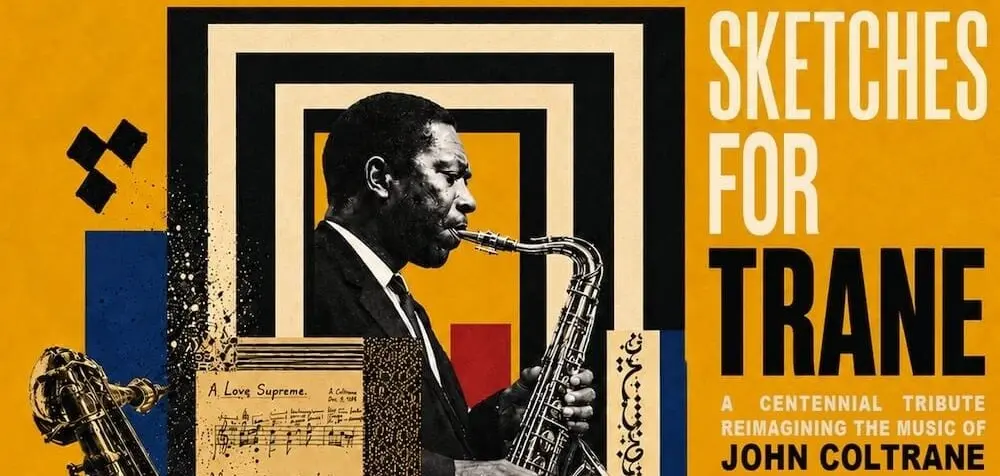
Now, as the music world prepares to celebrate the centenary of his birth, legendary percussionist and composer Kahil El’Zabar has stepped forward with Sketches For Trane (released via Spiritmuse Records). At 72 years old, El’Zabar has not merely crafted a tribute album; he has engineered a temporal bridge. By gathering some of the most dynamic luminaries of contemporary improvised music, Sketches For Trane looks backward to propel Coltrane’s gospel of expanded human consciousness directly into the ears of a new generation. It is a monumental achievement—a towering masterclass in reverence, reinvention, and rhythmic vitality that stands among the finest releases of the decade.
Detailed Chronology: Unpacking the Suite
The conceptual architecture of Sketches For Trane is built upon a delicate balance of reverence for the source material and reckless, visionary abandon. Across its various movements and reinterpretations, El’Zabar marshals a masterclass of collaborators to refract Coltrane’s catalog through a prism of modern Chicago-school avant-garde sensibilities and global percussion traditions.
Trane in Mind: The Crucible of Collaboration
El’Zabar’s enduring footprint on the Chicago jazz landscape dates back to the early 1970s. As the founder of the pioneering Ethnic Heritage Ensemble, a vital member of the Association for the Advancement of Creative Musicians (AACM), and a collaborator with legends ranging from Pharoah Sanders to Nina Simone, El’Zabar commands a profound historical authority. Nowhere is this more evident than on Trane in Mind, a composition that pairs El’Zabar with titanic saxophonist David Murray.
The track channels the playful, unpredictable energy of the Art Ensemble of Chicago, juxtaposing whimsical, see-sawing melodies with heavy, untethered free-blowing. Murray’s performance is nothing short of incendiary. He supercharges complex streams of musical logic with raw, visceral emotional torrents. Listening to Murray navigate the changes, one gets the distinct impression of a musician turning himself entirely inside out—searching desperately for that microscopic crack in his reed that might generate enough lift to make the entire ensemble levitate off the floor.
Sketches of a Love Supreme: Spiritual Candour and Tragic Resonance
The ghosts of jazz history loom large over Sketches of a Love Supreme, El’Zabar’s bold reimagining of Coltrane’s crowning spiritual masterpiece. The legendary opening motif of the original suite is dismantled and reassembled with a wonderfully lopsided, skip-rhythm that immediately destabilizes listener expectations.
From this rhythmic foundation emerges vocalist Dwight Trible, whose voice vibrates with a piercing spiritual candour not felt with such intensity since Albert Ayler’s Music is the Healing Force of the Universe. Trible’s delivery carries a message of profound cosmic yearning, rendered all the more poignant by the surrounding instrumental performances: Corey Wilkes’s exquisite, crying trumpet lines intertwining with the majestic piano of David Ornette Cherry.
Crucially, these recordings carry a devastating historical weight. David Ornette Cherry—son of legendary pocket trumpet pioneer Don Cherry, and brother of Nenah and Eagle-Eye Cherry—passed away just nine months after these sessions were captured, dying tragically in a London hotel room following a performance at a tribute concert dedicated to his father. His playing on this album stands as a breathtaking, valedictory testament to his immense talent.
Resolution and Afro Blue: Cubist Perspectives and Celestial Chi
The suite’s exploration of Coltrane’s A Love Supreme continues with Resolution, reinterpreted here by rising saxophone powerhouse Isiah Collier. Collier approaches the movement with the analytical mastery of a Cubist painter, splintering the core themes into multiple simultaneous perspectives. Alongside sudden, thunderous bursts of El’Zabar’s "drum-clouds" and Justin Dillard’s shimmering keyboard textures, Collier achieves an immolating, transcendent release of tension.
The album closes with Sketches of an Afro Blue, a dense, mesmerizing tapestry of tessellating percussion that feels less like a backing rhythm and more like the pavement convulsing beneath your dancing feet. This jiving, earth-bound bedrock provides the foundation for cellist Ishmael Ali to soar into the stratosphere, exploring the outer limits of his instrument as he spins line upon celestial line of healing chi.
Supporting Context & Metrics: The Architectural Pillars of the Project
To fully appreciate the scope of Sketches For Trane, one must examine the institutional and cultural infrastructure that birthed it. Jazz in the 21st century faces a unique crisis of historicism: it risks becoming a museum piece, preserved under glass by academic institutions rather than cultivated as a living, breathing folk art of the urban experience.
Kahil El’Zabar’s career represents the direct antithesis of this academic stasis. Born in Chicago, El’Zabar absorbed the foundational ethos of the AACM—an organization that has spent over half a century championing "Great Black Music" by prioritizing original compositions, multi-instrumentalism, and cross-genre fertilization.
- The Chicago-New York Axis: Projects like Sketches For Trane rely heavily on the invisible infrastructure of elite improvisation networks. The album bridges Chicago’s rhythmic, communal avant-garde lineage with the explosive tonal vocabulary of New York and West Coast modernism.
- Lineage and Generational Wealth: By integrating veteran forces like David Murray and Kahil El’Zabar with mid-career virtuosos (Corey Wilkes, Justin Dillard) and the blazing torchbearers of the current generation (Isiah Collier, Ishmael Ali), the album functions as an oral and practical transmission of musical DNA.
- Spiritmuse Records and Independent Distribution: Released via Spiritmuse Records—an imprint known for championing uncompromising, spiritually elevated jazz—the project bypasses the risk-averse formulas of major labels, ensuring that the uncompromising fire of Coltrane’s legacy is delivered unfiltered to dedicated listeners via physical formats and platforms like Bandcamp.
Official Statements & Critical Perspectives
While Spiritmuse Records and the participating artists have maintained a focused narrative around the album as an act of communal devotion, early critical reception has highlighted the project’s historical significance.
In statements accompanying the release rollout, El’Zabar emphasized that Sketches For Trane is not designed as a note-for-note replication of historical artifacts, but rather as an ongoing dialogue with the cosmos. "Trane gave us a roadmap to the infinite," El’Zabar notes in production briefs. "Our job, as practitioners of this music, is not to park our cars at his destination, but to use his map to drive further into the unknown."
Reviewers across the international jazz press have echoed this sentiment, praising the album’s refusal to slip into nostalgic pastiche. Critics have particularly underscored the courage required to reinvent A Love Supreme—a work treated by many purists as untouchable dogma. By injecting swing, polyrhythmic complexity, and avant-garde texture into the sacred text, El’Zabar and his ensemble have proven that Coltrane’s compositions are living organisms capable of infinite mutation.
Future Outlook: The Ongoing Evolution of Spiritual Jazz
As the global jazz community approaches the official centenary of John Coltrane’s birth, Sketches For Trane establishes a high-water mark for how legacy projects should be executed. It avoids the tired trap of retrospective box sets and celebrity-laden guest appearances, opting instead for a cohesive, fiercely energetic suite created by artists who live and breathe the idiom daily.
Looking forward, the ripple effects of this release are expected to resonate deeply within the contemporary improvised music scene. It signals a growing appetite for spiritually grounded, rhythmically complex jazz that speaks directly to the socio-political and existential anxieties of the 2020s. Just as Coltrane used his horn to search for divine order during the turbulent civil rights era, today’s masters are mobilizing that same fire music to navigate an increasingly fractured modern world.
At 72 years of age, Kahil El’Zabar has delivered a career-defining statement that honors a titan while cementing his own immortality within the canon. He has successfully gone back to the future, propagating Coltrane’s eternal message of expanded human potential to a world that desperately needs to hear it. To paraphrase a famous scientific milestone: this is one small step for man, but one Giant Steps for mankind.
Release Details:
- Sketches For Trane
- Release Date: September 23rd, 2026
- Label: Spiritmuse Records
- Format: Digital Download / Streaming / Physical
- Link: Bandcamp