Executive Overview
London’s historic Whitechapel Gallery currently plays host to a monumental cultural milestone: Living Threads, the first major United Kingdom retrospective dedicated to the visionary eco-feminist artist, poet, and activist Cecilia Vicuña. Born on the arid outskirts of Santiago, Chile, in 1948, Vicuña’s life and creative output have long been shaped by displacement, political upheaval, environmental consciousness, and an unyielding commitment to the relationality of all living things.
Spanning decades of cross-disciplinary production—from her formative years as an exiled dissident in London and Bogotá to her current home in New York—the exhibition arrives at a time of long-overdue global commercial and institutional recognition for the artist. Following her receipt of the prestigious Golden Lion for Lifetime Achievement at the 59th Venice Biennale in 2022 and her subsequent win of the Icon Artist Gold Medal at Art Basel Miami Beach in 2025, Living Threads cements Vicuña’s status as a towering figure in contemporary international art.
The exhibition is much more than a retrospective; it is a living, breathing ecosystem. Through massive textile installations like Quipu Menstrual 1 (unknotted) (2006–2024), surrealist paintings recreated after decades in exile, and interactive public projects such as Foraging Quipu (2025–2026), Vicuña challenges Western paradigms of monumental permanence. Instead of cold stone and static bronze, she offers up raw wool, organic detritus, and fleeting moments of human interaction. The result is a profound meditation on the invisible threads connecting humans, plants, animals, and the earth—an urgent artistic vocabulary for an era defined by ecological crisis and socio-political fragmentation.
Detailed Chronology: From the Foothills of Santiago to the Global Stage
To fully grasp the weight of Living Threads, one must trace the harrowing yet luminous trajectory of Cecilia Vicuña’s life, a narrative defined by the collision of personal memory, artistic innovation, and geopolitical trauma.
Formative Years and the Shock of Exile (1948–1975)
Vicuña’s artistic worldview was forged in the geographic and cultural landscapes of Chile. Growing up on the periphery of Santiago, she developed a deep, intuitive fascination with the vitality of fiber-based practices and the delicate interactions binding the natural world together. This early ecological intuition set the stage for her formal training at the prestigious Slade School of Fine Art in London, where she arrived in 1972 on a British Council scholarship.
However, the historical trajectory of her homeland—and her own life—was shattered in September 1973. The democratically elected Marxist president, Salvador Allende, was violently deposed in a brutal military coup led by General Augusto Pinochet. Suddenly, the nation Vicuña called home was swallowed by a regime characterized by terror, censorship, and systemic bloodshed. As a vocal leftist and artist studying abroad, Vicuña found herself effectively marooned; returning to Chile meant facing the very real threat of imprisonment, torture, or death.
Trapped in London as an exile, Vicuña channeled her grief and political outrage into collective action. In 1974, alongside fellow artists Guy Brett, John Dugger, and David Medalla, she co-founded Artists for Democracy (AFD). This groundbreaking London-based collective mobilized the international arts community to raise awareness about the plight of the Chilean people, protesting the Pinochet dictatorship and standing in solidarity with global liberation movements. While historical literature has occasionally relegated Vicuña to a secondary role within AFD, the Whitechapel Gallery exhibition boldly reclaims her foundational, steering position in the collective. Photographic documentation from 1974 shows an enthusiastic Vicuña surrounded by her Objects for the Chilean Resistance (1973–1974)—intimate, precarious assemblages crafted from overlooked and discarded daily items that screamed an intense, desperate desire for equality and survival amidst geopolitical terror.
The Nomadic Decades (1975–2000s)
When her UK visa expired in 1975, Vicuña embarked on a nomadic existence that would define the next chapter of her life. She relocated to Bogotá, Colombia, immersing herself in indigenous mythologies and pre-Columbian textile traditions before ultimately settling in New York in 1980.
Throughout these decades of rootlessness, much of Vicuña’s early output—including surrealist canvases produced during her student days—was lost, scattered, or destroyed during her continuous displacement. Yet, rather than capitulating to despair, Vicuña transformed loss into a generative mechanism. Her art became a repository for cyclic time, where the destruction of an object is never an absolute end, but merely a precursor to transformation.
The Ascendancy of an Icon (2022–Present)
For decades, Vicuña’s radical, eco-feminist, and anti-monumental practices operated on the margins of the mainstream commercial art market, which historically favored permanence, male-dominated heroic sculpture, and commodifiable luxury objects.
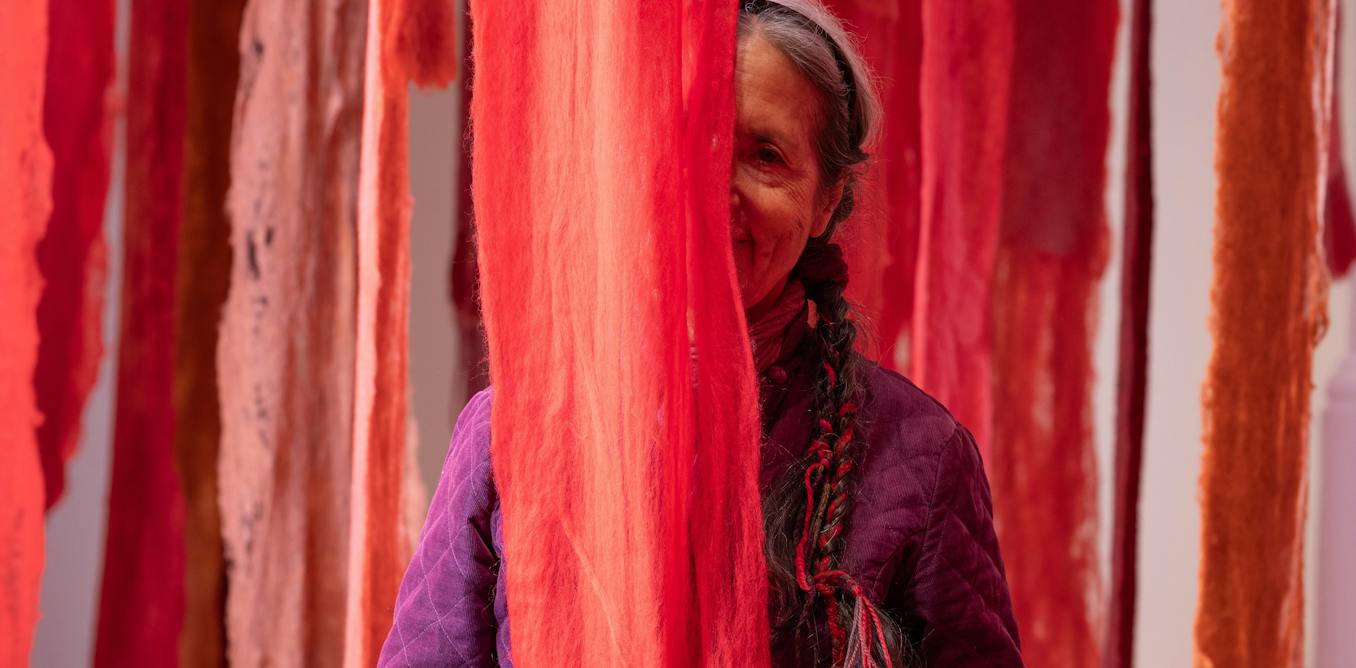
History, however, has caught up with her vision. The 2020s have marked an explosion of institutional acclaim. In 2022, the 59th Venice Biennale rightly honored her lifetime of pioneering work with the Golden Lion. This momentum carried forward into the mid-2020s, culminating in her receiving the Icon Artist Gold Medal at Art Basel Miami Beach in 2025. Living Threads at the Whitechapel Gallery stands as the crowning UK institutional acknowledgment of this long-overdue paradigm shift.
Supporting Context & Metrics: Decoding the Eco-Feminist Aesthetic
The Whitechapel exhibition offers visitors a masterclass in spatial choreography, subverting traditional gallery expectations through three distinct structural pillars: ephemeral monumentalism, political recovery, and participatory ecology.
| Exhibition Element | Medium / Materials | Core Thematic Focus |
|---|---|---|
| Quipu Menstrual 1 (unknotted) | Raw wool (deep reds, oranges, soft pinks) | Subversion of Western stone monuments; vitality of fiber; the "not yet." |
| Objects for the Chilean Resistance | Found objects, discarded everyday materials | Political dissidence, survival in exile, solidarity with global liberation. |
| Surrealist Paintings | Canvas, oil/mixed media (recreations) | Mourning lost history; cyclic time; the rebirth of destroyed archives. |
| Foraging Quipu | Natural and biological public contributions | Relationality, decomposition, communal transformation, viewer participation. |
The Monumentality of the Fragile: Quipu Menstrual 1
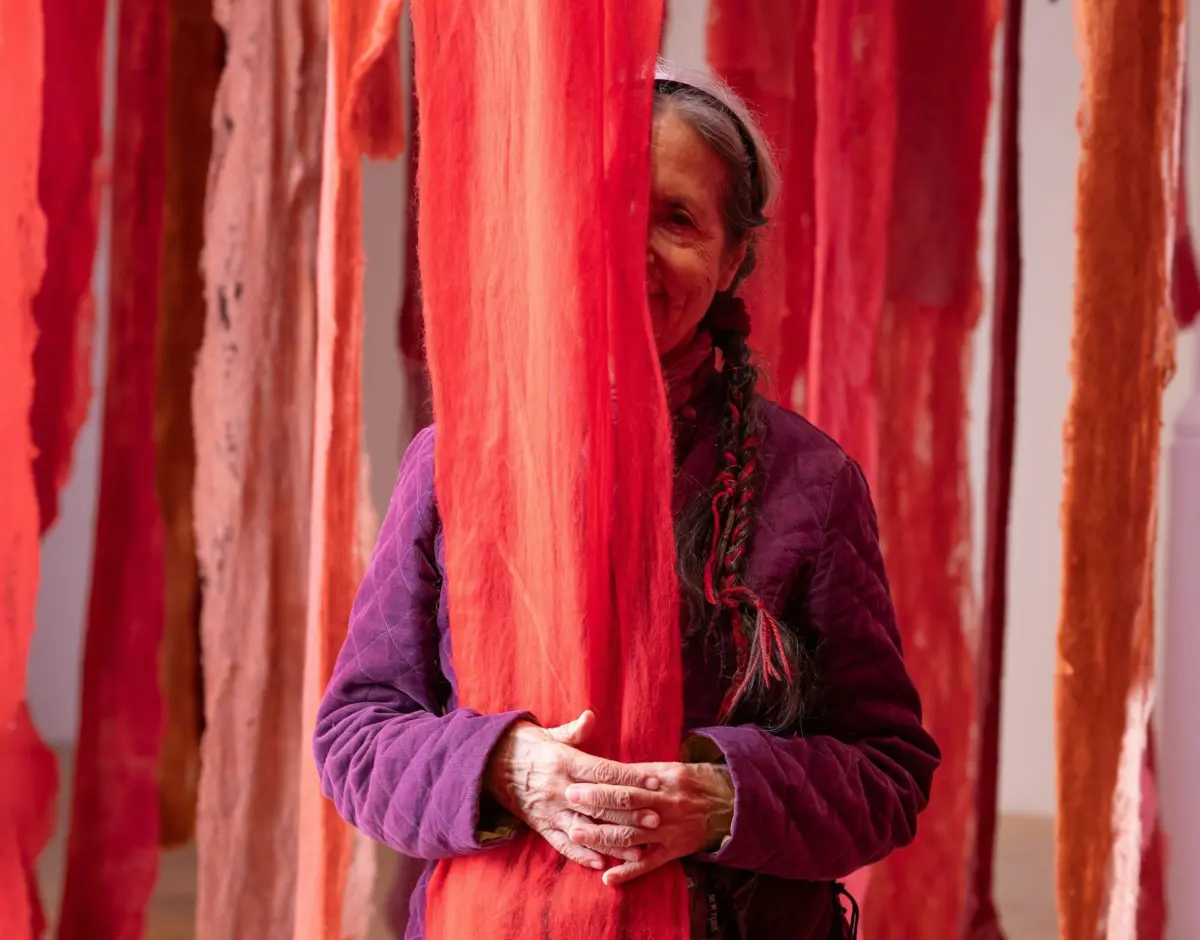
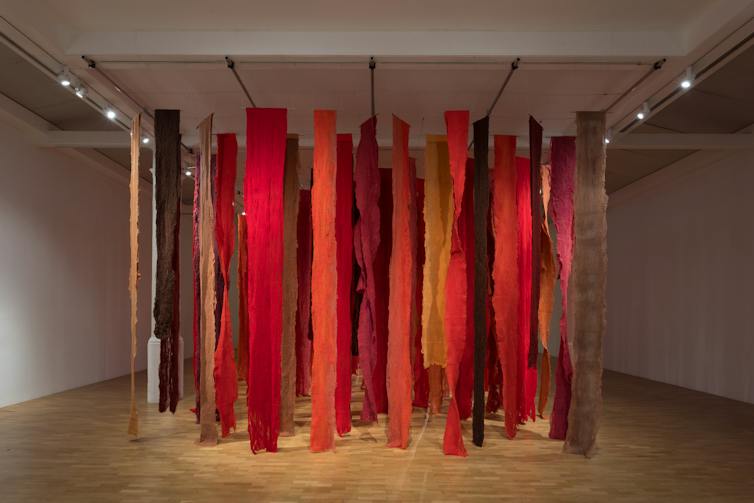
Upon entering the primary gallery space, visitors are immediately confronted by Quipu Menstrual 1 (unknotted) (2006–2024). Cascading from the ceiling in rigorous yet fluid structural rows, streams of raw wool in dramatic hues of deep crimson, vibrant marigold, and tender rose quartz fill the room. While certain strands sweep all the way to the gallery floor, others trail off abruptly at a third of that height, frayed and exhausted by their own weight.
By employing unspun wool on a monumental scale, Vicuña launches a direct philosophical assault on Western ideals of permanence, power, and memorialization. Traditionally, Western societies commemorate history through rigid bronze equestrian statues and towering marble monoliths—materials designed to resist time, conquer nature, and project unyielding authority. Vicuña counters this masculine, patriarchal impulse with a matriarchal, ecological alternative. Wool is organic, porous, shedding, and structurally vulnerable.
Furthermore, the installation is never truly still. Standing before the massive work reveals a micro-choreography: the subtle, ambient airflow within the Whitechapel Gallery catches the strands, causing them to sway gently like weeping willow branches in a summer breeze. As visitors circulate through the space, their moving bodies disturb the air further, entangling human hair, clothing lint, and airborne dust directly into the raw wool. The artwork breathes with the room, turning the passive viewer into an active, biological co-creator.
The Philosophy of the “Not Yet”
Central to Vicuña’s artistic vocabulary is the conceptual framework of the “not yet.” In an interview context, the artist has frequently deployed this open-ended phrase to signal an ontology rooted in constant becoming rather than fixed, finite being.
Western art history has long obsessed over the finished masterpiece—the static artifact locked behind glass or bolted to a pedestal. Vicuña flatly rejects this closure. Her installations are deliberately untethered and fragile, purposefully refusing to impose dogmatic meanings. By surrendering authorial control, she passes the ongoing life of the artwork over to natural environmental forces and the unpredictable actions of the public. The work is always incomplete, always in the process of becoming something else.
Reclaiming the Archives of Exile
In gallery three, the exhibition shifts focus toward Vicuña’s socio-political engagements, shining a long-overdue spotlight on her role within Artists for Democracy. The inclusion of photographic archives from 1974 presents a vibrant, smiling young Vicuña standing proudly alongside her Objects for the Chilean Resistance.
These diminutive, delicate assemblages were born out of profound psychological anxiety—the terror of being severed from one’s homeland while watching it subjected to fascist violence. By utilizing scraps, thread, twigs, and discarded debris, Vicuña demonstrated that political resistance does not require monumental resources; it can be forged from the margins, utilizing the discarded remnants of daily life to demand basic human dignity and equality.
Adjacent to these historical documents hang Vicuña’s surrealist-inflected paintings. Because her early canvases were systematically lost or destroyed during her decades of displacement across London, Bogotá, and New York, these works are modern recreations. Rather than viewing this loss as an unmitigated tragedy, Vicuña approaches recreation through the lens of cyclic time. The rebirth of these lost images embodies her belief in invisible threads of connection, where dissolution acts as a vital creative catalyst rather than a permanent destruction.
Official Statements and Curatorial Vision
The curatorial team at the Whitechapel Gallery has framed Living Threads as a vital corrective to institutional blind spots that have historically marginalized women artists from the Global South, particularly those whose practices intertwine political activism with ecological philosophy.
In curatorial notes accompanying the exhibition, representatives from the Whitechapel Gallery emphasize the profound timeliness of Vicuña’s work:
"Cecilia Vicuña has spent over five decades mapping the invisible webs that bind human consciousness to the natural world. At a moment in history marked by ecological breakdown, political polarization, and a crisis of historical memory, her work offers us a radical alternative. She teaches us how to listen to materials, how to honor the ephemeral, and how to practice art not as a commodity of permanence, but as an act of relational survival."
Art historians and critics have similarly rallied around the exhibition, praising its nuanced integration of Vicuña’s poetry, political activism, and textile installations. Dr. Elena Ramirez, a specialist in Latin American contemporary art, noted in a recent critical review:
"What makes Living Threads so breathtaking is its absolute refusal to separate the political from the ecological. When Vicuña hangs miles of bleeding, raw wool in Quipu Menstrual, she is simultaneously evoking the ancient Andean quipu accounting system, the trauma of the Chilean diaspora, the cyclical shedding of the female body, and the slow violence being inflicted upon our planetary biosphere. She weaves these threads together so seamlessly that the viewer cannot walk away unchanged."
Future Outlook: The Enduring Legacy of Living Threads
As Living Threads prepares to welcome international visitors at the Whitechapel Gallery ahead of its scheduled closing on February 14, 2027, the exhibition’s broader cultural reverberations are already being felt across the global contemporary art landscape.
The capstone of the exhibition journey—a participatory installation titled Foraging Quipu (2025–2026)—encapsulates the future trajectory of Vicuña’s practice. Eschewing traditional gallery acquisitions, the artist has invited members of the London public to forage for and contribute organic, biological, and everyday items encountered during their daily routines. Composed primarily of matter destined for decay, Foraging Quipu is a living sculpture that constantly transforms, rots, breathes, and morphs over time. Because human bodies move around it and biological matter naturally decomposes, no two visitors will ever encounter the exact same artwork.
This participatory, decentralized approach points toward a post-institutional future for contemporary art—one where museums are no mausoleums for dead objects, but rather active clearinghouses for communal healing, ecological attunement, and shared storytelling.
Cecilia Vicuña’s long-delayed ascension to global institutional prominence marks a turning point for the art world. By honoring an artist who has spent half a century listening to the silent language of wool, water, wind, and political resistance, the Whitechapel Gallery has not only validated a singular creative genius; it has provided contemporary audiences with an indispensable toolkit for surviving—and tenderly transforming—our troubled modern world.
Cecilia Vicuña: Living Threads is open at the Whitechapel Gallery, London, through February 14, 2027.