Executive Overview
For decades, the professional audio engineering and production community has shared an unspoken consensus: when it comes to critical listening, tracking, and mixing, wireless headphones are a non-starter. The trade-offs have historically been too severe. Bluetooth protocols introduce intolerable latency, heavy data compression degrades micro-dynamics, and a fluctuating noise floor compromises the analytical precision required for professional studio work. Consequently, producers, mix engineers, and tracking musicians have remained tethered to their consoles, interfaces, and headphone amps by yards of copper cabling.
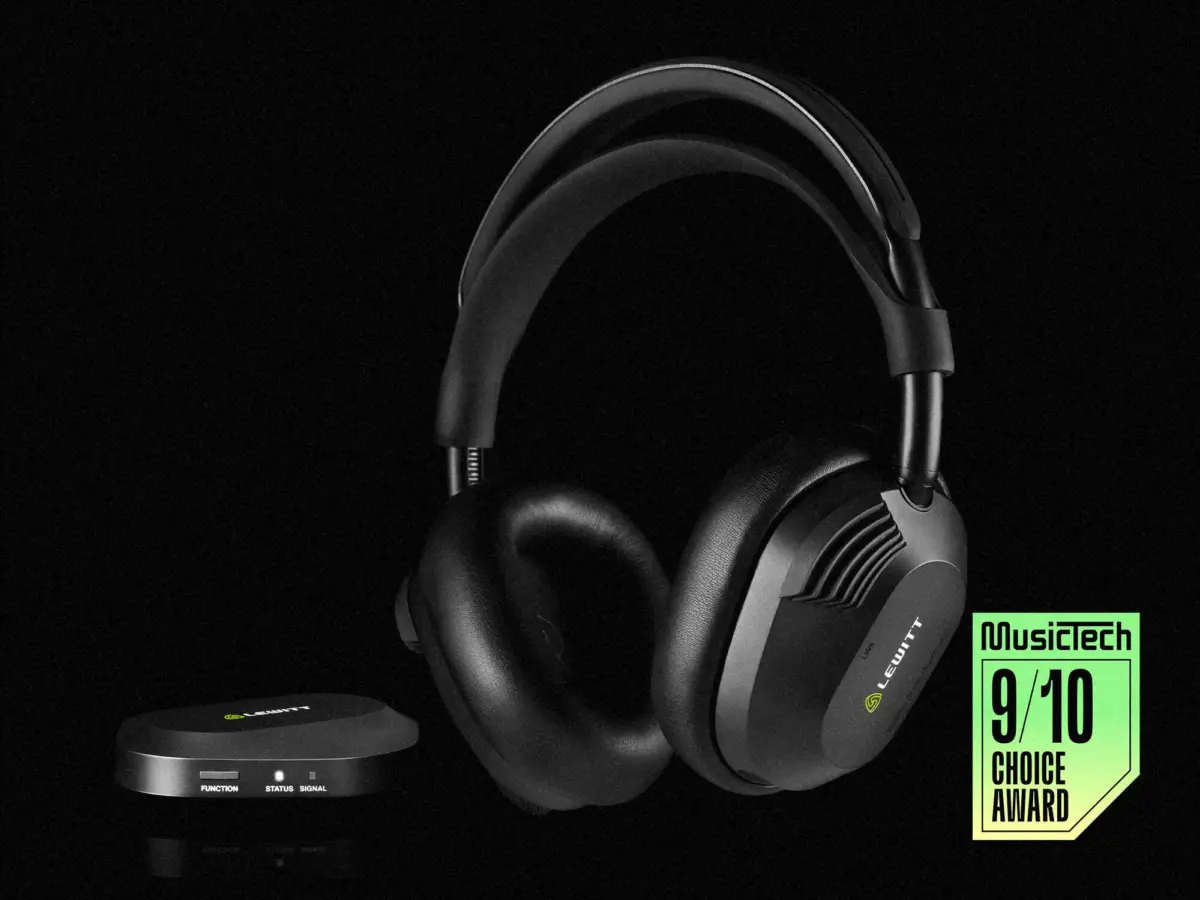
Enter the Lewitt LW6 wireless studio headphones (£519 / $699). Designed to bridge the gap between uncompromising sonic fidelity and untethered mobility, Lewitt’s latest hardware release challenges the foundational dogma of studio design. Built on proprietary Ultra-Wideband (UWB) wireless architecture known as RealSound technology, the LW6 promises uncompressed 24-bit/48kHz PCM audio transmission at a staggering 1,728kbps, keeping latency down to an imperceptible sub-six-millisecond threshold.
The implications of this technology extend far beyond mere convenience. In modern hybrid production environments, creators constantly pivot between roles: setting up microphones in the live room, adjusting outboard gear and hardware synthesizers, tracking instruments, and meticulously balancing mix balances at the DAW. The LW6 aims to function as a singular, unified monitoring solution capable of traversing these workflows without demanding a single compromise in audio integrity.

However, at a price point exceeding £500, these headphones enter a fiercely competitive market dominated by legacy wired studio monitors from brands like Beyerdynamic, Sennheiser, and Audio-Technica. This review offers a rigorous examination of the Lewitt LW6—evaluating its real-world connectivity, sonic performance, software integration, acoustic isolation, and long-term viability in professional production workflows.
Detailed Chronology & Technological Evolution
To understand the significance of the Lewitt LW6, one must first trace the evolution of personal monitoring devices in contemporary music production. Historically, the pipeline from audio interface to ear was strictly analog and copper-bound. While consumer-grade wireless headphones have evolved rapidly through successive iterations of Bluetooth (culminating in codecs like aptX Adaptive, LDAC, and LC3), these formats remain fundamentally lossy. Even at their highest consumer bitrates, they rely on psychoacoustic data reduction algorithms that strip away crucial high-frequency air and phase coherence—fatal flaws for anyone performing precision EQ cuts or mastering transient responses.
Lewitt’s development of the LW6 represents a paradigm shift by bypassing traditional Bluetooth for critical monitoring entirely. Instead, the company adopted an Ultra-Wideband (UWB) wireless methodology. The engineering timeline leading to the LW6 involved extensive acoustic testing, tuning sessions in collaboration with professional acousticians, and trials utilizing human test subjects to refine the headphone’s frequency response curve.

Upon unboxing, the user encounters a comprehensive ecosystem rather than just a pair of cans. The hardware package centers around a dedicated wireless transmitter powered via USB-C. This transmitter acts as the central hub of the system:
- Digital and Analog Integration: It can ingest audio digitally over USB-C or via a traditional 3.5mm analog input.
- Daisy-Chaining Capability: Uniquely, the transmitter features a 3.5mm analog output port, allowing engineers to stack multiple transmitter units or drive multiple pairs of LW6 headphones from a single analog source.
- Dual-Protocol Utility: For casual listening, commuting, or device pairing away from the studio, Bluetooth 5.3 (featuring standard SBC and AAC codecs) is built directly into the headphones.
In its flagship uncompressed wireless mode, the LW6 requires a direct line of sight to the transmitter within a functional range of roughly five meters (approx. 16 feet). While physical barriers like thick studio walls can disrupt the UWB signal, the range is more than sufficient for tracking in a home studio, adjusting a modular synth rig, or performing in front of a tracking microphone without getting tangled in cables. For scenarios demanding zero restrictions or higher bitrates, users can connect the headphones directly via a wired USB-C cable, unlocking support for high-resolution 24-bit/96kHz audio processing.
Supporting Context & Metrics: Performance Analysis
Evaluating studio gear requires dissecting core performance metrics: frequency response, transient accuracy, stereo imaging, and latency. The Lewitt LW6 delivers metrics that justify its ambitious feature set.

Sonic Signature and Frequency Balance
Tuned through extensive real-world testing, the LW6 exhibits an honest, flat, and highly detailed sonic profile. Out of the box, the tuning leans slightly toward the brighter side of neutral—a characteristic favored by many mix engineers for highlighting upper-midrange harshness, vocal sibilance, and high-frequency transient details.
- Transient Response: Fast, snappy, and articulate. Drum transients cut through cleanly without smearing.
- Stereo Imaging: Exceptionally wide and coherent, giving a spatial depth that mirrors an open-air listening environment rather than a closed-back acoustic space.
- Noise Floor: Remarkably silent. Even when pushed to extreme gain levels via interface outputs, there is an absence of digital artifacts, white noise, or transmission hum.
Software, DSP, and Virtual Environments
Hardware functionality is heavily augmented by Lewitt’s companion mobile and desktop software suite.
- Parametric EQ: Users can dial in a custom 5-band parametric EQ directly on the hardware profile to match personal taste or compensate for specific monitoring references.
- Virtual Studio Mode: Utilizing advanced Digital Signal Processing (DSP), this mode mimics the acoustic experience of sitting in front of a pair of high-end studio monitors in an acoustically treated room. It provides a vital secondary reference point for checking mix translation without requiring physical monitor switching.
- Space Replicator Integration: Registering the LW6 unlocks a complimentary copy of Lewitt’s Space Replicator Essential plug-in. This software allows engineers to audition their mixes through simulated acoustic profiles of world-class physical spaces, merging practical utility with immersive workflows.
Ergonomics, Isolation, and Safety
Comfort is paramount for engineers logging 10-to-12-hour sessions. Weighing in light relative to its robust tech stack, the LW6 distributes weight evenly across the head. The ear pads provide exceptional acoustic isolation, minimizing sound bleed even during loud tracking sessions. This prevents backing-track leakage or click-track bleed from contaminating sensitive vocal or acoustic microphone polar patterns. However, the unique geometric design of the ear pads means aftermarket replacements may not be universally compatible.

Furthermore, the headphones are capable of staggering output volumes. To protect hearing health against unexpected feedback loops, clicks, or digital pops during tracking, Lewitt integrated a configurable Loudness Guard feature via the companion app. This safety limiter caps audio peaks above a chosen Sound Pressure Level (SPL) threshold, though it can be entirely disabled for users requiring uninhibited dynamics.
Power Management
The LW6 operates strictly as an active device; it cannot pass audio passively if the battery is depleted, even when using a wired 3.5mm analog connection. Fortunately, battery anxiety is mitigated by a rated 21-hour battery life under continuous wireless operation. For emergency sessions, a 15-minute fast-charge via USB-C yields approximately three hours of playback time.
Official Statements & Industry Perspectives
Industry reaction to the LW6 has focused heavily on the viability of uncompressed short-range wireless monitoring in professional workflows.

"The goal with the LW6 was not to build another consumer lifestyle headphone with flashy noise-cancellation gimmicks," notes product development literature from Lewitt. "Our objective was to solve the physical limitations of the studio environment. By leveraging uncompressed Ultra-Wideband transmission, we have removed the cable without introducing the compression artifacts and latency that have alienated audio professionals from wireless technology for decades."
Early adopters and professional reviewers within the production community have echoed these sentiments, highlighting the psychological liberation of moving around a control room or tracking live instruments untethered. As professional music production increasingly decentralizes into hybrid home studios, project spaces, and mobile rigs, manufacturers are recognizing that workflow agility is just as critical as raw audio specs.
Future Outlook: The Evolution of Wireless Studio Infrastructure
The release of the Lewitt LW6 marks a critical inflection point in the pro-audio hardware sector. For years, the pro-audio industry has lagged behind consumer electronics in adopting wireless protocols, justified by the uncompromising demands of latency-free tracking and transparent frequency reproduction.

However, as UWB and proprietary high-bandwidth audio transmission technologies mature, the barrier to entry for professional wireless gear is lowering. The LW6 demonstrates that uncompressed wireless monitoring is no longer a theoretical proof-of-concept; it is a viable, highly functional reality.
Looking forward, the success of the LW6 will likely force competing studio hardware manufacturers to rethink their monitoring pipelines. Future iterations across the industry may feature standardized low-latency RF ecosystems integrated directly into audio interfaces, mixing consoles, and digital audio workstations (DAWs).
While aesthetic refinements—such as the integration of premium chassis materials like brushed aluminum or wood accents, alongside active noise cancellation engineered without compromising acoustic transparency—remain logical areas for future evolution, the core technical foundation has been established. The Lewitt LW6 proves unequivocally that wireless studio headphones have grown up, setting a new benchmark for how modern producers, engineers, and musicians will interact with their workspaces in the years to come.