Executive Overview
In the rarified world of electronic music gear, certain vintage instruments transcend their status as mere tools to become mythical objects of desire. Among the most legendary and elusive of these is the Synton Syrinx—a rare, avant-garde analog synthesizer manufactured in the Netherlands during the early 1980s by the now-defunct company Synton. Original units are notoriously difficult to track down, commanding astronomical prices on the secondhand market and remaining safely locked away in private collections rather than gracing modern touring racks.
Now, lightning is striking twice on Dutch soil. Boutique hardware manufacturer AnalogFX has officially announced the LARYNX, a performance-focused analog synthesizer built as a direct spiritual and sonic successor to the legendary Syrinx. Constructed around AnalogFX’s critically acclaimed SER-2020 architecture, the LARYNX bridges the gap between vintage golden-age analog warmth and modern performance flexibility.
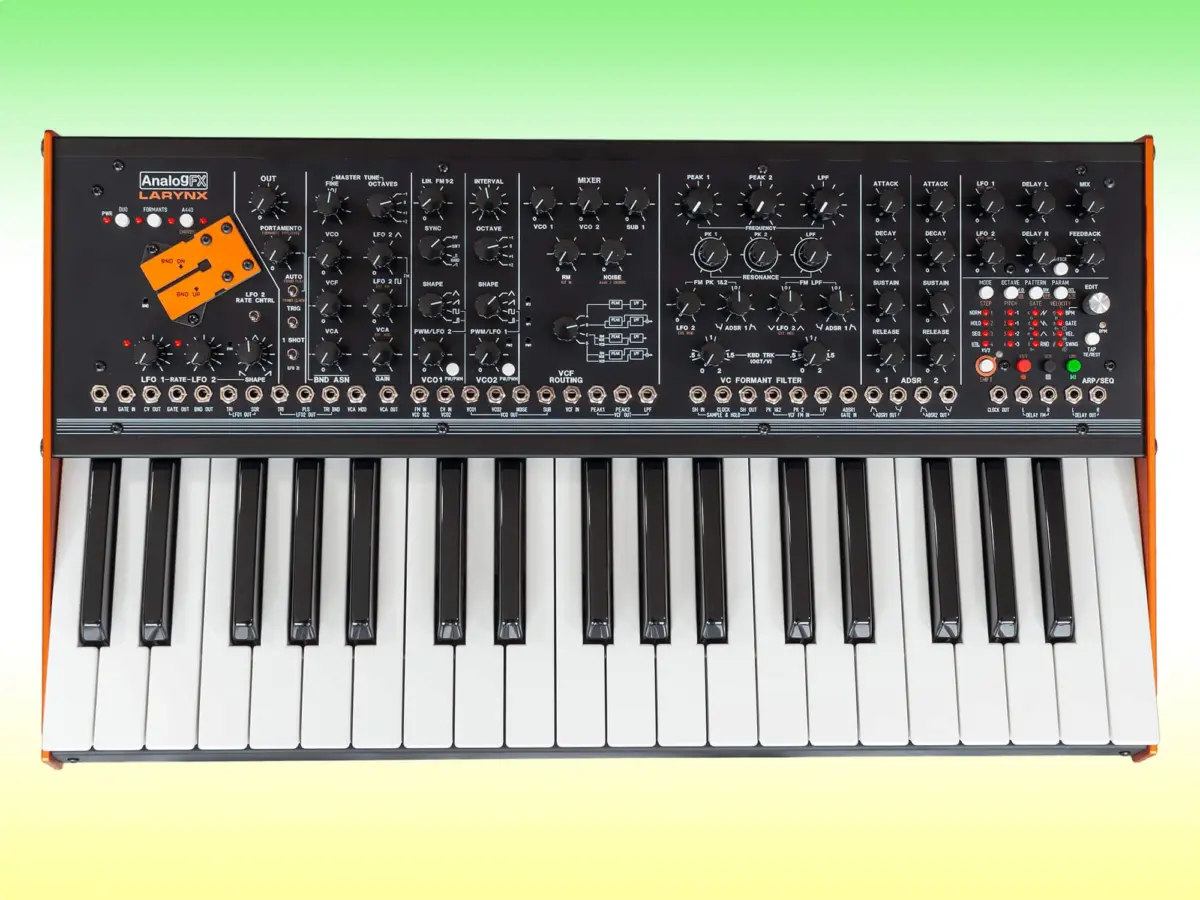
However, much like its historic muse, the LARYNX is destined to remain an ultra-exclusive piece of gear. AnalogFX has confirmed that its initial production run will be strictly limited to just 50 units worldwide. Featuring a 37-note aftertouch-enabled keyboard, a signature rectangular touch-bend controller, a robust triple-filter formant architecture, and modern conveniences like a built-in stereo delay and a 16-step sequencer, the LARYNX is designed to feel intensely alive under the fingertips. This comprehensive report explores the origins of the LARYNX, its deep-dive technical specifications, its place in synthesizer history, and what this ultra-limited release means for contemporary sound designers and collectors.
Detailed Chronology & Design Evolution
From Synton to AnalogFX: A Dutch Synthesizer Legacy
To understand the significance of the LARYNX, one must first look back at the rich, albeit boutique, history of Dutch synthesizer manufacturing. In the late 1970s and 1980s, Synton—led by Ruud Boiten—earned a stellar reputation for creating highly innovative, uncompromising electronic instruments. While the Synton 3000 modular system put the company on the map, it was the 1982 release of the Syrinx monophonic synthesizer that cemented its legacy. Featuring touch plates, advanced modulation routing, and a unique dual-filter design, the Syrinx was decades ahead of its time, though commercial production figures remained devastatingly low.
Decades later, fellow Dutch innovator Marc Stroobach, founder and lead developer of AnalogFX, set out to capture that elusive magic. AnalogFX first captured the attention of the global synth community with the SER-2020, a revered hardware synthesizer celebrated for its aggressive yet musical analog topology. Rather than merely cloning the past, Stroobach and his team used the SER-2020 platform as a springboard to build an instrument that honors the structural ethos of the Syrinx while answering the demands of modern producers.
The Conception and Engineering of the LARYNX
The development of the LARYNX was a labor of obsessive attention to detail. AnalogFX sought to recreate the tactile, visceral performance experience of the original Syrinx without sacrificing the stability and integration expected of a 21st-century instrument.
- Phase One (Architecture Adaptation): The engineering team adapted the beloved SER-2020 sound engine, focusing heavily on voltage-controlled stability while preserving the raw, untamed harmonic distortion that vintage enthusiasts crave.
- Phase Two (The Formant Challenge): Replicating the distinct vocal-like timbres of the Syrinx required a completely overhauled filter topology. The team developed a specialized triple-filter system capable of intricate formant sweeps.
- Phase Three (Tactile Integration): Paying homage to the Syrinx’s iconic control layout, AnalogFX integrated a rectangular Touch’n’Bend bender positioned strategically for intuitive real-time pitch manipulation, pairing it with a responsive 37-key aftertouch keyboard.
- Phase Four (The 50-Unit Limit): Due to the specialized nature of the components—particularly the reliance on classic CEM chips and meticulous hand-calibration processes—AnalogFX imposed a hard ceiling of 50 units for the initial production run, ensuring uncompromised build quality for every single instrument that rolls off the bench.
Supporting Context & Technical Metrics
The AnalogFX LARYNX is far more than a nostalgic tribute; it is a heavyweight sound-design workstation disguised as a compact 37-key performance synth. Beneath its sleek, rugged exterior lies a powerhouse of analog and digital hybrid engineering.

Oscillators and Sound Generation
At the absolute heart of the LARYNX’s sound engine are two robust CEM3340-based voltage-controlled oscillators (VCOs). The CEM3340 chip is legendary in synth history, having powered classics like the Sequential Circuits Prophet-5 (Revision 3), Roland Jupiter-6, and Memorymoog. These oscillators deliver surgical precision paired with organic drift.
To expand the lower registers and add fatness, AnalogFX included a dedicated sub-oscillator, alongside an onboard Noise Generator for percussion synthesis, wind effects, and sweeping textural layers.
The Triple-Filter Formant Architecture
Where the LARYNX truly separates itself from contemporary analog monosynths is its filtering section. The instrument utilizes a sophisticated triple filter configuration consisting of:
- PEAK 1
- PEAK 2
- LPF (Low Pass Filter)
This triad allows users to sculpt complex, vowel-like formants, razor-sharp leads, and cavernous sub-basses. Furthermore, the LARYNX features a dedicated Formant Mode pre-programmed with 16 distinct human voice formants, allowing the instrument to literally "speak" and articulate in ways traditional subtractive synthesizers cannot.
Voice Modes and Sequencing
Despite its monophonic roots, the LARYNX introduces remarkable polyphonic flexibility:
- Monophonic & Duophonic Operation: Ideal for classic leads, squelchy basslines, and expressive soloing.
- Five-Voice Oscillator Chord Mode: Enables rich, harmonized stabs and pads that take full advantage of the analog architecture.
- 16-Step Sequencer & Arpeggiator: Built-in generative tools designed to spark instant inspiration without requiring external MIDI clock routing, though seamless DAW and hardware integration is fully supported.
- Onboard Stereo Delay: Adds spatial depth and shimmering echoes directly within the analog signal path.
Connectivity and Inputs
Modern studio integration is a must, and the LARYNX delivers a comprehensive array of I/O options:
- MIDI IN/OUT for seamless hardware and software sequencing.
- Expression, Sustain, and Hold Pedal Inputs for maximum hands-free performance expression.
- Stereo Line Outputs to capture the full width of the onboard delay and filter separation.
- Dedicated Headphone Output for late-night session monitoring.
Official Statements
The unveiling of the LARYNX has sent ripples through the electronic music community, prompting widespread excitement among collectors and professional sound designers alike.

Marc Stroobach, Founder and Lead Developer at AnalogFX, shared the philosophy driving the instrument’s creation:
"With LARYNX, we wanted to create an instrument that feels alive under your hands," says Stroobach. "It’s inspired by some of the most expressive synthesizers ever made, but designed for today’s musicians who want immediate control, deep sound shaping, and a genuine connection between performance and sound. Every AnalogFX instrument starts from a passion for music and a belief that synthesizers should inspire creativity, not get in the way of it."
Industry analysts have noted that by tethering the release to an initial production run of just 50 units, AnalogFX is deliberately cultivating a high-prestige, collector-grade market status. While this scarcity may frustrate some working musicians who miss out on the initial batch, it guarantees that those fortunate enough to acquire a LARYNX will own a piece of modern electronic instrument history.
Future Outlook & Industry Impact
As the hardware synthesizer market continues to experience a renaissance—fueled by musicians seeking refuge from screen-based, in-the-box production workflows—the launch of the AnalogFX LARYNX marks a significant cultural and technological milestone.
The Boutique Hardware Boom
In an era dominated by mass-produced digital emulations and plugin subscriptions, boutique analog manufacturers are thriving by offering the exact opposite: imperfection, tactile warmth, and radical individuality. By channeling the esoteric spirit of the Synton Syrinx, AnalogFX has positioned itself at the cutting edge of the boutique hardware movement. The LARYNX proves that modern developers are no longer content simply cloning standard Minimoogs or TB-303s; they are looking further back into obscure historical archives to resurrect forgotten architectural concepts.
Collector Value and Legacy
With only 50 units allocated for this initial production run, the LARYNX is virtually guaranteed to achieve unicorn status on the secondary market within a few years. For electronic music producers, film scorers, and sound designers looking for a truly unique weapon to elevate their sonic palette, the LARYNX represents the pinnacle of expressive analog design.
Whether AnalogFX will expand production in the future remains to be seen, but for now, the race is on. The LARYNX is available now, and for the handful of lucky buyers quick enough to secure one, it promises a lifetime of deep, inspiring, and vocally expressive sonic exploration.