Executive Overview
For the first and potentially only time in United Kingdom exhibition history, the entirety of Katsushika Hokusai’s masterwork series, Thirty-six Views of Mount Fuji—inclusive of the ten supplementary prints added subsequent to its initial commercial success—is on public display. Hosted at the historic Dulwich Picture Gallery in London, this rare landmark exhibition draws directly from the prestigious Iuchi Collection.
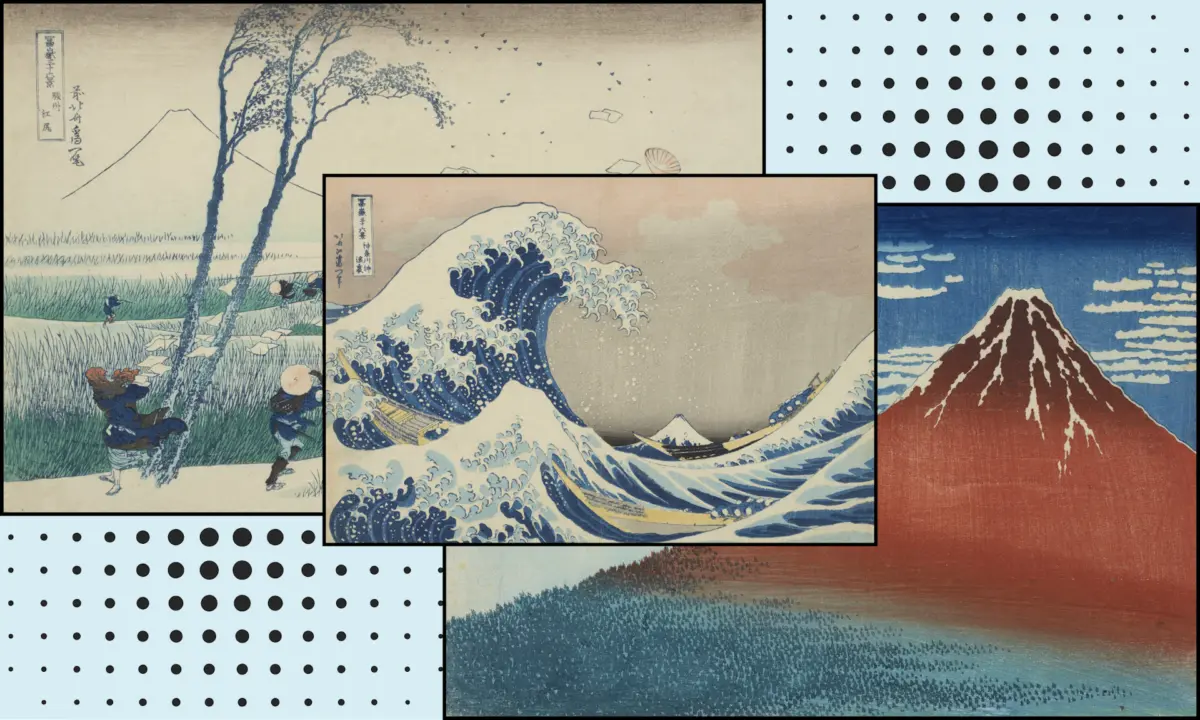
While popular culture has long flattened Hokusai’s monumental artistic legacy into a singular, ubiquitous icon—Under the Wave off Kanagawa, universally known as The Great Wave—this comprehensive showcase forces a radical re-evaluation. By assembling all 46 woodblock prints in a single geographic space, the exhibition challenges viewers to look past the isolated masterpiece and experience the shifting, multifaceted nature of Japan’s most sacred peak.
Seen through the lens of art history, cultural psychology, and curatorial design, the collection reveals a profound meditation on perspective, human scale, and interconnectedness. Created when the artist was in his seventies during the turbulent Bunsei and Tenpō eras of Edo-period Japan, these accessible, inexpensive prints were originally designed for ordinary citizens. Today, they offer contemporary audiences a masterclass in how human perception quickly hardens around a single narrative—and how true comprehension requires embracing the broader, shifting landscape of human experience.
Detailed Chronology: The Genesis of an Immortal Series
The Late-Life Renaissance of an Edo Master (1830–1833)
The creation of Thirty-six Views of Mount Fuji (Fugaku Sanjūrokkei) represents one of the most astonishing artistic flowerings in human history. Katsushika Hokusai was already in his seventies—an advanced age by 19th-century standards—when he embarked on the ambitious publishing project between 1830 and 1833. Far from resting on the laurels of a long and prolific career, Hokusai reimagined his visual vocabulary, capitalizing on the explosive growth of domestic tourism, pilgrimage culture, and commercial printmaking in Edo (modern-day Tokyo).
During this period, Mount Fuji was not merely a geographic landmark; it was a potent spiritual and cultural nexus. Ascending the mountain was considered a sacred act of purification and renewal. Hokusai tapped into this zeitgeist, creating commercial, mass-produced polychrome woodblock prints (ukiyo-e) intended for working-class citizens rather than elite patrons.
From Concept to Expansion: The 36 That Became 46
Originally commissioned and structured as a set of 36 distinct compositions, the immense commercial resonance and cultural appetite for the series prompted publisher Nishimuraya Yohachi (Eijudō) to commission an additional ten prints. These subsequent additions expanded the collection to 46 works.
Dulwich Picture Gallery’s exhibition brings together all 46 images. The chronological and spatial arrangement within the gallery’s exhibition rooms allows visitors to trace Hokusai’s evolving fascination with the mountain. In the opening gallery, visitors encounter three distinct interpretations of the peak:
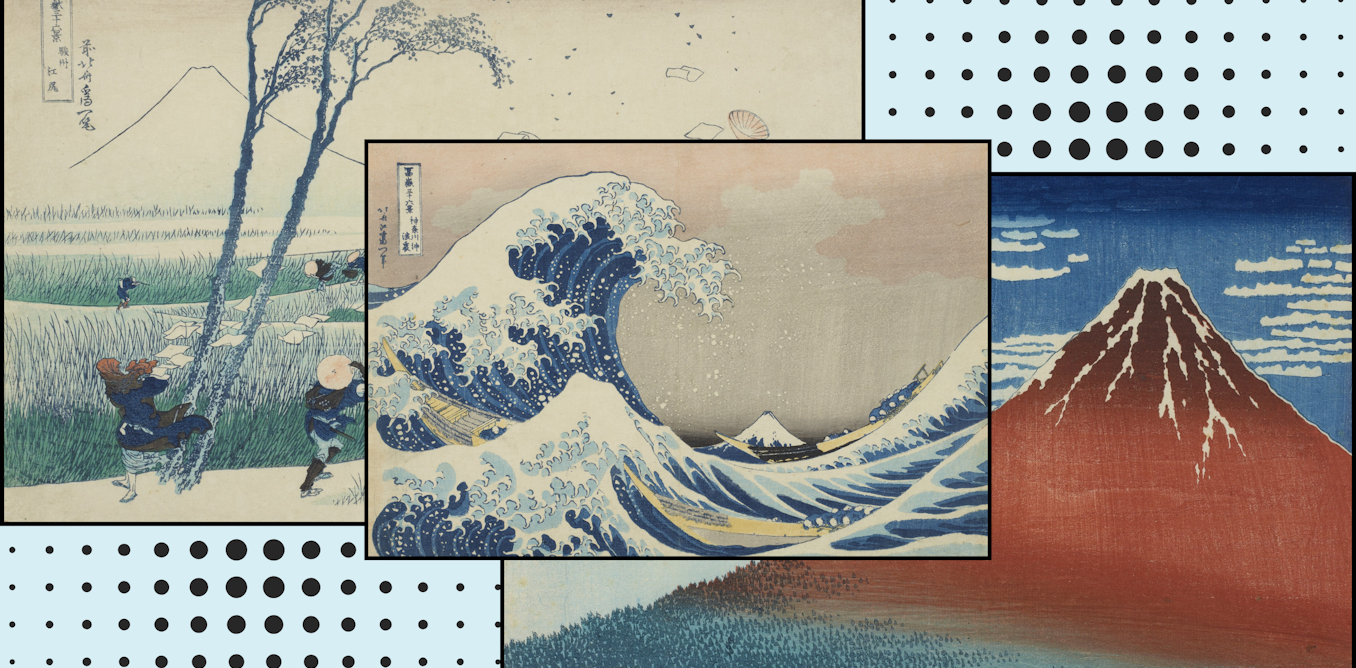
- Red Fuji (Clear Day with a Southern Breeze): The mountain is rendered almost as a pure, geometric form. A lustrous, resonant red catches the morning light against a receding blue sky, anchored at its base by a chorus of tiny, easily overlooked trees.
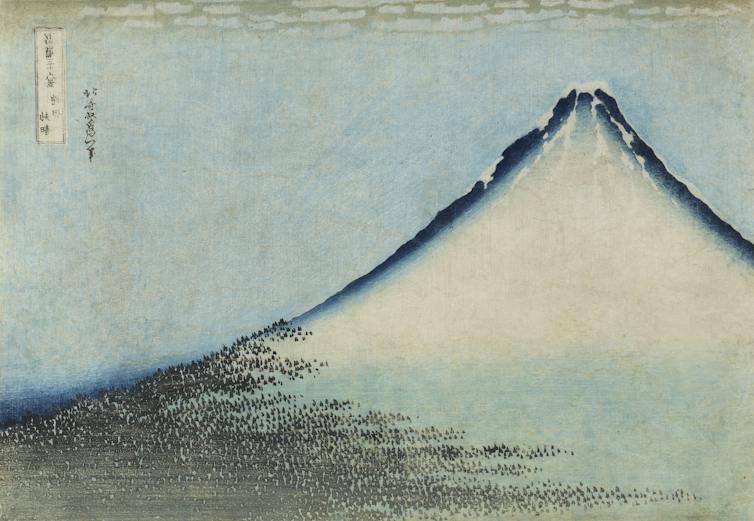
- Blue Fuji: A light blue variant with a ridge edged in heavy, dramatic indigo, offering a cooler, more inward-looking pathway into the mountain’s topography.
- The Storm Variant: A third composition featuring jagged, lightning-like cracks reminiscent of a fractured ceramic vessel, imbuing the sacred peak with a dark, deeply unsettled atmosphere.
Supporting Context & Metrics: The Mechanics of Masterpieces
The Socio-Economic Reality of Edo Printmaking
To understand the historical weight of the Dulwich exhibition, one must contextualize the medium. These works were not conceived as exclusive, high-end gallery paintings destined for museum vaults; they were cheap, consumer-grade ephemera sold on the bustling streets of Edo. Produced via a collaborative system involving the artist, the publisher, the woodblock carver (horishi), and the printer (suri-shi), these prints relied on newly imported synthetic and organic pigments—most notably Prussian blue (berori).
The introduction of Prussian blue revolutionized Japanese printmaking, replacing fugitive vegetable dyes with a deep, light-resistant oceanic pigment that defined Hokusai’s skies and waters. The sheer technical brilliance required to align multiple woodblocks across thousands of impressions is a testament to the sophisticated industrial craft of early 19th-century Japan.
Psychological Intersections: Art Therapy and Mentalising
The exhibition has prompted deep cross-disciplinary dialogues, notably regarding how viewers interact with visual art. Observers note that Hokusai’s framing of human activity against the backdrop of nature mirrors cognitive processes explored in modern psychology.
For instance, consider the print Mishima Pass in Kai Province, located in the third room of the exhibition. The composition depicts travelers linking their arms around the immense girth of a colossal cedar tree. A casual glance might suggest an affectionate, tender embrace among companions. However, historical and botanical context suggests they are attempting to measure the tree’s massive circumference.
This psychological pivot—from assuming emotional intimacy to recognizing objective measurement—highlights a core concept in mentalisation-based psychotherapeutic practice. Human beings routinely project internal emotional states onto external stimuli, instantly constructing narratives about strangers based on limited visual data. Hokusai’s prints consistently play with this perceptual vulnerability, placing observers between microscopic human labor and macrocosmic natural forces.
Furthermore, the scale of Hokusai’s natural forms invites comparisons to empirical psychological studies on awe. Research conducted by institutions such as the University of California, Berkeley, demonstrates that individuals who gaze upward at towering natural structures (such as giant eucalyptus trees) for even brief periods exhibit heightened prosocial behaviors, increased generosity, and a diminished sense of self-absorption. While a 19th-century Japanese woodblock print cannot physically alter modern behavior, viewing Hokusai’s expansive landscapes recalibrates the ego, reminding the viewer of their small place within a vast, interconnected ecosystem.
Official Statements & Curatorial Perspectives
Bridging Distances Through Color and Form
Curators and cultural critics examining the Dulwich Picture Gallery installation emphasize the unique challenge of presenting 19th-century Japanese aesthetics to contemporary British audiences.
"As contemporary viewers separated by vast geographic and temporal chasms, we can never truly experience Mount Fuji precisely as Hokusai’s initial Edo-period audience did," exhibition commentators note. "Yet, what transcends these cultural and historical boundaries is the raw, unmediated power of color, form, and spatial geometry."
The gallery’s design choices have also sparked critical discussion. The exhibition spaces are enveloped in dusky blue walls explicitly chosen to echo Hokusai’s signature palette. While some critics argue that the atmospheric, low-light staging creates an effective, contemplative quietness that allows viewers to commune directly with the fragile paper artifacts, others contend that the rigid separation of individual prints occasionally disrupts the narrative flow. Rather than allowing the eye to drift naturally across the interconnected web of vistas, the strict framing fixes the viewer in place, isolating compositions that were fundamentally designed to be experienced as a dynamic dialogue.
Future Outlook: The Enduring Legacy of an Unfolding Journey
As the exhibition Hokusai: Thirty-six Views of Mount Fuji from the Iuchi Collection runs at the Dulwich Picture Gallery through January 17, 2027, its broader cultural legacy is already crystallizing.
The exhibition provides a vital antidote to visual monotony. In an era dominated by instantaneous digital imagery and algorithmic reinforcement loops—where complex cultural objects are routinely reduced to single, viral memes like The Great Wave—Hokusai’s complete series serves as a profound structural corrective.
By the time visitors complete their journey through the gallery’s final rooms, where pilgrims climb into the rocky shelters near Fuji’s summit in a sequence resembling stop-motion film frames, the initial perception of The Great Wave is irrevocably transformed. The iconic wave is no longer isolated; it is contextualized by tiny triangles of distant mountains, laboring farmers, bustling bridges, and cooperative travelers.
Ultimately, Hokusai’s monumental series suggests that human understanding is an ongoing expedition. Just as the sacred peak shifts its identity across forty-six distinct viewpoints—appearing red in the dawn, blue in the shadow, fractured in a storm, and crowded with pilgrims at the summit—so too must human perception remain flexible, curious, and open to the vastness of the world beyond our immediate horizon.
Hokusai: Thirty-six Views of Mount Fuji from the Iuchi Collection is on display at the Dulwich Picture Gallery, London, until January 17, 2027.