On August 6, 2026, the prestigious Salzburg Festival played host to a triumph of operatic revisionism at the Großes Festspielhaus: a deeply penetrating, stripped-down production of Wolfgang Amadeus Mozart and Lorenzo da Ponte’s Così fan tutte. Directed by the visionary Christof Loy and conducted with incisive brilliance by Joana Mallwitz, this staging evolved from a restricted, COVID-era presentation in 2020 into a fully realized theatrical masterclass. Eschewing the hyper-busy stagecraft that so often plagues modern interpretations of standard-repertoire operas—such as the dizzying distractions of Rossini’s Il viaggio a Reims seen the previous evening—Loy opted for radical simplicity.
Working with a world-class ensemble featuring Elsa Dreisig, Victoria Karkacheva, Bogdan Volkov, André Schuen, Lea Desandre, and Johannes Martin Kränzle, the director abandoned extraneous historical window-dressing, regional local color, and forced dramaturgical updates. Instead, he treated Mozart and da Ponte’s complex psychological blueprint with uncompromised seriousness. Backed by the peerless tonal splendor of the Wiener Philharmoniker and the young artists of the Angelika Prokopp Sommerakademie, the production achieved a rare alchemy: it converted the cavernous expanses of the Großes Festspielhaus into a space of profound, breathless intimacy. The result was a searing examination of human desire, male vanity, and emotional awakening that left both audience and critics spellbound.
Detailed Chronology: The Evolution and Execution of a Masterpiece
From Pandemic Compromise to Grand Revival
The journey of Christof Loy’s Così fan tutte traces back to the extraordinary circumstances of 2020, when pandemic-era restrictions necessitated a trimmed, less-than-three-hour version of the opera. Returning to the score for the 2026 Salzburg Festival, Loy chose to reverse those earlier structural cuts, allowing the score to breathe in its full architectural integrity. More importantly, he restudied the entire theatrical concept.

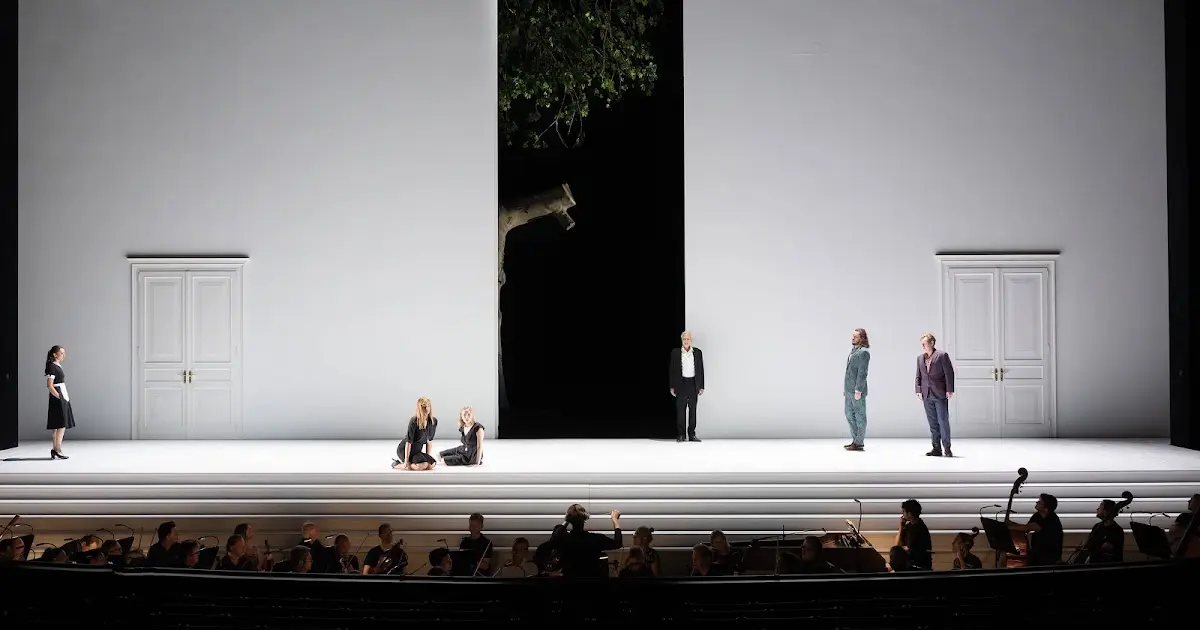
As detailed in the festival programme, Loy conceived the production around a central artistic paradox: performing on one of the world’s largest stages while achieving the raw intimacy of a chamber performance. The physical setup dispensed with elaborate stage machinery. The playing area was strikingly narrow, framed by austere black-and-modern aesthetics designed by Johannes Leiacker, with severe steps plunging directly down into the orchestra pit. The sisters, Fiordiligi and Dorabella, wore plain black garments and ordinary court shoes—save for Despina’s conspicuously chic footwear—while the disguised officers cast off silly period wigs in favor of sharp, colorful modern attire.
The Act I Arc: Lightness and the Slide into Complexity
The production was structured as a distinct emotional journey. Act I unfurled with deceptive lightness. Loy refused to treat the opera as a misogynistic farce or a shallow comedy of errors; instead, comedy emerged organically from character dynamics and real-world situations. Don Alfonso (Johannes Martin Kränzle) began the social experiment as an engaging, know-it-all puppet master orchestrating a harmless game that the two young officers (Bogdan Volkov’s Ferrando and André Schuen’s Guglielmo) eagerly joined.
However, as the evening crossed the threshold into Act Two, the theatrical weather shifted dramatically. The psychological safety net dissolved. A pivotal moment occurred during the dialogue between the sisters as they consciously dared to contemplate dalliance with the mysterious visitors. Loy’s staging subverted traditional blocking by keeping characters present on stage during crucial arias, forcing them to bear witness to each other’s internal processing. When Elsa Dreisig’s Fiordiligi wrestled with her shifting loyalties during her demanding arias, Volkov’s Ferrando stood watching. Similarly, Karkacheva’s Dorabella stared intently at Ferrando before pivoting to confront Schuen’s Guglielmo. Far from feeling contrived, these silent dialogues heightened the psychological stakes.

The Climax of Act II: Shell-Shocked Realization
As the opera progressed toward its finale, the atmosphere darkened into territory that felt genuinely perilous. Volkov’s rendition of Ferrando’s Act II aria exposed a raw landscape of heartache and fury, leaving both the character and the auditorium shell-shocked. The production brilliantly captured Ferrando’s internal war: the agonizing realization that while he remained deeply jealous of his fiancée’s new suitor, he was simultaneously falling under the spell of another woman.
Parallel to this, Schuen’s Guglielmo transitioned from initial smooth-toned charm to a dark, visceral viciousness. By the time the final notes approached, the traditional tidy resolutions felt entirely inadequate. Even as the couples paired off with their "correct" original partners in compliance with the libretto, Loy injected a lingering, corrosive doubt. Had anyone actually learned anything? The production left the audience gripping their seats, questioning whether the characters could ever unsee the dark mirrors held up to their own vanities.
Supporting Context & Metrics: Musical and Theatrical Dimensions
Musical Direction and Orchestral Precision
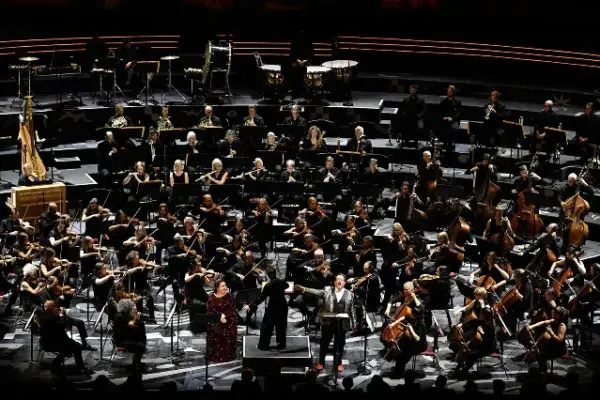
At the podium, Joana Mallwitz demonstrated absolute command over the musical forces. Leading the combined members of the Wiener Philharmoniker and the Angelika Prokopp Sommerakademie, Mallwitz’s approach to the score took no prisoners. From the opening notes of the overture—characterized by sharp, biting chords and vivid, incisive scurrying—her tempos were organically shaped and entirely driven by the dramatic narrative.

The orchestral playing possessed a razor-sharp clarity that avoided over-sentimentalizing Mozart’s score. The only minor instrumental critique lay in the continuo work: Pedro Beriso’s fortepiano recitatives included decorative touches and playful vamp-till-ready moments, but the instrument frequently felt underpowered in the massive acoustic space of the Festspielhaus. During several accompanied recitatives, the fortepiano’s voice was swallowed by the surrounding orchestral heft.
Notably, the Concert Choir of the Vienna State Opera Chorus played no physical stage role, remaining entirely unseen throughout the evening—a directorial choice that further centralized the focus on the psychological interplay of the six primary characters.
Vocal Characterizations and Performances
The vocal ensemble represented a masterclass in casting synergy:

- Elsa Dreisig (Fiordiligi): Dreisig anchored the dramatic core of the evening. Her voice combined lithe flexibility, an exquisite sense of musical line, and a fierce emotional intensity. Her delivery of "Come scoglio" balanced classical architectural rigidity with white-hot emotional conviction.
- Victoria Karkacheva (Dorabella): Serving as a brilliant foil to Dreisig, Karkacheva portrayed Dorabella not as a dizzy airhead, but as an intellectually curious, emotionally aware woman. Her Act II aria regarding Cupid began with light buoyancy before erupting into surprising dramatic fierceness.
- Bogdan Volkov (Ferrando): Possessing a lyric tenor with unexpected emotional depth, Volkov delivered a breathtaking "Un aura amorosa" that seemed to suspend time itself, contrasting sharply with his explosive, shattered Act II breakdown.
- André Schuen (Guglielmo): Schuen utilized his velvety, luxurious baritone to craft moments of almost irresistible seduction, smoothly transitioning into a complex persona marked by wounded masculine pride and simmering anger.
- Lea Desandre (Despina) & Johannes Martin Kränzle (Don Alfonso): Desandre injected youthful pertinence and sharp comedic timing into Despina, transforming her doctor and notary disguises into comic masterclasses. Kränzle charted Don Alfonso’s trajectory from jovial ringmaster to a man profoundly unsettled by the real emotional damage unspooled by his own experiment.
Official Statements and Directorial Vision
The production’s philosophical foundation was anchored by Christof Loy’s notes in the official Salzburg Festival programme book, where he articulated his rejection of superficial historical pastiche:
"I want to release the characters from any concrete context so that one can perceive them as human beings, not historical figures from 18th century Naples."
Expanding on the physical geometry of the production, Loy noted the deliberate minimalism of his staging for the colossal venue:

“[The production] dispenses with all external aids: there are only two doors, the characters, the music… The performers are far closer to the audience.”
This commitment to stripping away directorial gimmicks—such as updating the plot to twentieth-century package tours or heavy-handed gender-politics polemics—allowed the intrinsic theatrical power of Mozart and da Ponte’s creation to shine through unhindered.
Future Outlook
The success of Christof Loy’s Così fan tutte at the 2026 Salzburg Festival establishes a formidable benchmark for contemporary Mozart interpretation. By demonstrating that a minimalist aesthetic, when paired with world-class vocal casting and uncompromising musical direction, can conquer even the most monumental opera houses, the production offers a clear path forward for future stagings in major international houses.

As opera companies globally grapple with how to stage classic repertory without falling into the traps of hyper-conceptual over-intervention or dry museum-piece preservation, Loy and Mallwitz have provided an inspiring blueprint. They have proven that absolute fidelity to emotional and musical truth remains the most radical—and rewarding—choice an artistic team can make. Audiences and international opera houses will undoubtedly look to this landmark Salzburg staging as a defining touchstone for years to come.