Executive Overview
In June 1944, Group Captain James Stagg of the Royal Air Force delivered what many historians and meteorologists regard as the most critical weather forecast in human history. The operational success of Operation Overlord—the massive Allied invasion of Normandy—hinged entirely on his meteorological assessments. More than 150,000 Allied troops stood ready in southern England, their transport vessels marshaled, waiting for a green light from General Dwight D. Eisenhower. The fate of the European theatre, and the lives of tens of thousands of servicemen, depended on a razor-thin window of passable weather across the English Channel.
An inaccurate forecast could have resulted in catastrophic amphibious losses, scattering naval armadas, grounding air support, and potentially dooming the second front against Nazi Germany. Stationed in the high-stakes briefing room at Southwick House near Portsmouth, Eisenhower faced an impossible dilemma. The historic decision to delay the invasion from June 5 to June 6 ultimately rested on Stagg’s shoulders.
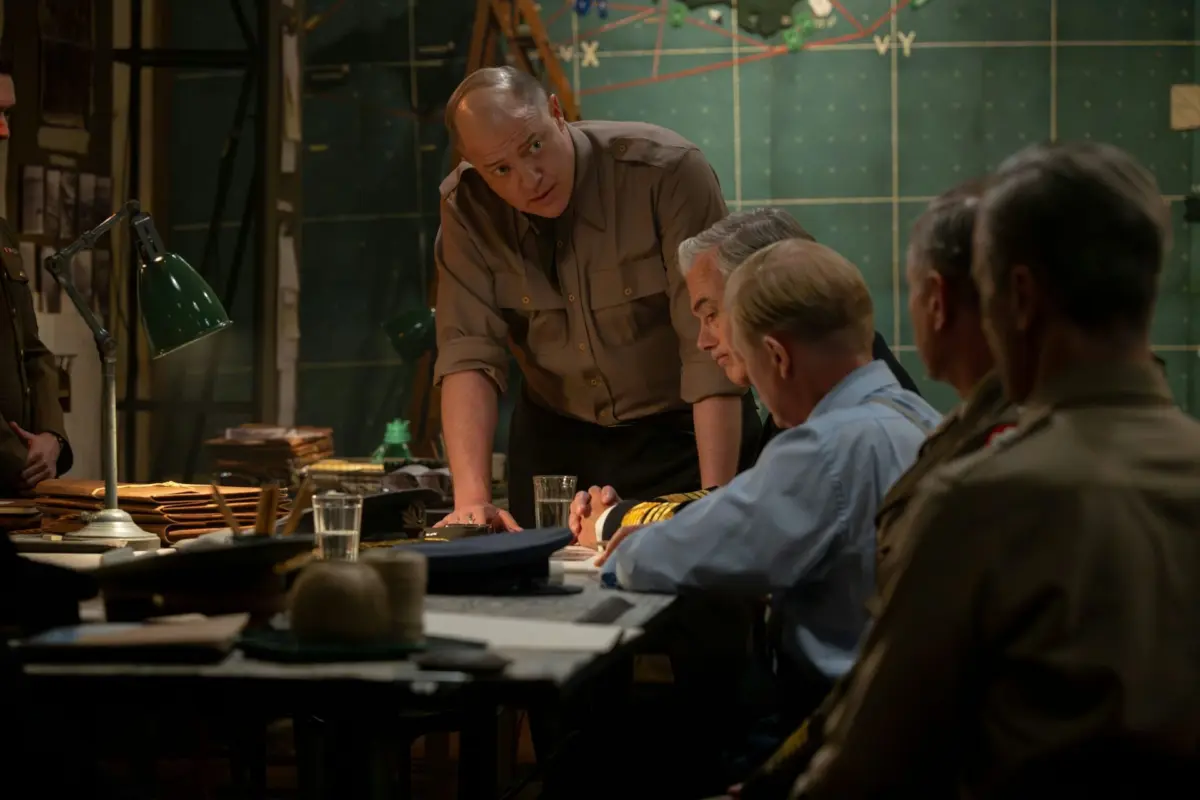
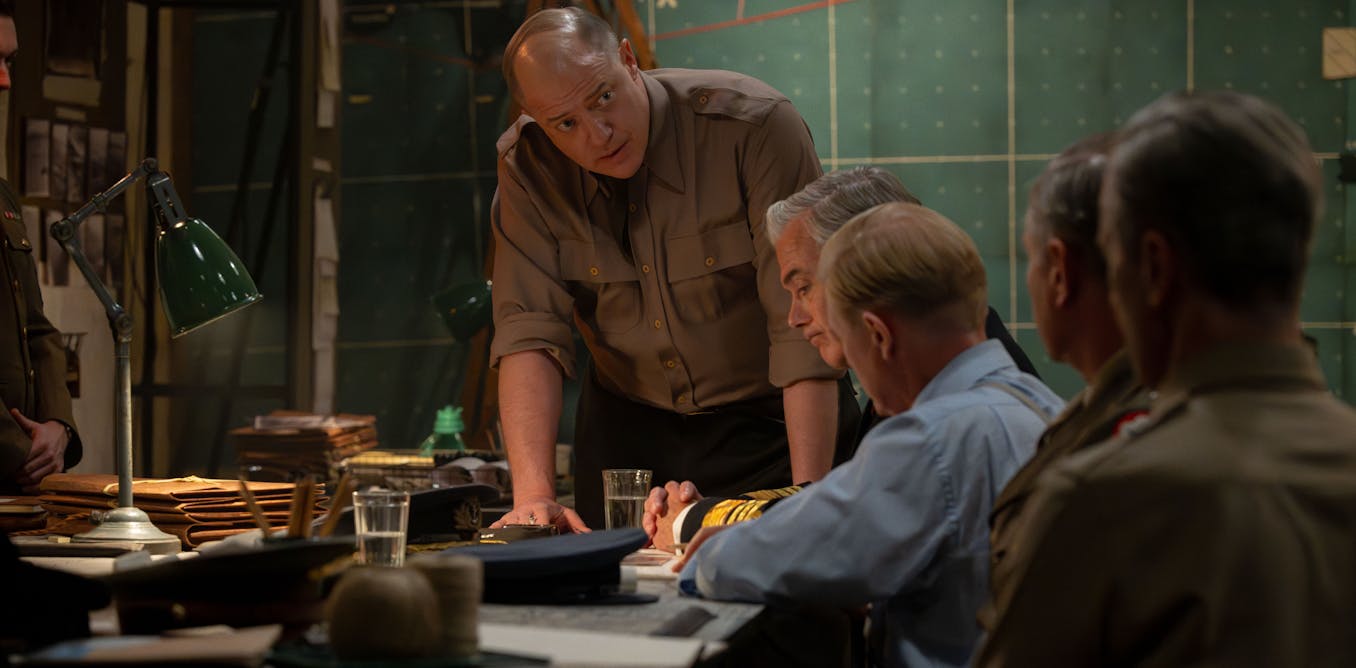
More than eight decades later, the wartime thriller film Pressure has renewed global interest in Stagg’s tense meteorological calculations. For modern atmospheric scientists, seeing a meteorologist cast as the central hero of a major cinematic production offers a rare moment of mainstream validation. More importantly, it provides a fascinating scientific opportunity: Would today’s advanced supercomputers, satellite networks, and artificial intelligence forecasting systems have successfully navigated the D-Day weather challenge?
To answer this question, a new scientific study has combined newly digitized historical weather observations, modern atmospheric physics, and cutting-edge artificial intelligence forecasting systems to meticulously recreate the meteorological dilemma Stagg and his teams confronted in the spring of 1944.
The findings are surprisingly nuanced. While modern AI models likely would have supported the historic decision to delay the invasion on June 5, they also would have underestimated the severe, localized weather conditions that materialized on June 6. Ultimately, the research demonstrates that even with contemporary, multi-billion-dollar forecasting technology, D-Day would still have been an extraordinarily difficult judgment call.
Detailed Chronology: The 72 Hours That Shaped World War II
To understand the magnitude of Stagg’s task, one must revisit the volatile atmospheric conditions of early June 1944. The planning for Operation Overlord required a convergence of very specific, highly restrictive weather parameters across three distinct zones: the English Channel, the Normandy landing beaches, and the inland skies where airborne troops would drop.
The Strict Meteorological Prerequisites
- Wind Speeds: Surface winds over the Channel could not exceed force 4 to 5 (moderate breeze) to prevent heavy swells that would swamp landing craft and cause widespread seasickness among invasion forces.
- Cloud Cover: Low-altitude cloud ceilings needed to remain above 2,500 feet for daylight bombing runs, while high-altitude cloud cover had to be minimal to allow moonlight for nighttime paratrooper drops.
- Visibility: Clear visibility was mandatory for naval gunners to spot coastal targets and for pilots to identify drop zones.
By June 3, 1944, Allied fleets had already embarked, packed densely with troops, armor, and supplies. Initial schedules pointed directly toward an invasion date of June 5. However, meteorological data flowing into Stagg’s headquarters began to tell a deeply concerning story.
The Clash of Forecasting Paradigms
In the run-up to the decision, Stagg was forced to mediate between two rival meteorological factions utilizing fundamentally opposing methods:
- The Physical-Dynamic School: Led by brilliant European meteorologists such as Sverre Pettersen and Geoffrey Wolfe, this team focused on the hydrodynamic equations of the atmosphere, tracking the physical creation, movement, and interaction of pressure systems across the North Atlantic and Europe.
- The Analogue School: Headed by the prominent American meteorologist Irving Krick, this faction relied heavily on historical pattern matching. Krick’s team searched decades of past weather maps to find historical analogs, operating under the assumption that current weather patterns would evolve along paths identical to historical precedents.
These two schools frequently produced contradictory advice. Pettersen’s physical models warned of an aggressive, rapidly deepening low-pressure system churning out of the North Sea, bringing heavy gales and torrential cloud cover. Krick’s analogue approach suggested a more optimistic outlook, predicting a temporary breakdown in the stormy pattern that would allow a brief window of acceptable weather.
Caught in the middle, Stagg leveraged his authority, boldly advising General Eisenhower on the night of June 4 that the June 5 invasion must be postponed due to rapidly deteriorating conditions. Eisenhower listened, halted the initial push, and bought a critical 24-hour reprieve.
Subsequent weather shifts opened a treacherous, narrow gap on June 6—a window that Stagg correctly identified, allowing Eisenhower to utter the immortal words: "Let’s go."
Supporting Context & Metrics: Recreating History Through Modern Science
To test how contemporary forecasting instruments would have performed during this historic crucible, researchers integrated historical data with modern computational power.
The Data Scarcity Paradox
Paradoxically, modern meteorologists actually have fewer raw historical observations immediately accessible from June 1944 than Stagg’s team possessed on the ground in real-time. Much of the weather data collected via ships, reconnaissance aircraft, and coastal observation stations remains locked away on physical paper archives. However, global data-digitization initiatives are actively transforming these historical ledgers into machine-readable formats.
By feeding these digitized historical observations into state-of-the-art numerical weather prediction models—using a sophisticated mathematical process known as data assimilation—scientists can construct a high-resolution, four-dimensional digital twin of the atmosphere as it existed over Europe in June 1944.
[Historical Paper Records]
         │
         ▼ (Digitization & Data Rescue)
[Digital Observation Datasets]
         │
         ▼ (Data Assimilation Techniques)
[Modern Numerical Weather Models / AI Frameworks]
         │
         ▼
[High-Resolution Historical Weather Reconstructions]
The AI Challenge: Testing the Artificial Intelligence Forecasting System (AIFS)
Researchers tested the Artificial Intelligence Forecasting System (AIFS)—developed by the European Centre for Medium-Range Weather Forecasts (ECMWF)—against the D-Day scenario. Unlike traditional numerical weather prediction models that solve complex fluid-dynamics differential equations, AI models function much like Irving Krick’s historical analogue approach, albeit on a massive, hyper-dimensional scale.
Neural networks are trained on decades of global atmospheric data, learning to recognize complex spatial and temporal patterns. When presented with a snapshot of current weather, the AI projects how those patterns will evolve based on historical precedent.
When researchers ran the AIFS on the June 1944 data:
- The North Sea Storm: The AI successfully captured the dangerous low-pressure system brewing in the North Sea, visualizing its rapid development.
- The Temporal Discrepancy: The AI model predicted that the storm system would sweep across the North Sea faster than it actually did in reality.
- The Probability Gap: Even with modern AI, the forecasts for the Normandy beaches on June 5 still showed roughly a 30% probability of gale-force winds and dense cloud cover.
This reveals a humbling truth: had Stagg relied on modern AI output alone, he would have seen a fragmented picture characterized by significant statistical uncertainty. The dilemma facing Eisenhower would not have disappeared; it merely would have worn a digital face.
Official Perspectives and Expert Analysis
The intersection of military history and atmospheric science highlights the enduring value of human expertise in crisis management. Atmospheric researchers emphasize that while computational power has expanded exponentially, the fundamental chaos of Earth’s atmosphere remains an unyielding constraint.
"The technical tools available to the modern forecaster would have been completely unimaginable to James Stagg and his teams," note lead researchers in atmospheric dynamics. "Yet, when facing existential operational risks, an executive decision-maker like Eisenhower cannot rely on algorithms alone. The experience, intuition, and courage of a human expert to interpret, contextualize, and challenge probabilistic forecasts remain utterly indispensable."
Since American meteorologist Ed Lorenz discovered atmospheric chaos theory in 1963, science has understood that the atmosphere is fundamentally sensitive to initial conditions—the famous "butterfly effect." To manage this unpredictability, modern meteorology utilizes ensemble forecasting, running dozens of parallel model simulations simultaneously to map out a probabilistic fan of potential future weather states.
Had ensemble forecasting been active in 1944, Stagg would have been presented with a spread of outcomes rather than a single deterministic prediction. This would have underscored the 30% risk of failure, likely intensifying the agonizing debate within the Southwick House briefing room.
Future Outlook: The Synergy of Physics and Artificial Intelligence
As meteorology enters its next evolutionary phase, the historical lessons of D-Day offer a compelling lens through which to view current technological transitions.
The traditional physics-based models—rooted in the hydrodynamic principles championed by Sverre Pettersen—have driven a remarkable, steady improvement in large-scale weather prediction accuracy, gaining roughly one day of reliable forecast skill per decade since the 1980s.
Today, however, the meteorological establishment is experiencing a paradigm shift. Artificial intelligence models are processing global weather forecasts in mere seconds, consuming a fraction of the computational energy required by traditional supercomputers running physical equations. Interestingly, this modern AI revolution brings weather forecasting full circle, echoing the pattern-matching debates of the 1940s.
The Hybrid Forecaster of Tomorrow
The future of meteorology does not lie in a winner-take-all battle between physical dynamics and artificial intelligence. Instead, the industry is moving toward a powerful hybrid framework:
- Physical Constraints: Ensuring AI-generated forecasts obey fundamental laws of conservation (mass, momentum, energy).
- AI Speed & Pattern Recognition: Utilizing neural networks to rapidly process vast multi-variable observations and flag anomalous atmospheric precursors.
- Human Synthesis: Maintaining skilled meteorologists in the loop to translate complex probabilities into clear, actionable intelligence for high-stakes decision-makers—whether commanding an amphibious invasion fleet or managing modern disaster-response operations.
Ultimately, the story of James Stagg and the D-Day forecast reminds us that technology is only as effective as the minds interpreting it. As cinematic dramatizations like Pressure bring these historical moments to light, they honor not just the soldiers who stormed the beaches of Normandy, but the quiet, analytical guardians whose scientific vigilance made victory possible.