Executive Overview
A photograph survives, yet the world that breathed life into it has been systematically dismantled. A voice lingers on a degraded, analog recording, but the singer has been legally and physically forbidden from standing before a live audience. A face flickers ghostlike across a digitized cinema screen, while the flesh-and-blood woman it originally belonged to has been stripped of her livelihood, her home, her national identity, and her basic right to be publicly remembered.
This is the haunting, politically charged terrain navigated by British-Iranian multidisciplinary artist Soheila Sokhanvari. Honored as the recipient of the prestigious 2026 David and Yuko Juda Art Foundation Award, Sokhanvari’s practice confronts a devastating existential question: What remains after a human life has been aggressively pushed out of the official historical narrative? Furthermore, can a portrait—however painstakingly and lovingly rendered—resurrect a woman whom the state has deliberately consigned to oblivion?
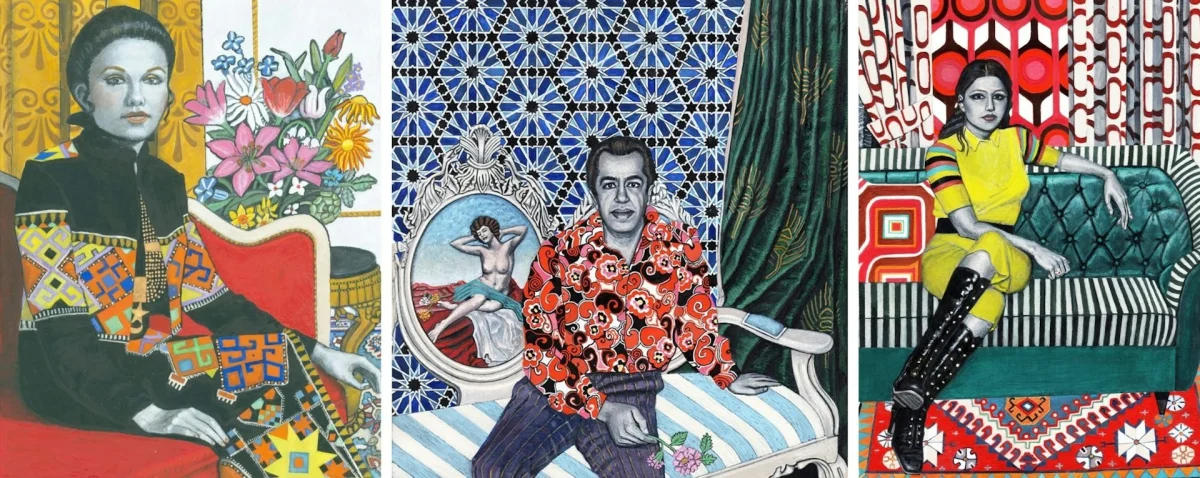
Through her breathtaking miniature paintings executed in egg tempera on calf vellum, Sokhanvari resurrects the memories of trailblazing Iranian women whose public lives were pulverized by sociopolitical upheaval. Her award-winning portfolio bridges the personal and the political, weaving together the fate of her own father, Ali-Mohammad Sokhanvari, alongside Iranian cultural icons such as Empress Farah Diba Pahlavi, pioneer actress Roohangiz Saminejad, film star Forouzan, polymath artist Shahrzad, and legendary singer Googoosh.
Sokhanvari’s work does not merely document historical loss; it acts as an act of artistic reclamation. By utilizing the intimate, delicate scale of traditional Persian miniature painting, she forces viewers to lean in close, transforming passive gallery-goers into intimate witnesses to state-sponsored erasure.
Detailed Chronology
To fully understand the gravity of Sokhanvari’s artistry, one must trace the timeline of personal rupture and national transformation that forged her unique visual vocabulary.
1964–1978: Roots in Shiraz and the Pahlavi Era
Soheila Sokhanvari was born in Shiraz, a city in southwestern Iran renowned for its deep poetry, exquisite gardens, and rich artistic heritage. During her early childhood, Iran was undergoing rapid, often polarizing modernization under the Pahlavi dynasty. Culturally, the nation was a complex space where traditional Islamic values collided with Western-leaning secularism, creating a vibrant, albeit turbulent, golden age for Iranian cinema, music, and the arts. Women were increasingly stepping into public, professional spheres as actors, directors, journalists, and politicians—a trajectory that, while promising, was fraught with class divides and severe political repression under the Shah’s secret police, SAVAK.
1978–1979: The Crucible of the Islamic Revolution
At the tender age of 14, Sokhanvari’s life was irrevocably cleaved in two. Sent away to Britain for her education just prior to the seismic 1979 Islamic Revolution, she found herself suddenly marooned thousands of miles from home. Overnight, the Iran she knew—a land of unfolding artistic expression and cosmopolitan ambition—evaporated, replaced by a fundamentalist theocracy that immediately targeted female autonomy, bodily sovereignty, and cultural production. Separated abruptly from her family, young Sokhanvari coped with profound isolation by obsessively drawing her relatives from old, fading photographs. This early trauma planted the seeds for her lifelong artistic exploration of exile not merely as a geographic displacement, but as a severe rupture in time.
2000–2022: The Long Arc to Rebel Rebel
For decades, Sokhanvari honed her technical mastery while carrying the psychological weight of her severed homeland. Her breakthrough came with the realization that the archival destruction happening in Iran could be fought using the microscopic precision of traditional Persian court painting. This culminated in her critically acclaimed 2022 landmark institutional solo exhibition, Rebel Rebel, hosted at London’s Barbican Centre. Featuring 28 meticulously crafted miniature portraits, the exhibition mapped a genealogy of Iranian women’s resistance across generations, connecting the performers of the pre-revolutionary era to the contemporary women risking their lives on the streets of Tehran in the Woman, Life, Freedom movement.
2026: Critical Vindication and the David and Yuko Juda Art Foundation Award
Sokhanvari’s selection for the 2026 David and Yuko Juda Art Foundation Award—curated by prominent art historian Alyce Mahon—cements her status as one of the most vital political artists of her generation. Presenting a curated series of five pivotal portraits for the award, Sokhanvari continues to challenge contemporary amnesia, proving that historical erasure can be actively resisted through the slow, meditative labor of painting.
Supporting Context & Metrics
The depth of Sokhanvari’s work is illuminated by understanding the cultural and technical metrics of her artistic process, as well as the harrowing biographies of her subjects.
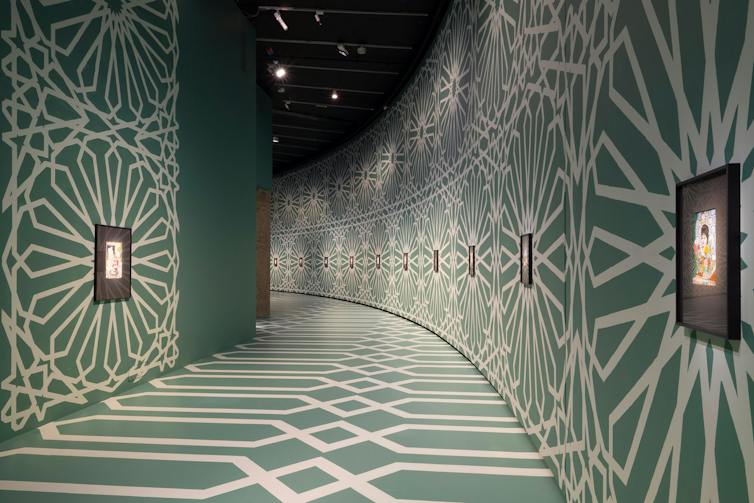
The Technique: Egg Tempera on Calf Vellum
Sokhanvari rejects rapid digital reproduction and large-scale canvases in favor of hyper-intimate, laborious craftsmanship rooted in Persian miniature traditions.
- The Medium: She grinds raw mineral pigments by hand, mixing them with fresh egg yolk to create egg tempera.
- The Canvas: She paints exclusively on prepared calf vellum.
- The Scale: These portraits are exceptionally small, requiring viewers to step into an intensely personal, almost voyeuristic proximity.
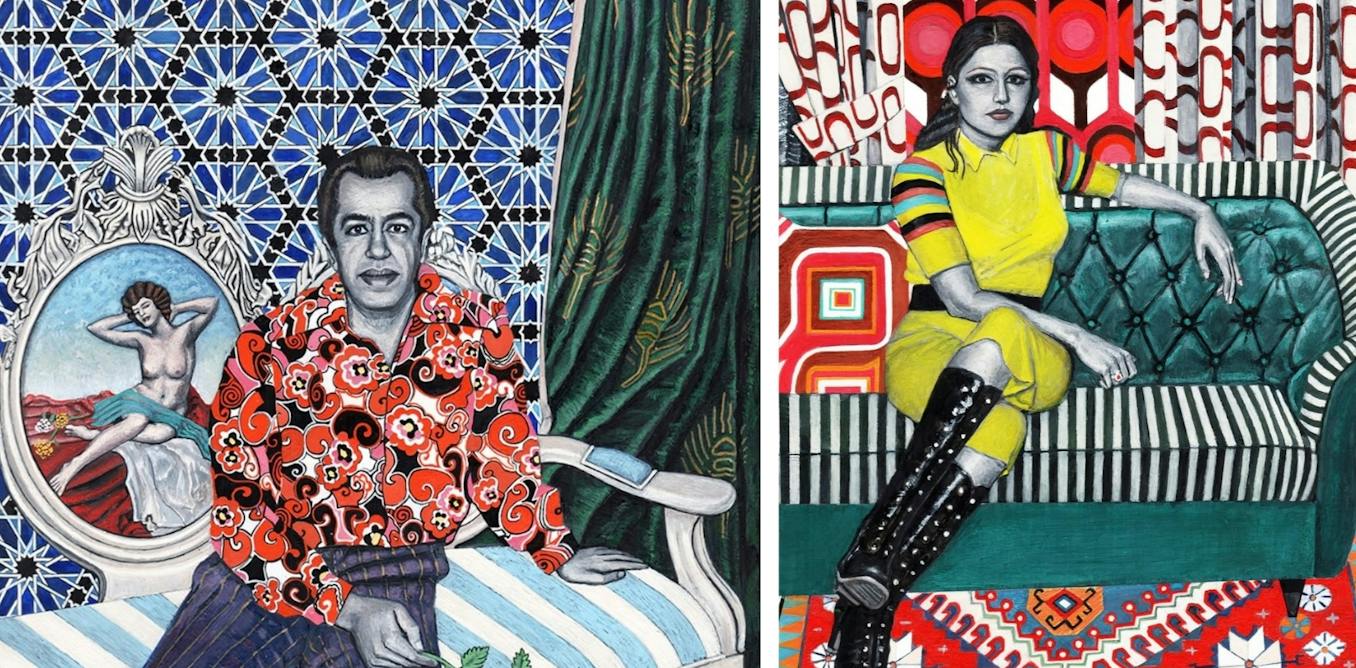
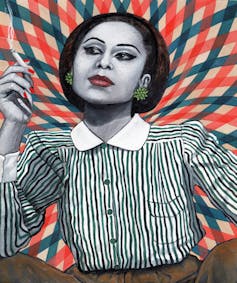
- The Aesthetic Contrast: While the faces of her subjects are rendered in a somber, spectral grey—mirroring the damaged, monochrome archival photographs from which they derive—vibrant, densely detailed Persian-inspired floral patterns and geometric motifs bloom dynamically around them. This visual tension symbolizes how the human spirit flowers even within hostile environments.
Case Studies of Erasure
1. Roohangiz Saminejad (1916–1997)
Saminejad was the trailblazing first female star of a Persian-language "talkie," starring in Ardeshir Irani’s 1933 film The Lor Girl. Her crime was simple yet revolutionary: she appeared on screen completely unveiled, speaking and dancing openly. The backlash was ferocious. Saminejad received relentless death threats, faced societal ostracization, and was ultimately forced to change her name to live out her life in total anonymity. Sokhanvari’s portrait of Saminejad deliberately strips away the colorful, ornate backgrounds seen in her other works, presenting her in stark monochrome. It is a visual testament that the lethal cost of female visibility in Iran predates the 1979 revolution; the revolution merely institutionalized it.
2. Parvin Kheirbakhsh, known as Forouzan (1937–2016)
Once one of Iran’s most celebrated cinematic icons, Forouzan faced immediate persecution after the 1979 revolution. Arrested and imprisoned by the new regime, she was released only after signing a humiliating letter of repentance. The state systematically seized all her financial assets and property, reducing a once-adorated national icon to absolute poverty. She died in relative obscurity, a stranger in her own country. Sokhanvari’s portrait, Hey, Baby I’m a Star, memorializes this tragic trajectory from ubiquitous adoration to forced oblivion.
3. Kobra Amin Saeedi, known as Shahrzad (1945–2025)
Perhaps the most harrowing narrative captured by Sokhanvari is that of Shahrzad—a pioneering actor, dancer, poet, journalist, and independent filmmaker. Shahrzad dared to transition from being an object on screen to an author behind the camera. Following her active participation in the 1979 protests against the compulsory hijab, she was imprisoned, subjected to brutal electric shock therapy in psychiatric institutions, stripped of her assets, and left utterly homeless. She passed away in deep poverty in 2025.
Because photographic archives of Shahrzad were severely compromised, Sokhanvari executed a profound artistic intervention for her portrait Kobra: she studied grainy, fragmented headshots, then posed as Shahrzad herself in her studio, having her husband photograph her posture. Using her own living body as a vessel, Sokhanvari restored the sovereign, statuesque self-possession—cigarette poised between red nails, gaze fiercely defiant—that the state had violently attempted to strip away.
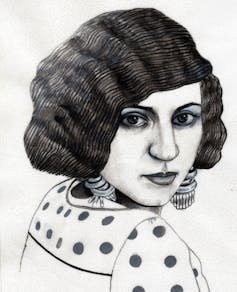
4. Googoosh (born 1950)
Iran’s most beloved pop icon, Googoosh, was subjected to a crushing 21-year silence following the 1979 revolution. Banned from performing or recording, she spent decades under effective house arrest, punctuated by a harrowing month in prison. While her iconic voice continued to echo underground across the Iranian diaspora via clandestine cassette tapes, she was ghostly and absent from the official cultural sphere. When she finally returned to the stage in 2000, it was strictly from exile. In Sokhanvari’s painting The Love Addict, a younger Googoosh sits before a framed portrait of her future self, ghost-grey hands bridging two agonizingly disconnected epochs of Iranian history.
Official Statements and Curatorial Perspectives
The significance of Sokhanvari’s victory at the 2026 David and Yuko Juda Art Foundation Award has drawn widespread praise from leading art historians, curators, and critics.
Curator Alyce Mahon, who selected Sokhanvari for the award, emphasized the profound socio-political urgency embedded within the artist’s miniature works:
"Soheila Sokhanvari does not merely paint history; she performs an act of radical forensic recovery. In an era where authoritarian regimes seek to legislate memory and erase women from the public ledger, her portraits act as defiant monuments. By returning these women to our gaze with such exquisite, heartbreaking tenderness, she challenges the permanence of oblivion."
Reflecting on her painstaking artistic process in recent interviews, Sokhanvari described portrait painting as an inherently political and emotional endeavor:
"Portraiture is an act of love, but it is also an act of defiance. Grinding the pigments by hand, mixing them with the yolk of an egg, and building these women up layer by layer on vellum—it is a slow, meditative mourning. These paintings cannot give these women back their stolen homes, their interrupted careers, or the decades they spent in forced silence. They cannot rebuild the vanished world of pre-revolutionary Iran. But through every deliberate brushstroke, they make a solemn vow: we refuse to let you be forgotten."
Art critics reviewing her installations have frequently highlighted how the miniature format subverts traditional power dynamics. By forcing viewers to lean in close to examine the delicate, jewel-toned surfaces, Sokhanvari creates an intimate, almost conspiratorial bond between the historical subject and the modern spectator, bypassing the detachment typical of large-scale museum viewing.
Future Outlook
As Soheila Sokhanvari accepts the 2026 David and Yuko Juda Art Foundation Award, her trajectory points toward an increasingly influential role in contemporary international art and political discourse. Her work transcends the specific geopolitical boundaries of Iran, speaking universally to the mechanisms of exile, state-sponsored censorship, and the persistent erasure of women across global histories.
Looking forward, Sokhanvari’s ongoing artistic endeavors aim to expand this Pantheon of the Erased. As global authoritarian movements continue to weaponize cultural censorship, the relevance of her forensic, archival-based portraiture grows ever more urgent. Her upcoming projects will likely continue to explore the intersection of familial memory and collective trauma, deploying the weaponized beauty of Persian iconography to challenge state-mandated amnesia.
Ultimately, Sokhanvari’s art offers a vital philosophical proposition for the 21st century: that while political violence can dismantle institutions, silence voices, and burn archives, the fierce act of looking back—mediated through the transformative power of art—can forge an unbroken lineage of female resistance that no regime can ever truly extinguish.