Executive Overview
Folk music has always been a communal anchor—a cyclical inheritance designed to process the fundamental spectrum of human experience, from profound grief to ecstatic joy. Traditionally, this transmission relies on acoustic instrumentation, generational melodies, and physical proximity: voices raised in unison, feet keeping time on wooden floors. Yet, as contemporary society grows increasingly fragmented, the avenues for collective catharsis have expanded. While audiences still find sanctuary in traditional folk circles, they are equally likely to seek transcendence in the sweat of a punk gig or the unironic euphoria of a classic pop refrain.
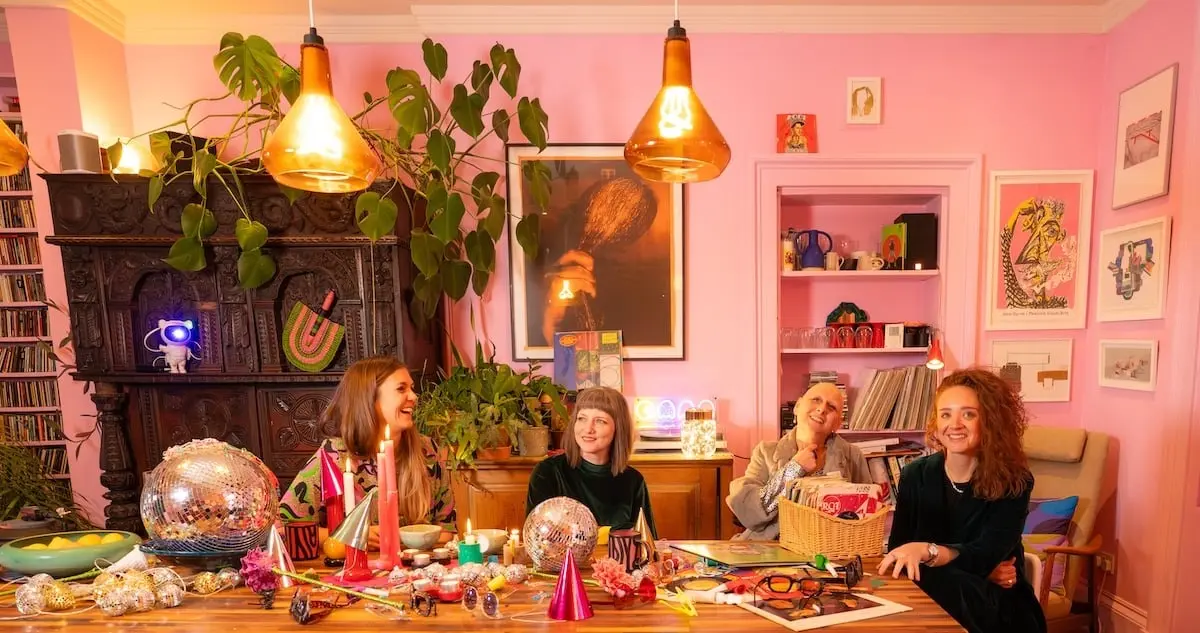
Enter Birdvox, a formidable Scottish supergroup that refuses to recognize the boundaries separating ancient tradition from modern dancefloor hedonism. Comprising four celebrated multi-instrumentalists and vocalists—Sarah Hayes (Admiral Fallow), Inge Thomson (Karine Polwart’s band, Harem Scarem), Jenny Sturgeon (Salt House), and Charlotte Printer (Altered Images, Joesef)—the quartet has forged an entirely singular sonic vocabulary.
Their upcoming debut album, Shamming the Drama (set for release on September 18th, 2026, via Hudson Records), is not merely a genre-crossing experiment; it is a masterclass in sonic juxtaposition. Weaving together traditional Scottish folk, Norn and Shetland dialects, pulsing disco beats, jittery post-punk, and glacial ambient electronica, Birdvox has engineered a record designed simultaneously for intellectual engagement, political reflection, and uninhibited physical movement.
Detailed Chronology & Track Breakdown: Navigating Shamming the Drama
To trace the arc of Shamming the Drama is to embark on a kaleidoscopic journey through disparate eras of sound production, bound tightly together by the sheer caliber of the ensemble’s vocal arrangements and instrumental dexterity.
The Opening Statements: Disruption and Intimacy
The album wastes no time establishing its disruptive ethos. The opener, Sea Change, functions as a bold mission statement. Channeling the theatricality of Kate Bush, the track locks into a quick-footed, sophisticated disco rhythm underpinned by a flurry of traditional dance melodies. Lyrically, it sets the tone by directly confronting lingering instances of misogyny within the contemporary music industry, proving instantly that this is music meant to provoke deep thought alongside kinetic movement.
By stark contrast, Grey Fedder represents the collection at its most ambient and sonically enveloping. Utilizing Roseanne Watt’s Shetland dialect translation of Kathleen Jamie’s acclaimed poem Grey Feather, the track opens with a subtle glimmer of electronics before foregrounding the human voice in a spine-tinglingly intimate mix. Washed in stunning vocal harmonies that unfold at a glacial pace, it features electronic effects that twinkle like mica embedded in coastal sand.
Rhythms of Anxiety and Kinetic Electro-Folk
The middle third of the record pivots toward danceability and sharp social commentary. Almosts and Redos builds its foundation on funky, chicken-scratch percussion reminiscent of a futuristic Talking Heads. Lyrically, it tackles the all-too-familiar contemporary anxiety of our current era—specifically, how an entire generation has been forced to learn resilience and joy in the face of relentless political uncertainty and personal hardship.
The tension heightens with Sparx, which kicks off with a pulsing Human League-style throb. Offset by itchy, glitchy electronic effects and vocals reminiscent of Hen Ogledd covering Kate Bush’s Hounds of Love, the track shifts gears into a gloriously kinetic slice of electro-folk. Here, the line between acoustic traditional instruments and synthetic hardware blurs entirely, further destabilized by the chaotic, welcome addition of Chris Greive’s trombone.
Deepening the narrative scope, King Orfeo serves up a rich, traditional narrative in classic ballad form, anchored unexpectedly by bone-dry, modern beats. Meanwhile, Set Me Up explores themes of vulnerability and resilience through a deliberate, minimal lens, utilizing delicate vocal harmonies and stop-start synthesizers to carve out space for emotional honesty.
The Natural World and Industrial Pulses
A pervasive thematic current throughout Shamming the Drama is humanity’s relationship with the natural world—and the rising urgency of ecological stewardship. Gannets is a swooping instrumental masterpiece where an acrobatic flute flutters across a canvas of danceable pulses, synthesized scrapes, and strange, organic churring sounds.
The industrial edge of the group’s electro-pop surfaces sharply on Cicadas, an unflinching meditation on transience, human loss, and grief that never surrenders its imperative to keep feet tapping. Conversely, the closing piece, Wagtails, drifts into a bucolic reverie. Featuring authentic field recordings of birdsong, strange looped percussion, disembodied wordless vocals, and agile flute work reminiscent of a folkier Virginia Astley, the album concludes in a peaceful haze of piano and wildlife sounds.
Pop Deconstructions and Neo-Classical Flourishes
Birdvox’s fluency in pop history is displayed brilliantly on Fire Baby. Driven by propulsive, minimal synths that evoke Giorgio Moroder, Marc Almond, the Pet Shop Boys, and New Order, the track is radically transformed by vocals that feel atavistic and deeply tethered to the natural world—a quality usually restricted to acoustic folk.
Similarly, Shape of a Friend opens with a trace of neoclassical flute before careering headlong into a lush pop melody that Christine McVie would proudly claim. This pop sensibility culminates in We Are, an explicit affirmation of community power wrapped snugly in the melodic language of 1980s left-field pop.
Supporting Context & Metrics: The Supergroup Blueprint
The unique gravitational pull of Birdvox lies in the formidable pedigree of its members. Individually, Hayes, Thomson, Sturgeon, and Printer have spent decades shaping the landscape of Scottish indie, folk, and alternative scenes.
| Artist | Primary Project / Collaborations | Key Instrumentation & Role |
|---|---|---|
| Sarah Hayes | Admiral Fallow, Solo Artist | Vocals, Multi-instrumentalist |
| Inge Thomson | Karine Polwart Band, Harem Scarem, Lau, Broken Family Band | Co-founder, Vocals, Multi-instrumentalist |
| Jenny Sturgeon | Salt House, Solo Artist (The Living Mountain) | Vocals, Multi-instrumentalist |
| Charlotte Printer | Altered Images, Joesef | Bass, Multi-instrumentalist |
By pooling their respective universes—ranging from the indie-pop sheen of Altered Images and Joesef to the chamber-folk intricacies of Salt House and Admiral Fallow—the quartet has managed to bypass the usual growing pains of collaborative supergroups.
Furthermore, the record’s dedication to linguistic preservation stands out as a major cultural metric. By incorporating Scots, Norn, and Shetland dialects into tracks like Grey Fedder, Birdvox actively resists the homogenizing pressures of modern monoculture. They demonstrate that regional identity and global electronic production are not mutually exclusive, but rather complementary forces capable of generating entirely fresh artistic statements.
Official Statements and Industry Insights
The philosophy underpinning Birdvox’s cross-pollination of genres points to a broader cultural realization: that art must evolve to match the emotional complexities of modern existence. In promotional notes accompanying the release of Shamming the Drama, the ensemble emphasizes the necessity of shared spaces—both physical and sonic—in an era defined by isolation.
"The idea that four very different musicians can join up and make folk music that is also pop music, music that you can dance to, grieve with and wonder at: that such experiences still exist and can be conjured out of the ether by four multi-instrumentalists from Scotland—surely that’s something to celebrate."
Musicologists and industry critics have noted that Birdvox’s integration of traditional folk with 1980s synth-pop and ambient electronica positions them at the vanguard of a new wave of progressive roots music. By refusing to treat traditional music as a museum artifact to be preserved under glass, the group treats heritage as a living, malleable tool for contemporary storytelling.
Future Outlook: A New Standard for Electro-Folk
As the music industry watches the rollout of Shamming the Drama ahead of its September 18th, 2026 release via Hudson Records, the implications for the wider folk scene are profound. Birdvox proves that traditional musicians do not need to remain tethered to acoustic purism to honor their roots.
With a live touring schedule in development and initial singles like Shape of a Friend already drawing critical acclaim across digital and broadcast platforms, the quartet is poised to redefine audience expectations. They offer a blueprint for future collaborations: one where technological innovation, ecological consciousness, and historical preservation coalesce into a singular, joyful noise.
In a world desperate for cohesion, Birdvox reminds us that whether through the shuffle of a disco beat, the intricate pull of a Shetland ballad, or the synthesized throb of a post-punk bassline, the fundamental human need for shared emotion remains unbroken.