Executive Overview
For over four decades, Anne Carson has quietly redrawn the cartography of contemporary literature. Operating at the intersections of poetry, translation, classical scholarship, essayistic prose, performance art, and visual composition, she has forged a body of work that rejects easy categorization. Yet, what is most striking about Carson—the laureate of the 2026 Nobel Prize in Literature—is not merely her breathtaking formal originality, extraordinary though it is. Rather, it is her singular ability to make the act of thinking itself feel like a high-stakes literary event.
At a historical juncture when academia and creative writing are rigidly sequestered into separate institutional silos, Carson has demonstrated how deeply they belong together. Her career serves as an enduring reminder that intellect and imagination do not compete; rather, they continually fuel and enrich one another. The resulting corpus is at once intellectually demanding and creatively daring, proving that rigorous scholarship and avant-garde art can occupy the exact same breath.
By bridging the ancient and modern worlds, interrogating the architecture of human desire, and pioneering radical formal experiments, Carson has fundamentally expanded the horizons of global letters. This profile examines the trajectory of her monumental career, the philosophical underpinnings of her masterworks, her profound influence on a rising generation of writers, and the broader cultural impact of her 2026 Nobel Prize.
Detailed Chronology: Milestones of a Revolutionary Oeuvre
To understand the scope of Anne Carson’s literary architecture, one must trace a chronology defined not by conventional progression, but by daring leaps across genres, mediums, and millennia.
The Emergence: Eros the Bittersweet (1986)
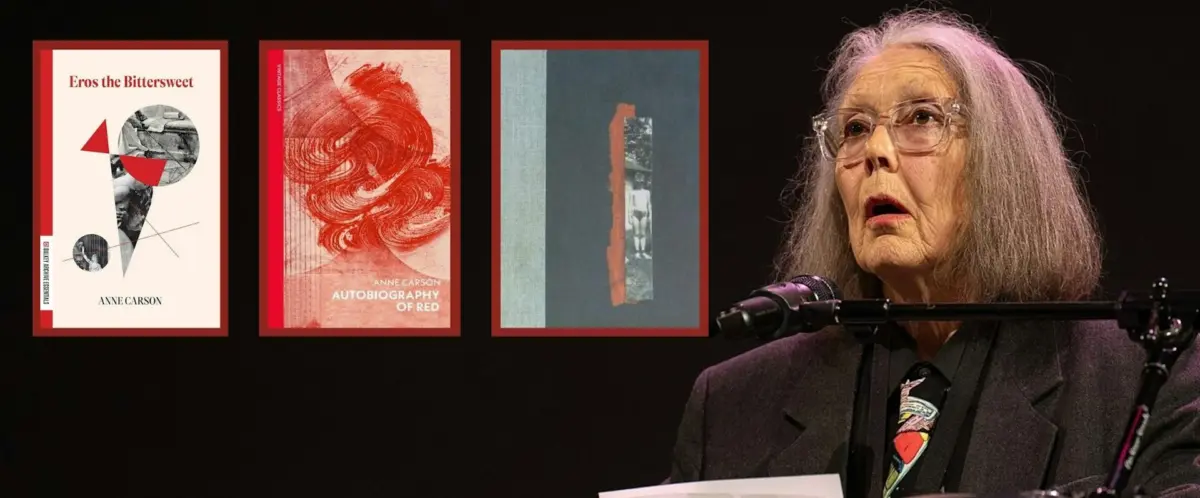
Carson announced her arrival not with a traditional collection of verse, but with Eros the Bittersweet, a brilliant hybrid of classical scholarship, philosophy, and literary criticism. Examining the Greek concept of glykypikron (sweet-bitter), Carson explored desire as a triangular dynamic born of distance, lack, and the space between lovers. The book immediately signaled her methodology: the ancient world would not be treated as a dusty archive of dead artifacts, but as a living, urgent laboratory for human emotion.
The Novel in Verse: Autobiography of Red (1998)
Twelve years later, Carson stunned the literary establishment with Autobiography of Red: A Novel in Verse. Taking a fragmentary poem by the ancient Greek lyricist Stesichoros about the monster Geryon—slain by Herakles—Carson reimagined the mythical beast as a contemporary, shy, winged photographer navigating modern heartbreak and self-discovery. By grafting an ancient myth onto a contemporary coming-of-age narrative, Carson demonstrated that antiquity could provide an acute lens for modern psychological landscapes.
The Poetics of Marriage: The Beauty of the Husband (2001)
Subtitle A Fictional Essay in 29 Tangos, this collection won the inaugural Griffin Poetry Prize. Structured around the aesthetic philosophies of John Keats, The Beauty of the Husband is a devastating, luminous autopsy of a failed marriage. Here, Carson perfected her trademark tone: a devastating blend of razor-sharp wit, classical allusion, and unsparing emotional excavation.
Radical Materiality: Nox (2010)
Perhaps no single publication better encapsulates Carson’s defiance of traditional book publishing than Nox. Presented as a facsimile of an accordion-fold art book that Carson constructed in a shoebox, Nox is an elegy for her estranged brother, Michael. It combines translated fragments of Catullus’s 101st poem, dictionary entries, photographs, letters, and handwritten marginalia. It is a monument to grief, proving that the physical book itself could become a site of mourning, archaeology, and tactile reading.
The Ephemeral and the Performative: Float (2016)
Consisting of twenty-two chapbooks packaged in a clear plastic sleeve—meant to be read in any order the reader chooses—Float further dismantled the linearity of the codex. Featuring works that range from essays on translation to performance scripts like Lecture on the History of Skywriting, Carson forced readers to confront the impermanence of language and the spatial dynamics of the page.
Supporting Context & Metrics: The Mechanics of Carson’s Art
+-----------------------------------------------------------------+
                    ANNE CARSON’S LITERARY MATRIX
+-----------------------+-----------------------------------------+
| Primary Disciplines   | Poetry, Translation, Classical Studies, |
|                       | Visual Art, Essay, Performance          |
+-----------------------+-----------------------------------------+
| Core Themes           | Distance, Desire, Absence, Mortality,   |
|                       | Translation as Transformation           |
+-----------------------+-----------------------------------------+
| Landmark Texts        | Eros the Bittersweet (1986)             |
|                       | Autobiography of Red (1998)             |
|                       | Nox (2010)                              |
+-----------------------+-----------------------------------------+
| Key Accolades         | MacArthur Fellowship (2000), Griffin    |
|                       | Poetry Prize (2001), Princess of        |
|                       | Asturias Award (2019), Nobel Prize in   |
|                       | Literature (2026)                       |
+-----------------------+-----------------------------------------+
The Inhabited Past
Carson moves effortlessly between ancient and modern worlds, not by collapsing historical difference, but by intensely inhabiting it. In her hands, antiquity is never a repository of cultural authority or a storehouse of exemplary texts. It is a living, unsettled terrain of voices, fragments, silences, and absences.
This is most evident in her treatment of ancient Greek literature. Carson’s Sappho, Simonides, Sophocles, and Euripides do not emerge as objects of sterile scholarly reconstruction; they are interlocutors. Their words cross centuries to illuminate experiences that continue to elude contemporary vocabularies: desire, grief, longing, estrangement, and mortality. Carson’s dialogue with antiquity reveals that the ancient world survives not because it is dutifully preserved in amber, but because it continually generates startling new meanings.
The Geography of Distance
Again and again, her composition returns to questions of distance. The distance between lovers. The distance between languages. The distance between the living and the dead. The distance between what can be known and what must remain perpetually elusive.
Desire in Carson’s universe is rarely a movement toward possession or mastery; rather, it is an encounter with absence. Her writing dwells in the gaps and intervals that structure human experience, finding there both acute pain and radical possibility. Few contemporary authors have written so perceptively about longing and the myriad forms it assumes across a human life.
This concern with distance is inseparable from her radical experimentation with form. Fragmentation, quotation, interruption, and collage become cognitive tools for thinking through memory, desire, and loss. Carson’s formal innovations never feel merely decorative or avant-garde for its own sake. They arise inexorably from the demands of the subjects she explores. Form is never decoration in Carson’s work; it is inquiry.
Official Statements and Institutional Recognition
The announcement of the 2026 Nobel Prize in Literature by the Swedish Academy cemented Carson’s status as a towering figure of world letters. The citation commended her for "a masterly oeuvre that bridges antiquity and modernity, and for transforming our understanding of how poetry, scholarship, and thought intersect."
From the Nobel Lecture / Academy Citation:
"Anne Carson has expanded the map of contemporary literature by demonstrating that the borders between criticism and creation are entirely porous. Her work honors the intelligence of the reader while offering an unsparing exploration of the spaces where human language reaches its absolute limits."
Reflecting on her lifelong project of translating figures like Sappho and Euripides, Carson has frequently noted in rare interviews that translation is not a mechanical act of linguistic substitution, but an ethical encounter with the radically other.
"When you translate an ancient text," Carson observed in a retrospective on her classical scholarship, "you are stepping into a room where someone has left a window open. You aren’t trying to fix the room; you are trying to feel the draft."
Academic institutions globally have echoed this sentiment. Colleagues and literary critics have pointed out that Carson’s receipt of the Nobel Prize signals a shift in how the Academy values hybrid genres. By awarding the prize to a writer who defies traditional genre classifications, the Nobel Committee has signaled that the future of literature lies in forms that refuse to choose between the essay, the poem, and the scholarly monograph.
Future Outlook: The Carsonian Legacy
The influence of Anne Carson’s output is already thoroughly visible in a younger generation of writers, translators, and scholars who move fluidly between criticism, translation, poetry, and creative prose.
For decades, academic and creative writing programs trained practitioners to stay within their lanes—scholars wrote peer-reviewed monographs for small audiences, while poets crafted lyric verses for literary magazines. Carson shattered those artificial boundaries. Countless contemporary writers have learned from her example that these activities not only can be combined, but that they illuminate one another in ways that single-discipline writing never can.
What Carson has bequeathed to contemporary literature is not a rigid method to be slavishly imitated, but a profound sense of intellectual freedom: a radical willingness to experiment, to embrace epistemological uncertainty, and to trust that rigorous, demanding thinking can itself become a supreme act of literary creation.
As we look toward the future of letters in the mid-21st century—an era dominated by digital fragmentation, algorithmic text generation, and shrinking attention spans—Carson’s work stands as a defiant monument to the power of deep, slow, uncompromising thought. Her Nobel Prize is not merely a retrospective capstone to a brilliant career; it is a beacon pointing toward what literature can achieve when it dares to look into the abyss of history, language, and human longing without flinching.