As part of its ambitious autumn tour, the English Touring Opera (ETO) has delivered a triumph of conceptual staging and musical cohesion with a striking operatic double bill. Performed at the historic Hackney Empire, the programme pairs Elena Langer’s 2002 contemporary monodrama Ariadne with Henry Purcell’s baroque masterpiece Dido & Aeneas.
This thoughtful pairing explores two of classical music’s most tragic heroines through an abstract, mythic lens. Rather than relying on heavy historical pastiche or overly literal ancient-world iconography, directors Anna Morrissey and Rebecca Meltzer opted for a streamlined, timeless aesthetic. This directorial choice places maximum emphasis on psychological depth, physicalized movement, and vocal clarity.
Spearheaded by powerhouse lead performances from Jessica Cale as Ariadne and Samantha Price as Dido, the double bill showcases the ETO’s capacity for ensemble-driven storytelling. Supported by sharp instrumental direction and a versatile eight-member core cast, the evening offered audiences a masterclass in modernizing early and contemporary opera without sacrificing emotional authenticity.

Detailed Chronology & Production Analysis
Part I: Elena Langer’s Ariadne
The evening opened with Elena Langer’s Ariadne, a 2002 monodrama originally written during the composer’s residency at the Almeida Theatre in collaboration with poet Glyn Maxwell. Acting as a modern-day psychological counterpart to Haydn’s Arianna a Naxos, the piece transpires almost entirely within the mind of its abandoned protagonist.
[The Bed Platform]
       │
       ├─► Ariadne (Jessica Cale) [Internalized distress & psychological arc]
       └─► Theseus (Kieron-Connor Valentine) [Silent presence / physicalized memory]
       │
[Rear Platform] ──► Instrumental Quartet (Oboe, Violin, Viola, Cello)
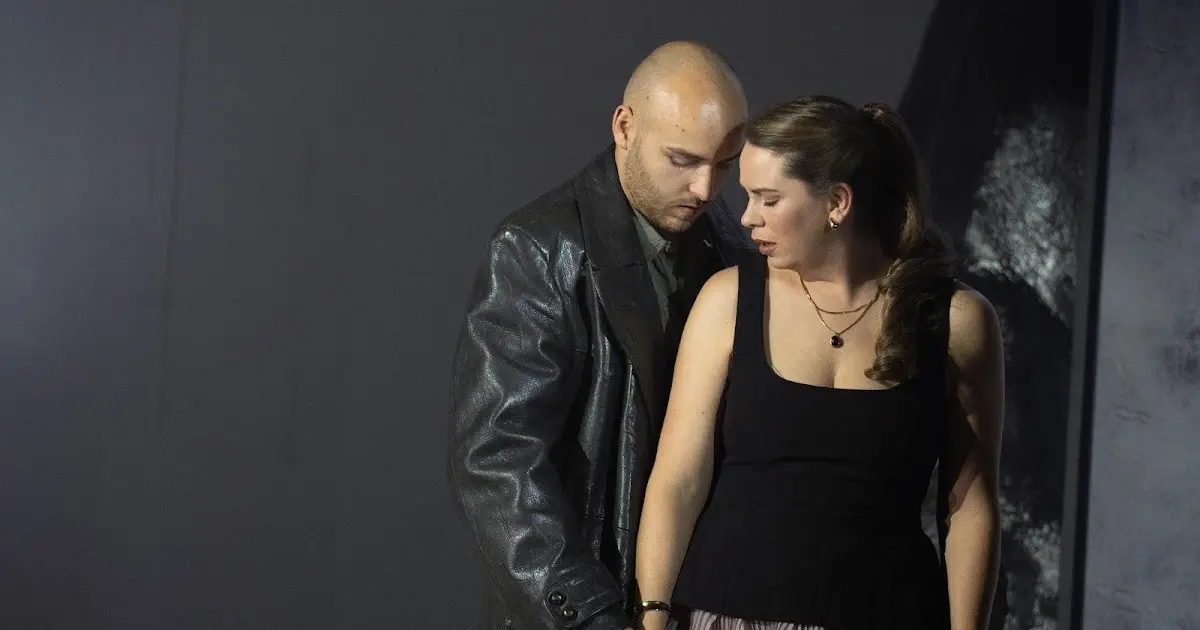
Director Anna Morrissey and designer Alex Berry framed the tragedy within a stark, clinical white box. At the rear, a raised platform housed a live instrumental quartet: Hannah Conliffe (oboe), Gary Ngan (violin), Hannah Gardiner (viola), and James Heathcote (cello). The action commenced with Ariadne and Theseus (Kieron-Connor Valentine) sharing a bed. Without a word or overt explanation, Theseus slipped away silently, setting the psychological tragedy into motion.
Valentine’s role throughout the first half was entirely non-verbal; he prowled the stage as a phantom presence, periodically shifting the very platform on which Ariadne’s bed rested. This staging served as a brilliant visual metaphor for the lingering weight of Theseus’s abandonment, haunting Ariadne’s thoughts until his sole vocal contribution—a brief, hallucinated echo of his voice—at the opera’s conclusion.

Jessica Cale delivered a masterclass in vocal and dramatic restraint. Sustaining intense focus over a 15-to-20-minute continuous monologue, Cale mapped Ariadne’s spiraling distress with acute precision. She never overplayed her hand, allowing the psychological arc to unfold naturally. Meanwhile, Langer’s vibrant, oboe-led score functioned almost as an ensemble character in its own right, expertly commenting on and amplifying Cale’s internal turmoil.
Part II: Henry Purcell’s Dido & Aeneas
Following the interval, the production shifted from the mythic isolation of Naxos to the courtly anxieties of Carthage. Directed by Rebecca Meltzer and conducted by Alex Robinson, this iteration of Dido & Aeneas took deliberate cues from the opera’s earliest recorded performance at Josiah Priest’s school. Alex Berry’s costume designs playfully acknowledged this historical performance context while preserving a striking, modern visual profile.
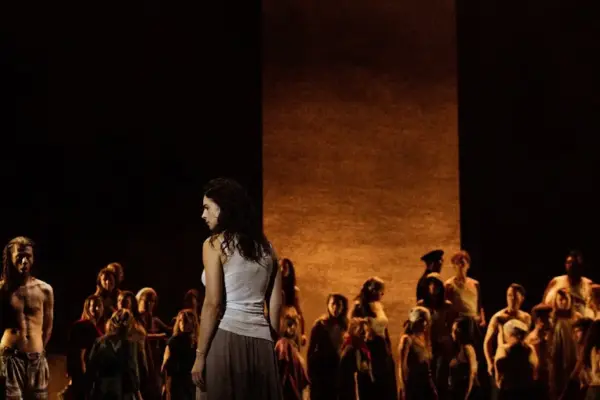
The staging retained the stark white box from Ariadne, augmented by a central platform and wrapped in translucent screens. Dido and Aeneas were kept perpetually in view—either centre-stage among the courtiers or looming behind the semi-transparent partitions—creating an inescapable sense of surveillance and societal pressure.

Samantha Price’s portrayal of Dido broke away from stoic archetype models, imbuing the Carthaginian queen with a palpable underlying anxiety. Her narrative development felt earned; Price carefully traced Dido’s cautious surrender to love alongside Michael Lafferty’s steady, self-assured Aeneas. Lafferty brought a grounding inner strength to the role, validating Dido’s sudden devotion. Notably, Meltzer integrated instrumental interludes from Purcell’s Diocletian immediately following the couple’s first scene, granting the characters vital dramatic breathing room to solidify their romantic connection.
┌─────────────────────────────────────────────────────────────┐
│                 CARTHAGINIAN COURT / ENSEMBLE               │
│  (Seamlessly transitions from high-society courtiers into   │
│                 dark-glasses-wearing witches)               │
└──────────────┬──────────────────────────────┬───────────────┘
               │                              │
       [Samantha Price]                [Michael Lafferty]
           (Dido)                          (Aeneas)
               │                              │
               └──────────────┬───────────────┘
                              │
                    [Director / Movement]
              (Rebecca Meltzer's physicalized style)
The supporting cast delivered equally compelling turns. Isabelle Atkinson (Belinda) and Alexandra Meier (Second Woman) portrayed a court that gently pressured rather than isolated the queen. In a brilliant stroke of theatrical economy, the ensemble transformed into a coven of witches simply by donning dark glasses. Lydia Shariff commanded the stage as a rich-voiced, deeply threatening Sorceress, supported capably by Atkinson, Meier, and a put-upon spirit played by Kieron-Connor Valentine.
Guy Elliott injected a burst of high-energy levity as the Sailor. Stripping down to vests and boxer shorts, the male ensemble ran amok in an unbridled display of release, even utilizing an onstage shower to wash away their Carthage constraints.

Supporting Context & Metrics
To fully appreciate the scope and technical demands of the ETO autumn tour double bill, consider the following structural and statistical breakdown:
- Performance Date: October 17, 2026
- Venue: Hackney Empire, London (Capacity ~1,850)
- Works Featured:
- Ariadne (Elena Langer, 2002, Libretto by Glyn Maxwell) — Approx. 20-minute monodrama.
- Dido & Aeneas (Henry Purcell, 1689, Libretto by Nahum Tate) — Full-length baroque opera.
- Cast Scale: A core ensemble of eight versatile singer-actors executed all solo, chorus, and specialized ensemble roles across both productions.
- Instrumental Forces:
- Ariadne: Soloist-led chamber quartet (Oboe, Violin, Viola, Cello).
- Dido & Aeneas: Period-informed chamber orchestra under Alex Robinson, augmented by continuo (harpsichord and theorbo).
Director Rebecca Meltzer’s background as a movement director heavily influenced the production. Eschewing traditional, rigid choreography, Meltzer allowed Purcell’s ingrained dance rhythms to dictate physical expression, turning the ensemble’s collective movement into a primary vehicle for narrative subtext.
Official Statements & Creative Insights
The production’s conceptual backbone is rooted in extensive dialogue between the creative team and the performers prior to opening night. Discussing her approach to taking on her first Dido, mezzo-soprano Samantha Price offered key insights into the artistic vision:

"The production is not specific to Roman mythology, and they are aiming for a timeless feel. They want to present the plot as clearly as possible, particularly as there is not a lot of story."
This commitment to clarity dictated the "less is more" philosophy applied to the opera’s devastating final sequence. Rather than cluttering the stage with elaborate props or distracting stage business during Dido’s lament ("When I am laid in earth"), Meltzer and Price stripped the stage bare. They relied entirely on vocal nuance, emotional honesty, and a starkly still performance space to maximize the emotional impact.
Furthermore, conductor Alex Robinson balanced period-performance conventions with theatrical pacing. While certain tempi in the opening scenes leaned unhurried—testing the agility of the continuo players within the cavernous acoustics of the Hackney Empire—Robinson successfully harnessed Purcell’s rhythmic vitality to color the dramatic action, particularly during the court and witch ensemble numbers.

Future Outlook
The English Touring Opera’s bold autumn presentation sets a high benchmark for contemporary stagings of early and 21st-century masterworks. By marrying Elena Langer’s concise, hyper-focused psychological exploration with Purcell’s baroque classic through a unified aesthetic framework, the ETO has proven that thematic relevance does not require literal modernization.
As the autumn tour continues to travel across the United Kingdom, this double bill demonstrates the viability of flexible, ensemble-based opera models. The success of the eight-singer core rotating effortlessly between courtly grace, psychological trauma, and menacing sorcery points toward a sustainable, highly imaginative future for regional and touring opera companies.
Audiences seeking innovative theatricality grounded in rigorous musicality will find the ETO’s current season an unmissable theatrical experience, confirming both Langer’s Ariadne and Purcell’s Dido & Aeneas as timeless explorations of human vulnerability.