Executive Overview
The digital audio workspace (DAW) ecosystem continues to accelerate at a breathtaking pace, bridging the gap between historical hardware rarity and hyper-modern software flexibility. Over the past fortnight, the music technology landscape has witnessed a prolific wave of software development. This period’s releases reflect a fascinating dichotomy within audio engineering: on one hand, developers are fiercely dedicated to the granular emulation of vintage analog hardware—from rare 1980s polyphonic synthesizers to legendary analog tape processors used on multiplatinum rock records. On the other hand, the industry is boldly pushing into unconventional sonic territory, experimenting with single-control micro-plugins, cassette coloration chains, and even repurposed retro gaming hardware.
For modern producers, mixing engineers, and sound designers, keeping pace with this deluge of freeware and commercial releases can quickly become overwhelming. This comprehensive digest cuts through the noise. Below, we provide an exhaustive architectural breakdown of the most significant virtual instruments, creative effects, and mixing tools released over the past two weeks. Whether you are hunting for vintage saturation, pristine algorithmic reverbs, or avant-garde granular processing, this report analyzes the engineering, workflow implications, and practical value of every major software release currently disrupting the studio landscape.
Detailed Chronology of Releases
CableGuys – TimeStop
- Category: Creative Effects & DAW Automation
- Pricing: $16 (Introductory Black Friday Sale; up to 78% off wider catalogue)
Kicking off the early wave of Black Friday software promotions, CableGuys has introduced TimeStop, a dedicated utility designed to bridge the gap between complex tape-stop effects and intuitive DAW workflow integration. Traditionally, creating organic-sounding tape deceleration and velocity drops required clunky audio rendering, third-party time-stretching, or tedious pitch-envelope manipulation. TimeStop streamlines this entirely by allowing producers to draw slowdown trajectories directly via standard DAW automation lanes.
The plugin features three distinct operational modes tailored to different production styles:
- Classic Mode: Emulates a traditional physical tape drag or vinyl stop, where pitch and time decrease in precise unison, yielding the classic warbling slowdown curve.
- Modern Mode: Decouples pitch from time, dropping the perceived musical pitch of the incoming audio signal without altering the underlying timing or grid placement.
- Loop Mode: Designed for aggressive electronic music production, this mode combines traditional tape deceleration with synchronized rhythmic stutters for chaotic, high-energy fills.
Modbap – oneTHNG: Fidelity Theory
- Category: Lo-Fi Saturation & Resolution Effects
- Pricing: $29 Introductory (Rising to $39)
Known primarily by modular synthesis enthusiasts for sophisticated Eurorack hardware modules like the Osiris, Trinity, and Per4mer, Modbap has officially crossed over into the software domain. Their inaugural plugin release, oneTHNG: Fidelity Theory, adopts a radically minimalist design philosophy: a three-plugin series where each standalone effect explores a singular acoustic or digital concept governed by one primary macro control.
Fidelity Theory tackles the intrinsic relationship between audio resolution and bandwidth inherent to vintage samplers. Operating on the principle that high-fidelity digital audio requires a trade-off where resolution must drop as bandwidth rises (and vice versa), sweeping the central macro control morphs the processing state continuously from a pristine 48 kHz / 6-bit profile down to a gritty 6 kHz / 16-bit format. To add further tonal color, Modbap has included selectable converter voicings—dubbed "Iron" and "Worn"—alongside a dedicated ring-aliasing stage control for vintage digital grit.
Light Reft – DZA.grain
- Category: Granular Synthesizer & Hardware Hack
- Pricing: €4.99 (Free via Bandcamp newsletter subscription; compatible with emulators)
In one of the most eccentric releases of the season, boutique hardware manufacturer Light Reft (renowned for physical units like the Monolit MIDI controller and Concrete effects box) has stepped outside conventional plugin parameters. DZA.grain is not a standard VST or AU plugin; rather, it is a fully functional homebrew granular synthesizer application natively compiled for the Sony PlayStation Portable (PSP).
Users can load custom audio samples directly onto the portable console via a standard PSP memory card. Once loaded, the interface provides comprehensive control over playback speed, grain size, spatial position, voice allocation, and pitch shifting, supported by a dedicated preset saving system. For producers without a vintage handheld console gathering dust in a drawer, Light Reft officially sanctions running the application via modern PSP software emulators.
Universal Audio – Empirical Labs FATSO Native
- Category: Analog Tape Simulation, Compression & Saturation
- Pricing: $79 Sale (Regularly $149)
Universal Audio has expanded its native plugin catalogue with the long-awaited release of the Empirical Labs FATSO Native. Standing for Full Analog Tape Simulator and Optimizer, this authentic software recreation delivers the exact harmonic saturation, high-frequency rounding, and dynamic control heard on iconic records by artists ranging from AC/DC and Pearl Jam to Soundgarden and Willie Nelson—all processed entirely within the CPU, independent of proprietary UAD hardware accelerators.

The plugin provides four distinct compression topologies:
- Buss Mode: Tuned for gluing entire stereo mixes together.
- General Purpose: Ideal for transparent dynamic control across varied instrumental sources.
- Tracking Mode: Fast-acting saturation designed for individual input channels.
- Spank Mode: An aggressive, heavily colored limiter-style setting for maximum punch.
Purchasing the native license grants access to two distinct iterations: FATSO Jr., which streamlines the interface for rapid tone-shaping, and FATSO Sr., which exposes deeper architectural parameters for advanced mix engineers.
Song Athletics – Song Keys
- Category: Multi-Sampled Virtual Keyboard Instrument
- Pricing: £29 Introductory (Rising to £49 on October 31)
London-based sample developers Song Athletics have consolidated eight foundational keyboard instruments into a streamlined virtual instrument plugin titled Song Keys. Recorded meticulously at London’s historic Snap Studios, the library captures the authentic acoustic and electro-mechanical resonance of classic hardware.
The curated instrument list includes:
- A pristine Bösendorfer 225 grand piano.
- An Eavestaff Pianett upright piano, featuring capture profiles for both standard and felt-muted timbres.
- A classic Rhodes Mk1 electric piano.
- Rare vintage analog synth patches sampled directly from Roland’s SH-101 and Juno-106.
Sonically, Song Keys avoids menu-diving by utilizing a streamlined macro-control architecture, giving users immediate fingertip access to integrated delay, room reverb, output volume, and tonal color effects.
Supporting Context & Metrics: The Fortnight’s Deep Cuts
Beyond the headline releases, the secondary tier of the fortnight’s software drops showcases an extraordinary depth of niche engineering, vintage gear preservation, and community-driven open-source development.
Idealism – Hetki
- Format: VST3 / AU Character Piano
- Price: €25.99
Developed by Idealism, Hetki is an intimate character piano sample library built from a rare 1908 Steinway Model O recorded at Greystoke Studio in London. Eschewing sterile, modern concert grand perfection, Hetki leaves the mechanical artifacts—hammer impacts, damper lifts, key releases, and even the subtle creaking of the piano bench—exposed on independent mixer faders. Alongside four natural piano voicings, the engine features six alternative processing modes, including half-speed tape degradation, hazy ambient layering, and algorithmic random note generation designed for cinematic underscoring.
Cherry Audio – Pentaphonic
- Format: Virtual Synthesizer
- Price: Commercial (Exact retail pricing varies by distributor)
Cherry Audio has achieved a minor engineering miracle by digitally resurrecting the Gleeman Pentaphonic, an ultra-rare five-voice analog polyphonic synthesizer originally designed by brothers Bob and Al Gleeman in 1981. With fewer than 70 physical units ever manufactured, the original hardware relied on pioneering Intel microprocessors to keep its discrete DCOs in tune under hot stage lights. Cherry Audio’s software adaptation preserves the idiosyncratic architecture of the original while dramatically expanding its capabilities: polyphony is increased to 16 voices, unison modes are added, and modern enhancements such as polyphonic aftertouch, pulse-width modulation, oscillator sync, a syncable arpeggiator, and a 16×4 step sequencer with humanization are integrated.
Soniccouture – Scanner:Library
- Format: Kontakt / Native Instruments Ecosystem
- Price: £139 Introductory (Rising to £179)
Teaming up with legendary electronic music innovator Robin Rimbaud (known professionally as Scanner), Soniccouture has released Scanner:Library. This specialized tape fragment sampler engine comprises three identical sample layers equipped with discrete envelopes, multimode filters, tape saturation, wow/flutter controls, and start-position randomization. Rimbaud populated the 3.5 GB sample library using his personal archive of physical cassette tapes dating back to the 1970s, featuring field recordings, police scanner intercepts, and modular improvisations processed through his extensive studio setup.

SubverseLab – Kubbe & Kaset
- Format: Effects Suite (Reverb & Tape Coloration)
- Price: $9 individually; $20 bundle intro pricing (Regularly $115)
Turkish developer SubverseLab has launched two distinct mix-processing plugins. Kubbe is an algorithmic reverb featuring three regional acoustic spaces (Hammam, Cistern, and Valley), complete with syncable pre-delay, dynamic ducking, and an infinite freeze function. Its companion plugin, Kaset, emulates the unique frequency roll-offs and saturation profiles of ferric, chrome, and metal cassette formulations. Uniquely, Kaset features a multi-stage "Dub" control that steps down high-frequency response from an open 10 kHz master down to an authentic, heavily saturated 4.4 kHz cassette generation.
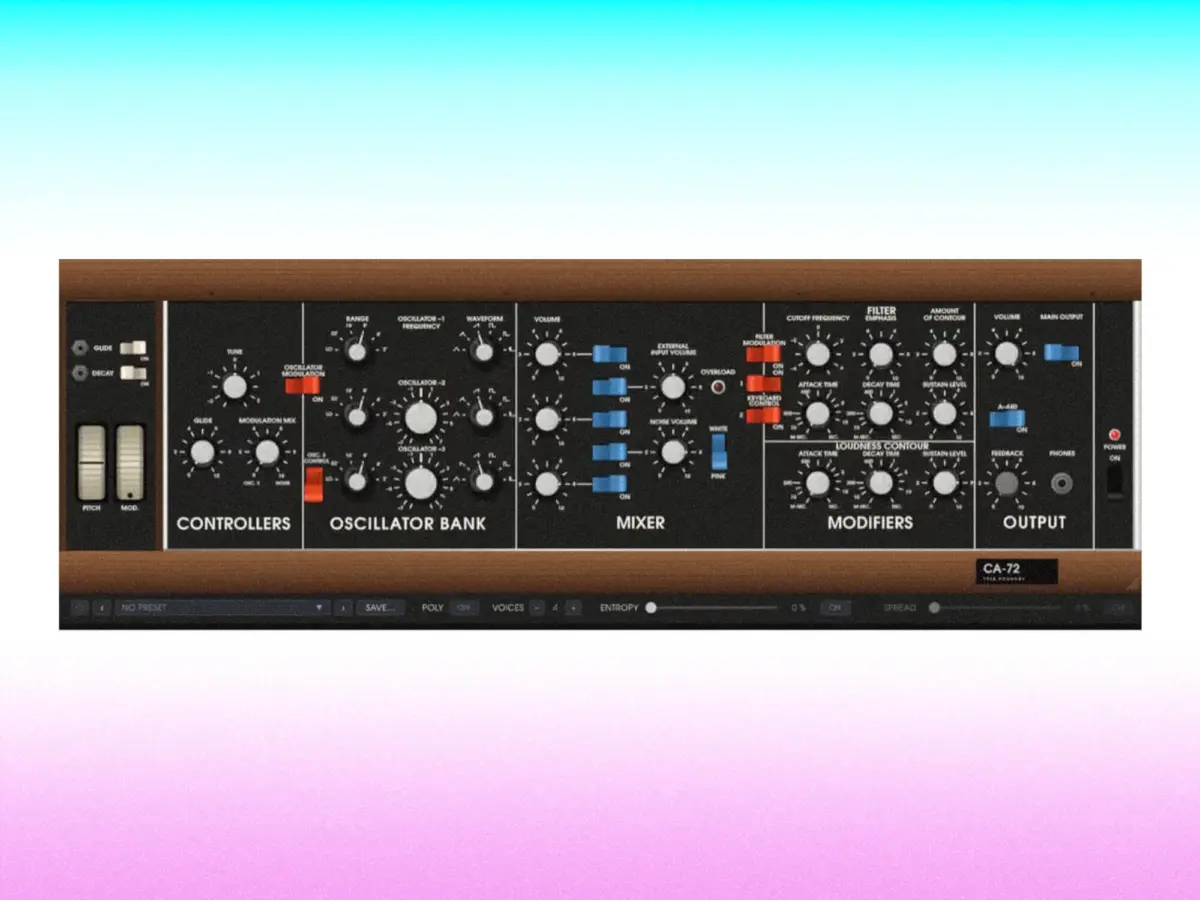
Idle Foundry – CA-72
- Format: Open-Source Minimoog Model D Emulation
- Price: Free (Available via GitHub)
Perhaps the most culturally significant release of the cycle is CA-72 by Idle Foundry. Operating as a free, open-source software emulation of the legendary 1970s Moog Minimoog Model D, this plugin was constructed by meticulously transcribing vintage service schematics, simulating the analog circuit boards—including the CA3046 oscillator board—and calibrating them using original Moog factory service manuals. Utilizing artificial intelligence assistance (Claude) to expedite circuit translation, Idle Foundry expanded the monophonic synth into a polyphonic instrument supporting up to 10 voices, per-voice analog drift, stereo spreading, and feedback loops.
Official Statements & Developer Insights
The philosophical motivations behind these releases highlight an industry-wide pivot toward purposeful, unbloated software design.
Speaking on the release of oneTHNG: Fidelity Theory, Modbap’s engineering team emphasized a desire to combat plugin fatigue:
"Modern producers are drowning in parameters. Every compressor has twenty hidden menus; every EQ looks like an airplane cockpit. With the oneTHNG series, our goal was to restrict the user interface down to a single physical truth. If you understand the relationship between bandwidth and resolution in vintage sampling, you don’t need a manual to use Fidelity Theory—you just grab the knob and listen."
Similarly, the open-source community rallied heavily around Idle Foundry’s release of the CA-72. In accompanying documentation released via GitHub, the development collective noted:
"Vintage analog emulation has historically been locked behind expensive corporate paywalls. By open-sourcing the circuit simulations of the Minimoog Model D and collaborating transparently with modern AI-assisted scripting, we want to prove that historical synthesis architecture can be studied, modified, and enjoyed freely by any programmer or musician on the planet."
Future Outlook: Trends Shaping the Next Quarter
As the audio software industry heads deeper into the fourth quarter and approaches the heaviest retail sales period of the year, several macro trends are crystallizing:
- Micro-Plugins and Specialized Workflow Tools: The era of the all-in-one "kitchen sink" channel strip is facing aggressive pushback. Producers are increasingly favoring single-purpose micro-plugins (such as CableGuys’ TimeStop and Modbap’s oneTHNG) that solve a precise mixing or creative problem instantly without cluttering the screen real estate or draining CPU resources.
- Native Processing Dominance: The transition away from hardware-locked DSP (such as older UAD-2 SHARC cards) to fully native CPU processing is now practically absolute. Companies that previously relied on proprietary hardware ecosystems are aggressively rewriting their architectures to run natively on Apple Silicon and modern x86 Windows processors without performance compromises.
- Hardware Preservation Through Code: Emulating increasingly rare, esoteric electronic instruments—whether it is a 1981 Gleeman Pentaphonic synthesizer, a 1908 Steinway character piano, or repurposing obsolete handheld gaming hardware like the PSP—demonstrates a growing cultural imperative within audio development: archiving physical sound artifacts before the original hardware degrades beyond repair.
As developers roll out deeper holiday promotions over the coming weeks, studios can expect an even greater influx of creative tools designed to inspire fresh workflows as the music production community enters the final stretch of the year.