Executive Overview
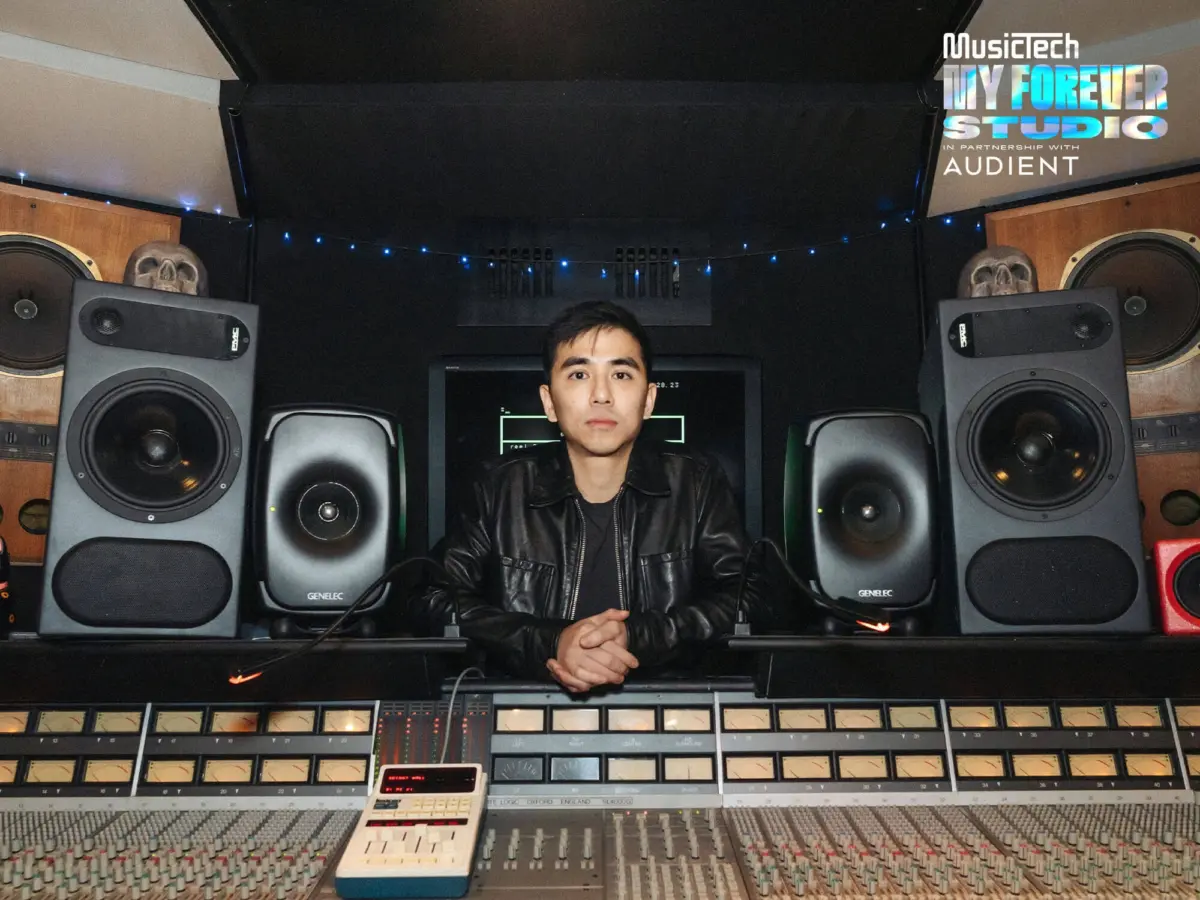
The modern recording studio is undergoing a quiet, high-stakes identity crisis. As land values skyrocket in global cultural capitals and commercial real estate falls prey to aggressive residential redevelopment, the physical sanctuaries where contemporary music history is forged are vanishing at an alarming rate. Yet, within the hallowed, brick-and-mortar halls of London’s legendary Battery Studios, elite engineer, mixer, and producer Caesar Edmunds continues to push the boundaries of what is sonically possible.
In a wide-ranging, deeply revealing feature interview on the My Forever Studio podcast—produced in partnership with Audient and hosted by Chris Barker and Will Betts—Edmunds pulls back the curtain on a remarkable career. From early discouragement by a music teacher in Singapore who claimed he had "no chance" of making it as a musician, to a mandatory two-year stint in national service as a police officer, Edmunds’ path to the top of the British engineering ecosystem was built entirely on grit, relentless hustling, and an unyielding passion for sound.
Today, Edmunds commands an elite workflow out of Battery Studios, carving out heavy-hitting mixes for an enviable roster of modern rock and indie royalty, including Ozzy Osbourne, Queens of the Stone Age, Wet Leg, and The Last Dinner Party. But what happens when an architect of modern heavy guitar music and immersive audio is given a blank check and absolute creative freedom to build his ultimate, idealized workspace?
This article explores Edmunds’ journey from outsider to industry vanguard, examining his strategic approach to the "Forever Studio" fantasy build, his reverence for analog warmth paired with cutting-edge Dolby Atmos technology, his vast and coveted guitar pedal collection, and the broader cultural crusade to protect the world’s remaining acoustic temples from the wrecking ball.
Detailed Chronology: From Singapore Classrooms to London’s Sonic Frontline
The Unlikely Beginning
Every great engineering career has a foundational myth, but Caesar Edmunds’ entry into the audio arts is defined by resistance rather than immediate encouragement. Growing up in Singapore, a young Edmunds faced conventional academic and artistic skepticism. Most notably, a local music teacher bluntly informed him that he possessed "no chance" of carving out a viable career as a musician.
Rather than dampening his creative ambitions, the discouragement served as an unconventional catalyst. Realizing that raw performance might not be his ultimate calling, Edmunds turned his fascination toward the invisible architecture of recorded music—how sound is captured, manipulated, shaped, and delivered to the listener.
The Detour of Duty
Before he could fully immerse himself in the professional audio landscape, Edmunds faced a profound civic obligation: a mandatory two-year stint in national service working as a police officer.
While law enforcement and crime prevention worlds away from the acoustics of a control room, Edmunds credits this period with instilling a vital sense of discipline, operational focus, and high-pressure problem-solving. These traits would later prove indispensable when managing complex, high-budget tracking sessions with notoriously unpredictable rock icons.
The Liverpool Awakening and the Moulder Apprenticeship
With his national service fulfilled, Edmunds relocated to the UK to formally study his craft at Liverpool’s renowned Liverpool Institute for Performing Arts (LIPA)—an institution co-founded by Paul McCartney that emphasizes real-world industry readiness.
Armed with a formal education, Edmunds made the classic, high-stakes pilgrimage to London, the beating heart of the UK music industry. There, he engaged in a relentless campaign of cold-calling, favor-trading, and studio-flooring that eventually landed him coveted work experience alongside legendary British producer and mix engineer Alan Moulder.
Working under Moulder—whose fingerprints are all over landmark records by My Bloody Valentine, Nine Inch Nails, The Smashing Pumpkins, and Arctic Monkeys—was Edmunds’ true baptism by fire. It was in these pressurized, tape-saturated environments that Edmunds learned the fine balance between technical precision and emotional resonance, absorbing the subtle art of driving analog gear to its absolute breaking point without sacrificing clarity.
The Rise to Battery Studios
Through years of tireless assistance, secondary engineering, and an unblemished reputation for reliability and taste, Edmunds transitioned from an eager assistant to an in-demand, Grammy-winning first-call engineer and mixer.
Today, his operational base is anchored in the historic Battery Studios in London. A facility steeped in decades of tracking heritage, Battery provides Edmunds with the ideal playground to marry vintage analog workflows with the rigorous demands of modern spatial audio. His discography now reads like a masterclass in contemporary guitar-driven music and boundary-pushing indie pop, featuring heavyweights such as Ozzy Osbourne and Queens of the Stone Age alongside critical darlings Wet Leg and The Last Dinner Party.
Supporting Context & Metrics: The Anatomy of a Modern Mixing Workflow
To understand Caesar Edmunds’ approach to his craft, one must examine the intersection of gear, physical space, and technological evolution in contemporary audio engineering.
The Spatial Audio Revolution: Dolby Atmos in the Control Room
While many traditionalists view immersive audio formats like Dolby Atmos with skepticism, Edmunds has embraced the medium as a creative frontier rather than a commercial gimmick. Mixing for Atmos requires a radical rethinking of spatial real estate. Instead of collapsing a dense wall of guitars, massive drums, and soaring vocals into a traditional stereo field (L/R), an Atmos mix places sounds within a three-dimensional hemispherical grid.
At Battery Studios, Edmunds utilizes advanced monitoring configurations to translate his signature aggressive rock aesthetic into spatial formats. The challenge—and the triumph—lies in maintaining the punch, weight, and cohesive glue of an analog-style stereo bus while leveraging height and surround channels to give the listener an unprecedented sense of intimacy and spatial separation.
The Secret Weapon: The Guitar Pedal Arsenal
Ask any engineer what distinguishes a good mix from a great one, and they will point to harmonic distortion, saturation, and character. For Edmunds, this is where his legendary guitar pedal collection takes center stage.
Rather than relying solely on software plugins to impart character, Edmunds frequently runs auxiliary tracks, vocals, synths, and even drum bus elements through his physical stompbox collection. Boutique fuzz pedals, vintage analog delays, rare chorus units, and custom overdrive circuits are integrated directly into his hardware inserts. This tactile manipulation of impedance, clipping, and frequency response injects a living, breathing organic texture into his mixes that digital modeling still struggles to replicate entirely.
Official Statements & Insights: Inside the My Forever Studio Podcast
During his appearance on the My Forever Studio podcast—hosted with trademark wit and irreverence by Chris Barker and Will Betts—Edmunds unpacked the theoretical architecture of his dream creative space.
Created in partnership with Audient, the podcast challenges top-tier audio professionals to design their ultimate "Forever Studio" anywhere in the universe, bounded by a strict set of rules. Guests are permitted a tightly limited inventory of items, forcing them to prioritize what is truly essential for their creative output. As the hosts emphasize: there is nostalgia, there are anecdotes, there are gags, but there are no bundles.
Keeping It Close to Home
When asked where in the cosmos he would plant his fantasy studio, Edmunds opted for practicality over science fiction, keeping his build close to home. Eschewing the cliché of an isolated island or a mountaintop retreat, Edmunds recognizes that a truly great studio must be integrated into a community of creative peers, accessible to visiting artists, and anchored in a vibrant musical ecosystem—much like his real-world residency at Battery Studios.
The Homely Studio Vibe
A recurring theme of Edmunds’ episode is the psychological architecture of the recording space. Too many modern production suites resemble clinical server rooms or sterile corporate boardrooms. Edmunds stresses that the most inspired performances occur when artists feel psychologically safe, relaxed, and uninhibited.
Creating a "homely" studio vibe is not merely a matter of interior design; it is an acoustic and psychological necessity. Warm lighting, comfortable seating, minimal visual distractions, and immediate access to instruments allow musicians to drop their guard and capture raw, vulnerable takes before overthinking sets in.
Future Outlook: The Fight for Iconic Studio Spaces
As Edmunds looks toward the future of the industry, his enthusiasm for technological advancement is tempered by a sobering reality: the systematic erasure of physical recording heritage.
Major metropolitan areas across the globe are experiencing relentless gentrification. Commercial recording studios—which often occupy large, acoustically isolated footprints in prime urban zones—are prime targets for real estate developers seeking to convert cultural landmarks into luxury flats or commercial office spaces.
The loss of spaces like Battery Studios, or historical institutions in London, Los Angeles, and New York, represents more than just the demolition of bricks and mortar. It threatens the loss of institutional memory, specialized acoustic environments, and community hubs where cross-pollination between veteran producers and emerging artists naturally occurs.
Edmunds remains a vocal advocate for the preservation of these spaces. He argues that while in-the-box mixing and bedroom production have democratized music creation, the physical recording studio remains an irreplaceable incubator for collective sonic alchemy.
Conclusion
Caesar Edmunds’ journey from a dismissed student in Singapore to a Grammy-winning pillar of London’s engineering community is a testament to perseverance, technical mastery, and an unyielding commitment to sonic character. Through his work at Battery Studios and his imaginative blueprint on the My Forever Studio podcast, Edmunds proves that the future of music production does not lie in choosing between the analog past and the digital future, but in expertly wielding both to push the art form forward.
To hear the full episode with Caesar Edmunds, subscribe to My Forever Studio on Apple Podcasts or Spotify, and explore all past episodes via MusicTech.