Executive Overview
In the evolving landscape of global contemporary jazz, few artists manage to bridge the chasm between ancient oral heritage and modern harmonic exploration quite like Syna Awel. A gifted vocalist, percussionist, and cultural custodian, Awel has captured the international music community’s attention with her distinctive fusion of traditional Amazigh poetry and cosmopolitan jazz arrangements. Her artistic trajectory reached a poignant zenith with the release of her debut album, Awel, via Imago Records in 2024, an exquisite project masterfully arranged by renowned drummer Karim Ziad.
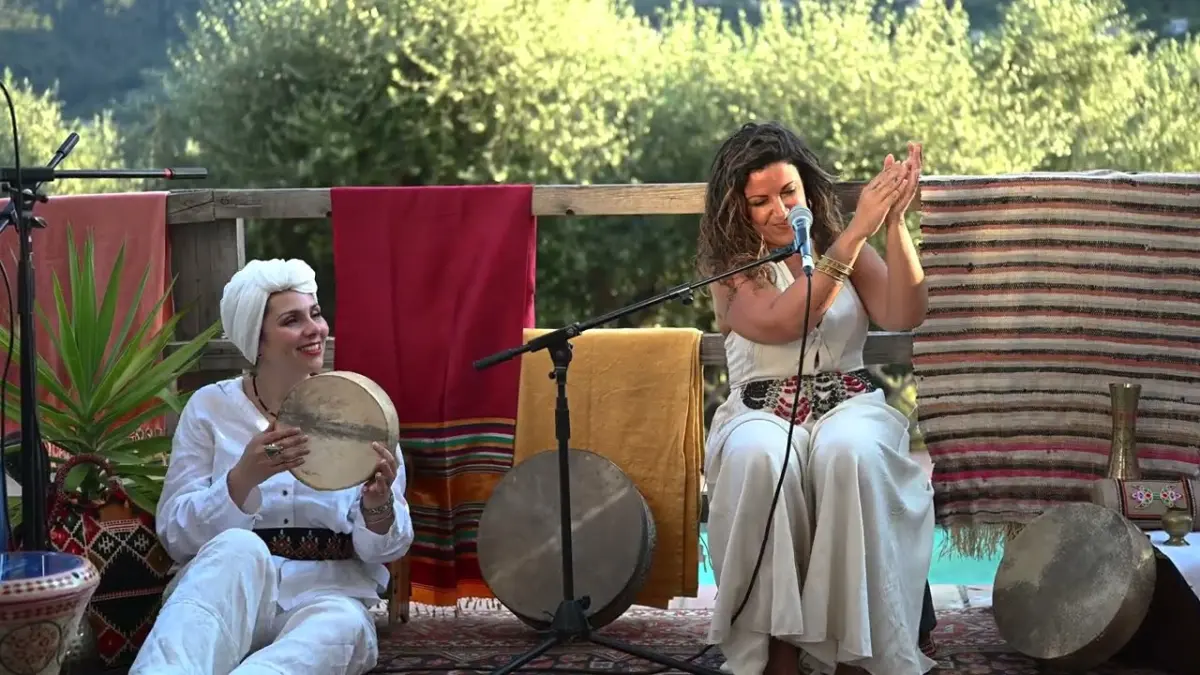
Expanding upon the studio achievements of her debut, Awel recently unveiled a mesmerizing open-air acoustic session filmed across a single sun-drenched afternoon in the mountainous landscapes that echo her heritage. Culminating with the hauntingly transcendent performance of her song “Incantation” as dusk settles over the horizon, this five-song visual and auditory document showcases the profound emotional resonance of Kabyle music. Accompanied by a stellar ensemble featuring Luc Lavenne on guitar, Anis Agrebi on oud, Tony Sgro on derbouka, and Mahir Bostandzija on percussion, Awel pivots away from the piano-and-bendir configuration of her studio recordings toward an intimate, organic instrumentation that breathes new life into centuries-old melodic frameworks.
This in-depth report examines Syna Awel’s artistic lineage, the cultural weight of her debut album, the technical mastery behind her recent live-session video project, and the broader implications of her work within the contemporary world-jazz paradigm. Through an exploration of her roots in the Kabyle village of Aït Bouaddou, the philosophical underpinnings of tracks like “Incantation,” and the collaborative ecosystem that fuels her music, this article offers a definitive look at an artist who is not merely preserving heritage, but actively expanding its vocabulary for a global audience.
Detailed Chronology
Roots in the Kabyle Mountains: The Formative Years of Syna Awel
To understand the intricate vocal stylings and rhythmic sensibilities of Syna Awel, one must trace her origins back to Aït Bouaddou, a picturesque yet rugged village nestled within the heart of the Kabyle mountains in northern Algeria. Growing up in this mountainous terrain, Awel was immersed in a rich sonic tapestry defined by the Amazigh oral tradition. In these communities, poetry and melody are not confined to paper or institutional archives; rather, they are carried by the human voice, passed down through generations as a living chronicle of history, resistance, joy, and sorrow.
As a Franco-Algerian artist navigating dual cultural identities, Awel absorbed the poetic cadence of the Kabyle language—Taqbaylit—long before she formalized her musical education. The oral tradition of her ancestors served as her primary conservatory. Every narrative, metaphor, and emotional nuance expressed in her current repertoire draws directly from the collective memory of the Amazigh people. When Awel sings, she channels the cadence of village gatherings, women’s wedding chants, and the storytelling traditions that have sustained North African indigenous populations through centuries of shifting political and social landscapes.
The Genesis of a Debut: The Making of Awel (2024)
The culmination of years of artistic refinement and cross-cultural exploration materialized in 2024 with the release of her self-titled debut album, Awel, under the Imago Records banner. The project was steered by the visionary artistic direction and arrangements of acclaimed drummer Karim Ziad, a towering figure in the intersection of North African rhythms and modern jazz. Ziad’s involvement provided a sophisticated structural foundation for Awel’s raw, emotive vocals.
In its original studio incarnation, Awel positioned the singer’s voice against a backdrop of jazz piano and the traditional bendir frame drum. This juxtaposition created a striking tension: the modal, microtonal intricacies of Amazigh melodies collided seamlessly with the chromatic harmonies and swinging cadences of contemporary jazz. Critics and listeners alike lauded the album for its fearless refusal to pander to Western world-music clichés. Instead of presenting traditional music as a museum piece, Awel and Ziad treated it as a living, malleable art form capable of engaging in a sophisticated dialogue with urban jazz sensibilities.
The Sunset Session: Capturing the Ephemeral in 2024
Eager to present her repertoire in a context that honored the organic, communicative nature of Kabyle performance, Awel organized and filmed a remarkable open-air acoustic session over the course of a single afternoon in 2024. The resulting visual document—subtitled in both Kabyle and French and made available via her official YouTube channel—captures five consecutive songs performed live without the safety net of studio overdubs.
The session serves as a visual metaphor for the passage of time and the continuity of tradition. Beginning in the bright, unfiltered warmth of afternoon sunlight, the performance progresses naturally as daylight fades, culminating in the deep indigo hues of twilight. This deliberate pacing mirrors the thematic content of the music itself: cyclical, patient, and deeply attuned to the natural world.
Rather than relying on the piano-and-bendir setup of the album, Awel enlisted a fresh lineup of virtuosic instrumentalists:
- Luc Lavenne on acoustic guitar, providing harmonic warmth and intricate fingerpicking.
- Anis Agrebi on the oud, injecting deep Mediterranean and Middle Eastern modal authenticity.
- Tony Sgro on the derbouka, driving the rhythmic pulse with nuanced fingerwork.
- Mahir Bostandzija on auxiliary percussion, enriching the rhythmic texture.
This acoustic ensemble strips away studio gloss, allowing the organic resonance of wood, gut, and skin to mingle with Awel’s commanding vocal delivery.
Supporting Context & Metrics
The Linguistic and Philosophical Weight of “Incantation”
The emotional and structural climax of the acoustic session is the performance of “Incantation,” a piece sung entirely in Kabyle. The song hinges on a profound philosophical couplet that encapsulates the human condition:
“Kul yiwen yesεa tidet-ines”
(Everyone holds their own truth)
Followed by the pragmatic reassurance that humanity does what it can within the limitations of existence.
Awel deliberately juxtaposes this existential assertion against the cyclical turning of a natural day. As she sings, the sun sets, the moon claims the evening sky, and the cosmic wheel turns once more. This artistic choice bridges the micro and the macro: individual human truths are fleeting and subjective, yet they are anchored within the eternal, immutable rhythms of nature—a central motif in traditional Amazigh worldview.
Global Digital Footprint and Distribution
While rooted in localized oral traditions, Syna Awel leverages modern digital architecture to disseminate her art across borders. Her growing listenership spans Europe, North Africa, and North America, united by the universal language of jazz and vocal improvisation.
| Metric / Platform | Detail | Strategic Impact |
|---|---|---|
| Debut Album | Awel (Imago Records, 2024) | Establishes her artistic identity and anchors her recorded catalog. |
| Arranger | Karim Ziad | Lends industry-wide credibility and rhythmic sophistication. |
| Acoustic Session | 5-song open-air live video (2024) | Showcases raw performance capability and visual storytelling. |
| Digital Distribution | YouTube, Bandcamp, SoundCloud | Enables direct-to-fan engagement and global accessibility. |
Listeners can stream her haunting rendition of “Incantation” directly via her SoundCloud page and secure physical or digital copies of the album through her Bandcamp portal. Furthermore, the complete, subtitled open-air session remains accessible for global viewing on her Official YouTube Channel.
Official Statements & Artistic Philosophy
While formal press releases regarding the acoustic session are concise, Awel’s artistic ethos speaks volumes through her songcraft and performance choices. In interviews surrounding the release of Awel, the artist has consistently emphasized the necessity of honoring her roots while refusing to be creatively pigeonholed by genre boundaries.
"Traditional music is not a static artifact trapped behind glass," cultural critics note when evaluating artists of Awel’s caliber. By translating the oral poetry of the Kabyle mountains into the sophisticated harmonic language of jazz, Awel asserts that Amazigh culture is dynamic, forward-looking, and fully conversant with contemporary global art forms.
Her choice to strip down the arrangements for the open-air session underscores a commitment to acoustic transparency. In an era dominated by heavy digital production and pitch-correction, Awel’s decision to film a continuous, unedited afternoon session highlights a profound confidence in her band’s collective musicianship and the enduring power of unplugged instrumentation.
Future Outlook
As Syna Awel looks beyond the successful campaign of her debut album and the viral resonance of her sunset acoustic session, her trajectory points toward an increasingly influential role in the international world-jazz ecosystem.
Expanding the Global Stage
The warm reception of Awel and its acoustic companion pieces signals a growing appetite among international audiences for authentic cultural fusions that bypass commercial pop formulas. Awel’s ability to move fluidly between French and Kabyle, and between modern jazz improvisation and ancient Amazigh modal structures, positions her perfectly for major international festival circuits, particularly in Europe and North Africa.
Upcoming Collaborative Projects and Tour Projections
Industry insiders anticipate that Awel will take her expanded acoustic lineup—featuring Lavenne, Agrebi, Sgro, and Bostandzija—on an extensive live itinerary throughout cultural centers in France and beyond. The intimacy of the guitar-oud-percussion configuration lends itself ideally to boutique concert halls, jazz clubs, and open-air summer festivals where acoustic fidelity and visual intimacy can be fully realized.
Furthermore, creative partnerships with producers and arrangers of Karim Ziad’s caliber open exciting doors for future sophomore recordings. Whether she chooses to explore further acoustic minimalism or delve deeper into orchestral jazz fusions, Awel’s artistic compass remains resolutely pointed toward truth, cultural continuity, and uncompromised musical excellence.
In an increasingly homogenized global music market, Syna Awel stands as a vital reminder that the most compelling contemporary art often arises from the deepest wells of heritage. As the sun sets on her acoustic session and rises on her burgeoning career, Awel proves that when everyone holds their own truth, hers is one worth listening to across every continent.