Executive Overview
Scaling up the intimate masterpieces of the Baroque era for a gargantuan 20th- or 21st-century auditorium is an act fraught with peril. When Johann Sebastian Bach composed his monumental Mass in B minor (BWV 232), he wrote for spaces of reflection, localized worship, and courtly or municipal patronage—never envisioning that his dense, polyphonic tapestry would one day be projected into the vast, cavernous spaces of London’s Royal Albert Hall.
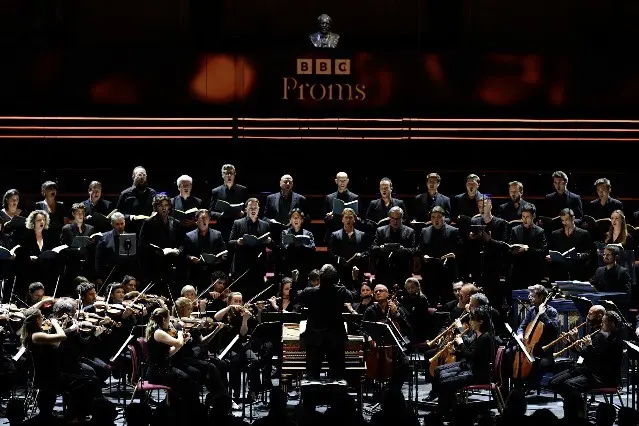
Yet, on Thursday, September 10, 2026, conductor Jonathan Cohen and his celebrated period-instrument ensemble, Arcangelo, dared to do just that. As part of the annual BBC Proms, the performance boldly subverted contemporary orthodoxies of "authentic" or historically informed performance practice. Eschewing the lean, single-voice-per-part chamber approach that Arcangelo has championed through the summer months, Cohen scaled up his forces to symphonic proportions. The result was an evening of breathtaking contradictions: an ensemble boasting a 50-strong choir and an expanded 25-piece string section that miraculously filled the Royal Albert Hall with sound without ever sacrificing technical brilliance or choral bravura.
While the acoustic peculiarities of the Victorian amphitheater created inevitable balance issues—swallowing up continuo instruments and occasionally obscuring intricate instrumental counterpoint beneath a tidal wave of choral fervor—the sheer quality, visceral energy, and emotional gravity of the performance secured its place as a landmark event of the 2026 Proms season. Featuring an elite roster of vocal soloists including Jeanine De Bique, Eva Zaïcik, Hugh Cutting, Nick Pritchard, and Florian Störtz, this Mass in B minor proved that when executed with supreme technical command and absolute conviction, Bach can speak just as powerfully on a grand scale.
Detailed Chronology & Musical Journey
To understand the trajectory of Arcangelo’s performance is to trace an arc from monumental assertion to ethereal introspection. From the opening bars to the final, transcendent crescendo, Cohen’s curation of the score offered an emotional and structural masterclass.
The Kyrie: A Bold Statement of Intent
The performance staked its claim immediately. The opening of the Kyrie was massive, uncompromising, and thunderously loud. Rather than easing the audience into the spiritual weight of the work, Cohen unleashed the full force of his fifty-person choir. In the subsequent fugue, the listener was treated to beautifully shaped and pointed singing, underpinned by a remarkably expressive range of dynamic shading.
.jpg)
The tonal partnership between sopranos Jeanine De Bique and Eva Zaïcik in the Christe eleison provided an early masterclass in vocal blending. Seductive, highly characterful, and deeply expressive, their interplay navigated the acoustic challenges of the hall with poise, ultimately resolving into a robust and tightly wound choral fugue.
The Gloria: Radiance, Danceregion, and Textual Clarity
The transition into the Gloria introduced a palpable bounce and buoyant energy, reinforced brilliantly by the piercing, celebratory timbre of three trumpets.
- Laudamus te: Eva Zaïcik returned to the stage with a deeply engaged performance. Her plangent, resonant tone was framed by a finely articulated, graceful violin solo.
- Gratias agimus / Domine Deus: The chorus’s velvety, smooth tone in Gratias agimus swelled organically into a rich, imposing texture. This segued seamlessly into the Domine Deus duet featuring De Bique and tenor Nick Pritchard. Both artists exhibited delightful delicacy and a marked differentiation in tone, keeping the texture miraculously light within the reverberant hall.
- Qui sedes & Quoniam: A sobering, reflective Qui tollis paved the way for counter-tenor Hugh Cutting’s rendition of Qui sedes. Cutting delivered a vibrant performance imbued with intense communicative power, his vocal lines beautifully complemented by the chestnut warmth of the solo oboe. Bass-baritone Florian Störtz followed with Quoniam, bringing a civilized swagger to the music. While Störtz’s lower register struggled slightly to completely penetrate the farthest reaches of the auditorium, his phrasing was continually elevated by the magnificent, soaring horn playing of Ursula Paludan Monberg.
- Gloria Finale: The movement concluded with a breathless, high-speed final chorus that somehow retained an astonishing lightness of foot in its fugal passages.
[Auditorium Acoustic Profile: Royal Albert Hall]
 ├── High Reverberation Time (approx. 2-3 seconds)
 ├── Choral Dominance (50-voice choir easily overpowers lower strings)
 ├── Continuous Weakness (Harpsichord & Organ struggle except in pianissimo)
 └── Soloist Projection (Varies dramatically based on artist's familiarity with the space)
The Credo: Architecture and Intimacy
The opening choruses of the Credo relied on a compelling rhythmic engine driven by the orchestral bass, cutting through the hall alongside trenchant, precise choral delivery.
In the Et in unum duet, De Bique and Cutting engaged in a polite yet intense battle of vocal presence, with Cutting holding a slight edge in sonic projection, though both supplied exquisite vocalism. The subsequent choral movements oscillated rapidly between light-footed agility, fierce intensity, and radiant brilliance, demonstrating the extraordinary versatility of Arcangelo’s choral contingent.
Störtz offered a sophisticated, stylish reading of Et in Spiritum Sanctum. Yet, the true emotional centerpiece of the Credo arrived with the Confiteor. Eschewing the choir entirely, Cohen deployed his five vocal soloists as a unified ensemble. Set against a spare, delicately scored instrumental background, this decision unlocked a moment of pure, suspended magic that silenced the auditorium.
.jpg)
The Sanctus to Agnus Dei: Triumphant Conclusion
The Sanctus saw the choir synthesize a lush, luxurious vocal weight with crisp, athletic rhythmic articulation. The ensuing Osanna raced past with breathless velocity, opening out into a luxurious, unhurried orchestral postlude that allowed the hall’s acoustics to work in the music’s favor.
Tenor Nick Pritchard claimed the spotlight in the Benedictus, accompanied by an exquisite, sighing flute solo. Pritchard sang with a fine-grained, intimate lyricism that forced the audience to lean inward, drawing them entirely into his artistic orbit.
The emotional climax crystallized in the Agnus Dei. Hugh Cutting delivered this profoundly heavy movement with striking beauty of tone, concentrated power, and immaculate phrasing. As the choir re-entered with hushed, breath-controlled dynamics, the sound gradually swelled, intensifying organically until the final, resolute cadence.
Supporting Context & Metrics: Reimagining Bach for the Albert Hall
To contextualize Jonathan Cohen’s artistic choices at the 2026 Proms, one must reflect on the inherent paradoxes of performing Baroque polyphony in arenas designed for 19th-century mass entertainment.
Historical Antecedents and Pragmatism
Bach himself was an intensely practical musician. Had he possessed access to the resources of major modern orchestras and the cavernous spaces of Europe’s grandest halls, musicological consensus suggests he would have eagerly expanded his scoring—much as Handel did during the Westminster Abbey commemorations.
.jpg)
Historically, early 20th-century pioneers grappled with this same acoustic reality. Recordings from 1929—such as tenor Walter Widdop’s heroic interpretations of the Benedictus—utilized an unapologetically grand, muscular style. While out of step with modern period-practice purism, that muscularity is precisely what is required to conquer the acoustic dead zones of the Royal Albert Hall.
Performance Metrics & Ensemble Scaling
- Total Choral Forces: 50 singers (incorporating both male and female altos, defying strict historical orthodoxy in favor of modern sonic weight).
- Orchestral Footprint:
- 25 strings (significantly larger than standard chamber-Baroque configurations)
- 4 flutes
- 4 oboes
- 2 bassoons
- 3 trumpets
- 1 horn (Ursula Paludan Monberg)
- Continuo section: 1 organ and 1 harpsichord (played intermittently by Jonathan Cohen).
The Acoustic Ledger: What Worked vs. What Faltered
While the performance triumphed on the grounds of artistic bravery and technical mastery, the physical constraints of the venue exposed notable engineering friction:
- The Continuo Deficit: Due to the sheer cubic volume of the Royal Albert Hall, neither the organ nor the harpsichord made a meaningful sonic contribution outside of the most intimate, stripped-back passages.
- The Choral-Orchestral Balance: As soon as the 50-voice choir entered in the initial Kyrie fugue, the sonic ledger tipped heavily in favor of the vocalists. The complex inner workings of the string writing were frequently swallowed, transforming the work from a collaborative chamber-symphonic dialogue into a dominantly choral showcase. Fortunately, the instrumental bass line maintained an impressive, grounding anchor throughout.
- Vocal Projection Variances: The soloists displayed mixed success in penetrating the auditorium’s far reaches—a variable likely tied directly to each singer’s prior experience performing within the unique acoustic dome of the venue.
Official Statements & Artistic Vision
Jonathan Cohen has long championed an approach to early music that prioritizes emotional vitality and structural clarity over dogmatic adherence to dry musicological rules. In pre-prom interviews and program notes leading up to the September 10 performance, Cohen emphasized the necessity of elasticity when bringing chamber-scaled works into grand public spaces.
"We are not here to preserve music in a glass case," Cohen’s curatorial philosophy suggests through his programming choices. "Bach’s architectural genius is robust enough to withstand—and indeed thrive within—varied scales of performance, provided the internal rhythmic integrity and human expression remain uncompromised."
Critics and audience members alike noted that while the performance abandoned the strict "one-voice-per-part" purity that defines modern minimalist Bach interpretation, it recaptured a sense of communal spectacle and unbridled joy that often gets lost in clinical, hyper-academic renditions. The "chutzpah" required to unleash fifty singers against the Albert Hall’s wooden paneling paid off precisely because Cohen refused to let the expanded forces bog down in sluggish tempi. His brisk, urgent pacing kept the polyphonic engine running at peak efficiency.
.jpg)
Future Outlook: The Evolution of Period Performance in Mega-Venues
The success—and the distinct friction points—of Arcangelo’s Mass in B minor at the 2026 BBC Proms offer a compelling roadmap for the future of Baroque performance in large-scale venues.
As classical music organizations increasingly seek to democratize access to complex, historical masterworks by staging them in multi-thousand-seat arenas, conductors and ensemble leaders will face a recurring dilemma: how to scale up acoustic volume without sacrificing contrapuntal clarity.
Cohen’s experiment proves that audiences do not demand academic asceticism when experiencing Bach live; they demand emotional authenticity, technical bravura, and communicative urgency. By treating the Mass in B minor not as a fragile museum artifact, but as a living, breathing theatrical and spiritual monolith, Arcangelo has set a new benchmark for how period-instrument ensembles can command the world’s largest stages. Future iterations of large-scale Baroque performances will undoubtedly look to Cohen’s balancing act—navigating the delicate tightrope between massive choral power and delicate instrumental counterpoint—as a definitive template for modern performance practice.