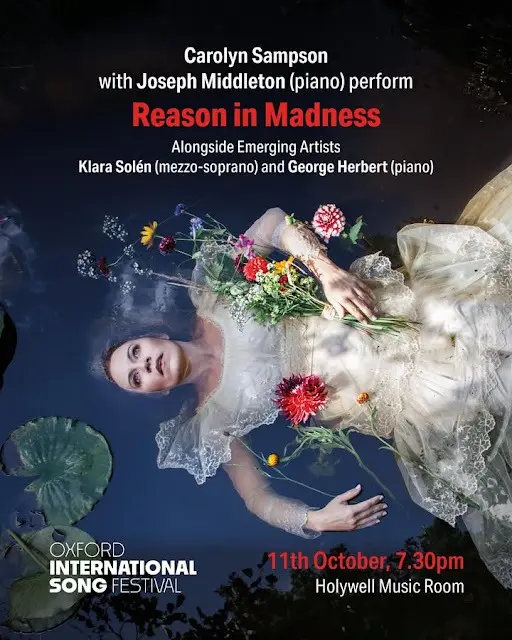
The Oxford International Song Festival recently offered audiences a masterclass in the psychological boundaries of art song. On Sunday, October 11, 2026, the historic Holywell Music Room played host to an evening recital titled Reason in Madness. This tour-de-force performance was delivered by soprano Carolyn Sampson and pianist Joseph Middleton, alongside a compelling curtain-raiser from the festival’s emerging artists, mezzo-soprano Klara Solén and pianist George Herbert.
The programme was meticulously designed to explore the outer edges of human emotion, mapping a stylistic geography of obsession, psychological fracture, and fixation. Moving seamlessly across centuries, languages, and aesthetic movements, Sampson and Middleton navigated the tortured psyches of literary and mythological archetypes—from Goethe’s Mignon and Shakespeare’s Ophelia to Pierre-Frélix Louys’s Bilitis and Jean Cocteau’s desperate gambler in Poulenc’s La Dame de Monte-Carlo.
As part of a triumphant thematic Sunday at the festival—which also featured morning and afternoon explorations of Mozart and Benjamin Britten—the evening concert stood out for its rigorous intellectual curation and emotional fearlessness. By pairing canonical German lieder with French impressionism and neo-classicism, the performers demonstrated how composers across Europe have consistently sought musical structures to contain, express, and elevate unhinged human passion.
Detailed Chronology & Performance Analysis
The Opening Prelude: Nordic Atmosphere and Late-Romantic Drama
The evening commenced with a showcase of the Oxford International Song Festival’s Emerging Artists programme. Mezzo-soprano Klara Solén and pianist George Herbert took the stage to present selections by Swedish composer Gösta Nystroem and Alma Schindler-Mahler.
Solén and Herbert opened with Nystroem’s 1948 song cycle, På reveln (At the reef), which sets texts by three distinct Swedish poets. The title track established an immediate coastal atmosphere through evocative, text-painting piano writing that underpinned a clean, direct vocal line. This was followed by "Otrolig dag" (Special day), a piece deceptively simple in its architecture, featuring delicate piano textures and a lyrically engaging vocal delivery. The cycle concluded with "Havet sjunger" (Singing of the sea), which transitioned seamlessly from a melancholic, misty soundscape into rich, high-romantic drama. Nystroem’s writing proved remarkably adept at capturing hyper-specific atmospheric moments.
The emerging duo then transitioned to Alma Schindler-Mahler’s Erntelied (Harvest Song). Beginning with a conventional, charmingly flowing piano melody, the song gradually unspooled as its harmonies grew increasingly complex. By its climax, the piece swelled into a deeply felt, late-romantic tour-de-force that set a high artistic bar for the remainder of the evening.
The German Heartlands: Spinning Wheels and Shattered Ophelias
Stepping into the main recital, Carolyn Sampson and Joseph Middleton launched directly into the psychological maelstrom with Franz Schubert’s quintessential masterpiece, Gretchen am Spinnrade. Initially interior, controlled, and rhythmic, Sampson’s interpretation conveyed a mind fundamentally elsewhere. Following the explosive emotional climax on the word "sein Kuss" (his kiss), her delivery morphed into an audible portrait of acute anxiety and psychological disturbance.
This thematic thread of the spinning maiden was cleverly expanded through settings by Johannes Brahms and Robert Schumann. Both composers tackled the same poem by Emanuel Heyse, yielding fascinatingly distinct results. Brahms’s Mädchen emerged as a charmingly folk-like yet melancholic vignette bolstered by a sophisticated piano accompaniment. Schumann’s Die Spinnerin shared this rustic simplicity while introducing brilliant, whirling piano figures that vividly evoked the hypnotic motion of the spinning wheel.

Schumann’s Herzelied (Heartache) subtly introduced the evening’s recurring tragic figure: Ophelia. This haunted, fragile song featured a drooping, overlapping piano accompaniment that prefigured the psychological dissolution central to the rest of the program. Brahms’s Ophelia-Lieder, composed as incidental music for a theatrical production, were delivered by Sampson and Middleton with striking simplicity and directness. Rather than over-inflating the miniatures, the duo honoured their folk-inflected charm.
By sharp contrast, Richard Strauss’s Drei Lieder der Ophelia presented immense technical and emotional complexity. Setting Karl Joseph Simrock’s German translations of Shakespeare, Strauss demands hyper-expressionist agility.
- In "Wie erkenn’ ich mein Treulieb’", Sampson navigated a dazzling, angular vocal line against an eccentric piano texture that shifted effortlessly from expressionist severity to chilling naivety.
- "Guten Morgen, ‘s ist Sankt Valentinstag" offered a fast, vivid, and deeply disturbing collision of jagged vocal phrasing and brilliant piano flourishes.
- Finally, in "Sie trugen ihn auf der Bahre bloss", Middleton’s eerie, restless accompaniment married with Sampson’s bleached vocal tone to create an atmosphere of profound desolation, perfectly capturing Ophelia’s instantaneous cognitive shifts.
The first half reached its emotional zenith with Hugo Wolf’s towering Mignon Lieder, drawing from Goethe’s seminal romantic novel Wilhelm Meister.
- "Mignon I – Heiß mich nicht reden" was delivered with bleak, uncompromising intensity.
- In "Mignon II – Nur wer die Sehnsucht kennt", Middleton injected urgent momentum into the keyboard while Sampson conveyed harrowing anxiety.
- "Mignon III – So laßt mich scheinen" offered a haunting, spectral beauty.
- The set culminated in "Kennst du das Land", where Sampson’s soaring vocal intensity was mirrored by a piano part that suggested Mignon was entirely untethered from reality, retreating inward into her own psychological universe.
Crossing the Channel: French Mystique and Neo-Classical Elegance
The second half of the recital transported the audience to France, beginning with Henri Duparc’s haunting setting of Mignon’s text, Romance de Mignon. Displaying a distinctly Gallic sensibility, Duparc utilized lush harmonic shifts and a throbbing, unsettling piano accompaniment that built to richly romantic climaxes, rounded out by a substantial instrumental postlude.
The programme then immersed itself in the erotic and mythological prose of Pierre-Frélix Louys via Les Chansons de Bilitis (1894). The evening featured three settings by Claude Debussy, bookended by the first and final settings by Charles Koechlin.
Koechlin’s opening "Hymne à Astarté" combined a massive, declamatory piano part with a dramatic, almost ritualistic vocal invocation that erupted into unbridled passion. Debussy’s subsequent triad—"La Flûte de Pan", "La Chevelure", and "Le Tombeau des naïades"—reminded listeners of Sampson’s affinity for these soundworlds, echoing her celebrated past portrayals of Mélisande. Middleton’s classical, razor-sharp accompaniment supported Sampson’s supple, effortless vocal line, culminating in a subtle eroticism and ambiguous emotional gravity. Koechlin’s closing "Épitaphe de Bilitis" brought the sequence to a close with formal, neo-classical restraint.
The Descent: Madness, War, and Desperation
Returning to Ophelia, Camille Saint-Saëns’s La mort d’Ophélie utilized a motoric, spinning piano figure and urgent vocal lines to dramatize Gertrude’s tragic account, before blooming into lyrical warmth at the mention of the word Chantant. Ernest Chausson’s Chanson d’Ophélie followed as a fluid, direct dialogue underscored by dark, brooding keyboard harmonies.
A thematic pivot brought forth Duparc’s masterpiece of longing and displacement, Au pays où se fait la guerre. Sampson navigated the shifting currents of the text with a supple, direct delivery that swelled effortlessly into a commanding, operatic climax.

The recital concluded with Francis Poulenc’s dramatic tour-de-force, La Dame de Monte-Carlo. Setting a text by Jean Cocteau originally written for soprano Denise Duval, Poulenc paints the portrait of an ageing, desperate gambling addict roaming the Riviera. Drawing on his memories of interwar Monte Carlo alongside figures like Diaghilev, Poulenc’s music balances biting cynicism with lingering pathos. Sampson leaned into the character with relish, deploying snarling diction and caustic bite to bring the hardened, single-minded protagonist vividly to life.
As a final parting gift, the duo offered an exquisite encore: Schubert’s profound and melancholic melodrama, Abschied der Erde.
Supporting Context & Metrics
| Performance Detail | Data / Specification |
|---|---|
| Event Date | Sunday, 11 October 2026 |
| Festival | Oxford International Song Festival (Day 1, Theme 3) |
| Venue | Holywell Music Room, Oxford |
| Main Artists | Carolyn Sampson (Soprano), Joseph Middleton (Piano) |
| Emerging Artists | Klara Solén (Mezzo-soprano), George Herbert (Piano) |
| Composer Scope | 12 featured composers (Schubert, Brahms, Schumann, Strauss, Wolf, Duparc, Koechlin, Debussy, Saint-Saëns, Chausson, Poulenc, Nystroem, Schindler-Mahler) |
| Literary Anchors | Goethe, Shakespeare, Heyse, Simrock, Louys, Cocteau |
The Holywell Music Room—widely recognized as Europe’s oldest purpose-built concert hall, opening its doors in 1748—provided an intimate acoustic environment uniquely suited to the psychological interiority of the lieder and mélodie repertoires. The acoustic transparency of the venue allowed Middleton’s nuanced pianism and Sampson’s crystalline vocal projection to interact without strain, ensuring that even the most delicate dynamic shifts registered with visceral impact.
Official Statements & Artistic Vision
While formal press releases from the festival administration emphasized the broader multi-thematic architecture of the opening weekend—which bridged classical masterworks by Mozart with the distinct emotional landscape of Benjamin Britten—individual artist contributions underscored a unified curatorial mission.
Joseph Middleton and Carolyn Sampson have long built a reputation for intelligent, narrative-driven programming that challenges traditional recital formats. By grouping disparate European traditions under the umbrella of "Reason in Madness," the duo sought to demonstrate that psychological fragility is a universal artistic currency. Rather than treating mental instability as a mere trope, the curation treated each protagonist—Gretchen, Ophelia, Mignon, Bilitis, and the Monte Carlo dame—as a complex agent of existential truth, whose emotional extremes required entirely unique harmonic and vocal languages.
Future Outlook
The success of Reason in Madness underscores the vital ongoing evolution of the Oxford International Song Festival as a premier global hub for art song interpretation. By pairing established world-class interpreters like Sampson and Middleton with rigorous platforms for emerging talent—demonstrated here by the compelling opening set from Klara Solén and George Herbert—the festival continues to nurture the next generation of vocal artists.
As the festival looks toward subsequent editions and touring iterations of these thematic recitals, the standard set on October 11, 2026, serves as a benchmark for how historical vocal literature can be re-contextualized through contemporary psychological lenses. Audiences and critics alike will be watching closely to see how Sampson, Middleton, and their peers continue to unearth the hidden emotional architectures of the classical canon in future seasons.