Executive Overview
To modern observers traversing the rolling green of the British countryside, the European rabbit (Oryctolagus cuniculus) is an omnipresent fixture—a quintessential, if occasionally destructive, element of the pastoral landscape. Yet, this familiarity belies a complex, turbulent history. Far from being a native species, the rabbit is one of the British Isles’ most consequential and economically devastating invasive species.
Its introduction and subsequent proliferation tell a captivating socio-political story of medieval England. Once a rare, ultra-exclusive luxury gifted almost exclusively by monarchs and the Norman aristocracy, the rabbit transitioned from a status symbol of the elite to a commonplace commodity. This biological and economic shift was accelerated by catastrophic demographic crises, most notably the Black Death (1346–1353), which fundamentally reshaped the social fabric, labor markets, and consumption habits of the realm.
Furthermore, the cultural footprint of the rabbit in medieval society extended far beyond the dinner table or the furrier’s workshop. Through illuminated manuscripts and marginalia, medieval scribes used the rabbit as a vehicle for subversive humor, inverting natural hierarchies to mock chivalric codes, aristocratic authority, and the rigid social stratifications of feudal Europe. Long before Monty Python envisioned the legendary "Killer Rabbit of Caerbannog," medieval Britons were already giggling at the prospect of bunnies putting their human and canine oppressors on trial.
Detailed Chronology: From Roman Curiosities to Tudor Plagues
To trace the trajectory of the rabbit in Britain is to chart a millennia-long course of ecological adaptation, royal patronage, and socio-economic upheaval.
The Roman Footnote and the Norman Arrival
While popular historical consensus long attributed the introduction of rabbits in Britain entirely to the Norman conquest of 1066, modern archaeology has complicated this narrative. Excavations at elite sites such as Fishbourne Roman Palace have occasionally yielded isolated rabbit bones dating back to the Roman period, suggesting early, isolated attempts at importation or keeping. However, these Roman colonies failed to establish a permanent, widespread wild population.
It was not until the post-Norman Conquest era that the rabbit established a permanent biological foothold in the British Isles. Imported primarily for their meat (known as "coney") and their dense, insulating fur, rabbits were initially delicate commodities that required intense artificial management. Because they were not yet naturalized to the harsh British winters or equipped to evade native predators without human intervention, they were housed in specialized, walled enclosures known as warrens.
The Twelfth and Thirteenth Centuries: Royal Monopolies
By the 12th century, documentary evidence begins to trace the spread of the species. One of the earliest legal and economic records surfaces in 1176 from the Scilly Isles, where a landowner named Richard de Wyka attempted to withhold tithes (the traditional ten-percent tax levied by the church) on his rabbits. De Wyka argued that "tithes were not payable on things of this kind"—a defense rooted in the sheer novelty and ambiguous legal status of the animal.
By the 13th century, rabbits had firmly ascended to the upper echelons of royal privilege. Crown records illustrate just how tightly guarded and prized these animals were. In 1235, King Henry III gifted ten live rabbits from his royal park at Guildford to Geoffrey Despenser, a prominent English landowner and Lord of Martley in Worcestershire. A few years later, royal dispatchers were sent to capture 30 to 40 rabbits from the same Guildford warren, though under strict instructions: they were only to harvest them if the warren was exceptionally well-stocked, ensuring the royal breeding stock remained uncompromised.
Rabbits were treated as luxury provisions fit only for the highest-tier feasts. While Henry III routinely requisitioned massive quantities of venison, wild boar, fish, swans, peacocks, and hares for royal banquets, rabbits did not make an appearance on his official Christmas feast requisition list until 1240. They commanded exorbitant market prices—costing four to five times as much as a standard chicken. Consequently, warren owners invested heavily in security, erecting stone watchtowers and fortified lodges to deter poachers and predatory carnivores.
The Fourteenth Century: The Black Death and Social Upheaval
The mid-14th century marked an inflection point in European history, and the fortunes of the rabbit were inextricably bound to this human tragedy. The Black Death of 1346 to 1353 decimated the European population, wiping out between one-third and two-thirds of inhabitants.
In the wake of this demographic catastrophe, the surviving peasantry and laboring classes experienced a dramatic improvement in their standard of living. With a severe labor shortage, workers could command higher wages, and surplus agricultural land became vastly more available. As disposable incomes rose among the lower estates, ordinary people began adopting lifestyles, fashions, and diets previously reserved for the nobility.
Rabbits reflected this shifting tide. Throughout the 14th and 15th centuries, rabbit meat filtered down to wealthier peasants, while aspiring craftsmen began utilizing rabbit fur for trim and warmth. The grey pelts of common rabbits provided accessible insulation, while specialized warrens bred rare silver-grey and black variants. Even royalty maintained their affinity for the fur: Henry VII famously ordered night attire tailored using luxury black rabbit fur.
Late Medieval Legislation: The Threat of the Poacher
As rabbit populations expanded—both through managed breeding and accidental escapes—two distinct trends emerged: rising agricultural damage and growing social subversion.
Manorial accounts from the era are replete with bitter complaints from landowners regarding the destruction wreaked by rabbits on crops, field boundaries, and woodlands. Yet, the greater anxiety for the ruling class was political. Hunting game, including rabbits, was tightly bound to aristocratic identity. Following the Peasants’ Revolt of 1381, the ruling elite grew intensely paranoid about the revolutionary potential of the armed working classes.
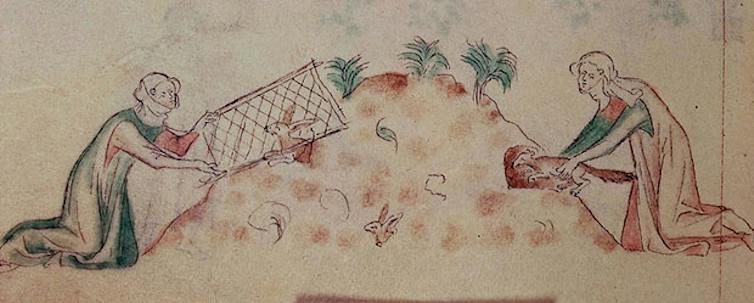
In 1390, Parliament enacted sweeping legislation explicitly barring laborers, artisans, and unlanded individuals from hunting or owning hunting implements. The state justified the law by arguing that under the innocent guise of hunting hares or rabbits, peasants would congregate to "make plots and conspiracies of rebellion" against the crown. The King assented to a comprehensive ban on "hounds and ferrets, hays, nets, hair-pipes, cords and all other devices" capable of taking forest beasts or rabbits.
The Tudor Era: Ecological Ubiquity
By the mid-16th century, the transformation of the rabbit from an exclusive royal gift to an ecological fixture was complete. Writing in 1555, the eminent Swiss naturalist Conrad Gesner observed that while rabbits bred in many parts of Europe, "the most plenty of all is in England." The species had successfully crossed the threshold from managed luxury to wild, self-sustaining population—setting the stage for its modern status as a pervasive, if destructive, feature of the countryside.
Supporting Context & Metrics
To fully grasp the historical and economic footprint of the European rabbit in Britain, consider the following structural dimensions:
- Economic Disparity: In 13th-century markets, a single rabbit cost roughly four to five times the price of a domestic chicken, placing it firmly out of reach for the medieval commoner and making it a prime target for high-stakes poaching.
- Demographic Shock: The Black Death (1346–1353) removed an estimated 33% to 66% of the European population, instantly rebalancing labor-to-land ratios and empowering the surviving peasantry to consume luxury goods like coney meat and fur.
- Legislative Backlash: The intersection of class anxiety and wildlife management resulted in punitive laws, such as the 1363 Sumptuary Laws (designed to curb excessive dress among lower estates) and the 1390 anti-poaching statutes designed to thwart peasant uprisings disguised as hunting parties.
- Modern Ecological Impact: Today, invasive species cost the UK economy upwards of £5 billion annually, with the European rabbit remaining a chief contributor through agricultural crop damage, soil erosion from burrowing, and competition with native flora and fauna.
Official Statements & Historical Perspectives
The duality of the rabbit—hailed as a culinary delicacy by kings and condemned as a subversive pest by parliaments—is best preserved in contemporary documents and the commentary of modern historians.
On Royal Stewardship and Value:
Archival records from the reign of Henry III illuminate the meticulous care afforded to early warrens. A Close Roll entry from the 1230s directed royal foresters:
"To catch 30 or 40 rabbits in his Guildford park… [provided] that the warren was well stocked,"
highlighting the Crown’s acute awareness of the fragility of these early, imported colonies and their status as high-value assets.
On Social Inversion and Sumptuary Excess:
The Parliament of 1363 attempted to halt the democratization of luxury goods through formal legislation, addressing:
"The excess of dress of people beyond their estate, to the very great destruction and impoverishment of the land."
This decree underscored aristocratic panic as peasants and craftsmen began adopting the consumption habits—including the wearing of rabbit pelts—traditionally reserved for the nobility.
On Subversion and the Fear of Rebellion:
The 1390 Parliamentary statute restricting hunting gear captured the deep-seated political paranoia of the feudal elite in the wake of the Peasants’ Revolt. Lawmakers argued that allowing laborers access to ferrets and nets for rabbit hunting would provide a convenient cover for rural conspirators to:
"Make plots and conspiracies of rebellion against our lord the king."
Cultural Reflections: The World Turned Upside Down
Perhaps the most enduring legacy of the medieval rabbit is found not in royal rolls or agricultural ledgers, but in the margins of sacred manuscripts. Medieval monks and scribes possessed a wicked, subversive sense of humor, frequently utilizing marginalia to practice what cultural historians term "social inversion"—the world turned upside down (mundus inversus).
Far from the docile, timid creatures of modern pastoral imagery, medieval manuscripts frequently depicted rabbits as aggressive, hyper-intelligent combatants seeking violent retribution against humanity and its canine enforcers.
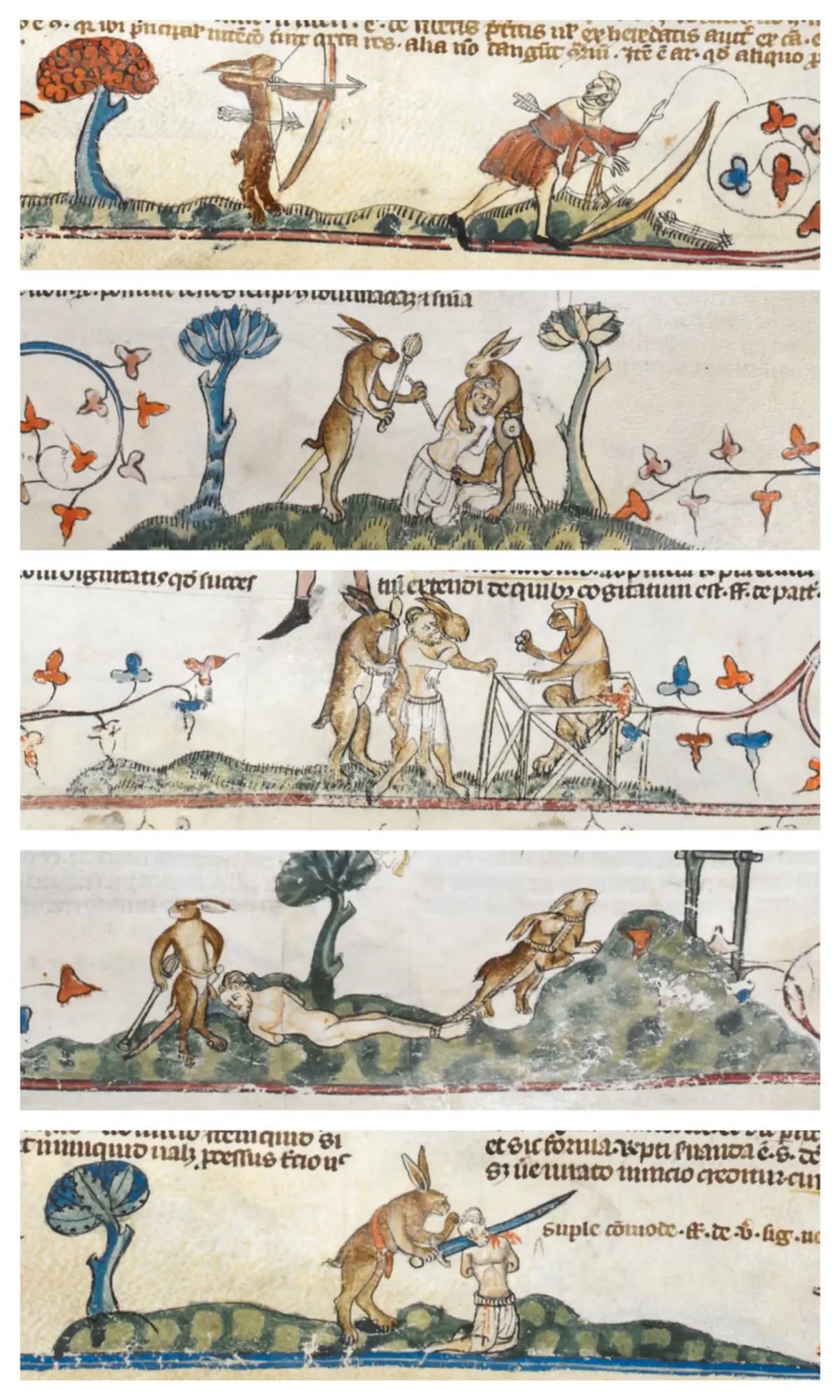
The most famous extant example is found in The Smithfield Decretals, an illuminated legal manuscript produced in London during the 1340s. The manuscript features a stunning sequential narrative in which giant rabbits turn the tables on their human and greyhound hunters: the bunnies successfully ambush the hunters, bind them in ropes, subject them to a formal mock trial, and ultimately execute them.
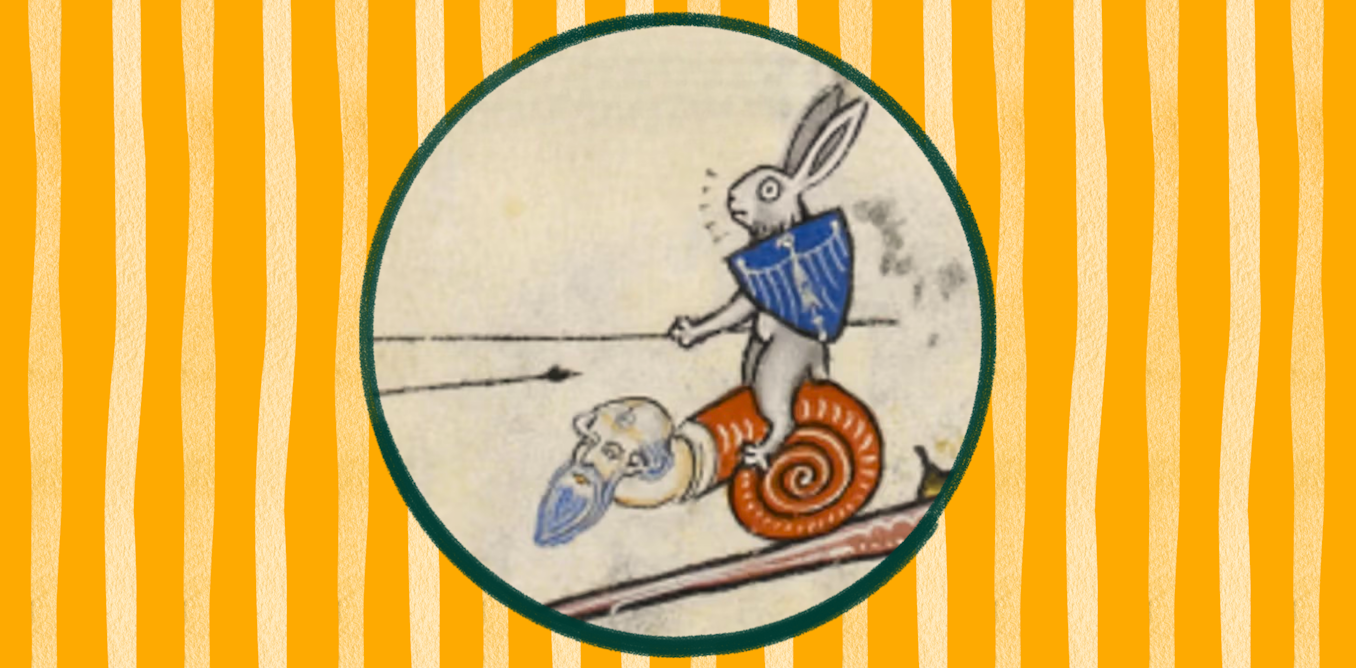
These illustrations were not merely whimsical doodles; they were sophisticated cultural commentary. By juxtaposing the high-minded, solemn ideals of chivalry—such as knightly combat and aristocratic hunting—with ridiculous scenes of rabbits jousting on the backs of snails or executing hounds, medieval artists engaged in a gentle self-mockery. This dark, gallows humor allowed a rigid, stratified society to safely release structural tensions.
In many ways, this medieval tradition forms a direct artistic and comedic lineage to modern pop-culture touchstones, such as the killer rabbit of Caerbannog in Monty Python and the Holy Grail (1975). When modern audiences laugh at a seemingly harmless bunny dispatching armored knights, they are tapping into a 700-year-old tradition of subversive, satirical folklore.
Future Outlook
As the UK continues to grapple with the multi-billion-pound economic toll of invasive species, the legacy of the European rabbit remains highly relevant. Modern conservationists, agricultural scientists, and wildlife managers face ongoing challenges in balancing ecosystem health, agricultural productivity, and heritage conservation.
While the medieval fear of peasant uprisings fueled by ferret-wielding poachers has long since faded into the history books, the ecological pressures introduced by the Norman aristocracy persist. Climate change, shifting land-use patterns, and the perpetual management of wild rabbit populations ensure that the humble coney will remain a subject of intense scientific study and economic calculation for centuries to come. The rabbit’s journey from a king’s guarded luxury to a ubiquitous countryside resident stands as a permanent reminder of how human migration, ecological introduction, and social change permanently alter the natural world.