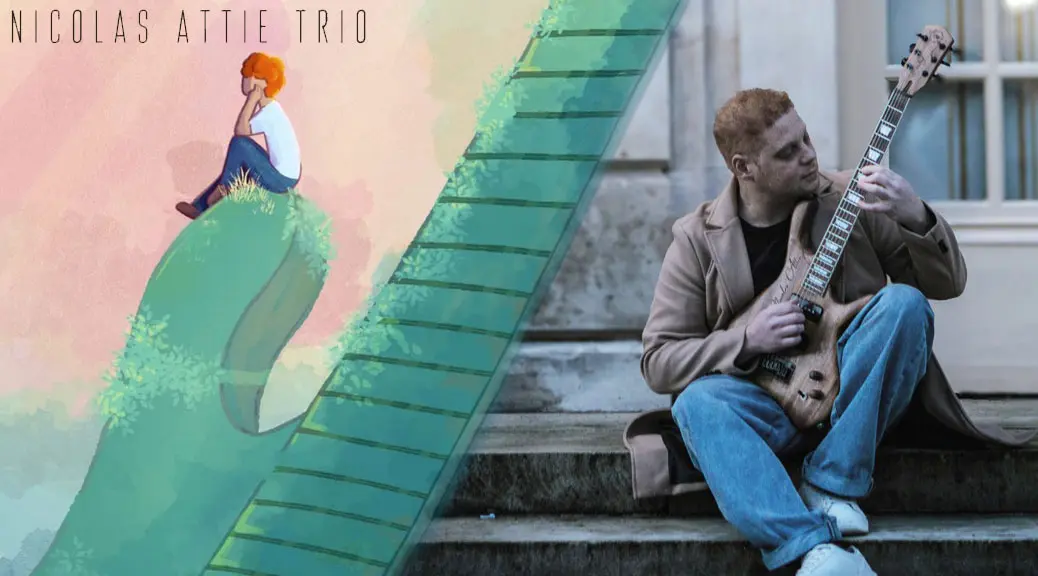
In an era increasingly dominated by heavily synthesized productions, hyper-compressed audio formats, and a reliance on digital manipulation, the classic acoustic jazz trio remains a rare bastion of organic human connection. Enter Borderline, the striking debut album from Guadeloupe-born, Europe-based guitarist and composer Nicolas Attie. Eschewing the temptation to lard his music with unnecessary electronics, elaborate studio wizardry, or desperate genre-blending gimmicks, Attie has crafted a refreshing, unapologetically traditional jazz guitar trio record. Joined by bassist Yves Torchinsky and drummer Léo Rodier, Attie honours the hallowed lineage of the guitar-bass-drums format while infusing it with a palpable sense of wonder, cultural warmth, and contemporary urgency.
This review-led journalistic feature explores the genesis of Borderline, breaking down its compositional framework, examining the exceptional interplay of its personnel, and placing Attie’s late-blooming career trajectory into the broader context of modern improvised music. Far from a mere academic exercise in mimicry, Borderline balances the structural rigour of bebop and modal jazz with an exploratory, highly conversational spirit. Through rigorous analysis of its tracklist, a deep dive into the bios of its constituent players, and an exploration of the evolving landscape of contemporary guitar-led jazz, this feature reveals why Nicolas Attie is one of the most compelling new voices to emerge on the international jazz scene.
Detailed Chronology
The Late-Blooming Genesis: From Guadeloupe to the Fretboard
To fully understand the artistic maturity present on Borderline, one must first examine the unconventional pathway of its creator. Nicolas Attie did not pick up the guitar as a child prodigy practicing scales before breakfast. Hailing originally from Guadeloupe—an archipelago in the Lesser Antilles with a rich musical identity deeply rooted in Gwoka, cadence, and European classical traditions—Attie came to jazz relatively late.
It was not until his twentieth year that Attie experienced a transformative encounter with the genre. Captivated by the harmonic complexity, emotional elasticity, and historical depth of jazz, he embarked on an intense, rigorous immersion into music theory, harmony, improvisation, and composition. This delayed entry point has arguably served as his greatest asset. Devoid of the routine burnout or conservatory cynicism that sometimes plagues young musicians, Attie approached the discipline with the unbridled passion of a late-stage convert. That lingering sense of discovery permeates every bar of Borderline. His playing avoids the dry, clinical precision of the academic; instead, it glows with the infectious enthusiasm of someone who remains perpetually fascinated by the infinite possibilities of the fretboard.
Assembling the Unit: Torchinsky, Rodier, and Collective Chemistry
An aspiring bandleader can write the most intricate charts in the world, but without the right collaborators, the music remains lifeless on the page. Recognizing the sacred, interdependent nature of the piano-less trio format—where the absence of chordal instrumentation leaves zero room for error—Attie carefully curated a rhythm section capable of breathing genuine life into his compositions.
He secured the talents of bassist Yves Torchinsky, a seasoned master of the double bass whose deep, resonant tone provides both the harmonic anchor and the rhythmic propulsion essential to a trio. Torchinsky is far from a mere timekeeper; his melodic intelligence allows him to weave counter-melodies around Attie’s lead lines, effectively operating as an equal voice rather than a background player.
Rounding out the trio is drummer Léo Rodier. Rodier possesses that rare, coveted gift in contemporary percussion: hyper-awareness. Rather than locking into a rigid, metronomic groove, Rodier listens intently to every micro-shift in mood, dynamics, and direction initiated by Attie and Torchinsky. The result is a profoundly democratic, highly conversational unit. Though Attie’s name sits atop the marquee as composer and guitarist, Borderline functions as a true collective—a conversation among three musicians utterly at ease in one another’s sonic company.
Supporting Context & Metrics
Anatomy of an Acoustic Format: The Guitar Trio Legacy
The guitar trio is a format steeped in jazz history, pioneered and popularized by legends such as Django Reinhardt, Nat King Cole, and later elevated to staggering heights by masters like Jim Hall, Wes Montgomery, John Scofield, Pat Metheny, and Julian Lage. The aesthetic challenge of the format is deceptively simple: with only three instruments, every note is exposed. There is no piano to fill out a suspended chord, no horn section to double a melody line, and no electronic pad to create atmospheric wash.

Nicolas Attie’s Borderline acknowledges this structural austerity and turns it into a superpower. By resisting the urge to modernize the sound through digital pedals, synth-guitar patches, or dense post-production layering, Attie embraces the naked truth of wood, steel, catgut, and air. This old-school approach requires immense technical control and supreme confidence in one’s material.
Track-by-Track Breakdown: Structure, Space, and Storytelling
Borderline achieves a remarkable equilibrium between composition and improvisation, driven by an intentional sequencing of tracks that guide the listener on an emotional and narrative arc.
- “Caperucita Roja”: The album opens with an immediate sense of purpose. An infectious, brightly hued theme immediately establishes the trio’s stylistic identity, acting as a dynamic springboard for the opening round of group interplay.
- “Eritaj”: Translating broadly to "Heritage" in various Caribbean-influenced contexts, this track continues the journey with a palpable sense of warmth and rhythmic flexibility. It subtly nods to Attie’s roots while firmly grounding the performance in contemporary European jazz sensibilities.
- “Stella By Starlight”: Including a standard as ubiquitous as Victor Young’s evergreen masterpiece is a high-stakes gamble for any debutant. Countless iterations exist, from Miles Davis to Charlie Parker and beyond. Yet, Attie and his trio pull off a masterstroke. They approach the composition without breathless over-reverence, nor do they cynically twist it into unrecognizable avant-garde noise. They simply play it with profound respect, exquisite taste, and deep lyricism.
- “Chiara”: Shifting focus to Attie’s original songwriting, this track is a masterclass in lyrical economy. It is spacious and deeply reflective, allowing Attie’s clean, expressive, unadorned guitar tone to speak with crystal clarity. He understands the power of silence, letting phrases breathe rather than suffocating the listener with an endless cascade of notes.
- “Borderline” (Title Track): The album’s centerpiece pushes the trio into more challenging harmonic territory. Here, the interplay grows more adventurous, testing the boundaries of the traditional format while maintaining an internal logic that prevents the music from fracturing.
- “Eighty Two”: Closing out the journey, this track encapsulates the dual pillars of the record: rigorous structural foundation balanced with absolute improvisational freedom. Attie’s playing radiates warmth, guiding the listener through a cohesive narrative arc that lingers long after the final chord fades.
Official Statements
While Borderline is an independent artistic statement rather than a corporate product driven by promotional soundbites, the critical consensus surrounding the album serves as an official validation of Attie’s artistic vision. Jazz critics and industry observers have widely praised the record for its refusal to pander to commercial trends.
In critical reviews published across leading European jazz journals, including UK Vibe, reviewers have highlighted the album’s purity of intent. Industry analysts note that Borderline represents a growing counter-movement among younger European jazz musicians who are intentionally stepping away from the laptop-heavy, loop-driven jazz-fusion hybrids of the 2010s. Instead, these artists are returning to the raw, unmediated power of acoustic interplay and real-time improvisation.
Furthermore, collaborators Yves Torchinsky and Léo Rodier have noted in promotional interviews surrounding the album’s release that the collaborative environment fostered by Attie was unique. Rather than presenting rigid, fully realized arrangements that left no room for interpretation, Attie reportedly encouraged his rhythm section to reshape the compositions from the inside out during recording sessions at the studio. This democratic ethos is precisely why Borderline sounds less like a guitar player backed by a rhythm section, and more like an organism breathing as one.
Future Outlook
As Borderline continues to circulate through international jazz radio stations, digital streaming platforms, and critical review circles, the trajectory for Nicolas Attie points sharply upward. In a crowded global market where hundreds of jazz albums are released weekly, breaking through the noise requires a distinct voice, a clear aesthetic vision, and undeniable technical chops—qualities that Attie possesses in abundance.
Looking ahead, the primary challenge for this nascent trio will be translating the intimate, beautifully captured acoustic nuances of Borderline into live performance settings. Festival organizers and club bookers across Europe are already taking notice, eager to test whether the delicate telepathy between Attie, Torchinsky, and Rodier can scale to larger stages.
For jazz aficionados weary of over-production and eager for authenticity, Borderline serves as a reassuring reminder that the traditional guitar trio format is far from exhausted; it simply requires the right hands to breathe new life into it. Nicolas Attie has delivered a wonderfully engaging debut statement—one that announces him not merely as a promising newcomer, but as a fully formed artist. He is, without question, a talent well worth keeping a close eye on as he maps out his next creative frontier.