For over two decades, Dacoury "Dahi" Natche has operated as one of modern music’s most vital, shape-shifting architects. Whether constructing the hypnotic, reversed-sample groove of Kendrick Lamar’s Pulitzer Prize-winning DAMN., laying down the brooding foundation for Drake’s Worst Behavior, or crafting multiplatinum anthems for 21 Savage, Big Sean, and SZA, Dahi has consistently defined the cutting edge of contemporary hip-hop and pop. Yet, despite an enviable resume stacked with Grammys, culture-shifting collaborations, and chart-topping hits, the Inglewood-bred producer has spent the vast majority of his career behind the scenes—servicing other artists, elevating their visions, and sculpting their narratives.
That dynamic is undergoing a profound paradigm shift. With his forthcoming solo album, Black Boy (Alternative)—slated for release via ALTER Music—Dahi is stepping firmly into the spotlight. More than just a collection of star-studded tracks, the record represents a watershed moment in the producer’s career: a deliberate, deeply personal artistic statement born from live instrumentation, radical spontaneity, and a collaborative process he describes as "music trading cards."
In this comprehensive profile, we explore Dahi’s evolution from a sample-flipping beatmaker to a holistic bandleader, examine his hardware-heavy studio philosophy, and unpack how he is navigating an era defined by artificial intelligence and instant gratification.
Detailed Chronology: From Inglewood Swap Meets to Manhattan Studios
The Formative Years: Instruments and Cinematic Escapes
Born Dacoury Dahi Natche to a North Korean mother and a Côte d’Ivoire father, Dahi’s early life in Inglewood, California, was quietly saturated with sound. His entry into the world of musical instrumentation was unorthodox, catalyzed by his stepfather’s idiosyncratic habit of hoarding second-hand instruments purchased for a mere $20 at local swap meets.
"My stepdad would go and buy random instruments at swap meets for $20, and the funny thing is he didn’t really know how to play any of those instruments. He just thought they were cool to have in the house," Dahi reflects. "It sparked my interest in sound and what you could do with an instrument. I picked them up, I started playing them, I didn’t really know what I was doing, but it was a form of expression."
This unstructured exploration soon gave way to formal music education, where Dahi began reading sheet music and studying how diverse genres and acoustic styles coalesced to tell stories. Crucially, his early creative development was heavily influenced by cinema. Struck by classic film scores like Vangelis’s iconic work on Chariots of Fire, Dahi developed an early appreciation for how music could act as a narrative compass, guiding audiences through emotional trials, triumphs, and human perseverance.
The Breakthrough Era and the Jungle City Revelation
By the early 2010s, Dahi had firmly established himself as a powerhouse producer, engineering an explosive three-year breakout streak that yielded generational tracks like Kendrick Lamar’s Money Trees (from good kid, m.A.A.d city), Drake’s Worst Behavior, and Big Sean’s I Don’t Fuck With You. His signature style—characterized by left-field melodic samples, such as reversing a tiny burst of Beach House’s Silver Soul or unearthing obscure 1970s soul tracks by the US Army band East of Underground for 21 Savage and J. Cole’s A Lot—made him an industry-wide phenom. Even pop royalty took notice; Madonna tapped him for her 2015 LP, Rebel Heart, where he collaborated alongside Avicii and BloodPop.
Yet, a pivotal moment arrived a decade ago during free-flowing recording sessions at Jungle City Studios in Manhattan. Holed up with an elite cadre of musicians, including acclaimed producer Sounwave and keyboardist Danny Keyz, under the direction of Kendrick Lamar, Dahi experienced a creative revelation.
"Everybody was naturally taking a role and aiding whatever the record needed: bassline, melody, rhythm, hooklines… the music just came so easy," Dahi recalls. "That experience really taught me about collaboration. We created so many ideas in a matter of 24 hours, and it triggered me like, ‘I feel like I’ve been doing this shit wrong for the longest time, because usually it’s just me in the studio making beats.’ I realised I needed to figure out how to bring some spontaneity into the room."
Supporting Context & Metrics: The Anatomy of Black Boy (Alternative)
The "Music Trading Cards" Methodology
To bring Black Boy (Alternative) to life, Dahi abandoned the solitary producer archetype in favor of a tightly knit, high-caliber touring and recording band. He enlisted guitarist Danny McKinnon (Free Nationals, Anderson .Paak), keyboardist Ely Rise (Childish Gambino, SZA), rhythm section virtuoso John Key (Solange Knowles), and London-based textural sound designer and producer Jonah Stevens.
Rather than running a traditional, hierarchical session where sidemen merely execute a producer’s pre-written score, Dahi fostered an egalitarian environment.
"When we’re in the room, I call it music trading cards," he explains. "It wasn’t just Dahi and the all-stars; everybody meets each other halfway in the process. I’m like, ‘what are you listening to?’ and vice versa… let’s try and figure out a through-line. A few ideas started with just me and Danny together; I’d play bass, pull up a drum loop, or figure out a rhythm."
Genre-Bending Soundscapes: "African Radiohead"
Stylistically, Black Boy (Alternative) functions as an auditory letter to Dahi’s younger self, bridging three distinct pillars of influence: 1990s rock music, West African soul, and experimental hip-hop. Dahi has aptly described the sonic architecture of the record as "African Radiohead," a descriptor validated by tracks like the single Running (featuring Childish Gambino), which pits complex, interlocking guitar and rhythm sections against a dizzying 6/8 time signature while a distant saxophone wails in the periphery.
West African soul is similarly baked into the album’s DNA. The sun-drenched, pristine intro of Love Me—featuring Nigerian-British vocalist Obongjayar—utilizes layered, multi-tracked guitar rhythms reminiscent of a looper pedal stacking incremental variations to create a living, breathing pulse. Meanwhile, hip-hop anchors remain firmly intact on cuts like Who Are You (featuring Vince Staples and Channel Tres) and How To Pray (featuring Kendrick Lamar and Amber Mark).
Hardware-Heavy Production Arsenal
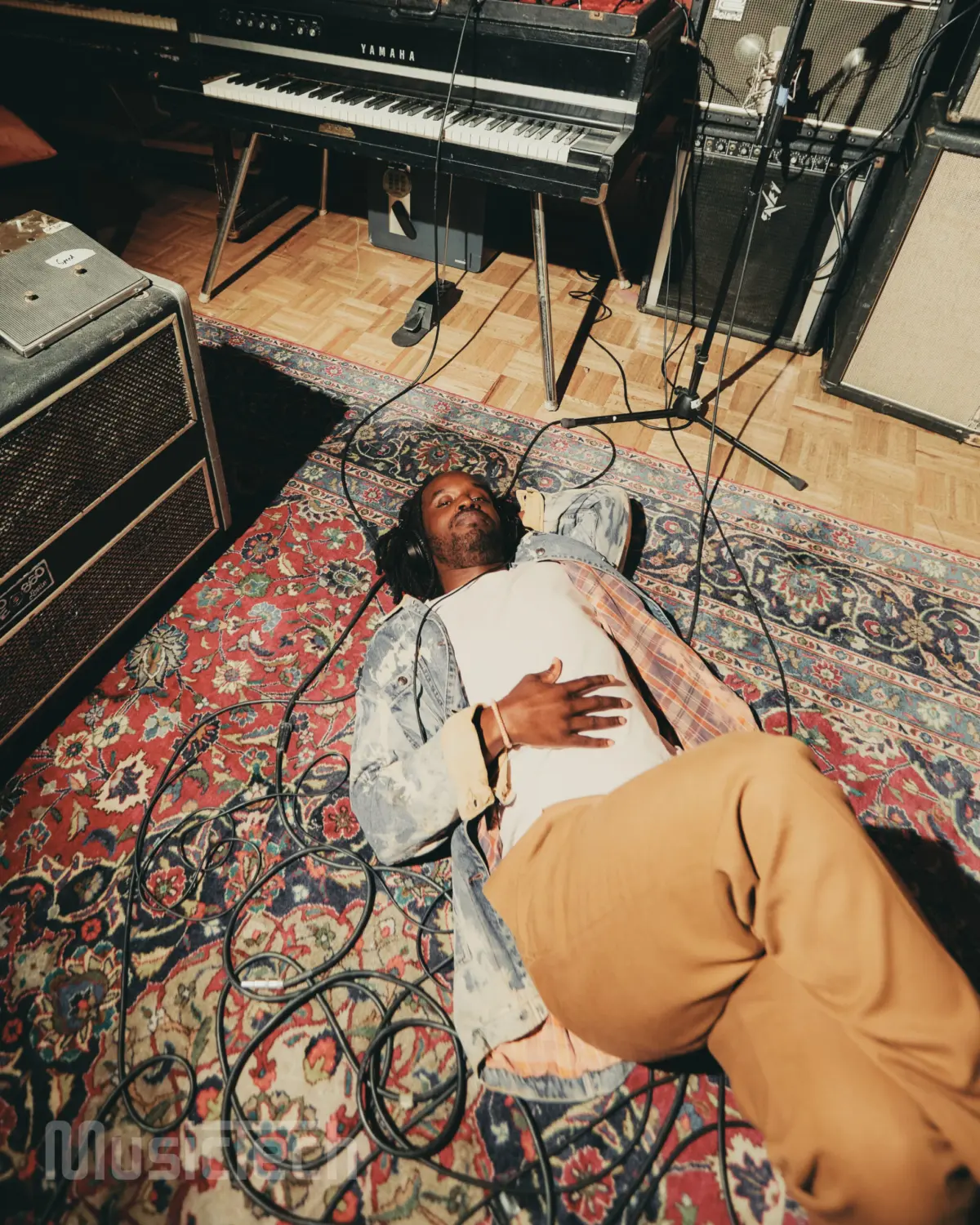
In an industry increasingly dominated by in-the-box digital production, Dahi’s workflow remains aggressively hardware-centric. To escape creative ruts, he physically moves around the studio, jumping between instruments and gear:
Guitars: His trusty Fender Telecaster serves as the primary weapon, favored for a direct-input (DI) sound with straight drive and minimal reverb. "I wanted something that didn’t feel glossed up," he notes. "It was more about the style of guitar playing rather than the guitar having this special tone."
Synthesizers & Keyboards: Sequential’s iconic analog synth, the Prophet-5, anchors the record alongside vintage staples like the Mellotron and Roland Jupiter-4.
Drums: Dahi relies on a roughly 50/50 hybrid approach, combining live acoustic drumming with programmed elements to achieve a punchy, inimitable weight that is notoriously difficult to capture with live room mics alone.
Vocals: For the first time in his career, Dahi steps up to the microphone as a lead vocalist. On the lead single Rest of Your Life, he delivers a hypnotic, fuzzy falsetto pushed dangerously close to the red using Universal Audio’s Neve 1073 plugin.
Official Statements & Industry Insights
Dahi’s transition from behind-the-board hitmaker to frontline artist offers a unique vantage point on the current state of music production. Speaking on the modern erosion of live musicianship in pop, he sounds a cautionary note:
"The idea of a band and musicianship in pop music today has become kind of a lost art: how to bring musicians together, and those musicians having a specific style that creates a signature sound and feel. It reminds me of how records were formed back in the day; everybody came in and did their part, from arrangers to session players, different types of engineers—it was an assembly of people. That was something I wanted in my career."
Furthermore, Dahi addresses the existential anxieties sweeping the creative community, particularly regarding the rapid rise of generative artificial intelligence and software democratization:
"AI is the biggest thing, man. Anyone can make a beat now. There are tutorial videos on YouTube on how to get certain sounds, and so much information about how to make music. But the biggest thing is having love for making records. Being a producer still takes somebody that can come in and finish a job or an idea. How do you make something with feeling and style? You’ve still gotta do the work."
On the topic of archival patience, Dahi offers advice for a generation addicted to instant gratification:
"Make notes, save shit, and review it once in a while. You’ll hear it differently; that’s the magic of music. Don’t throw away anything. Sometimes the way of the world won’t allow you to hear an idea in a certain context, or it’s just not ready. We live in a generation of instant gratification, where if it’s not hitting then it ain’t good – the world is deaf right now. But you have to keep pushing forward and know that what you made is really great."
Future Outlook
As Black Boy (Alternative) prepares for its August 28 release via ALTER Music, Dahi faces a dual set of unprecedented professional challenges: translating a sprawling, collaborative studio masterwork into a compelling live concert experience, and performing as a lead vocalist for the very first time.
Rather than attempting to rigidly recreate the album’s guest-heavy roster on tour, Dahi envisions a live show structured around the communal ethos of the recording sessions—a revolving door of world-class musicianship operating under a unified sonic thread.
For an artist who has spent the last twenty years constructing the foundational pillars of modern hip-hop royalty, stepping out of the shadows is a high-stakes gamble. Yet, armed with decades of studio mastery, an uncompromising hardware philosophy, and an unyielding commitment to organic collaboration, Dahi isn’t just releasing an album—he is authoring a masterclass on artistic reinvention.
Dahi’s Black Boy (Alternative) is available via ALTER Music.