Executive Overview
In a powerful demonstration of mentorship, community engagement, and artistic excellence, world-renowned cellist Sheku Kanneh-Mason recently concluded a triumphant regional tour with a surprise collaborative performance alongside 24 aspiring young musicians. Fresh from captivating audiences in Middlesbrough, Kendal, and Gateshead alongside the prestigious Royal Northern Sinfonia (RNS) and conductor Dinis Sousa—where they delivered stirring renditions of Saint-Saëns’s Cello Concerto No. 1—Kanneh-Mason turned his attention from the traditional concert hall stage to the bustling concourse of The Glasshouse International Centre for Music.
The culmination of this tour was not merely another professional milestone for the celebrated soloist; it was a deeply collaborative, cross-generational celebration of music education. Joining forces with students from The Glasshouse’s Young Sinfonia and its specialized Centre for Advanced Training (CAT) programmes, alongside dedicated tutors, professional RNS players, and esteemed education programme alumni, Kanneh-Mason formed a formidable 24-piece massed cello ensemble.
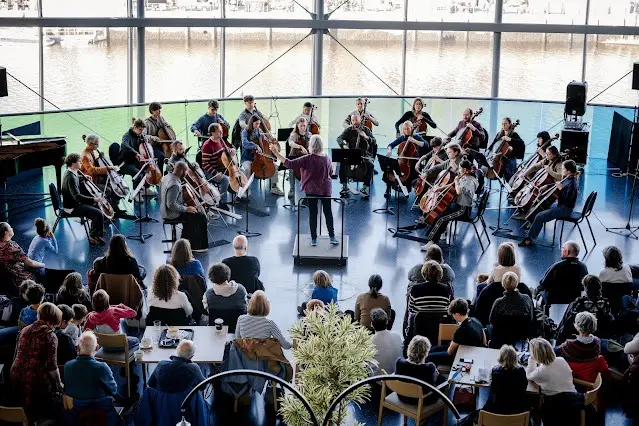
This unexpected union served as the crown jewel of The Glasshouse’s ongoing Make Music Young People initiative. After an intensive rehearsal session tucked away in the acoustically pristine Northern Rock Foundation Hall, the ensemble migrated to the sunlit concourse for a free, informal lunchtime concert. Performing before a captivated, unsuspecting public audience, the ensemble delivered a genre-spanning repertoire that showcased both the rigorous technical training of the young musicians and the unifying power of live performance.
This comprehensive report examines the background of the tour, the structural significance of The Glasshouse’s educational frameworks, the logistical and artistic execution of the massed cello performance, official reflections from the artists involved, and the broader implications of such high-level mentorship for the future of classical music in the United Kingdom.
Detailed Chronology
The Regional Orchestral Run
The journey leading up to the momentous Sunday concourse performance began earlier in the week with a rigorous regional concert series. Sheku Kanneh-Mason teamed up with the Royal Northern Sinfonia—the UK’s only full-time chamber orchestra, renowned for its dynamic interpretations and collaborative spirit—under the baton of acclaimed conductor Dinis Sousa.
The trio of performances kicked off in Middlesbrough, offering regional audiences an intimate yet powerful encounter with Camille Saint-Saëns’s lyrical and technically demanding Cello Concerto No. 1 in A minor, Op. 33. The tour then wound its way to Kendal, drawing classical music enthusiasts from across the Lake District, before arriving at its orchestral home base: The Glasshouse in Gateshead.
Throughout these performances, Kanneh-Mason’s execution of the Saint-Saëns concerto was widely praised for its emotional depth, tonal warmth, and effortless virtuosity. Yet, true to his well-documented commitment to music education and community outreach, the soloist made it clear that his time in the North East would extend far beyond the professional stage.
The Rehearsal Process: Behind Closed Doors
On Sunday morning, the atmosphere shifted from the formal, hushed reverence of the main auditorium to the energetic, collaborative hum of the Northern Rock Foundation Hall. Here, 24 cellists assembled for an intensive rehearsal led in spirit, if not entirely in formal instruction, by Kanneh-Mason himself.
The ensemble was a fascinating micro-society of the musical world. It brought together raw, youthful potential and seasoned professional artistry. Alongside Kanneh-Mason sat students from The Glasshouse’s Centre for Advanced Training (CAT) and Young Sinfonia. Bridging the gap between student and professional were dedicated instrumental tutors, active players from the Royal Northern Sinfonia, and alumni of The Glasshouse’s extensive education pipelines who have since forged professional careers in the arts.

The rehearsal space buzzed with a unique synergy. Young musicians who had spent months mastering their parts in practice rooms suddenly found themselves sharing stands, breathing in sync, and adjusting their intonation alongside one of the most recognizable classical artists of their generation. Technical advice was exchanged freely; bow strokes were aligned, and phrasing was debated not with academic stiffness, but with a shared passion for the music at hand.
The Concourse Performance
Following the meticulous preparations in the Northern Rock Foundation Hall, the 24-piece cello ensemble took over The Glasshouse’s expansive, architecturally striking concourse. Designed to bring music into the daily lives of visitors, the concourse serves as a public threshold where art and everyday community life intersect.
As the ensemble settled into their formation, curious shoppers, café patrons, and dedicated classical music fans gathered around the open space, forming a dense, supportive perimeter. The performance formed part of The Glasshouse’s ongoing Lunchtime Concerts series—a vital cultural offering of free, bite-sized Sunday performances designed to showcase the fruits of the CAT programme’s labor, ranging from complex classical masterworks to folk traditions and contemporary compositions.
Far from playing an easy, watered-down arrangement, the ensemble plunged into an ambitious and eclectic repertoire. The setlist opened a window into the rich versatility of the cello choir, beginning with a mesmerizing movement from Brazilian composer Heitor Villa-Lobos’s Bachianas Brasileiras No. 1—a masterwork originally scored for an orchestra of cellos that brilliantly bridges Brazilian folk idioms with the sophisticated counterpoint of J.S. Bach.
The mood then shifted toward the infectious syncopations of American jazz and ragtime, featuring dynamic arrangements of works by George Gershwin and Scott Joplin. The rich, mahogany resonance of 24 cellos reverberating through the glass-and-steel architecture created an immersive sonic experience, leaving the audience spellbound and demonstrating the astonishing caliber of the young performers.
Supporting Context & Metrics
The Infrastructure of Excellence: The Glasshouse and CAT Programmes
The success of Sunday’s performance was no accident; it was the direct product of a robust, long-term institutional investment in youth music education. The Glasshouse International Centre for Music (formerly Sage Gateshead) has long operated under the philosophy that world-class performance venues must be matched by world-class community access and educational pipelines.
At the heart of this ecosystem is the Centre for Advanced Training (CAT), an intensive training ground funded by the Department for Education’s Music and Dance Scheme. The CAT programme is specifically designed for young people aged 11 to 18 who demonstrate exceptional musical potential, dedication, and a desire to pursue music at a professional level. Providing tailored instrumental tuition, musicianship classes, ensemble coaching, and performance opportunities, the CAT programme acts as a vital bridge between regional talent and the global classical stage.
Complementing the CAT initiative is The Glasshouse’s wider weekend school structure, which houses non-auditioned, inclusive ensembles, bands, and choirs catering to young people of all ages and abilities. With applications remaining open all year round, these ensembles ensure that music-making is not restricted to an elite few, but remains a democratic, accessible joy for the wider community.
The Power of Massed Ensembles in Music Education
The pedagogical decision to deploy a "massed cello" ensemble carries profound psychological and technical benefits for developing musicians. In standard orchestral settings, string players—particularly cellists—often find themselves playing supporting harmonic roles, seated deep within the section.

A massed cello choir changes this dynamic entirely. By isolating the instrument’s register, young players are forced to listen more intently to one another, balancing the soaring tenor melodies with the deep, resonant basslines. Furthermore, sharing a stage with a global icon like Sheku Kanneh-Mason demystifies the upper echelons of the classical music industry. It transforms an abstract career path into a tangible, achievable reality. Studies in music education consistently show that direct mentorship from working professionals significantly boosts self-efficacy, persistence, and long-term engagement among adolescent musicians.
Official Statements and Reflections
The impact of the collaboration resonated deeply with all participants, highlighting the emotional and cultural value of arts mentorship.
Reflecting on the experience, Sheku Kanneh-Mason shared his perspective on the day’s events:
"After my concerts in Middlesbrough, Kendal and then here at The Glasshouse this week, it was a really special conclusion to hear the young cellists play in the rehearsal and then to join them out on the Concourse, on Sunday morning. The next generation of musicians matters so much and I loved seeing all the enthusiasm and hearing the talent."
Organizers and educational staff at The Glasshouse echoed these sentiments, emphasizing that moments of cross-generational collaboration are central to the institution’s core mission. By inviting young talents to perform shoulder-to-shoulder with international soloists and professional orchestral players, the center effectively dismantles the invisible barrier between the student practice room and the international concert hall.
Future Outlook: Sustaining the Momentum
As the echoes of 24 cellos fade from the concourse of The Glasshouse, the legacy of this unique collaboration is poised to leave a lasting imprint on the regional cultural landscape. For the young members of the Young Sinfonia and the Centre for Advanced Training, the experience of sharing a performance space with Sheku Kanneh-Mason will serve as an enduring touchstone of inspiration through their formative years.
The event underscores a vital truth for the future of the classical music sector: artistic excellence and community engagement are not mutually exclusive pursuits; they are symbiotic. When institutions like The Glasshouse create frameworks where world-class artists can seamlessly integrate with grassroots educational programmes, they do more than just entertain an audience—they actively cultivate the cultural leaders of tomorrow.
Looking ahead, programmes like Make Music Young People and the ongoing Lunchtime Concerts series will continue to provide vital platforms for youth development. With applications for The Glasshouse’s weekend schools and training programmes remaining open year-round, the doors are wide open for the next wave of regional talent to step forward. If Sunday’s performance on the concourse is any indication, the future of British cello playing is in remarkably capable, enthusiastic, and talented hands.