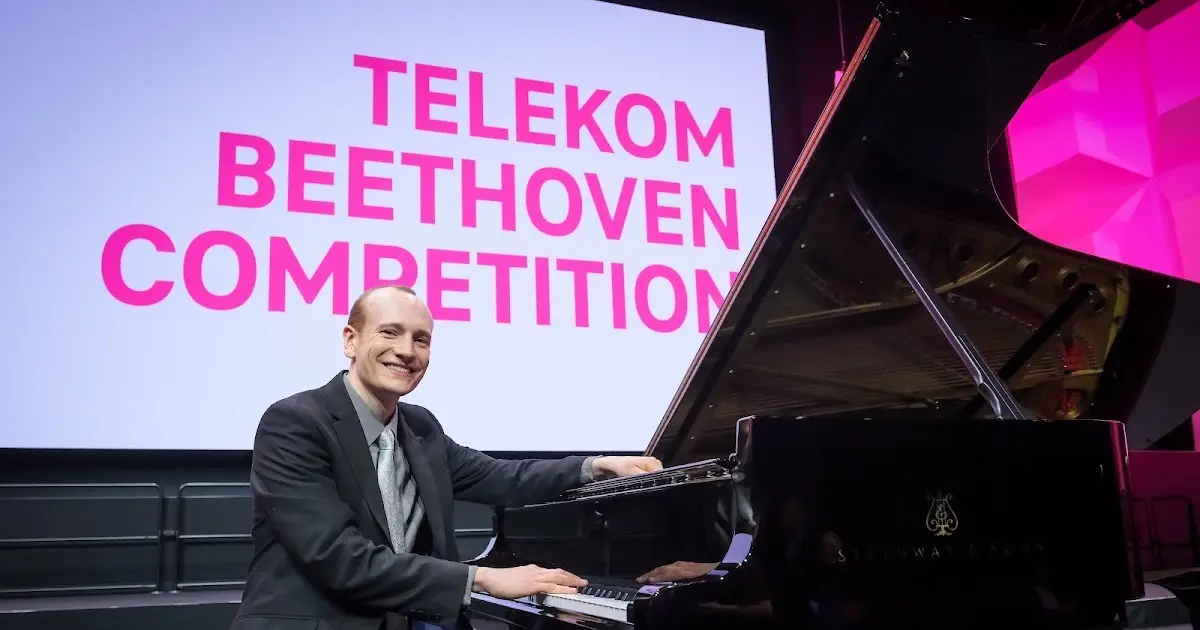
The stately Marble Hall of Hatfield House provided a majestic and resonant backdrop for one of the most compelling piano recitals of the season. On October 9, 2026, the Hatfield House Music Festival welcomed Seth Schultheis, a fast-rising American pianist based in London, for a morning performance that challenged conventional recital programming. Schultheis, who currently serves as an Aud Jebson Fellow at the Royal Academy of Music, arrived fresh off his triumphs at the 2025 Telekom Beethoven Competition in Bonn, Germany, where he captured both the First Prize and the prestigious Special Prize for Chamber Music.
Rather than relying on the traditional architecture of grand, multi-movement sonatas, Schultheis curated an adventurously fragmented programme. Across just over an hour of music, he guided the audience through an astonishing sequence of approximately 34 short movements. This thoughtfully constructed journey bridged the classical mastery of Ludwig van Beethoven, the complex sonic architectures of contemporary American composer Elizabeth Ogonek, and the emotionally volatile Romanticism of Robert Schumann.
Despite possessing an unassuming stage presence that belies his virtuosic command, Schultheis proved to be an intellectual and deeply sensitive interpreter. His execution was characterized by formidable finger strength, pristine clarity, and an intuitive grasp of quicksilver mood shifts. By placing three distinct musical minds in dialogue through miniature forms, Schultheis transformed what could have been a disjointed set of fragments into a cohesive, highly engaging exploration of artistic freedom and unconstrained imagination.
Detailed Chronology and Performance Analysis
Part I: Beethoven’s 11 Bagatelles, Op. 119
The recital commenced not with the monumental architecture of a late Beethoven sonata, but with the more intimate, unbuttoned world of the 11 Bagatelles, Op. 119. Beethoven famously referred to such short pieces derisively—or perhaps playfully—as "cobbler’s patches," yet they reveal a composer completely unfettered by the rigorous structural demands of larger symphonic or sonata forms.
Schultheis anchored the opening minuet and trio with classic poise, establishing a baseline of aristocratic elegance before rapidly subverting expectations. As the sequence unfolded, the music veered mercurially between quirky character studies and moments of fleeting serenity. Schultheis deftly balanced robust, rustic dance rhythms with intricate, filigree ornamentation.
Particularly striking was his handling of the sequence’s harmonic inquiries. A classical gesture would suddenly pivot into a showy dance infused with faint echoes of Weber, only to dissolve into a helter-skelter dash toward a touching, understated conclusion. While Schultheis did not present these miniatures as wild, free-form improvisations—opting instead to frame them as the calculated, highly refined products of Beethoven’s late imagination—his acute sensitivity to abrupt tonal shifts and sly, unexpected endings set a high artistic standard for the morning.
Part II: Elizabeth Ogonek’s Preludes (2024)
Moving from the early 19th century to contemporary soundscapes, Schultheis introduced five preludes by American composer Elizabeth Ogonek. Educated at Indiana University and the USC Thornton School of Music before undertaking advanced studies under Julian Anderson at the Guildhall School as a Marshall Scholar, Ogonek has established a reputation for crafting hyper-articulate, texturally rich instrumental works.
The five preludes performed at Hatfield House showcased a mastery of intricate textures and dense, complex harmonies.
- Prelude No. 1: Opened with a deceptively flowing surface masking an underlying, restless agitation.
- Prelude No. 2: Inherited this nervous energy, deploying mobile harmonies that continually skirted the edges of darker, more ominous emotional territory.
- Prelude No. 3: Adopted a slower, more uncompromising stance, though its severe posture was constantly softened by delicate, labyrinthine elaborations.
- Prelude No. 4: Unfurled as a gossamer-thin web of pure sound, showcasing Schultheis’s immaculate control over soft dynamics and pedal work.
- Prelude No. 5: Concluded the set with a brief, exotic, quasi-Oriental vignette characterized by transparent, glittering elaborations that shimmered in the acoustic of the Marble Hall.
Part III: Robert Schumann’s Davidsbündlertänze, Op. 6
The recital reached its emotional and architectural climax with Robert Schumann’s Davidsbündlertänze, Op. 6. Composed in 1837—just three years before Schumann secured his hard-fought marital union with his beloved muse, Clara Wieck—this monumental suite of 18 short movements is a cornerstone of Romantic piano literature. Schumann conceived the work as a manifesto of the Davidsbund (League of David), an imaginary brotherhood dedicated to fighting the "Philistines" of conventional art and narrow-minded musical taste.
Fittingly, the work opens with a direct quotation from Clara herself: a brief, punchy mazurka rhythm that sets the stage for a dizzying array of emotional states. Schultheis proved remarkably attuned to the famously volatile, almost bipolar dualities of Schumann’s psyche, personified by his alternating artistic alter-egos, the fiery Florestan and the introspective Eusebius.
Schultheis’s performance navigated the chasm between tender yearning and explosive impetuosity with effortless technical assurance. His fingers possessed the iron strength required for the muscular, rhythmically driven sections, yet remained remarkably supple during the work’s most vulnerable, introspective cantabile episodes. Deceptively simple melodies constantly gave way to sudden bursts of urgency and skittish agility.

As the 18 movements drew to a close, Schultheis guided the listener through a deeply moving transition: a tender, flowing movement peppered with quirky harmonic corners suddenly blossomed into a final, vigorous dance. The recital ultimately wound down with a quiet, beautifully restrained dance, leaving the Marble Hall hanging suspended in a hush of profound collective reflection.
Supporting Context & Metrics
To fully appreciate the significance of Seth Schultheis’s recital at the Hatfield House Music Festival, one must examine the broader metrics of his career trajectory, the logistical parameters of the concert, and the conceptual weight of his chosen repertoire.
Programme Metrics
- Total Duration: Approximately 70 minutes of continuous music-making without an intermission.
- Total Movements: Roughly 34 distinct short movements, creating an intense mosaic of musical ideas.
- Historical Span: Encompassing works written across a roughly two-century timeline (Beethoven’s late-period bagatelles c. 1820s, Schumann’s high-Romantic cycle from 1837, and Ogonek’s ultra-contemporary preludes from 2024).
Festival and Venue Context
The Hatfield House Music Festival, held annually in Hertfordshire, has earned a stellar reputation for curating imaginative programmes that marry world-class classical performance with historic architectural spaces. The Marble Hall, with its high ceilings, ornate Italianate plasterwork, and historic tapestries, presents distinct acoustical challenges. Its bright, lively resonance demands extraordinary articulation from pianists; muddy pedaling is instantly exposed. Schultheis’s crisp finger-work and nuanced command of dynamics turned the hall’s natural acoustic properties into an asset, allowing even the most gossamer textures of Ogonek’s preludes and the quietest cadences of Schumann to project with crystalline clarity.
Artist Profile
Seth Schultheis’s rise has been meteoric yet grounded in rigorous academic and competitive validation. Based in London, his appointment as an Aud Jebson Fellow at the Royal Academy of Music has provided a platform for deep artistic exploration. However, his international breakthrough came at the prestigious 2025 Telekom Beethoven Competition in Bonn. Winning both the First Prize and the Special Prize for Chamber Music placed him in an elite echelon of young interpreters, signaling not only technical brilliance but a rare maturity in musical communication.
Official Statements and Critical Reception
The critical reception of Schultheis’s Hatfield House recital has underscored a paradigm shift in how young virtuosos are choosing to present themselves to the classical music public. Rather than using high-profile festival slots to showcase standard, barnstorming Romantic sonatas—such as the Tchaikovsky or Rachmaninoff concertos that often dominate competitive repertoires—Schultheis opted for intellectual transparency and emotional nuance.
Festival organizers and music critics alike have lauded the pianist’s ability to weave disparate stylistic eras into a unified narrative. In interviews following his Bonn competition victory, Schultheis frequently emphasized the importance of storytelling in programming, noting that modern audiences respond powerfully when artists treat miniatures not as mere encores or throwaway pieces, but as dense, concentrated universes of meaning.
Reflecting on the overarching concept of the October 9 recital, local cultural commentators noted:
"In an era where classical recitals often lean heavily on safe, monumental warhorses, Seth Schultheis offered a masterclass in daring programming. By trusting the intelligence of his audience and the intrinsic power of the short form, he proved that 34 fleeting movements can tell a deeper story than any single sonata ever could."
Furthermore, academic mentors at the Royal Academy of Music have pointed to Schultheis’s fellowship work as evidence of a new generation of musicians who refuse to compartmentalize historical and contemporary repertoires. By pairing Beethoven directly with Ogonek, Schultheis implicitly argued that the search for structural freedom and expressive immediacy remains an unbroken thread running through the entire history of Western keyboard literature.
Future Outlook
As Seth Schultheis looks ahead to the remainder of his tenure as an Aud Jebson Fellow at the Royal Academy of Music and beyond, his performance at the Hatfield House Music Festival marks a definitive milestone in his artistic evolution. The critical acclaim garnered by his uncompromising program signals a bright, intellectually rigorous future on the international concert stage.
Upcoming Milestones and Trajectory
- International Orchestral Engagements: Building upon his success at the 2025 Telekom Beethoven Competition, Schultheis is slated for a series of high-profile concerto appearances across Europe, with a particular focus on the Beethoven piano concerto cycle.
- Chamber Music Collaborations: Given that he secured the Special Prize for Chamber Music in Bonn, industry insiders anticipate expanded chamber collaborations throughout the UK and mainland Europe, leveraging his sensitive accompanimental instincts demonstrated during the Schumann cycle.
- Championing Contemporary Voices: Schultheis’s willingness to program demanding contemporary works—such as Elizabeth Ogonek’s 2024 preludes—positions him as a vital champion of living composers. Promoters are increasingly looking to him to commission and premiere works that bridge the gap between classical tradition and avant-garde exploration.
Ultimately, Schultheis’s October morning in the Marble Hall of Hatfield House was far more than a routine festival appearance. It served as a compelling manifesto for a young artist who possesses the technical mastery of a titan, the intellectual curiosity of a scholar, and the delicate touch of a poet. As he continues to refine his repertoire and expand his global footprint, Seth Schultheis is undeniably a young pianist to watch closely in the years to come.