Executive Overview
In the rapidly evolving landscape of contemporary electronic music production, the low-end has undergone a seismic shift. Once relegated to the foundational background of a mix—acting merely as a rhythmic anchor or a subtle sub-harmonic cushion—bass has clawed its way to the very forefront of modern auditory architecture. Today, producers across genres like dubstep, drum & bass, hyperpop, trap, and various club sub-genres spend countless hours sculpting a single sub-bass line. They layer harmonics, meticulously control saturation, and weave intricate spatial movements until the low-end is no longer just a supporting element: it is the hook, the signature, and the drop that defines a track’s commercial success.
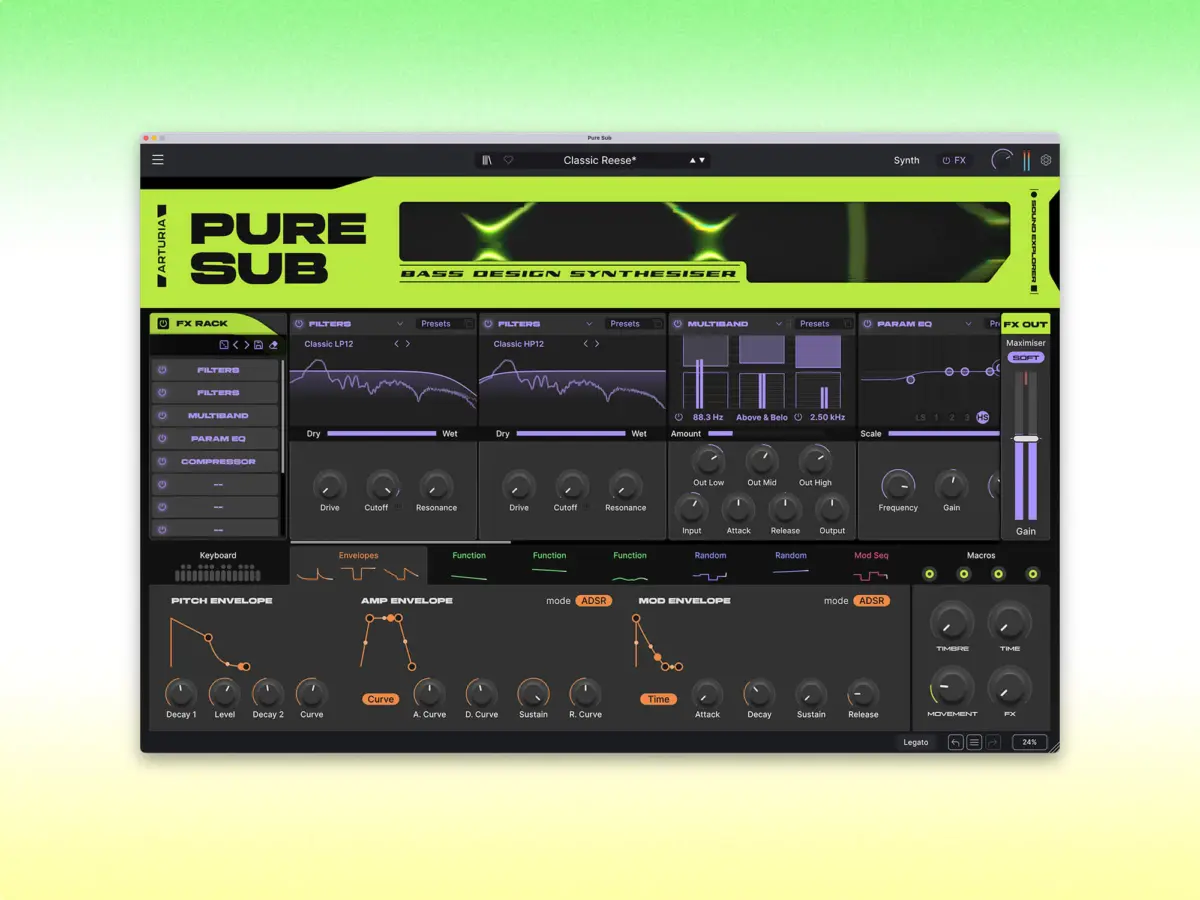
Recognizing this paradigm shift, renowned software and hardware instrument developer Arturia has introduced Pure SUB, a dedicated bass synthesizer engineered specifically to tackle the complexities of modern low-end sound design. Designed with an unwavering focus on weight, impact, and dynamic motion, Pure SUB departs from traditional, general-purpose subtractive synths by narrowing its scope to do one job—and do it exceptionally well.
Offering a sophisticated three-way architectural split between raw sub-frequencies, complex harmonics, and textural elements, alongside a specialized Sub Processor, advanced motion control, and extensive MIDI Polyphonic Expression (MPE) capabilities, Pure SUB arrives as a formidable tool for producers seeking to dominate club sound systems. Available immediately at a promotional launch price of $/€49, this instrument is poised to change how bedroom producers and professional mixing engineers alike approach the foundation of their music.
Detailed Chronology: The Evolution of Low-End Dominance and the Genesis of Pure SUB
To understand the engineering philosophy behind Arturia’s Pure SUB, one must examine how the role of bass has transformed over the past decade.
The Shift from Background Foundation to Front-and-Center Hook
Historically, mixing low frequencies was a game of compromise. Producers wrestled with phase cancellation, muddy mixing environments, and the physical limitations of vinyl mastering. Sub-bass was typically generated using basic sine or triangle waves, tucked safely beneath mid-range instrumentation, and heavily compressed to maintain headroom.
However, the proliferation of digital audio workstations (DAWs), advanced spectral analysis tools, and hyper-accurate monitoring systems changed the rules. As sound design evolved into a premier craft—one once reserved exclusively for soaring synthesizer leads and aggressive synth-brass patches—producers began turning their creative lenses downward. Low-end became a canvas for texture. The pursuit of the "drop-defining" bass meant that sub frequencies were subjected to the same intricate processing chains previously reserved for vocals or leads: wavefolding, multi-band distortion, frequency shifting, and granular texturing.
Arturia’s Targeted Development Cycle
Entering this hyper-specialized market required a different approach from Arturia, a company historically celebrated for its painstakingly authentic analog emulations (such as the V Collection) and versatile creative workstations like Pigments. Rather than building another do-it-all synthesizer, the development team zeroed in on the exact pain points modern electronic music producers face when engineering heavy low-end.
The conceptualization of Pure SUB focused on a trinity of core challenges:
- Translational Integrity: How to ensure a bass patch sounds massive on a laptop speaker, yet retains its skull-rattling impact on a massive club rig equipped with dual 18-inch subwoofers.
- Harmonic Interest: Moving beyond static sub-bass tones by introducing dynamic, morphing timbres that retain their fundamental pitch integrity.
- Streamlined Workflow: Eliminating the complex routing matrices often required in modular or semi-modular soft synths to achieve modern, moving bass sounds, allowing producers to reach a finished, mix-ready tone in a fraction of the time.
The result of this focused development cycle is a hybrid engine that balances surgical low-frequency control with creative, modern sound-shaping tools.
Architecture and Sound Design Engine: Inside Pure SUB
At the heart of Pure SUB is an innovative synthesis framework built from the ground up to address the demands of modern bass music production. The instrument abandons traditional, cluttered UI layouts in favor of an optimized, workflow-driven interface.
The Three-Way Split: Sub, Harmonics, and Texture
The core architecture of Pure SUB relies on a sophisticated three-way split engine that divides the sound design process into distinct, manageable pillars:
- The Sub Engine: Dedicated entirely to the foundational weight of the patch. This section generates rock-solid, phase-coherent sub frequencies ranging from ultra-clean 808-style drops to deep, subterranean sine waves that anchor the mix without muddying the upper registers.
- The Harmonics Engine: A dual-mode sound generator capable of morphing timbres across a wide spectrum. Whether a producer needs the warmth of analog saturation or the wide, phasing richness of a Reese bass, this engine handles the mid-to-high frequency content that gives the bass its vocal-like character and cut-through ability in a dense mix.
- The Noise and Texture Layer: Modern bass music relies heavily on grit, air, and organic movement. This layer allows producers to blend in custom noise profiles, vinyl crackle, industrial grit, or synthetic air, ensuring the bass retains high-frequency detail and presence even when played on smaller playback systems.
The Sub Processor and Filter Arsenal
To shape these three pillars, Pure SUB integrates a powerful suite of processing tools. Most notably, the Sub Processor acts as a bass-focused chain of expert-built modes designed to distort, texturize, and transform a patch in just a few clicks. Instead of forcing producers to manually set up complex parallel distortion buses—which often lead to phase cancellation and low-end loss—the Sub Processor applies intelligent saturation algorithms that preserve the integrity of the fundamental frequency while enriching the upper harmonics.
Complementing this processor is an expansive collection of over 40 filter modes. These filters are specifically calibrated to handle heavy resonance and aggressive drive without collapsing the low-end—a common pitfall of standard software filters ported from traditional subtractive synthesizers.

Motion Tools and Expressivity
A static bass line quickly loses listener engagement in modern electronic music. Pure SUB addresses this by embedding advanced motion and modulation capabilities directly into the heart of the synth:
- Three Flexible Envelopes: Designed to carve out precise transients and tail lengths, ensuring every hit punches through the mix with rhythmic precision.
- Six Customisable Modulators: Allowing users to map LFOs, random generators, and step sequencers to virtually any parameter within the synth—including modulating the modulators themselves for evolving, complex polyrhythmic textures.
- Full Keyboard Expressivity: Complete with MPE (MIDI Polyphonic Expression) support, enabling performers to manipulate pitch bend, pressure, and slide per-note for organic, expressive bass lines that breathe with human-like performance dynamics.
FX Rack, Presets, and Resampling
Rounding out the feature set is a dedicated FX rack equipped with modern distortion algorithms, spatial effects, and dynamics processing. For creators experiencing writer’s block, the built-in preset randomizer features an "instant new sound" option that generates fresh, inspiring patches on the fly. Additionally, an integrated resampling tool gives every note or audio bounce a subtle, organic variation, preventing the robotic, static feel that can sometimes plague digital soft synths.
Supporting Context & Metrics: The Modern Low-End Economy
To fully grasp why a dedicated instrument like Pure SUB represents a significant market moment, one must look at the broader metrics of modern music production software and listening habits.
The Rise of Specialized Software Instruments
Over the past five years, the virtual instrument market has shifted away from massive, all-encompassing romplers and workstations toward hyper-specialized plugins. Producers are increasingly favoring tools designed for a singular purpose executed at the absolute highest level.
- Workflow Efficiency: Industry data from major digital audio workstation analytics indicates that modern producers complete tracks faster when utilizing task-specific plugins rather than routing complex multi-plugin chains.
- CPU Optimization: A dedicated synth like Pure SUB requires significantly less processing overhead compared to running a complex chain of saturators, sub-harmonic generators, multi-band compressors, and synths simultaneously. This allows producers to run dozens of instances across a heavy session without experiencing buffer underruns or latency spikes.
The Physics of Low-End Translation
Mixing bass remains one of the most technically challenging aspects of audio engineering. Human hearing is notoriously non-linear in the low frequencies (as described by the Fletcher-Munson equal-loudness contours), meaning sub-bass requires significantly more physical energy to be perceived at equal volumes compared to mid-range frequencies. Furthermore, the modern consumption landscape spans an unprecedented range of playback devices:
- High-end club sound systems capable of reproducing frequencies down to 25 Hz with brutal efficiency.
- Consumer headphones and earbuds that rely on psychoacoustic harmonic generation (missing fundamental synthesis) to trick the brain into hearing sub-bass that the physical drivers cannot actually reproduce.
By building intelligent harmonic generation and multi-band textural blending directly into Pure SUB’s architecture, Arturia addresses these acoustic realities at the source level. Producers no longer have to rely purely on trial-and-error processing during the mixing stage to make their low-end translate across diverse listening environments.
Official Statements and Industry Reception
Ahead of the release, Arturia’s development and communications teams released detailed statements highlighting the cultural and technical philosophy driving the instrument:
"In modern electronic music, from dubstep and drum & bass to the wider world of club and bass-driven production, low-end has become the defining voice," the press release notes.
"Over the past decade, bass has moved from the foundation under the track toward the front of it. It’s not unusual now for a producer to spend hours on a single sub — sculpting harmonics, distortion, and movement until the bass is the hook, the signature, the drop. With the rise of sound design as a craft, a sound once felt and forgotten is now designed with the care once reserved for the lead. Pure SUB is a synthesizer built for that one job."
Early feedback from beta testers and early-access electronic music producers has centered on the synth’s ability to bridge the gap between surgical cleanliness and aggressive, club-ready warmth. Producers have particularly praised the Sub Processor’s capacity to add audible weight and harmonic richness to simple MIDI notes without requiring external saturation plugins or complex parallel routing setups.
Future Outlook: What Pure SUB Means for the Future of Bass Production
The launch of Pure SUB marks a fascinating inflection point in software synthesizer design. As the boundaries between sound design, composition, and mixing continue to blur, instruments that streamline complex engineering tasks into intuitive, creative workflows are set to dominate the market.
Impact on Genre-Specific Production
- Dubstep and Hybrid Trap: Producers in these spaces will likely leverage Pure SUB’s advanced motion tools, MPE expressivity, and aggressive Sub Processor modes to create evolving, growling mid-bass layers that seamlessly transition into earth-shattering sub drops.
- Drum & Bass: The ability to generate wide Reese basses while maintaining a rock-solid, mono-compatible sub-frequency foundation will prove invaluable for D&B producers tackling the demanding headroom requirements of modern club mastering standards.
- Pop, Hip-Hop, and Contemporary R&B: Even outside heavy electronic sub-genres, beatmakers looking for pristine, punchy 808s that translate perfectly across laptop speakers and car stereos will find the three-way split engine an indispensable addition to their template.
Pricing and Availability
Pure SUB is available now through Arturia’s official website and authorized retail partners. Capitalizing on an aggressive introductory strategy, the plugin is currently offered at a launch price of $/€49.
As electronic music continues to push sonic boundaries and low-end remains the undisputed engine of the dancefloor, tools like Arturia’s Pure SUB ensure that creators have the precise, powerful weaponry needed to make their music felt as much as it is heard.